SUBSCRIBE TO OUR FREE NEWSLETTER
Daily news & progressive opinion—funded by the people, not the corporations—delivered straight to your inbox.
5
#000000
#FFFFFF
To donate by check, phone, or other method, see our More Ways to Give page.
Daily news & progressive opinion—funded by the people, not the corporations—delivered straight to your inbox.
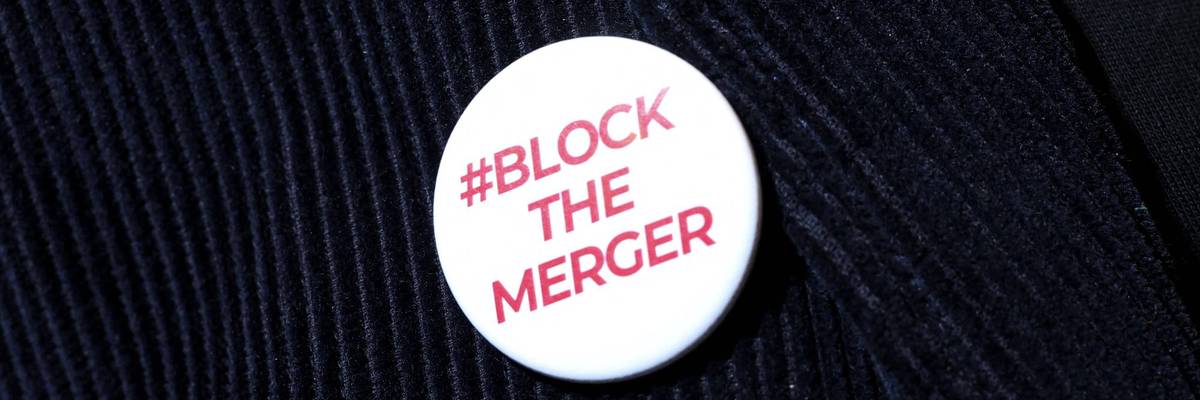
A protester wears a "Block the Merger" pin in opposition to the Paramount-Warner deal during CinemaCon at Caesars Palace on April 14, 2026 in Las Vegas, Nevada.
"With this lawsuit, California and our sister states are fighting for free and fair markets, not rigged markets," said Attorney General Rob Bonta. "America has no kings in government or our economy.”
In filing an antitrust lawsuit against Paramount Skydance over its proposed $111 billion acquisition of Warner Bros. Discovery, 12 state attorneys general on Monday deployed a legal tactic successfully used in 2022 to block another megamerger pushed by book publisher Simon & Schuster.
States including California, New York, Colorado, and Washington argued in the lawsuit that should the merger be approved, just one massive corporation would control more than 30% of anticipated top-grossing blockbuster films with large budgets and audiences, while just four distributors—Paramount, Disney, Universal, and Sony—would control more than 90% of those films.
In 2022, the US Department of Justice (DOJ) argued successfully that Simon & Schuster's proposed acquisition of Penguin Random House would harm competition among book publishers as they vied for the rights to books anticipated to be bestsellers.
California Attorney General Rob Bonta, who is leading the coalition of states in the biggest legal challenge against the merger thus far, said that "the unlawful merger of these two entertainment behemoths would lead to higher prices, lower quality, and less content for film and television, harming movie theaters, basic cable distributors, and ultimately, audiences on every sofa and movie theater seat in the US."
The lawsuit also argues that after the proposed merger, just three distribution companies would control 75% of wide-release theatrical films and 27% of the market in licensing for basic cable television channels.
The merger, said the attorneys general in the US District Court for the Northern District of California, would violate Section 7 of the Clayton Act, which bars business mergers and acquisitions that substantially lessen competition or create a monopoly.
"In this country, no one is above the law," said Bonta. "With this lawsuit, California and our sister states are fighting for free and fair markets, not rigged markets. America has no kings in government or our economy.”
New York Mayor Zohran Mamadani expressed pride that his state was fighting the deal, which he said "is not a merger that serves the public."
The media advocacy group Free Press emphasized that along with reducing competition among film distribution companies, the merger would create a "media colossus" that would also include control over CBS—taken over by Skydance Media CEO David Ellison last year after his company merged with Paramount—and CNN.
The merger would give tech mogul Larry Ellison and his family—allies of President Donald Trump's administration—"the power to shape public discourse at the president’s direction in exchange for the administration’s regulatory approval," said Free Press. "That’s why administration officials like Secretary of Defense Pete Hegseth have openly rooted for the Ellisons to obtain CNN, based on their documented promises to make 'sweeping changes' to the network to please Trump."
Following the Ellisons' takeover of CBS, the leadership of newly appointed right-wing editor-in-chief Bari Weiss has been condemned by First Amendment advocates as Weiss has sought to remake CBS News—spiking a "60 Minutes" segment on Trump's mass deportations and firing the leadership of the flagship investigative news show.
“President Trump and his cronies want to rush this anti-competitive deal through because David Ellison has demonstrated time and again that he will leverage his control of his media empire to silence Trump’s critics and amplify MAGA propaganda," said Free Press co-CEO Jessica González, thanking the state attorneys general for their legal challenge. "That’s corruption, plain and simple. Any merger of this scale would diminish creativity and diversity in entertainment, weaken journalists’ ability to hold those in power accountable, and further endanger our democracy."
"This is especially true when the Ellisons are in charge," said González. "To win approval for their takeover of CBS News, the Ellisons promised to gut hard-hitting reporting across the network—and have gleefully followed through. And they’ll do the same to undermine editorial independence at CNN if they gain control of the global news network."
Although Paramount's proposed merger has already been approved by 20 countries and regions globally, and Trump's DOJ claimed the creation of an even larger media empire was "not likely to harm competition or American consumer,” regulators in the United Kingdom and the European Union have leaned toward looking more closely at the deal. The lawsuit, said González, "means that this corrupt merger is far from a done deal."
"While the administration won’t take a stand against the president’s billionaire cronies, we can still stop the Ellisons’ power grab," said González. "While Paramount is flaunting its corruption and toasting Trump officials, we’re standing with the workers and artists at the heart of the news and entertainment industries—and with the American people, who deserve a diverse and independent media system that works on their behalf, and against the self-interest of greedy billionaires and unethical politicians.”
The lawsuit also followed a series of town halls held in Los Angeles, New York, and Atlanta by the American Economic Liberties Project, titled "Main Street vs. the Merger." Anti-monopoly advocates heard from entertainment workers, small business owners, and others who would be impacted by the Paramount-Warner Bros. deal.
Comedian Adam Conover warned at one town hall that the merger would lead to higher streaming prices, and writers and other media workers shared fears that the deal would lead to mass layoffs.
"I spent the last month meeting with the workers and business owners who’d be hit with this deal,” said Alvaro Bedoya, senior adviser at American Economic Liberties Project, on Monday. “The rich guys who run Paramount can say what they want, but the people who actually work for them know that this will kill jobs and screw over the small businesses that are the lifeblood of this industry. I hope the states win and win fast, because these people need it.”
Lawsuits challenging mergers typically take at least several months and up to a year to be decided by a judge, and the states are asking the companies to freeze the proposed merger deal—which was set to close in the third quarter of 2026—which the case is being adjudicated. California also said it would seek a temporary restraining order if the companies did not agree to pause the deal.
Paramount has agreed to pay Warner Bros. Discovery shareholders $650 million for each quarter the deal isn't finalized, starting in October.
“This illegal merger would mean layoffs for artists and workers, higher prices for consumers, and the death of Hollywood,” said Matt Stoller, research director at American Economic Liberties Project. “State enforcers have done the right thing in seeking to block it. It is time to stop oligarchs from strip-mining our culture and selling America off for parts. Blocking this megamerger is the first step in doing so.”
Dear Common Dreams reader, It’s been nearly 30 years since I co-founded Common Dreams with my late wife, Lina Newhouser. We had the radical notion that journalism should serve the public good, not corporate profits. It was clear to us from the outset what it would take to build such a project. No paid advertisements. No corporate sponsors. No millionaire publisher telling us what to think or do. Many people said we wouldn't last a year, but we proved those doubters wrong. Together with a tremendous team of journalists and dedicated staff, we built an independent media outlet free from the constraints of profits and corporate control. Our mission has always been simple: To inform. To inspire. To ignite change for the common good. Building Common Dreams was not easy. Our survival was never guaranteed. When you take on the most powerful forces—Wall Street greed, fossil fuel industry destruction, Big Tech lobbyists, and uber-rich oligarchs who have spent billions upon billions rigging the economy and democracy in their favor—the only bulwark you have is supporters who believe in your work. But here’s the urgent message from me today. It's never been this bad out there. And it's never been this hard to keep us going. At the very moment Common Dreams is most needed, the threats we face are intensifying. We need your support now more than ever. We don't accept corporate advertising and never will. We don't have a paywall because we don't think people should be blocked from critical news based on their ability to pay. Everything we do is funded by the donations of readers like you. When everyone does the little they can afford, we are strong. But if that support retreats or dries up, so do we. Will you donate now to make sure Common Dreams not only survives but thrives? —Craig Brown, Co-founder |
In filing an antitrust lawsuit against Paramount Skydance over its proposed $111 billion acquisition of Warner Bros. Discovery, 12 state attorneys general on Monday deployed a legal tactic successfully used in 2022 to block another megamerger pushed by book publisher Simon & Schuster.
States including California, New York, Colorado, and Washington argued in the lawsuit that should the merger be approved, just one massive corporation would control more than 30% of anticipated top-grossing blockbuster films with large budgets and audiences, while just four distributors—Paramount, Disney, Universal, and Sony—would control more than 90% of those films.
In 2022, the US Department of Justice (DOJ) argued successfully that Simon & Schuster's proposed acquisition of Penguin Random House would harm competition among book publishers as they vied for the rights to books anticipated to be bestsellers.
California Attorney General Rob Bonta, who is leading the coalition of states in the biggest legal challenge against the merger thus far, said that "the unlawful merger of these two entertainment behemoths would lead to higher prices, lower quality, and less content for film and television, harming movie theaters, basic cable distributors, and ultimately, audiences on every sofa and movie theater seat in the US."
The lawsuit also argues that after the proposed merger, just three distribution companies would control 75% of wide-release theatrical films and 27% of the market in licensing for basic cable television channels.
The merger, said the attorneys general in the US District Court for the Northern District of California, would violate Section 7 of the Clayton Act, which bars business mergers and acquisitions that substantially lessen competition or create a monopoly.
"In this country, no one is above the law," said Bonta. "With this lawsuit, California and our sister states are fighting for free and fair markets, not rigged markets. America has no kings in government or our economy.”
New York Mayor Zohran Mamadani expressed pride that his state was fighting the deal, which he said "is not a merger that serves the public."
The media advocacy group Free Press emphasized that along with reducing competition among film distribution companies, the merger would create a "media colossus" that would also include control over CBS—taken over by Skydance Media CEO David Ellison last year after his company merged with Paramount—and CNN.
The merger would give tech mogul Larry Ellison and his family—allies of President Donald Trump's administration—"the power to shape public discourse at the president’s direction in exchange for the administration’s regulatory approval," said Free Press. "That’s why administration officials like Secretary of Defense Pete Hegseth have openly rooted for the Ellisons to obtain CNN, based on their documented promises to make 'sweeping changes' to the network to please Trump."
Following the Ellisons' takeover of CBS, the leadership of newly appointed right-wing editor-in-chief Bari Weiss has been condemned by First Amendment advocates as Weiss has sought to remake CBS News—spiking a "60 Minutes" segment on Trump's mass deportations and firing the leadership of the flagship investigative news show.
“President Trump and his cronies want to rush this anti-competitive deal through because David Ellison has demonstrated time and again that he will leverage his control of his media empire to silence Trump’s critics and amplify MAGA propaganda," said Free Press co-CEO Jessica González, thanking the state attorneys general for their legal challenge. "That’s corruption, plain and simple. Any merger of this scale would diminish creativity and diversity in entertainment, weaken journalists’ ability to hold those in power accountable, and further endanger our democracy."
"This is especially true when the Ellisons are in charge," said González. "To win approval for their takeover of CBS News, the Ellisons promised to gut hard-hitting reporting across the network—and have gleefully followed through. And they’ll do the same to undermine editorial independence at CNN if they gain control of the global news network."
Although Paramount's proposed merger has already been approved by 20 countries and regions globally, and Trump's DOJ claimed the creation of an even larger media empire was "not likely to harm competition or American consumer,” regulators in the United Kingdom and the European Union have leaned toward looking more closely at the deal. The lawsuit, said González, "means that this corrupt merger is far from a done deal."
"While the administration won’t take a stand against the president’s billionaire cronies, we can still stop the Ellisons’ power grab," said González. "While Paramount is flaunting its corruption and toasting Trump officials, we’re standing with the workers and artists at the heart of the news and entertainment industries—and with the American people, who deserve a diverse and independent media system that works on their behalf, and against the self-interest of greedy billionaires and unethical politicians.”
The lawsuit also followed a series of town halls held in Los Angeles, New York, and Atlanta by the American Economic Liberties Project, titled "Main Street vs. the Merger." Anti-monopoly advocates heard from entertainment workers, small business owners, and others who would be impacted by the Paramount-Warner Bros. deal.
Comedian Adam Conover warned at one town hall that the merger would lead to higher streaming prices, and writers and other media workers shared fears that the deal would lead to mass layoffs.
"I spent the last month meeting with the workers and business owners who’d be hit with this deal,” said Alvaro Bedoya, senior adviser at American Economic Liberties Project, on Monday. “The rich guys who run Paramount can say what they want, but the people who actually work for them know that this will kill jobs and screw over the small businesses that are the lifeblood of this industry. I hope the states win and win fast, because these people need it.”
Lawsuits challenging mergers typically take at least several months and up to a year to be decided by a judge, and the states are asking the companies to freeze the proposed merger deal—which was set to close in the third quarter of 2026—which the case is being adjudicated. California also said it would seek a temporary restraining order if the companies did not agree to pause the deal.
Paramount has agreed to pay Warner Bros. Discovery shareholders $650 million for each quarter the deal isn't finalized, starting in October.
“This illegal merger would mean layoffs for artists and workers, higher prices for consumers, and the death of Hollywood,” said Matt Stoller, research director at American Economic Liberties Project. “State enforcers have done the right thing in seeking to block it. It is time to stop oligarchs from strip-mining our culture and selling America off for parts. Blocking this megamerger is the first step in doing so.”
In filing an antitrust lawsuit against Paramount Skydance over its proposed $111 billion acquisition of Warner Bros. Discovery, 12 state attorneys general on Monday deployed a legal tactic successfully used in 2022 to block another megamerger pushed by book publisher Simon & Schuster.
States including California, New York, Colorado, and Washington argued in the lawsuit that should the merger be approved, just one massive corporation would control more than 30% of anticipated top-grossing blockbuster films with large budgets and audiences, while just four distributors—Paramount, Disney, Universal, and Sony—would control more than 90% of those films.
In 2022, the US Department of Justice (DOJ) argued successfully that Simon & Schuster's proposed acquisition of Penguin Random House would harm competition among book publishers as they vied for the rights to books anticipated to be bestsellers.
California Attorney General Rob Bonta, who is leading the coalition of states in the biggest legal challenge against the merger thus far, said that "the unlawful merger of these two entertainment behemoths would lead to higher prices, lower quality, and less content for film and television, harming movie theaters, basic cable distributors, and ultimately, audiences on every sofa and movie theater seat in the US."
The lawsuit also argues that after the proposed merger, just three distribution companies would control 75% of wide-release theatrical films and 27% of the market in licensing for basic cable television channels.
The merger, said the attorneys general in the US District Court for the Northern District of California, would violate Section 7 of the Clayton Act, which bars business mergers and acquisitions that substantially lessen competition or create a monopoly.
"In this country, no one is above the law," said Bonta. "With this lawsuit, California and our sister states are fighting for free and fair markets, not rigged markets. America has no kings in government or our economy.”
New York Mayor Zohran Mamadani expressed pride that his state was fighting the deal, which he said "is not a merger that serves the public."
The media advocacy group Free Press emphasized that along with reducing competition among film distribution companies, the merger would create a "media colossus" that would also include control over CBS—taken over by Skydance Media CEO David Ellison last year after his company merged with Paramount—and CNN.
The merger would give tech mogul Larry Ellison and his family—allies of President Donald Trump's administration—"the power to shape public discourse at the president’s direction in exchange for the administration’s regulatory approval," said Free Press. "That’s why administration officials like Secretary of Defense Pete Hegseth have openly rooted for the Ellisons to obtain CNN, based on their documented promises to make 'sweeping changes' to the network to please Trump."
Following the Ellisons' takeover of CBS, the leadership of newly appointed right-wing editor-in-chief Bari Weiss has been condemned by First Amendment advocates as Weiss has sought to remake CBS News—spiking a "60 Minutes" segment on Trump's mass deportations and firing the leadership of the flagship investigative news show.
“President Trump and his cronies want to rush this anti-competitive deal through because David Ellison has demonstrated time and again that he will leverage his control of his media empire to silence Trump’s critics and amplify MAGA propaganda," said Free Press co-CEO Jessica González, thanking the state attorneys general for their legal challenge. "That’s corruption, plain and simple. Any merger of this scale would diminish creativity and diversity in entertainment, weaken journalists’ ability to hold those in power accountable, and further endanger our democracy."
"This is especially true when the Ellisons are in charge," said González. "To win approval for their takeover of CBS News, the Ellisons promised to gut hard-hitting reporting across the network—and have gleefully followed through. And they’ll do the same to undermine editorial independence at CNN if they gain control of the global news network."
Although Paramount's proposed merger has already been approved by 20 countries and regions globally, and Trump's DOJ claimed the creation of an even larger media empire was "not likely to harm competition or American consumer,” regulators in the United Kingdom and the European Union have leaned toward looking more closely at the deal. The lawsuit, said González, "means that this corrupt merger is far from a done deal."
"While the administration won’t take a stand against the president’s billionaire cronies, we can still stop the Ellisons’ power grab," said González. "While Paramount is flaunting its corruption and toasting Trump officials, we’re standing with the workers and artists at the heart of the news and entertainment industries—and with the American people, who deserve a diverse and independent media system that works on their behalf, and against the self-interest of greedy billionaires and unethical politicians.”
The lawsuit also followed a series of town halls held in Los Angeles, New York, and Atlanta by the American Economic Liberties Project, titled "Main Street vs. the Merger." Anti-monopoly advocates heard from entertainment workers, small business owners, and others who would be impacted by the Paramount-Warner Bros. deal.
Comedian Adam Conover warned at one town hall that the merger would lead to higher streaming prices, and writers and other media workers shared fears that the deal would lead to mass layoffs.
"I spent the last month meeting with the workers and business owners who’d be hit with this deal,” said Alvaro Bedoya, senior adviser at American Economic Liberties Project, on Monday. “The rich guys who run Paramount can say what they want, but the people who actually work for them know that this will kill jobs and screw over the small businesses that are the lifeblood of this industry. I hope the states win and win fast, because these people need it.”
Lawsuits challenging mergers typically take at least several months and up to a year to be decided by a judge, and the states are asking the companies to freeze the proposed merger deal—which was set to close in the third quarter of 2026—which the case is being adjudicated. California also said it would seek a temporary restraining order if the companies did not agree to pause the deal.
Paramount has agreed to pay Warner Bros. Discovery shareholders $650 million for each quarter the deal isn't finalized, starting in October.
“This illegal merger would mean layoffs for artists and workers, higher prices for consumers, and the death of Hollywood,” said Matt Stoller, research director at American Economic Liberties Project. “State enforcers have done the right thing in seeking to block it. It is time to stop oligarchs from strip-mining our culture and selling America off for parts. Blocking this megamerger is the first step in doing so.”