SUBSCRIBE TO OUR FREE NEWSLETTER
Daily news & progressive opinion—funded by the people, not the corporations—delivered straight to your inbox.
5
#000000
#FFFFFF
To donate by check, phone, or other method, see our More Ways to Give page.
Daily news & progressive opinion—funded by the people, not the corporations—delivered straight to your inbox.
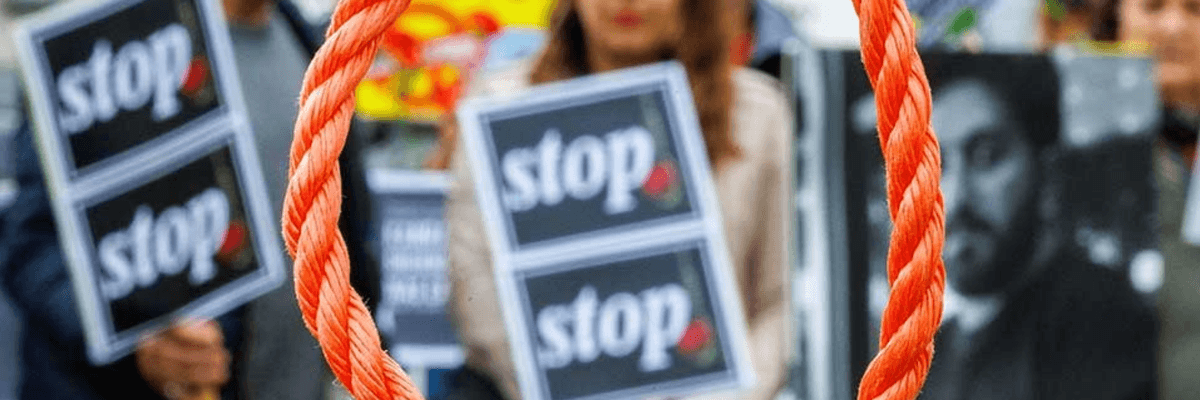
Lebanese activists protest against the death penalty in this undated photo.
"In a country that has experienced profound loss and suffering, this decision represents a powerful commitment to the right to life," said the UN's human rights chief.
In a move cheered by human rights defenders around the world, Lebanon's Parliament on Tuesday abolished the death penalty for all crimes, making the country the first in the Arab world to do so and standing in stark contrast to neighboring and nearby nations.
Lebanon's abolition—announced on June 30 at the 9th World Congress Against the Death Penalty in Paris—was approved by parliamentary lawmakers and, once signed by President Joseph Aoun as expected, will make the country the 129th worldwide to abolish capital punishment.
Under amendments introduced by Independent MP Abdul Rahman Bizri, execution—formerly carried out by hanging or firing squad—will be replaced as the ultimate punishment by life imprisonment under hard labor for crimes committed after abolition. Those currently condemned to death will have their sentences commuted to hard labor for life.
“Lebanon is regaining its pioneering role in the region as a defender of human rights,” Lebanese Justice Minister Adel Nassar said, adding that his country “has chosen to combat murder rather than resort to capital punishment."
MP Georges Okais of the Christian, right-wing Lebanese Forces party, said that “Abolishing the death penalty is a historic achievement, and we have adopted international standards regarding human rights.”
Hezbollah's parliamentary bloc walked out in protest of abolition, which is also opposed by other lawmakers including Independent MP Jihad al-Samad, who called the move "contrary to Islamic law."
Opponents of abolition argue that it, plus a general amnesty draft law introduced in April, could result in leniency for perpetrators of bombings and other serious crimes.
However, Nassar insisted that abolition “does not mean leniency toward criminals.”
Lebanese law had designated execution as punishment for a wide range of crimes including—but not limited to—murder, aggravated rape, terrorism, treason, spying, military desertion, aggravated theft, and arson. While 84 people were sentenced to death, Lebanon has not executed anyone in 22 years.
“We can see the uncertainty that those who are condemned to death are living under," one psychologist working in Lebanese prisons told the French advocacy group Together Against the Death Penalty in a 2021 study. "We don’t apply the death penalty, but we don’t cancel it either."
"Are we going to wake them up one day and tell them that they will be executed?" the psychologist added, describing the process in Japan and Europe's last executioner, Belarus, without mentioning the countries. "It is the most horrible thing to live through. It leads to anxiety, depression, and stress that is sometimes uncontrollable. They are alive, but without living.”
Lebanon's imminent abolition stands in stark contrast with neighboring and regional countries. Iran, Saudi Arabia, and Yemen rank among the world's most prolific executioners, while Syria's recent history is marred by thousands of extrajudicial executions during the administration of President Ahmed al-Sharaa, and Israel recently legalized the hanging of "terrorists"—a law critics claim will only be applied to Palestinians.
Daniel Cullen, project manager at Oxford University's Death Penalty Research Unit, lauded Lebanon's achievement, which came at "a time of myriad domestic challenges."
"Since October 2023, Israeli forces have conducted intense bombardments in their campaign against the Hezbollah militant group, resulting in thousands of civilian deaths, including during periods of nominal ceasefire," Cullen wrote. "Together with the Israeli military occupation of large areas of the south of the country and issuing of evacuation orders, this has resulted in the displacement of around one million people."
"Even prior to this, the country had already experienced a stark economic collapse since 2019, with a near 40% reduction in GDP, in addition to recovering from the effects of the explosion at Beirut port in August 2020," he continued. "Against this background, Minister of Justice Adel Nassar specifically highlighted the importance of the abolition legislation as a demonstration of Lebanon’s ability to commit to international human rights standards."
"Lebanon’s commitment to achieving abolition during a time of national crisis demonstrates that this is entirely possible," Cullen added.
United Nations High Commissioner for Human Rights Volker Türk said on social media: "I welcome the Lebanese Parliament's decision formally to abolish the death penalty, and call on others to follow its lead. In a country that has experienced profound loss and suffering, this decision represents a powerful commitment to the right to life."
European Union High Representative for Foreign Affairs and Security Policy Kaja Kallas called Lebanon's abolition "a significant step forward for human rights in the country."
"As the first country in the region to abolish the death penalty, Lebanon is setting a powerful example for other countries in the Middle East and beyond, reinforcing the strong global trend towards abolition and the growing international support for ending the death penalty worldwide," she continued.
"The European Union calls on all countries that still apply the death penalty to abolish it and, pending abolition, to maintain or introduce a moratorium on executions as a first step," Kallas added, urging "those considering its reintroduction to refrain from such a regressive step."
The West African nation of Burkina Faso adopted a draft penal code last December that would restore the death penalty for crimes including treason, terrorism, and espionage. An effort to revive capital punishment in the Central Asian country of Kyrgyzstan was blocked by its Constitutional Court. Turkish President Recep Tayyip Erdoğan has repeatedly said he is ready to reintroduce the death penalty during his 23 years in power, while populist Filipino Sen. Ronald dela Rosa—a former police chief closely associated with former President Rodrigo Duterte's mass-murderous drug crackdown—reintroduced death penalty legislation after his reelection last year.
Human Rights Watch Lebanon researcher Ramzi Kaiss hailed Lebanon's "final break from a cruel sentence that should never be imposed.”
“Capital punishment is unique in its cruelty and finality and is plagued with arbitrariness, prejudice, and error,” Kaiss asserted.
Amnesty International called the move "a landmark victory."
“Lebanon’s decision to abolish the death penalty marks a major milestone and a victory for human rights in the country," said Heba Morayef, Amnesty's Middle East and North Africa director.
Morayef continued:
Justice must be rooted in human rights, not in an irreversible and cruel punishment. After more than two decades without executions, today’s step transforms a precarious hiatus in executions into lasting legal protection upholding the right to life and bringing Lebanon in line with the global trend towards abolition.
The passing of this law is testament to the decades of tireless advocacy by Lebanese human rights defenders and organizations, as well as the leadership of key officials who recognized the death penalty as a cruel and inhuman punishment, often imposed after unfair proceedings and the burden of which frequently falls on those at most disadvantage.
“To turn this law from paper to practice, Lebanese authorities must now ensure that all death sentences are commuted and ratify the key international treaty on abolition, while advancing broader reforms to strengthen a justice system based on dignity, fairness, and respect for human rights," Morayef added. "Authorities must accompany this law with broader legislative reform, including to ensure that any criminal justice punishments are consistent with human rights principles.”
Dear Common Dreams reader, It’s been nearly 30 years since I co-founded Common Dreams with my late wife, Lina Newhouser. We had the radical notion that journalism should serve the public good, not corporate profits. It was clear to us from the outset what it would take to build such a project. No paid advertisements. No corporate sponsors. No millionaire publisher telling us what to think or do. Many people said we wouldn't last a year, but we proved those doubters wrong. Together with a tremendous team of journalists and dedicated staff, we built an independent media outlet free from the constraints of profits and corporate control. Our mission has always been simple: To inform. To inspire. To ignite change for the common good. Building Common Dreams was not easy. Our survival was never guaranteed. When you take on the most powerful forces—Wall Street greed, fossil fuel industry destruction, Big Tech lobbyists, and uber-rich oligarchs who have spent billions upon billions rigging the economy and democracy in their favor—the only bulwark you have is supporters who believe in your work. But here’s the urgent message from me today. It's never been this bad out there. And it's never been this hard to keep us going. At the very moment Common Dreams is most needed, the threats we face are intensifying. We need your support now more than ever. We don't accept corporate advertising and never will. We don't have a paywall because we don't think people should be blocked from critical news based on their ability to pay. Everything we do is funded by the donations of readers like you. When everyone does the little they can afford, we are strong. But if that support retreats or dries up, so do we. Will you donate now to make sure Common Dreams not only survives but thrives? —Craig Brown, Co-founder |
In a move cheered by human rights defenders around the world, Lebanon's Parliament on Tuesday abolished the death penalty for all crimes, making the country the first in the Arab world to do so and standing in stark contrast to neighboring and nearby nations.
Lebanon's abolition—announced on June 30 at the 9th World Congress Against the Death Penalty in Paris—was approved by parliamentary lawmakers and, once signed by President Joseph Aoun as expected, will make the country the 129th worldwide to abolish capital punishment.
Under amendments introduced by Independent MP Abdul Rahman Bizri, execution—formerly carried out by hanging or firing squad—will be replaced as the ultimate punishment by life imprisonment under hard labor for crimes committed after abolition. Those currently condemned to death will have their sentences commuted to hard labor for life.
“Lebanon is regaining its pioneering role in the region as a defender of human rights,” Lebanese Justice Minister Adel Nassar said, adding that his country “has chosen to combat murder rather than resort to capital punishment."
MP Georges Okais of the Christian, right-wing Lebanese Forces party, said that “Abolishing the death penalty is a historic achievement, and we have adopted international standards regarding human rights.”
Hezbollah's parliamentary bloc walked out in protest of abolition, which is also opposed by other lawmakers including Independent MP Jihad al-Samad, who called the move "contrary to Islamic law."
Opponents of abolition argue that it, plus a general amnesty draft law introduced in April, could result in leniency for perpetrators of bombings and other serious crimes.
However, Nassar insisted that abolition “does not mean leniency toward criminals.”
Lebanese law had designated execution as punishment for a wide range of crimes including—but not limited to—murder, aggravated rape, terrorism, treason, spying, military desertion, aggravated theft, and arson. While 84 people were sentenced to death, Lebanon has not executed anyone in 22 years.
“We can see the uncertainty that those who are condemned to death are living under," one psychologist working in Lebanese prisons told the French advocacy group Together Against the Death Penalty in a 2021 study. "We don’t apply the death penalty, but we don’t cancel it either."
"Are we going to wake them up one day and tell them that they will be executed?" the psychologist added, describing the process in Japan and Europe's last executioner, Belarus, without mentioning the countries. "It is the most horrible thing to live through. It leads to anxiety, depression, and stress that is sometimes uncontrollable. They are alive, but without living.”
Lebanon's imminent abolition stands in stark contrast with neighboring and regional countries. Iran, Saudi Arabia, and Yemen rank among the world's most prolific executioners, while Syria's recent history is marred by thousands of extrajudicial executions during the administration of President Ahmed al-Sharaa, and Israel recently legalized the hanging of "terrorists"—a law critics claim will only be applied to Palestinians.
Daniel Cullen, project manager at Oxford University's Death Penalty Research Unit, lauded Lebanon's achievement, which came at "a time of myriad domestic challenges."
"Since October 2023, Israeli forces have conducted intense bombardments in their campaign against the Hezbollah militant group, resulting in thousands of civilian deaths, including during periods of nominal ceasefire," Cullen wrote. "Together with the Israeli military occupation of large areas of the south of the country and issuing of evacuation orders, this has resulted in the displacement of around one million people."
"Even prior to this, the country had already experienced a stark economic collapse since 2019, with a near 40% reduction in GDP, in addition to recovering from the effects of the explosion at Beirut port in August 2020," he continued. "Against this background, Minister of Justice Adel Nassar specifically highlighted the importance of the abolition legislation as a demonstration of Lebanon’s ability to commit to international human rights standards."
"Lebanon’s commitment to achieving abolition during a time of national crisis demonstrates that this is entirely possible," Cullen added.
United Nations High Commissioner for Human Rights Volker Türk said on social media: "I welcome the Lebanese Parliament's decision formally to abolish the death penalty, and call on others to follow its lead. In a country that has experienced profound loss and suffering, this decision represents a powerful commitment to the right to life."
European Union High Representative for Foreign Affairs and Security Policy Kaja Kallas called Lebanon's abolition "a significant step forward for human rights in the country."
"As the first country in the region to abolish the death penalty, Lebanon is setting a powerful example for other countries in the Middle East and beyond, reinforcing the strong global trend towards abolition and the growing international support for ending the death penalty worldwide," she continued.
"The European Union calls on all countries that still apply the death penalty to abolish it and, pending abolition, to maintain or introduce a moratorium on executions as a first step," Kallas added, urging "those considering its reintroduction to refrain from such a regressive step."
The West African nation of Burkina Faso adopted a draft penal code last December that would restore the death penalty for crimes including treason, terrorism, and espionage. An effort to revive capital punishment in the Central Asian country of Kyrgyzstan was blocked by its Constitutional Court. Turkish President Recep Tayyip Erdoğan has repeatedly said he is ready to reintroduce the death penalty during his 23 years in power, while populist Filipino Sen. Ronald dela Rosa—a former police chief closely associated with former President Rodrigo Duterte's mass-murderous drug crackdown—reintroduced death penalty legislation after his reelection last year.
Human Rights Watch Lebanon researcher Ramzi Kaiss hailed Lebanon's "final break from a cruel sentence that should never be imposed.”
“Capital punishment is unique in its cruelty and finality and is plagued with arbitrariness, prejudice, and error,” Kaiss asserted.
Amnesty International called the move "a landmark victory."
“Lebanon’s decision to abolish the death penalty marks a major milestone and a victory for human rights in the country," said Heba Morayef, Amnesty's Middle East and North Africa director.
Morayef continued:
Justice must be rooted in human rights, not in an irreversible and cruel punishment. After more than two decades without executions, today’s step transforms a precarious hiatus in executions into lasting legal protection upholding the right to life and bringing Lebanon in line with the global trend towards abolition.
The passing of this law is testament to the decades of tireless advocacy by Lebanese human rights defenders and organizations, as well as the leadership of key officials who recognized the death penalty as a cruel and inhuman punishment, often imposed after unfair proceedings and the burden of which frequently falls on those at most disadvantage.
“To turn this law from paper to practice, Lebanese authorities must now ensure that all death sentences are commuted and ratify the key international treaty on abolition, while advancing broader reforms to strengthen a justice system based on dignity, fairness, and respect for human rights," Morayef added. "Authorities must accompany this law with broader legislative reform, including to ensure that any criminal justice punishments are consistent with human rights principles.”
In a move cheered by human rights defenders around the world, Lebanon's Parliament on Tuesday abolished the death penalty for all crimes, making the country the first in the Arab world to do so and standing in stark contrast to neighboring and nearby nations.
Lebanon's abolition—announced on June 30 at the 9th World Congress Against the Death Penalty in Paris—was approved by parliamentary lawmakers and, once signed by President Joseph Aoun as expected, will make the country the 129th worldwide to abolish capital punishment.
Under amendments introduced by Independent MP Abdul Rahman Bizri, execution—formerly carried out by hanging or firing squad—will be replaced as the ultimate punishment by life imprisonment under hard labor for crimes committed after abolition. Those currently condemned to death will have their sentences commuted to hard labor for life.
“Lebanon is regaining its pioneering role in the region as a defender of human rights,” Lebanese Justice Minister Adel Nassar said, adding that his country “has chosen to combat murder rather than resort to capital punishment."
MP Georges Okais of the Christian, right-wing Lebanese Forces party, said that “Abolishing the death penalty is a historic achievement, and we have adopted international standards regarding human rights.”
Hezbollah's parliamentary bloc walked out in protest of abolition, which is also opposed by other lawmakers including Independent MP Jihad al-Samad, who called the move "contrary to Islamic law."
Opponents of abolition argue that it, plus a general amnesty draft law introduced in April, could result in leniency for perpetrators of bombings and other serious crimes.
However, Nassar insisted that abolition “does not mean leniency toward criminals.”
Lebanese law had designated execution as punishment for a wide range of crimes including—but not limited to—murder, aggravated rape, terrorism, treason, spying, military desertion, aggravated theft, and arson. While 84 people were sentenced to death, Lebanon has not executed anyone in 22 years.
“We can see the uncertainty that those who are condemned to death are living under," one psychologist working in Lebanese prisons told the French advocacy group Together Against the Death Penalty in a 2021 study. "We don’t apply the death penalty, but we don’t cancel it either."
"Are we going to wake them up one day and tell them that they will be executed?" the psychologist added, describing the process in Japan and Europe's last executioner, Belarus, without mentioning the countries. "It is the most horrible thing to live through. It leads to anxiety, depression, and stress that is sometimes uncontrollable. They are alive, but without living.”
Lebanon's imminent abolition stands in stark contrast with neighboring and regional countries. Iran, Saudi Arabia, and Yemen rank among the world's most prolific executioners, while Syria's recent history is marred by thousands of extrajudicial executions during the administration of President Ahmed al-Sharaa, and Israel recently legalized the hanging of "terrorists"—a law critics claim will only be applied to Palestinians.
Daniel Cullen, project manager at Oxford University's Death Penalty Research Unit, lauded Lebanon's achievement, which came at "a time of myriad domestic challenges."
"Since October 2023, Israeli forces have conducted intense bombardments in their campaign against the Hezbollah militant group, resulting in thousands of civilian deaths, including during periods of nominal ceasefire," Cullen wrote. "Together with the Israeli military occupation of large areas of the south of the country and issuing of evacuation orders, this has resulted in the displacement of around one million people."
"Even prior to this, the country had already experienced a stark economic collapse since 2019, with a near 40% reduction in GDP, in addition to recovering from the effects of the explosion at Beirut port in August 2020," he continued. "Against this background, Minister of Justice Adel Nassar specifically highlighted the importance of the abolition legislation as a demonstration of Lebanon’s ability to commit to international human rights standards."
"Lebanon’s commitment to achieving abolition during a time of national crisis demonstrates that this is entirely possible," Cullen added.
United Nations High Commissioner for Human Rights Volker Türk said on social media: "I welcome the Lebanese Parliament's decision formally to abolish the death penalty, and call on others to follow its lead. In a country that has experienced profound loss and suffering, this decision represents a powerful commitment to the right to life."
European Union High Representative for Foreign Affairs and Security Policy Kaja Kallas called Lebanon's abolition "a significant step forward for human rights in the country."
"As the first country in the region to abolish the death penalty, Lebanon is setting a powerful example for other countries in the Middle East and beyond, reinforcing the strong global trend towards abolition and the growing international support for ending the death penalty worldwide," she continued.
"The European Union calls on all countries that still apply the death penalty to abolish it and, pending abolition, to maintain or introduce a moratorium on executions as a first step," Kallas added, urging "those considering its reintroduction to refrain from such a regressive step."
The West African nation of Burkina Faso adopted a draft penal code last December that would restore the death penalty for crimes including treason, terrorism, and espionage. An effort to revive capital punishment in the Central Asian country of Kyrgyzstan was blocked by its Constitutional Court. Turkish President Recep Tayyip Erdoğan has repeatedly said he is ready to reintroduce the death penalty during his 23 years in power, while populist Filipino Sen. Ronald dela Rosa—a former police chief closely associated with former President Rodrigo Duterte's mass-murderous drug crackdown—reintroduced death penalty legislation after his reelection last year.
Human Rights Watch Lebanon researcher Ramzi Kaiss hailed Lebanon's "final break from a cruel sentence that should never be imposed.”
“Capital punishment is unique in its cruelty and finality and is plagued with arbitrariness, prejudice, and error,” Kaiss asserted.
Amnesty International called the move "a landmark victory."
“Lebanon’s decision to abolish the death penalty marks a major milestone and a victory for human rights in the country," said Heba Morayef, Amnesty's Middle East and North Africa director.
Morayef continued:
Justice must be rooted in human rights, not in an irreversible and cruel punishment. After more than two decades without executions, today’s step transforms a precarious hiatus in executions into lasting legal protection upholding the right to life and bringing Lebanon in line with the global trend towards abolition.
The passing of this law is testament to the decades of tireless advocacy by Lebanese human rights defenders and organizations, as well as the leadership of key officials who recognized the death penalty as a cruel and inhuman punishment, often imposed after unfair proceedings and the burden of which frequently falls on those at most disadvantage.
“To turn this law from paper to practice, Lebanese authorities must now ensure that all death sentences are commuted and ratify the key international treaty on abolition, while advancing broader reforms to strengthen a justice system based on dignity, fairness, and respect for human rights," Morayef added. "Authorities must accompany this law with broader legislative reform, including to ensure that any criminal justice punishments are consistent with human rights principles.”