
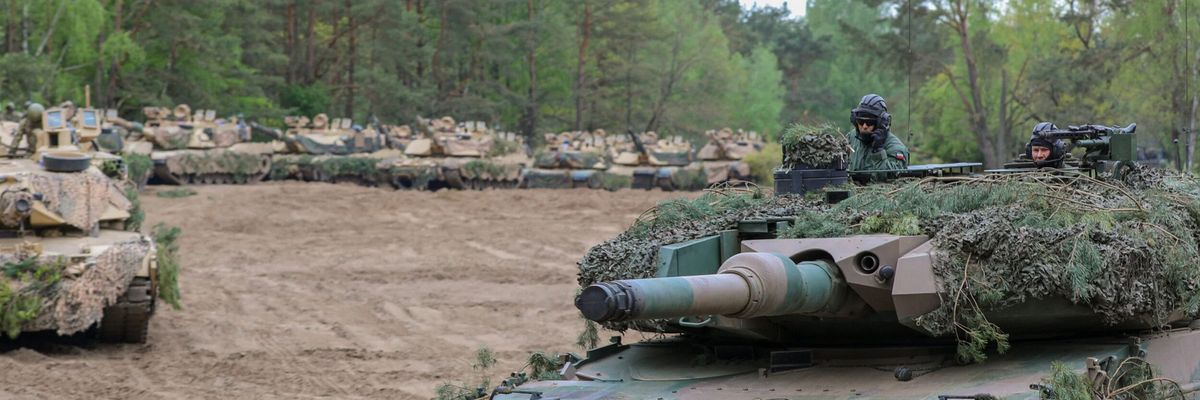
A Polish Leopard II main battle tank advances past American M1 Abrams tanks during the Defender Europe wargames in Drawsko Pomorskie, Poland in May 2022.
Global Military Spending Hits All-Time High of $2.24 Trillion: Analysis
The United States, China, and Russia together accounted for 56% of the world's total military expenditures in 2022.
An annual analysis published Monday revealed that global military spending rose to an all-time high of over $2.2 trillion last year, driven largely by Russia's invasion of Ukraine and the Western response, as well as the steadily increasing Pentagon budget in the United States.
The Stockholm International Peace Research Institute's (SIPRI) annual report showed a 3.7% overall increase in worldwide military expenditures to $2.24 trillion in 2022, including a 13% rise in Europe—the continent's sharpest increase in three decades—amid Russia's war on Ukraine.
Ukrainian defense spending skyrocketed 640% last year to $44 billion, the biggest single-year increase ever recorded by SIPRI. Meanwhile, Russian military spending surged 9.2% to $86.4 billion.
Among European nations, significant increases in military spending were observed in Finland (36%), Lithuania (27%), Sweden (12%), and Poland (11%).
"The invasion of Ukraine had an immediate impact on military spending decisions in Central and Western Europe," SIPRI senior researcher Diego Lopes da Silva said in a statement. "This included multiyear plans to boost spending from several governments."
"As a result, we can reasonably expect military expenditure in Central and Western Europe to keep rising in the years ahead," he added.
The United States remained by far the world's biggest military spender, with its $877 in expenditures accounting for 39% of the global total in 2022. The U.S.—which is also the world's biggest arms exporter—China, and Russia together accounted for 56% of the global total.
"The increase in the USA's military spending in 2022 was largely accounted for by the unprecedented level of financial military aid it provided to Ukraine," said Nan Tian, another SIPRI senior researcher. "Given the scale of U.S. spending, even a minor increase in percentage terms has a significant impact on the level of global military expenditure."
In Asia, China—with its $292 billion military budget—remained the world's second-biggest spender, while Japanese defense expenditures rose 5.9% to $46 billion, and Indian military spending increased 6% to $81.4 billion.
Other countries with notable increases in 2022 military expenditures include Ethiopia (88%), Turkey (26%), and Saudi Arabia (16%).
"The continuous rise in global military expenditure in recent years is a sign that we are living in an increasingly insecure world," said Tian. "States are bolstering military strength in response to a deteriorating security environment, which they do not foresee improving in the near future."
We are at a crossroads
This country and this world are at a monumental crossroads. In a few short weeks, US voters will have an opportunity to beat back the forces of fascism and confront the billionaires who are rigging the economy, our media system, and our democracy, making it increasingly impossible for ordinary people to get by. We’re not just talking about the election. We’re talking about what must be done once these fascist elements are vanquished from power. We need a bolder set of solutions than what either major party has so far been willing to offer and a working-class movement ready to fight like hell for it. Trump didn't emerge from nowhere. The conditions that fueled MAGA authoritarianism were created by decades of radical neoliberal economic policies and a corrupt political system dominated by corporate interests. They slashed taxes on the super-rich, promising that the benefits would trickle down. They said giveaways to the corporate titans would make life more affordable for the rest of us. It was all bullshit. And when a bitter, betrayed populace searches for someone to blame, right-wing demagogues have little trouble finding scapegoats. People know when they're being lied to, but you won't hear any of this from the corporate media. Only independent journalism—powered and funded by people who believe in building a better world—can deliver truly trustworthy daily news. Our Fall Campaign is underway, and we need your help. To power our newsroom through the rest of the year, we need to raise $125,000 by midnight on October 31. So if you share our vision, please contribute whatever you can to sustain our work. |
An annual analysis published Monday revealed that global military spending rose to an all-time high of over $2.2 trillion last year, driven largely by Russia's invasion of Ukraine and the Western response, as well as the steadily increasing Pentagon budget in the United States.
The Stockholm International Peace Research Institute's (SIPRI) annual report showed a 3.7% overall increase in worldwide military expenditures to $2.24 trillion in 2022, including a 13% rise in Europe—the continent's sharpest increase in three decades—amid Russia's war on Ukraine.
Ukrainian defense spending skyrocketed 640% last year to $44 billion, the biggest single-year increase ever recorded by SIPRI. Meanwhile, Russian military spending surged 9.2% to $86.4 billion.
Among European nations, significant increases in military spending were observed in Finland (36%), Lithuania (27%), Sweden (12%), and Poland (11%).
"The invasion of Ukraine had an immediate impact on military spending decisions in Central and Western Europe," SIPRI senior researcher Diego Lopes da Silva said in a statement. "This included multiyear plans to boost spending from several governments."
"As a result, we can reasonably expect military expenditure in Central and Western Europe to keep rising in the years ahead," he added.
The United States remained by far the world's biggest military spender, with its $877 in expenditures accounting for 39% of the global total in 2022. The U.S.—which is also the world's biggest arms exporter—China, and Russia together accounted for 56% of the global total.
"The increase in the USA's military spending in 2022 was largely accounted for by the unprecedented level of financial military aid it provided to Ukraine," said Nan Tian, another SIPRI senior researcher. "Given the scale of U.S. spending, even a minor increase in percentage terms has a significant impact on the level of global military expenditure."
In Asia, China—with its $292 billion military budget—remained the world's second-biggest spender, while Japanese defense expenditures rose 5.9% to $46 billion, and Indian military spending increased 6% to $81.4 billion.
Other countries with notable increases in 2022 military expenditures include Ethiopia (88%), Turkey (26%), and Saudi Arabia (16%).
"The continuous rise in global military expenditure in recent years is a sign that we are living in an increasingly insecure world," said Tian. "States are bolstering military strength in response to a deteriorating security environment, which they do not foresee improving in the near future."
- Global Military Spending Tops $2 Trillion for First Time in History ›
- 'Scandalous': G7 Nations Spend 62 Times More on Military Than Humanitarian Aid | Common Dreams ›
- 'Wars, Uncertainty, and Geopolitical Upheaval' Led to 2025 Global Military Spending Surge | Common Dreams ›