SUBSCRIBE TO OUR FREE NEWSLETTER
Daily news & progressive opinion—funded by the people, not the corporations—delivered straight to your inbox.
5
#000000
#FFFFFF
To donate by check, phone, or other method, see our More Ways to Give page.
Daily news & progressive opinion—funded by the people, not the corporations—delivered straight to your inbox.
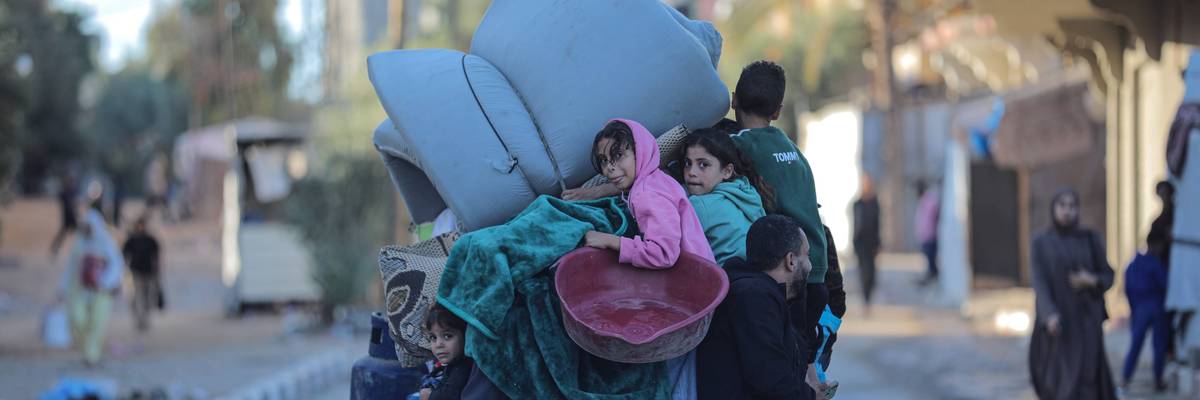
Palestinians living in the al-Dawa neighborhood north of Nuseirat Refugee Camp flee their homes once again after the Israeli army advances beyond the "Yellow Line" established under the ceasefire agreement in the central Gaza Strip, Palestine, on November 18, 2026.
Israeli Defense Minister Israel Katz said the military should prepare to make newly seized territory beyond the ceasefire line "permanent parts of Israel’s security zones."
Thousands of Palestinians have been forced to flee for their lives after Israeli forces launched a new ground assault on central Gaza on Wednesday, advancing past the so-called "yellow line" despite last year's ceasefire agreement.
Since the agreement was signed last October, Israel has gradually expanded its control over Gaza in violation of the deal's terms and killed over 1,600 Palestinians in near-daily strikes. Its surprise attack on Wednesday, which saw tanks rolling into areas near the Bureij and Nuseirat refugee camps beyond the ceasefire line, is its first ground incursion into this area since the agreement went into effect.
At least three Palestinians were killed in Israeli attacks across central Gaza, according to medical officials. Meanwhile, Middle East Eye reported that at least two people were wounded by "indiscriminate fire" near the Nuseirat refugee camp as scores of residents fled the area.
The Israeli army said it was targeting "terrorist infrastructure" in residential areas where many Palestinian families and displaced residents live. In a message posted on social media after the assault had already begun, Israel’s Coordinator of Government Activities in the Territories told residents to "stay away from the area where our forces are operating" until further updates were given.
In a statement Wednesday, Gaza's Ministry of Social Development warned that the assault posed a "direct threat to the lives of tens of thousands of displaced people, forcibly driving them toward new waves of displacement." It added that the "continuation of military operations in the vicinity of populated areas and shelters" was "a grave violation of international humanitarian law and a direct threat to the social protection system."
The Palestinian militant group Hamas decried the new assault as "a serious development and a flagrant violation of the ceasefire agreement," adding that "forced evacuation orders and the displacement of thousands of residents from their areas under threat and bombardment constitute a new crime against civilians and a blatant violation of international humanitarian law."
Israeli Defense Minister Israel Katz indicated on Wednesday that the military intended to maintain its territorial control in Gaza, saying that in the event of further escalation, it was prepared to "maneuver and seize additional territory, while evacuating residents and destroying terrorist infrastructure on the ground, turning these areas into permanent parts of Israel’s security zones in the north and south."
Katz said this policy was supported by Israeli Prime Minister Benjamin Netanyahu, who in May directed the military to seize at least 70% of Gaza, up from the 53% it was supposed to control temporarily under the original ceasefire agreement.
Despite the ceasefire's requirement that Israel eventually hand territorial control back to Palestinians, Netanyahu said in September that Israel was "not withdrawing" from the territory it controls. He said Israel controlled 60% of Gaza and that "there is still more to come."
Finance Minister Bezalel Smotrich has called for Israel to fully annex territory “at least as far as the yellow line in Gaza,” rather than merely maintain it as a military buffer zone. He has also advocated repopulating the exclave with Israeli settlers.
Wednesday's assault followed several other attacks over the past week, including some on civilian areas, which killed at least 37 Palestinians. Those attacks included an attack on Nasser Hospital in Khan Younis on November 12, which killed six people, including a surgeon.
On Tuesday, Israeli forces killed at least four Palestinians, including 6-year-old Eyas Ahmed al-Namnam, who was shot near his displaced family's tent east of Deir al-Balah in central Gaza.
Another child, 11-year-old Mansour Khader Nabhan, died Wednesday at al-Shifa Hospital after being critically injured when an Israeli drone dropped an explosive on civilians in Bir al-Naaja, west of Jabalia, in northern Gaza.
In a report to the United Nations Security Council, the Gaza Board of Peace, created by US President Donald Trump, criticized Israel's continued attacks and restrictions on critical aid needed for recovery from devastating floods and warned that Israel's actions were causing the ceasefire to collapse.
“The distance between what has been agreed and what is happening on the ground nonetheless remains the principal risk to the process,” the board said. "Restrictions imposed by Israel on the entry of supplies and equipment, compounded by funding shortfalls, continued to impede preparedness and response efforts."
“A ceasefire that delivers nothing visible cannot be sustained indefinitely,” the report said. “Should it collapse, there would be no road map to return to, no administration to deploy, and no enabling environment to rebuild.”
As the world commemorated three years since the start of Israel's genocidal war in Gaza, which has killed more than 74,000 Palestinians, including more than 21,000 children, according to official estimates, 100 humanitarian organizations warned last month that Israel's continued attacks, restrictions on humanitarian aid, and advances deeper into Gaza had become normalized despite last year's ceasefire agreement.
“A ceasefire is meaningless if children are still being killed and families are still unable to rebuild their lives," said Inger Ashing, the CEO of Save the Children. "Since the ceasefire was announced, nearly one child has been killed every day."
Sarah Sanbar, the acting Israel and Palestine researcher at Human Rights Watch, said, "The outside world may be under a dangerous illusion that life in Gaza is returning to normal, but reality tells a very different story."
"There is nothing normal," she added, "about living in a tent under bombardment, without enough food or drinking water for your family.”
This country and this world are at a monumental crossroads. US voters have an opportunity to beat back the forces of fascism and confront the billionaires who are rigging the economy, our media system, and our democracy, making it increasingly impossible for ordinary people to get by. We’re not just talking about the election. We’re talking about what must be done once these fascist elements are vanquished from power. We need a bolder set of solutions than what either major party has so far been willing to offer and a working-class movement ready to fight like hell for it. Trump didn't emerge from nowhere. The conditions that fueled MAGA authoritarianism were created by decades of radical neoliberal economic policies and a corrupt political system dominated by corporate interests. They slashed taxes on the super-rich, promising that the benefits would trickle down. They said giveaways to the corporate titans would make life more affordable for the rest of us. It was all bullshit. And when a bitter, betrayed populace searches for someone to blame, right-wing demagogues have little trouble finding scapegoats. People know when they're being lied to, but you won't hear any of this from the corporate media. Only independent journalism—powered and funded by people who believe in building a better world—can deliver truly trustworthy daily news. If you share our vision, please contribute whatever you can to sustain our work. |
Thousands of Palestinians have been forced to flee for their lives after Israeli forces launched a new ground assault on central Gaza on Wednesday, advancing past the so-called "yellow line" despite last year's ceasefire agreement.
Since the agreement was signed last October, Israel has gradually expanded its control over Gaza in violation of the deal's terms and killed over 1,600 Palestinians in near-daily strikes. Its surprise attack on Wednesday, which saw tanks rolling into areas near the Bureij and Nuseirat refugee camps beyond the ceasefire line, is its first ground incursion into this area since the agreement went into effect.
At least three Palestinians were killed in Israeli attacks across central Gaza, according to medical officials. Meanwhile, Middle East Eye reported that at least two people were wounded by "indiscriminate fire" near the Nuseirat refugee camp as scores of residents fled the area.
The Israeli army said it was targeting "terrorist infrastructure" in residential areas where many Palestinian families and displaced residents live. In a message posted on social media after the assault had already begun, Israel’s Coordinator of Government Activities in the Territories told residents to "stay away from the area where our forces are operating" until further updates were given.
In a statement Wednesday, Gaza's Ministry of Social Development warned that the assault posed a "direct threat to the lives of tens of thousands of displaced people, forcibly driving them toward new waves of displacement." It added that the "continuation of military operations in the vicinity of populated areas and shelters" was "a grave violation of international humanitarian law and a direct threat to the social protection system."
The Palestinian militant group Hamas decried the new assault as "a serious development and a flagrant violation of the ceasefire agreement," adding that "forced evacuation orders and the displacement of thousands of residents from their areas under threat and bombardment constitute a new crime against civilians and a blatant violation of international humanitarian law."
Israeli Defense Minister Israel Katz indicated on Wednesday that the military intended to maintain its territorial control in Gaza, saying that in the event of further escalation, it was prepared to "maneuver and seize additional territory, while evacuating residents and destroying terrorist infrastructure on the ground, turning these areas into permanent parts of Israel’s security zones in the north and south."
Katz said this policy was supported by Israeli Prime Minister Benjamin Netanyahu, who in May directed the military to seize at least 70% of Gaza, up from the 53% it was supposed to control temporarily under the original ceasefire agreement.
Despite the ceasefire's requirement that Israel eventually hand territorial control back to Palestinians, Netanyahu said in September that Israel was "not withdrawing" from the territory it controls. He said Israel controlled 60% of Gaza and that "there is still more to come."
Finance Minister Bezalel Smotrich has called for Israel to fully annex territory “at least as far as the yellow line in Gaza,” rather than merely maintain it as a military buffer zone. He has also advocated repopulating the exclave with Israeli settlers.
Wednesday's assault followed several other attacks over the past week, including some on civilian areas, which killed at least 37 Palestinians. Those attacks included an attack on Nasser Hospital in Khan Younis on November 12, which killed six people, including a surgeon.
On Tuesday, Israeli forces killed at least four Palestinians, including 6-year-old Eyas Ahmed al-Namnam, who was shot near his displaced family's tent east of Deir al-Balah in central Gaza.
Another child, 11-year-old Mansour Khader Nabhan, died Wednesday at al-Shifa Hospital after being critically injured when an Israeli drone dropped an explosive on civilians in Bir al-Naaja, west of Jabalia, in northern Gaza.
In a report to the United Nations Security Council, the Gaza Board of Peace, created by US President Donald Trump, criticized Israel's continued attacks and restrictions on critical aid needed for recovery from devastating floods and warned that Israel's actions were causing the ceasefire to collapse.
“The distance between what has been agreed and what is happening on the ground nonetheless remains the principal risk to the process,” the board said. "Restrictions imposed by Israel on the entry of supplies and equipment, compounded by funding shortfalls, continued to impede preparedness and response efforts."
“A ceasefire that delivers nothing visible cannot be sustained indefinitely,” the report said. “Should it collapse, there would be no road map to return to, no administration to deploy, and no enabling environment to rebuild.”
As the world commemorated three years since the start of Israel's genocidal war in Gaza, which has killed more than 74,000 Palestinians, including more than 21,000 children, according to official estimates, 100 humanitarian organizations warned last month that Israel's continued attacks, restrictions on humanitarian aid, and advances deeper into Gaza had become normalized despite last year's ceasefire agreement.
“A ceasefire is meaningless if children are still being killed and families are still unable to rebuild their lives," said Inger Ashing, the CEO of Save the Children. "Since the ceasefire was announced, nearly one child has been killed every day."
Sarah Sanbar, the acting Israel and Palestine researcher at Human Rights Watch, said, "The outside world may be under a dangerous illusion that life in Gaza is returning to normal, but reality tells a very different story."
"There is nothing normal," she added, "about living in a tent under bombardment, without enough food or drinking water for your family.”