5
#000000
#FFFFFF
To donate by check, phone, or other method, see our More Ways to Give page.
Daily news & progressive opinion—funded by the people, not the corporations—delivered straight to your inbox.
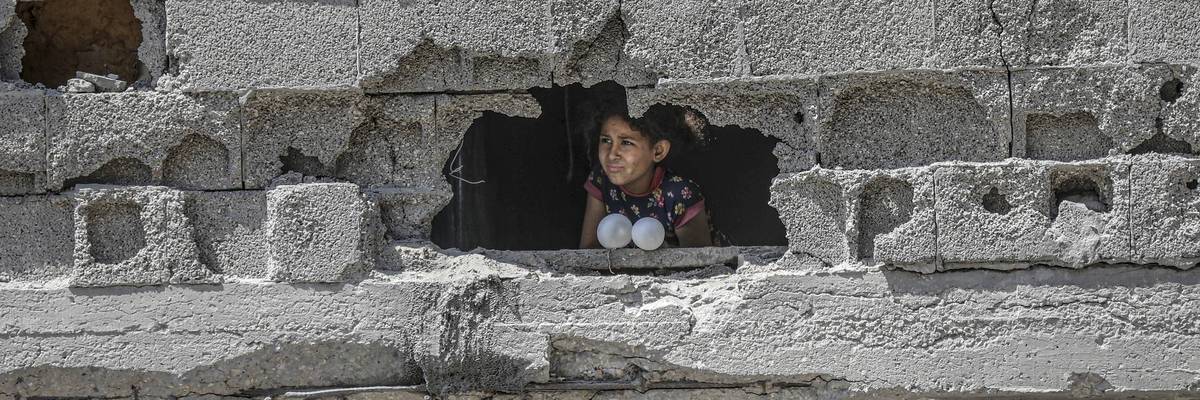
A child peers through a hole in a damaged concrete wall in the Al-Tuffah neighborhood of Gaza City, Gaza Strip, near the yellow line, on September 22, 2026.
"The yellow line cannot be treated simply as a line on a map. It has become a mechanism of encirclement and ethnic cleansing."
A year after a so-called "ceasefire" deal established the Israel Defense Forces' "yellow line" in Gaza, separating the IDF-controlled eastern part of Gaza from about 47% of the strip that was originally set aside for Palestinians, the Israeli military has crept westward, block by block—effectively "asphyxiating" Gaza's population of 2.1 million people, as one aid group said Monday.
Médecins Sans Frontières (MSF), also known by its English name, Doctors Without Borders, said that the US-backed IDF now occupies about 65% of the Gaza Strip, "squeezing people into a smaller and smaller area" and leaving Palestinians uncertain about where the yellow line begins and ends as they are forced to repeatedly move.
"People risk being shot by Israeli forces when they approach it, and MSF teams continue to treat people with gunshot wounds sustained nearby," said the organization.
MSF released its statement on the shifting yellow line and the organization's struggles to provide medical aid for Palestinians days after the Danish Refugee Council reported on refugee camps near the boundary, where 80% of Palestinians interviewed by the DRC said they've faced water shortage and people reported rat and rodent infestations, continued food scarcity despite a ceasefire deal that required a ramp-up of humanitarian aid, and rapid spread of illnesses.
DRC accused Israel of "a policy of protracted displacement," which was supported by MSF's reporting Monday.
"The October 2025 ceasefire in Gaza was supposed to end civilians' suffering," said DRC. "Nearly a year on, it exists largely in name only. Displacement in Gaza has not ended; it has changed shape."
The United Nations Office for the Coordination of Humanitarian Affairs (OCHA) also warned last month about the IDF's gradual push westward through demolitions and the movement of military forces, noting that residents have continued living in neighborhoods adjacent to the yellow line, such as Al-Tuffah and Al Zaytoun in Gaza City, "because they have nowhere else to go."
"Where do we go? This is a question we’ve been asking ourselves for three years,” Safaa Mushtaha of Al-Tuffah told OCHA. “We accepted living near the yellow line, but it’s become unbearable.”
Ibtisam Malika, who also lives near the line, added that "every two to three months, we are forced to move and leave our belongings behind."
MSF described how families are being "pushed into overcrowded and unlivable conditions" and how the group's ability to deliver clean water has been impeded when there are attacks near the yellow line.
"The yellow line cannot be treated simply as a line on a map,” says Amande Bazerolle, head of emergency response for MSF in Gaza. “It has become a mechanism of encirclement and ethnic cleansing, while cutting communities off from the infrastructure, healthcare, water, and other essentials they need to survive.”
The medical aid group treated more than 1,500 cases of chickenpox in June and July, and has treated more that 11,000 cases of skin disorders including scabies this year.
One official said a majority of Palestinians in Gaza have less than six liters of water per day for drinking, bathing, and other domestic uses, and Israeli restrictions on the delivery of many items—ones that authorities claim are "dual-use" and could be used by Hamas for military purposes—have left families and medical providers without essentials.
“We are treating gastroenteritis, acute respiratory infections, a lot of skin conditions, hepatitis, bacterial skin infections, scabies, and lice," said Dr. Murad Asaliyya, medical activities manager for MSF in Gaza. “At the same time, we are facing severe shortages in terms of medical supplies. Even the cream we need to treat scabies has been restricted by the Israeli authorities.”
Other crucial items that have been restricted by Israel include engine oil and spare parts, "crippling the infrastructure needed to keep hospitals, ambulances and water systems running," said MSF.
MSF emphasized that the area near the yellow line is hardly the only part of Gaza where Palestinians face continued Israeli attacks. In June and July, the group's medical teams treated more than 1,200 cases of "violent trauma" across the strip, "including blast injuries, burns, gunshot wounds, and injuries resulting from physical assault."
Since Israel began relentlessly attacking Gaza in October 2023 in retaliation for a Hamas-led attack, the military offensive has killed more than 74,000 Palestinians, including more than 20,000 children, with experts warning that the true death toll is likely far higher. About 80% of all structures across Gaza have been damaged, said MSF.
The group released its findings as Israeli Finance Minister Bezalel Smotrich boasted in an interview about the IDF's encroachment on the territory that had been ostensibly set aside for Palestinians last year, saying the moving of the yellow line and the destruction of Gaza and its infrastructure "encourages migration" and that "a world will not be built there."
Israeli Finance Minister Bezalel Smotrich:The Gaza Strip should never be rebuilt — a memorial to sin. That is also what will encourage migration from there the most. https://t.co/EnZCIPrs9x
— Clash Report (@clashreport) October 5, 2026
“Destruction, displacement, and deprivation have become normalized—practices Israel is carrying out with impunity,” said Bazerolle. “Governments must act now to ensure Israel stops the destruction and killing, prevents ethnic cleansing, and stops denying Palestinians the means of survival.”
Dear Common Dreams reader, It’s been nearly 30 years since I co-founded Common Dreams with my late wife, Lina Newhouser. We had the radical notion that journalism should serve the public good, not corporate profits. It was clear to us from the outset what it would take to build such a project. No paid advertisements. No corporate sponsors. No millionaire publisher telling us what to think or do. Many people said we wouldn't last a year, but we proved those doubters wrong. Together with a tremendous team of journalists and dedicated staff, we built an independent media outlet free from the constraints of profits and corporate control. Our mission has always been simple: To inform. To inspire. To ignite change for the common good. Building Common Dreams was not easy. Our survival was never guaranteed. When you take on the most powerful forces—Wall Street greed, fossil fuel industry destruction, Big Tech lobbyists, and uber-rich oligarchs who have spent billions upon billions rigging the economy and democracy in their favor—the only bulwark you have is supporters who believe in your work. But here’s the urgent message from me today. It's never been this bad out there. And it's never been this hard to keep us going. At the very moment Common Dreams is most needed, the threats we face are intensifying. We need your support now more than ever. We don't accept corporate advertising and never will. We don't have a paywall because we don't think people should be blocked from critical news based on their ability to pay. Everything we do is funded by the donations of readers like you. When everyone does the little they can afford, we are strong. But if that support retreats or dries up, so do we. Will you donate now to make sure Common Dreams not only survives but thrives? —Craig Brown, Co-founder |
A year after a so-called "ceasefire" deal established the Israel Defense Forces' "yellow line" in Gaza, separating the IDF-controlled eastern part of Gaza from about 47% of the strip that was originally set aside for Palestinians, the Israeli military has crept westward, block by block—effectively "asphyxiating" Gaza's population of 2.1 million people, as one aid group said Monday.
Médecins Sans Frontières (MSF), also known by its English name, Doctors Without Borders, said that the US-backed IDF now occupies about 65% of the Gaza Strip, "squeezing people into a smaller and smaller area" and leaving Palestinians uncertain about where the yellow line begins and ends as they are forced to repeatedly move.
"People risk being shot by Israeli forces when they approach it, and MSF teams continue to treat people with gunshot wounds sustained nearby," said the organization.
MSF released its statement on the shifting yellow line and the organization's struggles to provide medical aid for Palestinians days after the Danish Refugee Council reported on refugee camps near the boundary, where 80% of Palestinians interviewed by the DRC said they've faced water shortage and people reported rat and rodent infestations, continued food scarcity despite a ceasefire deal that required a ramp-up of humanitarian aid, and rapid spread of illnesses.
DRC accused Israel of "a policy of protracted displacement," which was supported by MSF's reporting Monday.
"The October 2025 ceasefire in Gaza was supposed to end civilians' suffering," said DRC. "Nearly a year on, it exists largely in name only. Displacement in Gaza has not ended; it has changed shape."
The United Nations Office for the Coordination of Humanitarian Affairs (OCHA) also warned last month about the IDF's gradual push westward through demolitions and the movement of military forces, noting that residents have continued living in neighborhoods adjacent to the yellow line, such as Al-Tuffah and Al Zaytoun in Gaza City, "because they have nowhere else to go."
"Where do we go? This is a question we’ve been asking ourselves for three years,” Safaa Mushtaha of Al-Tuffah told OCHA. “We accepted living near the yellow line, but it’s become unbearable.”
Ibtisam Malika, who also lives near the line, added that "every two to three months, we are forced to move and leave our belongings behind."
MSF described how families are being "pushed into overcrowded and unlivable conditions" and how the group's ability to deliver clean water has been impeded when there are attacks near the yellow line.
"The yellow line cannot be treated simply as a line on a map,” says Amande Bazerolle, head of emergency response for MSF in Gaza. “It has become a mechanism of encirclement and ethnic cleansing, while cutting communities off from the infrastructure, healthcare, water, and other essentials they need to survive.”
The medical aid group treated more than 1,500 cases of chickenpox in June and July, and has treated more that 11,000 cases of skin disorders including scabies this year.
One official said a majority of Palestinians in Gaza have less than six liters of water per day for drinking, bathing, and other domestic uses, and Israeli restrictions on the delivery of many items—ones that authorities claim are "dual-use" and could be used by Hamas for military purposes—have left families and medical providers without essentials.
“We are treating gastroenteritis, acute respiratory infections, a lot of skin conditions, hepatitis, bacterial skin infections, scabies, and lice," said Dr. Murad Asaliyya, medical activities manager for MSF in Gaza. “At the same time, we are facing severe shortages in terms of medical supplies. Even the cream we need to treat scabies has been restricted by the Israeli authorities.”
Other crucial items that have been restricted by Israel include engine oil and spare parts, "crippling the infrastructure needed to keep hospitals, ambulances and water systems running," said MSF.
MSF emphasized that the area near the yellow line is hardly the only part of Gaza where Palestinians face continued Israeli attacks. In June and July, the group's medical teams treated more than 1,200 cases of "violent trauma" across the strip, "including blast injuries, burns, gunshot wounds, and injuries resulting from physical assault."
Since Israel began relentlessly attacking Gaza in October 2023 in retaliation for a Hamas-led attack, the military offensive has killed more than 74,000 Palestinians, including more than 20,000 children, with experts warning that the true death toll is likely far higher. About 80% of all structures across Gaza have been damaged, said MSF.
The group released its findings as Israeli Finance Minister Bezalel Smotrich boasted in an interview about the IDF's encroachment on the territory that had been ostensibly set aside for Palestinians last year, saying the moving of the yellow line and the destruction of Gaza and its infrastructure "encourages migration" and that "a world will not be built there."
Israeli Finance Minister Bezalel Smotrich:The Gaza Strip should never be rebuilt — a memorial to sin. That is also what will encourage migration from there the most. https://t.co/EnZCIPrs9x
— Clash Report (@clashreport) October 5, 2026
“Destruction, displacement, and deprivation have become normalized—practices Israel is carrying out with impunity,” said Bazerolle. “Governments must act now to ensure Israel stops the destruction and killing, prevents ethnic cleansing, and stops denying Palestinians the means of survival.”
A year after a so-called "ceasefire" deal established the Israel Defense Forces' "yellow line" in Gaza, separating the IDF-controlled eastern part of Gaza from about 47% of the strip that was originally set aside for Palestinians, the Israeli military has crept westward, block by block—effectively "asphyxiating" Gaza's population of 2.1 million people, as one aid group said Monday.
Médecins Sans Frontières (MSF), also known by its English name, Doctors Without Borders, said that the US-backed IDF now occupies about 65% of the Gaza Strip, "squeezing people into a smaller and smaller area" and leaving Palestinians uncertain about where the yellow line begins and ends as they are forced to repeatedly move.
"People risk being shot by Israeli forces when they approach it, and MSF teams continue to treat people with gunshot wounds sustained nearby," said the organization.
MSF released its statement on the shifting yellow line and the organization's struggles to provide medical aid for Palestinians days after the Danish Refugee Council reported on refugee camps near the boundary, where 80% of Palestinians interviewed by the DRC said they've faced water shortage and people reported rat and rodent infestations, continued food scarcity despite a ceasefire deal that required a ramp-up of humanitarian aid, and rapid spread of illnesses.
DRC accused Israel of "a policy of protracted displacement," which was supported by MSF's reporting Monday.
"The October 2025 ceasefire in Gaza was supposed to end civilians' suffering," said DRC. "Nearly a year on, it exists largely in name only. Displacement in Gaza has not ended; it has changed shape."
The United Nations Office for the Coordination of Humanitarian Affairs (OCHA) also warned last month about the IDF's gradual push westward through demolitions and the movement of military forces, noting that residents have continued living in neighborhoods adjacent to the yellow line, such as Al-Tuffah and Al Zaytoun in Gaza City, "because they have nowhere else to go."
"Where do we go? This is a question we’ve been asking ourselves for three years,” Safaa Mushtaha of Al-Tuffah told OCHA. “We accepted living near the yellow line, but it’s become unbearable.”
Ibtisam Malika, who also lives near the line, added that "every two to three months, we are forced to move and leave our belongings behind."
MSF described how families are being "pushed into overcrowded and unlivable conditions" and how the group's ability to deliver clean water has been impeded when there are attacks near the yellow line.
"The yellow line cannot be treated simply as a line on a map,” says Amande Bazerolle, head of emergency response for MSF in Gaza. “It has become a mechanism of encirclement and ethnic cleansing, while cutting communities off from the infrastructure, healthcare, water, and other essentials they need to survive.”
The medical aid group treated more than 1,500 cases of chickenpox in June and July, and has treated more that 11,000 cases of skin disorders including scabies this year.
One official said a majority of Palestinians in Gaza have less than six liters of water per day for drinking, bathing, and other domestic uses, and Israeli restrictions on the delivery of many items—ones that authorities claim are "dual-use" and could be used by Hamas for military purposes—have left families and medical providers without essentials.
“We are treating gastroenteritis, acute respiratory infections, a lot of skin conditions, hepatitis, bacterial skin infections, scabies, and lice," said Dr. Murad Asaliyya, medical activities manager for MSF in Gaza. “At the same time, we are facing severe shortages in terms of medical supplies. Even the cream we need to treat scabies has been restricted by the Israeli authorities.”
Other crucial items that have been restricted by Israel include engine oil and spare parts, "crippling the infrastructure needed to keep hospitals, ambulances and water systems running," said MSF.
MSF emphasized that the area near the yellow line is hardly the only part of Gaza where Palestinians face continued Israeli attacks. In June and July, the group's medical teams treated more than 1,200 cases of "violent trauma" across the strip, "including blast injuries, burns, gunshot wounds, and injuries resulting from physical assault."
Since Israel began relentlessly attacking Gaza in October 2023 in retaliation for a Hamas-led attack, the military offensive has killed more than 74,000 Palestinians, including more than 20,000 children, with experts warning that the true death toll is likely far higher. About 80% of all structures across Gaza have been damaged, said MSF.
The group released its findings as Israeli Finance Minister Bezalel Smotrich boasted in an interview about the IDF's encroachment on the territory that had been ostensibly set aside for Palestinians last year, saying the moving of the yellow line and the destruction of Gaza and its infrastructure "encourages migration" and that "a world will not be built there."
Israeli Finance Minister Bezalel Smotrich:The Gaza Strip should never be rebuilt — a memorial to sin. That is also what will encourage migration from there the most. https://t.co/EnZCIPrs9x
— Clash Report (@clashreport) October 5, 2026
“Destruction, displacement, and deprivation have become normalized—practices Israel is carrying out with impunity,” said Bazerolle. “Governments must act now to ensure Israel stops the destruction and killing, prevents ethnic cleansing, and stops denying Palestinians the means of survival.”