SUBSCRIBE TO OUR FREE NEWSLETTER
Daily news & progressive opinion—funded by the people, not the corporations—delivered straight to your inbox.
5
#000000
#FFFFFF
To donate by check, phone, or other method, see our More Ways to Give page.
Daily news & progressive opinion—funded by the people, not the corporations—delivered straight to your inbox.
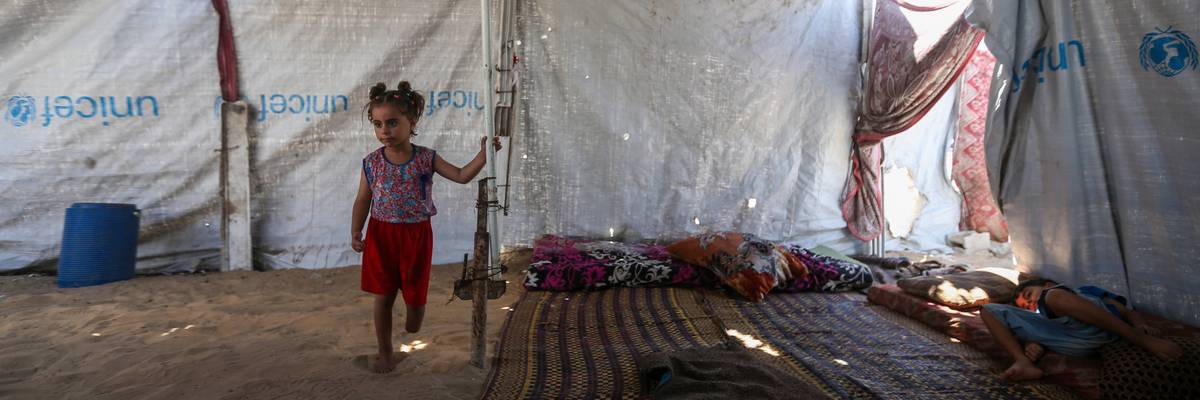
A child with an amputated leg stands inside her tent on August 18, 2026, in Beit Lahia, Gaza.
More than 11,000 children have severe life-changing injuries, including thousands who have had limbs amputated as a result of Israel's assault on Gaza.
Gaza has the world's largest concentration of child amputees thanks to Israel's genocidal war. Now, as Australian charities seek to deliver hundreds of wheelchairs to the children injured in the onslaught, Israel has reportedly been blocking them for more than a year and a half.
The Australian Broadcasting Corporation (ABC) reported last week that:
More than 900 wheelchairs, donated by two Australian charities to help injured children in Gaza, are stuck in warehouses in Jordan due to Israeli restrictions on aid deliveries into the war-ravaged strip.
Two shipments from New South Wales-based charity Kids on Wheels Alliance arrived in Jordan in February 2025, while a third, from Wheelchairs for Kids based in Western Australia, arrived in October 2025.
But instead of being delivered to children with severe mobility issues inside Gaza, they remain sitting in storage facilities managed by the Jordan Hashemite Charity Organization (JHCO).
According to the report, JHCO submitted an application in February 2025 for the wheelchairs to be included in an aid convoy headed to Gaza, where more than 11,000 kids have been left with "severe, life-changing injuries, including permanent disabilities that require long-term care and rehabilitation," according to the United Nations Children's Fund (UNICEF).
That application was denied by the Coordinator of Government Activities in the Territories (COGAT), the Israeli agency responsible for aid coordination, because "medical equipment and medicines were not approved for inclusion in that convoy." The application has been marked as "pending" for the last 19 months, meaning that a new request cannot be sent.
An Israeli government source told ABC that Israel had not blocked the delivery of the wheelchairs. But COGAT did not answer specific questions from the network about what had happened to the shipment.
The agency said it had allowed the entry of thousands of wheelchairs "without any quantitative restrictions," as well as "approximately 22,000 tons of medical equipment and medicines" since the beginning of the ceasefire in October 2025.
One source told the outlet that the wheelchairs may have been held up under Israel's rules blocking possible "dual-use" items that authorities believe could serve a military purpose.
The wheelchairs have specialized features: they are adapted for rough terrain to help users navigate the rubble-strewn streets of Gaza and are adjustable to grow with the children who use them.
But as Dr. Abdullah Al-Balawi, a physician with the Palestinian Australian New Zealand Medical Association who has watched the boxes pile up undelivered, explained, "they do not pose any threat."
The stalled wheelchairs are hardly the first medical or disability equipment to be blocked as a result of Israel's strict restrictions on humanitarian supplies entering Gaza. Human rights groups have previously documented the use of dual-use restrictions to block wheelchair batteries, X-ray equipment, and materials used to manufacture prosthetic limbs.
It's not just medical supplies. Portable toilets have also been blocked, as have sleeping bags and tarps. These items are in high demand as around 90% of Palestinians living in Gaza remain displaced, with Israel's attacks having destroyed most of the buildings. According to a report from humanitarian organizations in April, bandages, diapers, shampoo, and tent poles have also been blocked.
Human Rights Watch has argued that the dual-use restrictions are unnecessarily broad and arbitrary, allowing certain items some days and rejecting them on others. The organization has called on Israel to remove the dual-use label on "medical-related supplies, assistive aids, and accessible technology like eyeglasses, wheelchairs, walkers, canes [and] hearing aids."
Amnesty International has described Israel's blocking of lifesaving medical and other forms of humanitarian assistance—including food, water and sanitation supplies, fuel, and shelter materials and equipment—as part of a pattern that amounts to genocide.
"The humanitarian aid must not stop," Al-Balawi said. "This is part of the stubbornness of the other side by not letting in this aid; the wheelchairs are only a part of it."
Dear Common Dreams reader, It’s been nearly 30 years since I co-founded Common Dreams with my late wife, Lina Newhouser. We had the radical notion that journalism should serve the public good, not corporate profits. It was clear to us from the outset what it would take to build such a project. No paid advertisements. No corporate sponsors. No millionaire publisher telling us what to think or do. Many people said we wouldn't last a year, but we proved those doubters wrong. Together with a tremendous team of journalists and dedicated staff, we built an independent media outlet free from the constraints of profits and corporate control. Our mission has always been simple: To inform. To inspire. To ignite change for the common good. Building Common Dreams was not easy. Our survival was never guaranteed. When you take on the most powerful forces—Wall Street greed, fossil fuel industry destruction, Big Tech lobbyists, and uber-rich oligarchs who have spent billions upon billions rigging the economy and democracy in their favor—the only bulwark you have is supporters who believe in your work. But here’s the urgent message from me today. It's never been this bad out there. And it's never been this hard to keep us going. At the very moment Common Dreams is most needed, the threats we face are intensifying. We need your support now more than ever. We don't accept corporate advertising and never will. We don't have a paywall because we don't think people should be blocked from critical news based on their ability to pay. Everything we do is funded by the donations of readers like you. When everyone does the little they can afford, we are strong. But if that support retreats or dries up, so do we. Will you donate now to make sure Common Dreams not only survives but thrives? —Craig Brown, Co-founder |
Gaza has the world's largest concentration of child amputees thanks to Israel's genocidal war. Now, as Australian charities seek to deliver hundreds of wheelchairs to the children injured in the onslaught, Israel has reportedly been blocking them for more than a year and a half.
The Australian Broadcasting Corporation (ABC) reported last week that:
More than 900 wheelchairs, donated by two Australian charities to help injured children in Gaza, are stuck in warehouses in Jordan due to Israeli restrictions on aid deliveries into the war-ravaged strip.
Two shipments from New South Wales-based charity Kids on Wheels Alliance arrived in Jordan in February 2025, while a third, from Wheelchairs for Kids based in Western Australia, arrived in October 2025.
But instead of being delivered to children with severe mobility issues inside Gaza, they remain sitting in storage facilities managed by the Jordan Hashemite Charity Organization (JHCO).
According to the report, JHCO submitted an application in February 2025 for the wheelchairs to be included in an aid convoy headed to Gaza, where more than 11,000 kids have been left with "severe, life-changing injuries, including permanent disabilities that require long-term care and rehabilitation," according to the United Nations Children's Fund (UNICEF).
That application was denied by the Coordinator of Government Activities in the Territories (COGAT), the Israeli agency responsible for aid coordination, because "medical equipment and medicines were not approved for inclusion in that convoy." The application has been marked as "pending" for the last 19 months, meaning that a new request cannot be sent.
An Israeli government source told ABC that Israel had not blocked the delivery of the wheelchairs. But COGAT did not answer specific questions from the network about what had happened to the shipment.
The agency said it had allowed the entry of thousands of wheelchairs "without any quantitative restrictions," as well as "approximately 22,000 tons of medical equipment and medicines" since the beginning of the ceasefire in October 2025.
One source told the outlet that the wheelchairs may have been held up under Israel's rules blocking possible "dual-use" items that authorities believe could serve a military purpose.
The wheelchairs have specialized features: they are adapted for rough terrain to help users navigate the rubble-strewn streets of Gaza and are adjustable to grow with the children who use them.
But as Dr. Abdullah Al-Balawi, a physician with the Palestinian Australian New Zealand Medical Association who has watched the boxes pile up undelivered, explained, "they do not pose any threat."
The stalled wheelchairs are hardly the first medical or disability equipment to be blocked as a result of Israel's strict restrictions on humanitarian supplies entering Gaza. Human rights groups have previously documented the use of dual-use restrictions to block wheelchair batteries, X-ray equipment, and materials used to manufacture prosthetic limbs.
It's not just medical supplies. Portable toilets have also been blocked, as have sleeping bags and tarps. These items are in high demand as around 90% of Palestinians living in Gaza remain displaced, with Israel's attacks having destroyed most of the buildings. According to a report from humanitarian organizations in April, bandages, diapers, shampoo, and tent poles have also been blocked.
Human Rights Watch has argued that the dual-use restrictions are unnecessarily broad and arbitrary, allowing certain items some days and rejecting them on others. The organization has called on Israel to remove the dual-use label on "medical-related supplies, assistive aids, and accessible technology like eyeglasses, wheelchairs, walkers, canes [and] hearing aids."
Amnesty International has described Israel's blocking of lifesaving medical and other forms of humanitarian assistance—including food, water and sanitation supplies, fuel, and shelter materials and equipment—as part of a pattern that amounts to genocide.
"The humanitarian aid must not stop," Al-Balawi said. "This is part of the stubbornness of the other side by not letting in this aid; the wheelchairs are only a part of it."
Gaza has the world's largest concentration of child amputees thanks to Israel's genocidal war. Now, as Australian charities seek to deliver hundreds of wheelchairs to the children injured in the onslaught, Israel has reportedly been blocking them for more than a year and a half.
The Australian Broadcasting Corporation (ABC) reported last week that:
More than 900 wheelchairs, donated by two Australian charities to help injured children in Gaza, are stuck in warehouses in Jordan due to Israeli restrictions on aid deliveries into the war-ravaged strip.
Two shipments from New South Wales-based charity Kids on Wheels Alliance arrived in Jordan in February 2025, while a third, from Wheelchairs for Kids based in Western Australia, arrived in October 2025.
But instead of being delivered to children with severe mobility issues inside Gaza, they remain sitting in storage facilities managed by the Jordan Hashemite Charity Organization (JHCO).
According to the report, JHCO submitted an application in February 2025 for the wheelchairs to be included in an aid convoy headed to Gaza, where more than 11,000 kids have been left with "severe, life-changing injuries, including permanent disabilities that require long-term care and rehabilitation," according to the United Nations Children's Fund (UNICEF).
That application was denied by the Coordinator of Government Activities in the Territories (COGAT), the Israeli agency responsible for aid coordination, because "medical equipment and medicines were not approved for inclusion in that convoy." The application has been marked as "pending" for the last 19 months, meaning that a new request cannot be sent.
An Israeli government source told ABC that Israel had not blocked the delivery of the wheelchairs. But COGAT did not answer specific questions from the network about what had happened to the shipment.
The agency said it had allowed the entry of thousands of wheelchairs "without any quantitative restrictions," as well as "approximately 22,000 tons of medical equipment and medicines" since the beginning of the ceasefire in October 2025.
One source told the outlet that the wheelchairs may have been held up under Israel's rules blocking possible "dual-use" items that authorities believe could serve a military purpose.
The wheelchairs have specialized features: they are adapted for rough terrain to help users navigate the rubble-strewn streets of Gaza and are adjustable to grow with the children who use them.
But as Dr. Abdullah Al-Balawi, a physician with the Palestinian Australian New Zealand Medical Association who has watched the boxes pile up undelivered, explained, "they do not pose any threat."
The stalled wheelchairs are hardly the first medical or disability equipment to be blocked as a result of Israel's strict restrictions on humanitarian supplies entering Gaza. Human rights groups have previously documented the use of dual-use restrictions to block wheelchair batteries, X-ray equipment, and materials used to manufacture prosthetic limbs.
It's not just medical supplies. Portable toilets have also been blocked, as have sleeping bags and tarps. These items are in high demand as around 90% of Palestinians living in Gaza remain displaced, with Israel's attacks having destroyed most of the buildings. According to a report from humanitarian organizations in April, bandages, diapers, shampoo, and tent poles have also been blocked.
Human Rights Watch has argued that the dual-use restrictions are unnecessarily broad and arbitrary, allowing certain items some days and rejecting them on others. The organization has called on Israel to remove the dual-use label on "medical-related supplies, assistive aids, and accessible technology like eyeglasses, wheelchairs, walkers, canes [and] hearing aids."
Amnesty International has described Israel's blocking of lifesaving medical and other forms of humanitarian assistance—including food, water and sanitation supplies, fuel, and shelter materials and equipment—as part of a pattern that amounts to genocide.
"The humanitarian aid must not stop," Al-Balawi said. "This is part of the stubbornness of the other side by not letting in this aid; the wheelchairs are only a part of it."