SUBSCRIBE TO OUR FREE NEWSLETTER
Daily news & progressive opinion—funded by the people, not the corporations—delivered straight to your inbox.
5
#000000
#FFFFFF
To donate by check, phone, or other method, see our More Ways to Give page.
Daily news & progressive opinion—funded by the people, not the corporations—delivered straight to your inbox.
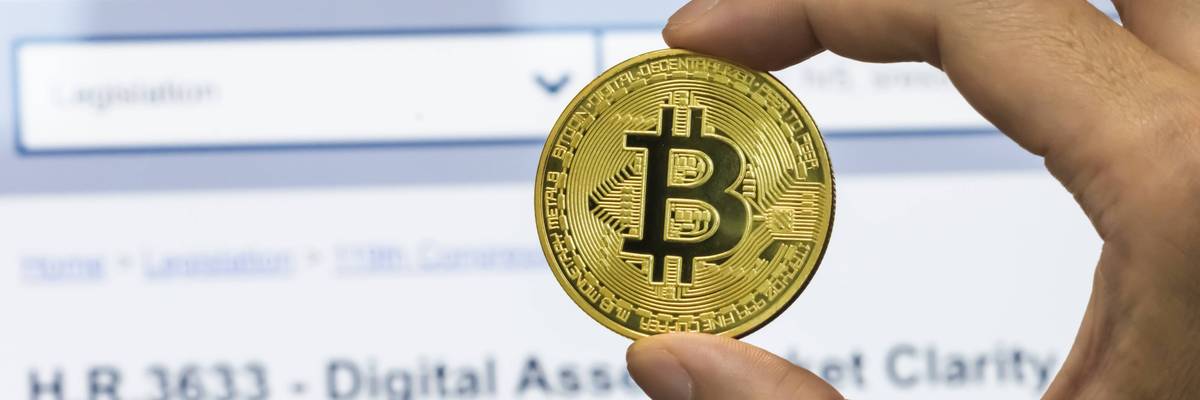
A person holds a gold-colored souvenir token bearing the Bitcoin symbol in front of a computer screen displaying the Congress.gov page for HR 3633, the Digital Asset Market Clarity Act, on September 15, 2026.
"The need for responsible cryptocurrency regulation remains," said one anti-corruption advocate.
The US Senate voted not to advance a major cryptocurrency bill on Tuesday, heeding warnings from critics that it would fail to regulate the volatile financial asset effectively and would allow President Donald Trump to continue profiting lavishly from it with little oversight.
Earlier reports indicated that crypto industry darling Sen. Kirsten Gillibrand (D-NY) was trying to rally enough Democrats to support the GOP-led Digital Asset Market Clarity Act to get the 60 votes necessary to break the filibuster.
But by Tuesday afternoon, even Gillibrand herself had jumped ship. In what turned out to be a 50-49 vote against the legislation, she joined every other member of the Democratic caucus to vote against the Clarity Act. So did four Republicans—Sen. Susan Collins (Maine), Josh Hawley (Mo.), Jerry Moran (Kan.), and Thom Tillis (NC).
Democrats who voted against the legislation said that a revised version presented by Republicans on Sunday failed to meet their demands for rules to prevent Trump and other high-ranking officials from profiting from their cryptocurrency ventures while in office.
In 2025, Trump reported roughly $1.4 billion in crypto-related income, including hundreds of millions from his family’s crypto exchange World Liberty Financial (WLF) and from sales of his $TRUMP meme coin.
"President Trump, his children, and his Cabinet are making billions of dollars in the crypto space, in part from bilking everyday Americans out of their hard-earned money," said Sen. Elissa Slotkin (D-Mich.) in a post to social media. "I cannot in good conscience vote for any legislation that codifies that behavior from public officials."
Sen. Ruben Gallego (D-Ariz.), who negotiated the bill's ethics language with Tillis, said in a statement that "instead of spending their time twisting themselves into knots to appease President Trump, Republicans should have worked more closely with Senate Democrats to craft a bill that could pass with strong ethics provisions.”
Reuters reported in August that crypto-aligned super political action committees have spent nearly $190 million during this election cycle to support industry-friendly candidates.
"It’s no secret that they are seeking to ram a bill through Congress based upon not the merits of the bill, but the threat that they will spend even more money in elections against people who vote against it,” said Sen. Chris Murphy (D-Conn.), who voted against the bill.
Ella Fanger, corporate power policy adviser for the progressive activist group Demand Progress, said in a statement that Democrats "dodged a bullet by refusing to go along with the dangerously weak bill that Trump and the crypto industry have asked for," though she questioned why Gillibrand was advocating for the measure up to the last minute, "particularly at a time when she is claiming to oppose Trump's corruption."
The Clarity Act is stalled for now and likely won't be revived until after the November midterms. But Scott Greytak, deputy executive director of Transparency International US, said that "the need for responsible cryptocurrency regulation remains."
"Before bringing it back, Congress must confront two fundamental failures of the legislation," he said in a statement. "First, it must stop President Trump—and future presidents and other public officials—from profiting from the crypto industry while shaping and enforcing its rules. President Trump’s crypto interests make the stakes clear: Public officials who write or enforce the rules for crypto shouldn’t be allowed to cash in on it."
"Second, Congress must ensure that law enforcement can follow the money wherever it moves," he continued. "Unless the bill applies strong anti-money laundering and sanctions rules across the crypto market, scammers, drug cartels, terrorist financiers, sanctions evaders, and corrupt officials will exploit the weakest parts of the system to move and hide their money."
Sen. Elizabeth Warren (D-Mass.), one of the Clarity Act's most outspoken critics, said, “Let’s make sure that we do not pass a crypto bill that will let Donald Trump continue to rake in billions of dollars in crypto profits while working families across this country struggle to deal with higher prices and an economy that gets worse by the day."
Dear Common Dreams reader, It’s been nearly 30 years since I co-founded Common Dreams with my late wife, Lina Newhouser. We had the radical notion that journalism should serve the public good, not corporate profits. It was clear to us from the outset what it would take to build such a project. No paid advertisements. No corporate sponsors. No millionaire publisher telling us what to think or do. Many people said we wouldn't last a year, but we proved those doubters wrong. Together with a tremendous team of journalists and dedicated staff, we built an independent media outlet free from the constraints of profits and corporate control. Our mission has always been simple: To inform. To inspire. To ignite change for the common good. Building Common Dreams was not easy. Our survival was never guaranteed. When you take on the most powerful forces—Wall Street greed, fossil fuel industry destruction, Big Tech lobbyists, and uber-rich oligarchs who have spent billions upon billions rigging the economy and democracy in their favor—the only bulwark you have is supporters who believe in your work. But here’s the urgent message from me today. It's never been this bad out there. And it's never been this hard to keep us going. At the very moment Common Dreams is most needed, the threats we face are intensifying. We need your support now more than ever. We don't accept corporate advertising and never will. We don't have a paywall because we don't think people should be blocked from critical news based on their ability to pay. Everything we do is funded by the donations of readers like you. When everyone does the little they can afford, we are strong. But if that support retreats or dries up, so do we. Will you donate now to make sure Common Dreams not only survives but thrives? —Craig Brown, Co-founder |
The US Senate voted not to advance a major cryptocurrency bill on Tuesday, heeding warnings from critics that it would fail to regulate the volatile financial asset effectively and would allow President Donald Trump to continue profiting lavishly from it with little oversight.
Earlier reports indicated that crypto industry darling Sen. Kirsten Gillibrand (D-NY) was trying to rally enough Democrats to support the GOP-led Digital Asset Market Clarity Act to get the 60 votes necessary to break the filibuster.
But by Tuesday afternoon, even Gillibrand herself had jumped ship. In what turned out to be a 50-49 vote against the legislation, she joined every other member of the Democratic caucus to vote against the Clarity Act. So did four Republicans—Sen. Susan Collins (Maine), Josh Hawley (Mo.), Jerry Moran (Kan.), and Thom Tillis (NC).
Democrats who voted against the legislation said that a revised version presented by Republicans on Sunday failed to meet their demands for rules to prevent Trump and other high-ranking officials from profiting from their cryptocurrency ventures while in office.
In 2025, Trump reported roughly $1.4 billion in crypto-related income, including hundreds of millions from his family’s crypto exchange World Liberty Financial (WLF) and from sales of his $TRUMP meme coin.
"President Trump, his children, and his Cabinet are making billions of dollars in the crypto space, in part from bilking everyday Americans out of their hard-earned money," said Sen. Elissa Slotkin (D-Mich.) in a post to social media. "I cannot in good conscience vote for any legislation that codifies that behavior from public officials."
Sen. Ruben Gallego (D-Ariz.), who negotiated the bill's ethics language with Tillis, said in a statement that "instead of spending their time twisting themselves into knots to appease President Trump, Republicans should have worked more closely with Senate Democrats to craft a bill that could pass with strong ethics provisions.”
Reuters reported in August that crypto-aligned super political action committees have spent nearly $190 million during this election cycle to support industry-friendly candidates.
"It’s no secret that they are seeking to ram a bill through Congress based upon not the merits of the bill, but the threat that they will spend even more money in elections against people who vote against it,” said Sen. Chris Murphy (D-Conn.), who voted against the bill.
Ella Fanger, corporate power policy adviser for the progressive activist group Demand Progress, said in a statement that Democrats "dodged a bullet by refusing to go along with the dangerously weak bill that Trump and the crypto industry have asked for," though she questioned why Gillibrand was advocating for the measure up to the last minute, "particularly at a time when she is claiming to oppose Trump's corruption."
The Clarity Act is stalled for now and likely won't be revived until after the November midterms. But Scott Greytak, deputy executive director of Transparency International US, said that "the need for responsible cryptocurrency regulation remains."
"Before bringing it back, Congress must confront two fundamental failures of the legislation," he said in a statement. "First, it must stop President Trump—and future presidents and other public officials—from profiting from the crypto industry while shaping and enforcing its rules. President Trump’s crypto interests make the stakes clear: Public officials who write or enforce the rules for crypto shouldn’t be allowed to cash in on it."
"Second, Congress must ensure that law enforcement can follow the money wherever it moves," he continued. "Unless the bill applies strong anti-money laundering and sanctions rules across the crypto market, scammers, drug cartels, terrorist financiers, sanctions evaders, and corrupt officials will exploit the weakest parts of the system to move and hide their money."
Sen. Elizabeth Warren (D-Mass.), one of the Clarity Act's most outspoken critics, said, “Let’s make sure that we do not pass a crypto bill that will let Donald Trump continue to rake in billions of dollars in crypto profits while working families across this country struggle to deal with higher prices and an economy that gets worse by the day."
The US Senate voted not to advance a major cryptocurrency bill on Tuesday, heeding warnings from critics that it would fail to regulate the volatile financial asset effectively and would allow President Donald Trump to continue profiting lavishly from it with little oversight.
Earlier reports indicated that crypto industry darling Sen. Kirsten Gillibrand (D-NY) was trying to rally enough Democrats to support the GOP-led Digital Asset Market Clarity Act to get the 60 votes necessary to break the filibuster.
But by Tuesday afternoon, even Gillibrand herself had jumped ship. In what turned out to be a 50-49 vote against the legislation, she joined every other member of the Democratic caucus to vote against the Clarity Act. So did four Republicans—Sen. Susan Collins (Maine), Josh Hawley (Mo.), Jerry Moran (Kan.), and Thom Tillis (NC).
Democrats who voted against the legislation said that a revised version presented by Republicans on Sunday failed to meet their demands for rules to prevent Trump and other high-ranking officials from profiting from their cryptocurrency ventures while in office.
In 2025, Trump reported roughly $1.4 billion in crypto-related income, including hundreds of millions from his family’s crypto exchange World Liberty Financial (WLF) and from sales of his $TRUMP meme coin.
"President Trump, his children, and his Cabinet are making billions of dollars in the crypto space, in part from bilking everyday Americans out of their hard-earned money," said Sen. Elissa Slotkin (D-Mich.) in a post to social media. "I cannot in good conscience vote for any legislation that codifies that behavior from public officials."
Sen. Ruben Gallego (D-Ariz.), who negotiated the bill's ethics language with Tillis, said in a statement that "instead of spending their time twisting themselves into knots to appease President Trump, Republicans should have worked more closely with Senate Democrats to craft a bill that could pass with strong ethics provisions.”
Reuters reported in August that crypto-aligned super political action committees have spent nearly $190 million during this election cycle to support industry-friendly candidates.
"It’s no secret that they are seeking to ram a bill through Congress based upon not the merits of the bill, but the threat that they will spend even more money in elections against people who vote against it,” said Sen. Chris Murphy (D-Conn.), who voted against the bill.
Ella Fanger, corporate power policy adviser for the progressive activist group Demand Progress, said in a statement that Democrats "dodged a bullet by refusing to go along with the dangerously weak bill that Trump and the crypto industry have asked for," though she questioned why Gillibrand was advocating for the measure up to the last minute, "particularly at a time when she is claiming to oppose Trump's corruption."
The Clarity Act is stalled for now and likely won't be revived until after the November midterms. But Scott Greytak, deputy executive director of Transparency International US, said that "the need for responsible cryptocurrency regulation remains."
"Before bringing it back, Congress must confront two fundamental failures of the legislation," he said in a statement. "First, it must stop President Trump—and future presidents and other public officials—from profiting from the crypto industry while shaping and enforcing its rules. President Trump’s crypto interests make the stakes clear: Public officials who write or enforce the rules for crypto shouldn’t be allowed to cash in on it."
"Second, Congress must ensure that law enforcement can follow the money wherever it moves," he continued. "Unless the bill applies strong anti-money laundering and sanctions rules across the crypto market, scammers, drug cartels, terrorist financiers, sanctions evaders, and corrupt officials will exploit the weakest parts of the system to move and hide their money."
Sen. Elizabeth Warren (D-Mass.), one of the Clarity Act's most outspoken critics, said, “Let’s make sure that we do not pass a crypto bill that will let Donald Trump continue to rake in billions of dollars in crypto profits while working families across this country struggle to deal with higher prices and an economy that gets worse by the day."