

SUBSCRIBE TO OUR FREE NEWSLETTER
Daily news & progressive opinion—funded by the people, not the corporations—delivered straight to your inbox.
5
#000000
#FFFFFF
To donate by check, phone, or other method, see our More Ways to Give page.
Daily news & progressive opinion—funded by the people, not the corporations—delivered straight to your inbox.
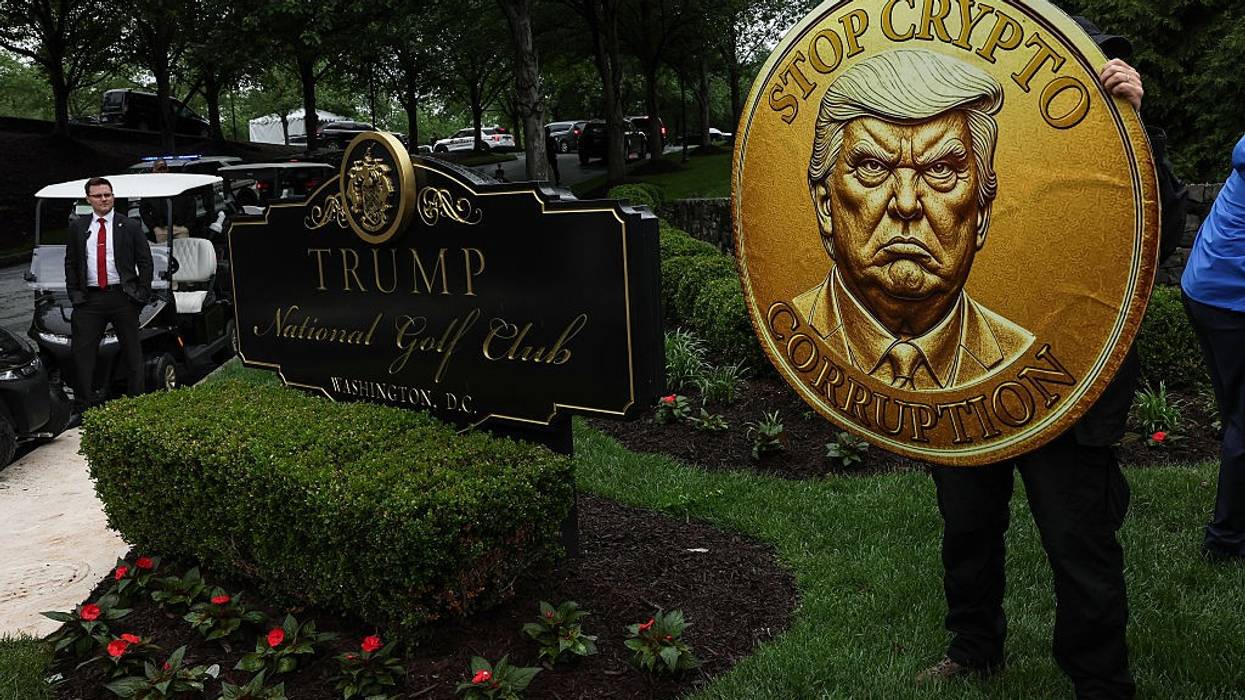
Trump's personal meme coin alone has left its investors $3.2 billion underwater, Public Citizen found.
A report released Thursday by government watchdog Public Citizen estimates that President Donald Trump's assorted cryptocurrency products have left investors on the hook for billions of dollars in losses.
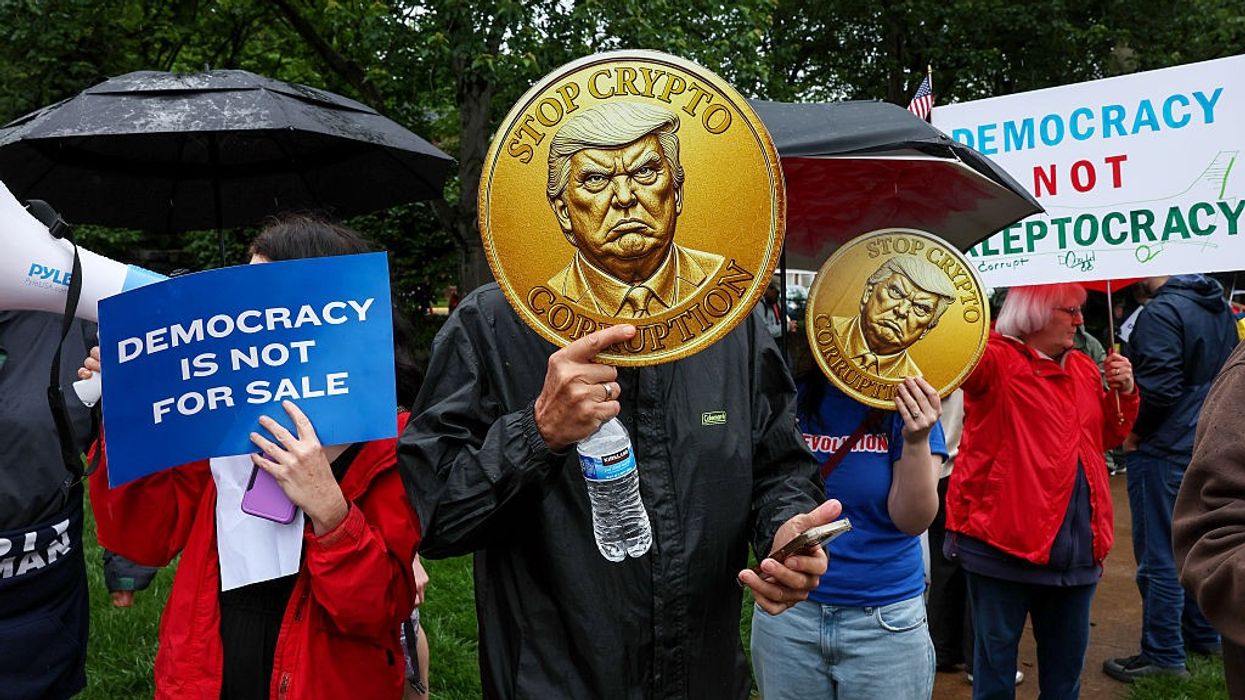
In total, Public Citizen found that Trump's crypto schemes have left investors at least $4.7 billion in the hole, with the majority of those losses coming from investments into the president's personal meme coin, which he launched just three days before the start of his second term.
The value of Trump's meme coin peaked at over $73 per token two days after its launch. Since then, its value has completely cratered and it is currently trading in the $2 range.
Early investors in the coin scooped up tokens that they quickly unloaded to other buyers, who were left holding the bag after the value of the digital assets collapsed.
In all, Public Citizen explained, 1% of wallets that invested in the coin reaped 80% of all gains, while 65% of wallets that put money into it are underwater to the tune of $3.2 billion.
Even as many investors in the Trump coin saw the value of their investments deteriorate, the president profited handsomely, hauling in $635 million in licensing fees from the coin last year alone.
Trump was also not personally hurt by the coin's drop in value given that he invested no money to acquire his own share of the digital tokens, which Public Citizen estimated is worth $271 million.
While the Trump meme coin accounted for the lion's share of losses suffered by investors, Public Citizen also highlighted the damage done by governance tokens issued by World Liberty Financial, the cryptocurrency venture co-founded by Donald Trump Jr. and Eric Trump in 2024.
As explained by Public Citizen, a governance token is "a digital commodity that conveys to holders certain 'rights with respect to the associated functional crypto system,' according to the SEC and Commodity Futures Trading Commission (CFTC)."
In practice, however, Public Citizen said that owning such tokens is akin to having "membership in a condo board—but without actually getting to vote on many issues or even own the condo."
The price of the tokens reached a peak of $0.33 per unit in September 2025, but they're now trading at under $0.06 per unit.
And much like the Trump meme coin, a small group of early investors made a killing on the tokens while most others racked up losses totaling at least $1 billion.
"The accredited and foreign investors who got in on the private sale paid $0.015 or $0.05, meaning they’re up anywhere from 15% to 283%," wrote Public Citizen. "Almost everyone who bought the tokens on the public market, though, is down—possibly as much as 83%, if they bought at the peak."
Public Citizen also highlighted the money lost by people who bought nonfungible tokens (NFTs) that Trump marketed as digital trading cards and that sold for $99 a piece.
While the cards were initially worth $12.3 million at the time of their release, their aggregate value has since fallen to $3 million, leaving investors $9.3 million underwater. But regardless of how well investors in the cards fared, Trump still made $7.2 million in licensing fees and royalties on secondary market sales, Public Citizen found.
Zach Everson, research director for Public Citizen's Trump Accountability Project and author of the report, cautioned Trump critics against ridiculing people who invested in the president's crypto products in a Thursday social media post.
"Trust me, I get the desire to sneer," wrote Everson. "People decided to put their money into virtual currencies backed by the word of a man who: admitted to misusing charitable funds; took six companies into bankruptcy; was convicted of 34 felony counts of falsifying business records. But these people got screwed over nevertheless."
"We have never seen financial conflicts or corruption of this magnitude."
The Office of the Comptroller of the Currency, a regulatory agency whose leader was chosen by President Donald Trump, granted preliminary approval on Friday to World Liberty Financial's application for a federal bank charter.
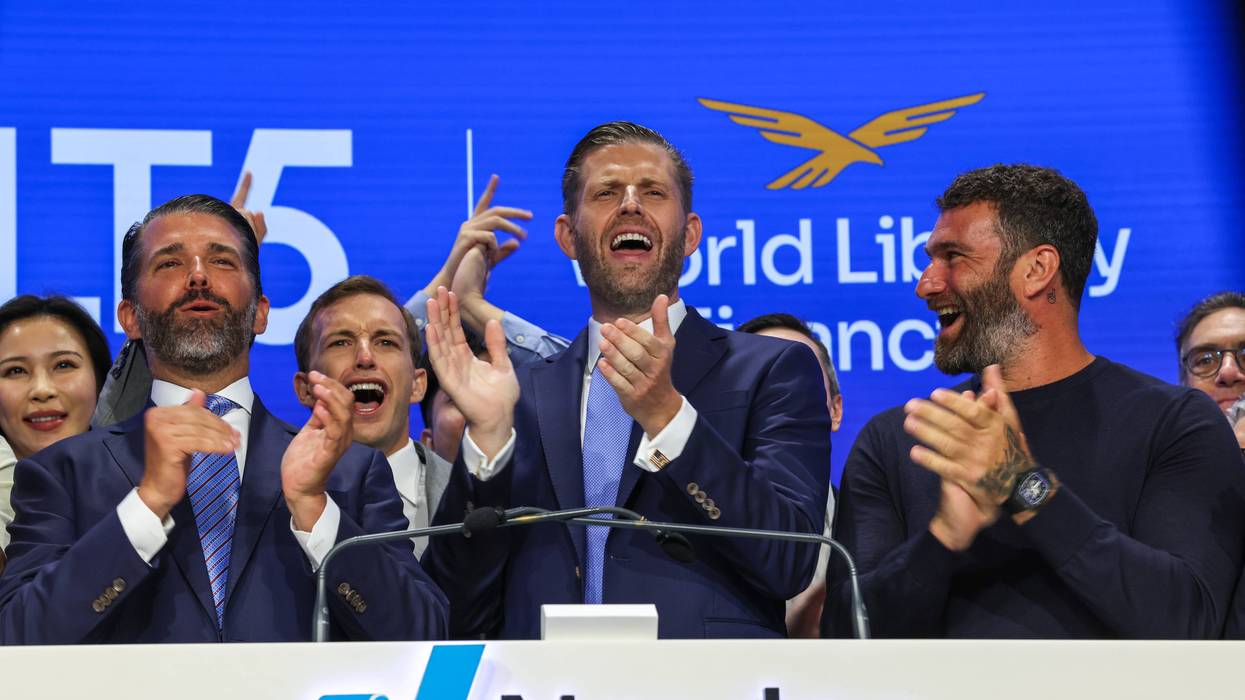
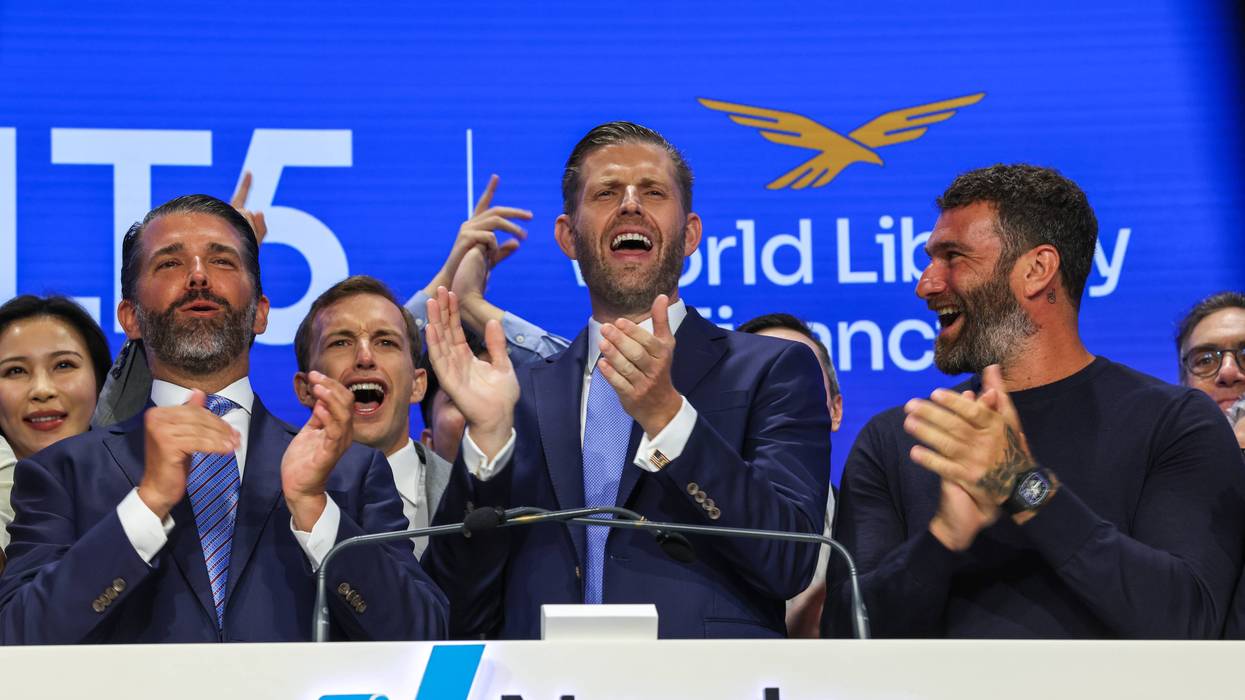
World Liberty Financial is a crypto venture launched in 2024 by the president's two eldest sons, Donald Trump Jr. and Eric Trump, and several partners. The firm's website states that WLF is 38% owned by "an entity affiliated with Donald J. Trump and certain of his family members."
WLF applied for a US bank charter in January, drawing alarm from lawmakers and watchdogs who said the review process would be rife with conflicts of interest. "We have never seen financial conflicts or corruption of this magnitude," Sen. Elizabeth Warren (D-Mass.), the top Democrat on the Senate Banking Committee, said at the time.
The OCC, headed by Jonathan Gould, announced the approval decision in a letter published Friday. WLF's application was assessed by career OCC staff, the agency said.
"The Office of the Comptroller of the Currency (OCC) has reviewed your application to establish a new national trust bank, which will engage in operations of a trust company and activities related thereto, including fiduciary activities, with the title of World Liberty Trust Company, National Association," the letter states. "The OCC hereby grants preliminary conditional approval of your charter application upon determining that your proposal meets certain regulatory and policy requirements."
In response to the news, Warren wrote on social media that "this is the most brazen act of self-dealing our financial system has ever seen."
Reuters reported that the charter, if finalized, would allow World Liberty's "to directly issue its USD1 stablecoin, as well as custody the US dollar assets backing it, both of which are now handled by a business partner, BitGo."
"Hoping to capitalize on the Trump administration’s crypto-friendly stance, the industry has been knocking on the OCC’s door for such charters," Reuters noted. "They allow crypto companies to hold assets on behalf of clients nationwide under a single federal charter, as well as to provide other settlement and asset servicing functions—making it easier to court major institutional clients. Other crypto firms, including Ripple and Circle, have received preliminary approval for such charters under Comptroller Jonathan Gould."
World Liberty Financial welcomed the OCC's preliminary approval as "a milestone in a multi-step chartering process." The firm said in a press release that the newly formed bank's board would be chaired by Zach Witkoff, the son of Trump's special envoy to the Middle East.
Last year, Trump reaped around $527 million in proceeds from token sales by WLF, according to financial disclosures released in late June.
"They are making sure they are rich beyond their wildest dreams long after Trump departs the White House (if he departs the White House)," journalist Mehdi Hasan wrote in response to the OCC decision. "It's so openly and nakedly and obviously corrupt, I'm not sure it can be overstated."
“Trump is without question the most corrupt president in American history,” said Senate Minority Leader Chuck Schumer.
A group of Democratic US senators on Monday issued a new report outlining the unprecedented self-enrichment being carried out by President Donald Trump during his second term in office.
The report, called "The Cost of Corruption: How Trump Turns Power into Profit at Americans' Expense," accuses the president and his family of turning "the power of the presidency into eye-popping profits," with Trump himself increasing his net worth by more than $2 billion since his return to the Oval Office last year.
The report highlights how Trump's two eldest sons have invested in numerous technology start-ups that have subsequently received lavish contracts from the US Department of Defense.
According to a report published by The Washington Post last week, the Trump sons' portfolio of tech firms has collectively generated "at least $3.2 billion in direct government business" and an "additional $3.1 billion in future contract options" since their initial investments.
The report also points to the massive windfall the Trump family has scored from World Liberty Financial, its cryptocurrency venture that is nearly half owned by a fund backed by the United Arab Emirates and that helped Trump pocket more than $1 billion in just a year.
While Trump and his family cash in, the report adds, the president and his administration have dismantled the Consumer Financial Protection Bureau, slashed spending on the Supplemental Nutritional Assistance Program, and given lavish tax cuts to the richest Americans.
Trump's acceptance of a $400 million luxury jet from the royal family of Qatar also gets a mention, and the report notes that the president is using at least $1 billion in taxpayer money to renovate the plane with security upgrades.
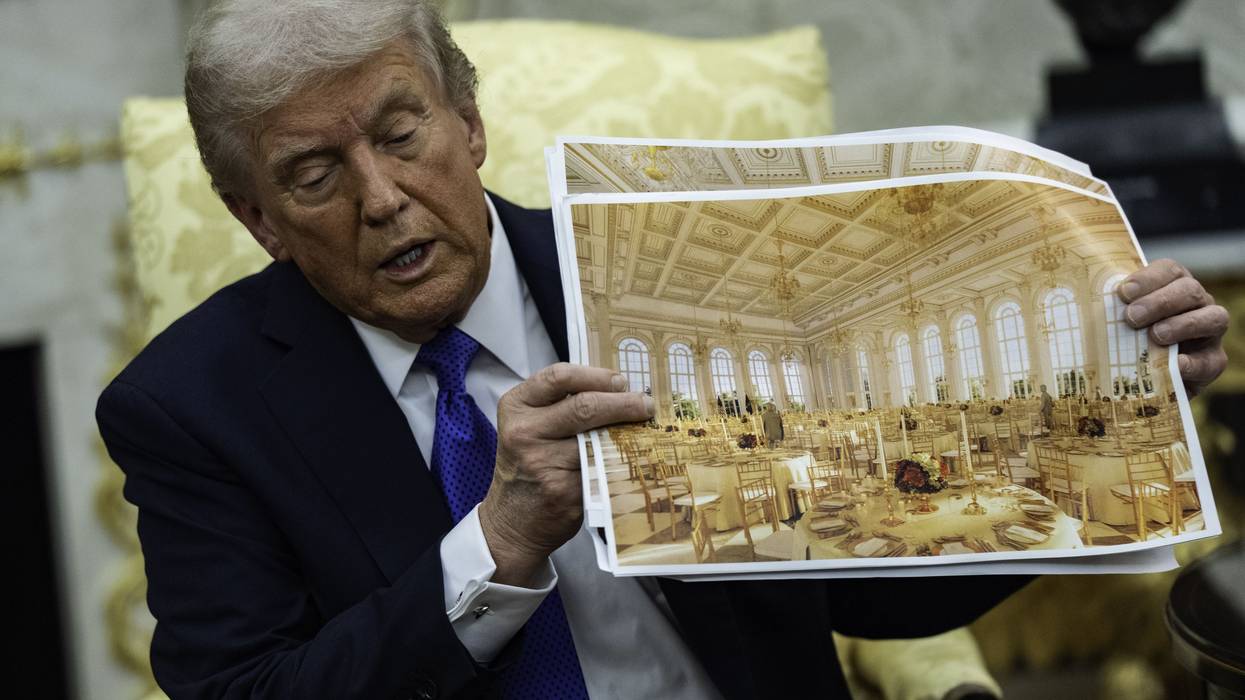
The report also cites a number of Trump "vanity projects," including his luxury White House ballroom and his French-style arch in Washington, DC, as wastes of money and resources.
“Trump is without question the most corrupt president in American history,” said Senate Minority Leader Chuck Schumer (D-NY) in announcing the report. “Trump has betrayed the American people by using our highest office not for the good of country, but to pad his own bank account, at the expense of working families."
The report is part of a broader initiative by Senate Democrats to hold the Trump White House accountable, which will include an anti-corruption working group composed of Schumer along with Sens. Sheldon Whitehouse (D-RI), Jeff Merkley (D-Ore.), Catherine Cortez Masto (D-Nev.), Alex Padilla (D-Calif,), and Andy Kim (D-NJ).
Merkley, in announcing his support for the initiative, said that "the Trump swamp of corruption is a mile deep and MEGA-wide."
"Trump and his family use his office and official connections to rake in billions for themselves at every turn," Merkley added. "Not only is this making life more expensive for hard-working Americans, it’s a threat to government 'by and for the people.'"
One expert who has studied presidential wealth called Trump's windfall "completely unprecedented" in American history.
Annual financial disclosures released Tuesday reveal that US President Donald Trump pocketed at least $2.2 billion—more than half of it from his family's crypto grift—during his first year back in the White House, a windfall that experts say is without precedent in American history.
The disclosure report shows that Trump pulled in $635 million in royalties from Celebration Coins, an entity linked to the president's meme coin. The president also disclosed around $527 million in proceeds from token sales by World Liberty Financial, the Trump family crypto venture spearheaded by Eric Trump and Donald Trump Jr.
“It is completely unprecedented,” Megan Gorman, a tax attorney who has studied the history of presidential wealth, told The New York Times of the president's windfall.
Robert Weissman, co-president of the consumer advocacy group Public Citizen, said in a statement that "Trump’s obscene income is driven by various cryptocurrency schemes, leveraging his political position to exploit a scam-driven industry that he once said was nothing more than a racket."
"In doing so, he’s ripping off investors—to the tune of billions—who want to get in on the game with him, or think that buying his crypto products is an innocent means to show their support," said Weissman. "Most troubling, Trump’s personal profit interest has now aligned him with the crypto industry, paving the way for dangerous legislation that will facilitate mass rip-offs and even threaten financial system stability."
Trump's massive profits from an industry he's tasked with regulating represent what the watchdog group Campaign Legal Center (CLC) described as an "unprecedented" conflict of interest, notwithstanding the White House's laughable claim that "neither the president nor his family has ever engaged—or will ever engage—in conflicts of interest."
"We have never seen a president have direct conflicts of interest with his financial holdings and the policies he supports, and it’s another example why we need widespread ethics reform now," Kedric Payne, CLC's senior director of ethics, told The Wall Street Journal.
The Journal noted that, in addition to crypto profits, "Trump reported $4.7 million in income last year from Trump-branded watches, as well as $1.9 million in royalties from his 'Save America' book."
"Multimillion-dollar licensing deals linked to real-estate developers stretched from Romania to India to across the Middle East. A $6,484-a-month pension from the Screen Actors Guild continued paying out," the newspaper observed.
The disclosures also include tens of million dollars in legal settlements stemming from Trump's lawsuits against major companies, including ABC, CBS, and Meta.
Sen. Elizabeth Warren (D-Mass.), the top Democrat on the Senate Banking Committee, said Tuesday that lawmakers must add language to the upper chamber's crypto legislation that prevents "the president, vice president, senior administration officials, members of Congress, and their families from profiting off the crypto industry."
"If it does not," the senator warned, "it will only turbocharge Donald Trump’s brazen crypto corruption."
"For the first time in history, a president is leaning on a bank regulator to give his private enterprise the implicit backing of the federal government," said one critic.
Critics expressed alarm on Tuesday amid a new report suggesting that President Donald Trump's cryptocurrency firm is about to get federal banking privileges.
As reported by NOTUS, the Office of the Comptroller of the Currency (OCC) in the coming weeks is expected to approve a national trust bank charter for World Liberty Financial, the crypto startup founded by members of the Trump family and the family of Trump Middle East envoy Steve Witkoff.
Were it to receive the charter, NOTUS explained, World Liberty Financial would receive "significant legal and financial benefits," including being able "to settle financial transactions akin to Venmo or PayPal on the World Liberty Financial platform, through which the Trump family could receive a cut."
David Wachsman, a spokesperson for World Liberty Financial, dismissed concerns about conflicts of interest, telling NOTUS that "none of [the company's] leadership or employees work for the US government," even though the president and his entire family stand to personally benefit from the charter's approval.
Corey Frayer, director of investor protection for Consumer Federation of America, told NOTUS that here was simply no precedent for a sitting president being granted such privileges for a company he founded by a comptroller whom he personally appointed.
"For the first time in history, a president is leaning on a bank regulator to give his private enterprise the implicit backing of the federal government," Frayer explained. “It’s outrageous."
Diana Henriques, a veteran financial journalist best known for her extensive coverage of the Ponzi scheme run by disgraced financier Bernie Madoff, also expressed horror at the prospect of the OCC carrying out the president's bidding.
"The guardrails continue to fall," Henriques wrote. "It is functionally impossible to regulate a bank owned by the president. Yet it can imperil the entire banking system if it runs off the rails. For heaven's sake, this has to be stopped."
Derek Martin, vice president at Focal Point Strategy Group, wrote that there is "no other way to interpret" the NOTUS report "than Trump using the government to advance his own firm's interests."
"World Liberty Financial's entire brand—and reason for existence, basically—is 'We are affiliated with Trump,'" Martin added. "This is just the latest way they're leveraging it."
Government watchdogs for months have been raising alarms about the president having his own cryptocurrency firm, which has received massive investments from foreign governments since its founding in 2024.
According to NOTUS reporter Jeff Stein, Trump has reported personally earning $57 million from World Liberty Financial so far, a number that could get significantly higher if the firm is granted its charter.
An analysis published by Forbes last month estimated that Trump has nearly tripled his wealth since returning to office, going from a net worth of $2.3 billion in 2024 to $6.5 billion in 2026.