SUBSCRIBE TO OUR FREE NEWSLETTER
Daily news & progressive opinion—funded by the people, not the corporations—delivered straight to your inbox.
5
#000000
#FFFFFF
To donate by check, phone, or other method, see our More Ways to Give page.
Daily news & progressive opinion—funded by the people, not the corporations—delivered straight to your inbox.
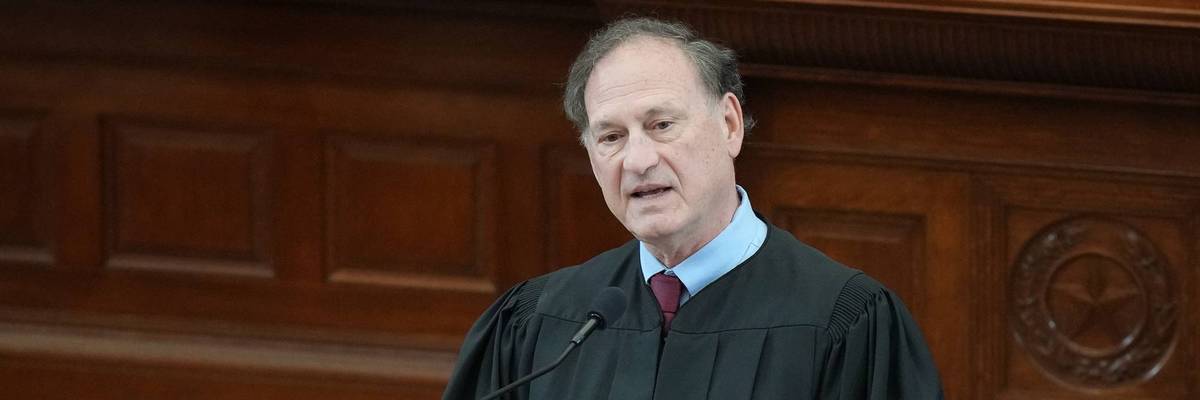
US Supreme Court Justice Samuel Alito speaks during the investiture ceremony for Texas Supreme Court justices Kyle Hawkins and James Sullivan at the state Capitol in Austin on Thursday, May 7, 2026.
Oil companies warned Alito that if the Supreme Court didn't exempt them from state climate lawsuits, it could adversely affect his personal investments.
Following years of pressure from critics who called out his severe conflicts of interest, the right-wing Supreme Court Justice Samuel Alito has recused himself from a major climate case on Monday, just days before the lawsuit was scheduled to be heard.
Next week, the court is scheduled to hear oral arguments in Suncor Energy v. County Commissioners of Boulder County, a case nearly a decade in the making that could determine whether oil giants can face billions of dollars worth of lawsuits for climate-related damages and misleading the public about the planet-heating effects of fossil fuels.
A coalition of environmental groups and anti-corruption watchdogs has pushed for Alito to recuse himself from the case because the justice personally holds stock in ConocoPhillips and Phillips 66—companies that face around two dozen climate lawsuits that could be directly affected by his ruling.
As Hannah Story Brown, the deputy research director on climate and governance issues at the Revolving Door Project, explained back in 2023, the Suncor case was promoted strategically by oil companies to allow Alito to get around his oil investments.
"While most of the lawsuits were brought against a dozen or so different fossil fuel companies, the Colorado municipalities are only suing ExxonMobil and Suncor Energy—the stocks of which Alito does not own," she wrote for The American Prospect. "This presents an opportunity to get around Alito’s likely recusal from considering the other four petitions to which ConocoPhillips and Phillips 66 are parties."
In May, a Supreme Court spokesperson said Alito had declined to recuse because he had no financial interest in either company that is a party to the Boulder case and had been advised by court counsel that recusal was not required.
However, in September, just weeks before oral arguments, the group Consumer Watchdog found that shareholders, including Alito, had received warnings from the two companies that climate lawsuits could adversely impact their businesses and, in turn, his investments. Oil industry groups, meanwhile, told the court in briefs that a ruling in the Suncor case could make those lawsuits go away.
“Justice Alito has a direct and documented financial stake in the outcome of Suncor v. Boulder," explained Alexandra Nagy, Organizing Director of Consumer Watchdog. "Under the Supreme Court’s own Code of Conduct, Alito should recuse.”
Federal law expressly states that judges—including Supreme Court justices—must disqualify themselves from cases where their "impartiality might reasonably be questioned." However, there has historically been a lack of enforcement for Supreme Court justices, because there is no higher court to rule on whether those ethics rules have been violated.
In 2023, following revelations about Justice Clarence Thomas' receipt of gifts and travel from billionaire donor Harlan Crow, the Supreme Court adopted its own nonbinding ethics code.
Also informing that ethics policy were revelations about Alito, who was found to have taken a luxury fishing vacation with GOP billionaire investor Paul Singer, whose hedge fund has invested billions of dollars in Suncor. Singer’s hedge fund had business before the court at least 10 times, during which Alito did not recuse himself.
The justices ultimately still determine whether to disqualify themselves from cases, and critics have derided the ethics code as a “PR stunt.”
On Monday, however, the clerk of the Supreme Court sent a single-sentence notice to the parties in Suncor v. Boulder that "Justice Alito has determined that he will not continue to participate in this case." It provided no further explanation for the justice's decision.
In a post on social media, the Revolving Door Project called it “bad news for Exxon, and a win for the power of public pressure calling out the blatant corruption" of the court led by Chief Justice John Roberts, adding that the group had been “calling for [Alito’s] recusal for YEARS.”
Kathy Mulvey, director of the Fossil Fuel Accountability Program at the Union of Concerned Scientists (UCS), also celebrated the decision but emphasized that it should never have taken this long to come to fruition.
“Justice Alito’s recusal in this case should’ve been a foregone conclusion," Mulvey said. "While we welcome today's announcement as a step toward a fairer, more impartial process for all parties involved, Justice Alito's decision is the bare minimum we should expect from a justice on our nation’s highest court."
UCS filed an amicus curiae brief before the court last month documenting what it described as ExxonMobil and Suncor’s “concealment and denial of the hazards they knew would result from the normal use of their fossil fuel products.”
“Internal corporate documents and other evidence now in the public domain show that the fossil fuel industry employed many of the same deceptive strategies used by the tobacco and lead industries, which have been the subject of extensive litigation," Mulvey explained. "In those cases, courts addressed claims that manufacturers possessed substantial internal knowledge regarding the dangers of their products while simultaneously conducting coordinated public campaigns to minimize, obscure, or cast doubt upon those dangers."
She added that "communities like Boulder deserve their day in court, through a process protected from financial conflicts of interest and from an industry hell-bent on securing immunity from liability.”
Alito's recusal could have major ramifications for the case's outcome. With only eight justices participating, a 4-4 split would leave intact a Colorado Supreme Court ruling allowing Boulder’s climate lawsuit to proceed, while producing no nationwide precedent that could shut down similar cases elsewhere.
The question of whether states and municipalities can sue fossil fuel companies takes on new urgency as the Trump administration halts federal action on the climate crisis and states and municipalities are left to fend for themselves.
An analysis commissioned in 2018 projected that the area around Boulder County would require between $96 million and $157 million to make only some of the necessary adaptations to climate change through 2050.
"What [Boulder] was saying was: 'We want damages for this because we’re spending a ton of money dealing with climate change," explained Sam Sankar, senior vice president at Earthjustice, in an interview with Slate. "'We’re having to reinforce roads to deal with extreme heat or extreme precipitation. We’ve got to rebuild infrastructure to deal with hundred-year floods that are happening every other year now. We’re dealing with heat stress and heat stroke and all the things that the people in our town are being affected by. We’ve never had wildfire seasons like this in the past. It’s very hard for us to deal with, and we’re spending a ton of money to upgrade systems, to fight the fires, or even to deal with the aftermath of these things."'
"What Suncor and Exxon are trying to do right now is stop the case from going forward," Sankar said. "What they’re saying is that this kind of case shouldn’t even get off the ground. There shouldn’t be a trial; there shouldn’t be any kind of judgment. They should be let off the hook before the trial begins."
Dear Common Dreams reader, It’s been nearly 30 years since I co-founded Common Dreams with my late wife, Lina Newhouser. We had the radical notion that journalism should serve the public good, not corporate profits. It was clear to us from the outset what it would take to build such a project. No paid advertisements. No corporate sponsors. No millionaire publisher telling us what to think or do. Many people said we wouldn't last a year, but we proved those doubters wrong. Together with a tremendous team of journalists and dedicated staff, we built an independent media outlet free from the constraints of profits and corporate control. Our mission has always been simple: To inform. To inspire. To ignite change for the common good. Building Common Dreams was not easy. Our survival was never guaranteed. When you take on the most powerful forces—Wall Street greed, fossil fuel industry destruction, Big Tech lobbyists, and uber-rich oligarchs who have spent billions upon billions rigging the economy and democracy in their favor—the only bulwark you have is supporters who believe in your work. But here’s the urgent message from me today. It's never been this bad out there. And it's never been this hard to keep us going. At the very moment Common Dreams is most needed, the threats we face are intensifying. We need your support now more than ever. We don't accept corporate advertising and never will. We don't have a paywall because we don't think people should be blocked from critical news based on their ability to pay. Everything we do is funded by the donations of readers like you. When everyone does the little they can afford, we are strong. But if that support retreats or dries up, so do we. Will you donate now to make sure Common Dreams not only survives but thrives? —Craig Brown, Co-founder |
Following years of pressure from critics who called out his severe conflicts of interest, the right-wing Supreme Court Justice Samuel Alito has recused himself from a major climate case on Monday, just days before the lawsuit was scheduled to be heard.
Next week, the court is scheduled to hear oral arguments in Suncor Energy v. County Commissioners of Boulder County, a case nearly a decade in the making that could determine whether oil giants can face billions of dollars worth of lawsuits for climate-related damages and misleading the public about the planet-heating effects of fossil fuels.
A coalition of environmental groups and anti-corruption watchdogs has pushed for Alito to recuse himself from the case because the justice personally holds stock in ConocoPhillips and Phillips 66—companies that face around two dozen climate lawsuits that could be directly affected by his ruling.
As Hannah Story Brown, the deputy research director on climate and governance issues at the Revolving Door Project, explained back in 2023, the Suncor case was promoted strategically by oil companies to allow Alito to get around his oil investments.
"While most of the lawsuits were brought against a dozen or so different fossil fuel companies, the Colorado municipalities are only suing ExxonMobil and Suncor Energy—the stocks of which Alito does not own," she wrote for The American Prospect. "This presents an opportunity to get around Alito’s likely recusal from considering the other four petitions to which ConocoPhillips and Phillips 66 are parties."
In May, a Supreme Court spokesperson said Alito had declined to recuse because he had no financial interest in either company that is a party to the Boulder case and had been advised by court counsel that recusal was not required.
However, in September, just weeks before oral arguments, the group Consumer Watchdog found that shareholders, including Alito, had received warnings from the two companies that climate lawsuits could adversely impact their businesses and, in turn, his investments. Oil industry groups, meanwhile, told the court in briefs that a ruling in the Suncor case could make those lawsuits go away.
“Justice Alito has a direct and documented financial stake in the outcome of Suncor v. Boulder," explained Alexandra Nagy, Organizing Director of Consumer Watchdog. "Under the Supreme Court’s own Code of Conduct, Alito should recuse.”
Federal law expressly states that judges—including Supreme Court justices—must disqualify themselves from cases where their "impartiality might reasonably be questioned." However, there has historically been a lack of enforcement for Supreme Court justices, because there is no higher court to rule on whether those ethics rules have been violated.
In 2023, following revelations about Justice Clarence Thomas' receipt of gifts and travel from billionaire donor Harlan Crow, the Supreme Court adopted its own nonbinding ethics code.
Also informing that ethics policy were revelations about Alito, who was found to have taken a luxury fishing vacation with GOP billionaire investor Paul Singer, whose hedge fund has invested billions of dollars in Suncor. Singer’s hedge fund had business before the court at least 10 times, during which Alito did not recuse himself.
The justices ultimately still determine whether to disqualify themselves from cases, and critics have derided the ethics code as a “PR stunt.”
On Monday, however, the clerk of the Supreme Court sent a single-sentence notice to the parties in Suncor v. Boulder that "Justice Alito has determined that he will not continue to participate in this case." It provided no further explanation for the justice's decision.
In a post on social media, the Revolving Door Project called it “bad news for Exxon, and a win for the power of public pressure calling out the blatant corruption" of the court led by Chief Justice John Roberts, adding that the group had been “calling for [Alito’s] recusal for YEARS.”
Kathy Mulvey, director of the Fossil Fuel Accountability Program at the Union of Concerned Scientists (UCS), also celebrated the decision but emphasized that it should never have taken this long to come to fruition.
“Justice Alito’s recusal in this case should’ve been a foregone conclusion," Mulvey said. "While we welcome today's announcement as a step toward a fairer, more impartial process for all parties involved, Justice Alito's decision is the bare minimum we should expect from a justice on our nation’s highest court."
UCS filed an amicus curiae brief before the court last month documenting what it described as ExxonMobil and Suncor’s “concealment and denial of the hazards they knew would result from the normal use of their fossil fuel products.”
“Internal corporate documents and other evidence now in the public domain show that the fossil fuel industry employed many of the same deceptive strategies used by the tobacco and lead industries, which have been the subject of extensive litigation," Mulvey explained. "In those cases, courts addressed claims that manufacturers possessed substantial internal knowledge regarding the dangers of their products while simultaneously conducting coordinated public campaigns to minimize, obscure, or cast doubt upon those dangers."
She added that "communities like Boulder deserve their day in court, through a process protected from financial conflicts of interest and from an industry hell-bent on securing immunity from liability.”
Alito's recusal could have major ramifications for the case's outcome. With only eight justices participating, a 4-4 split would leave intact a Colorado Supreme Court ruling allowing Boulder’s climate lawsuit to proceed, while producing no nationwide precedent that could shut down similar cases elsewhere.
The question of whether states and municipalities can sue fossil fuel companies takes on new urgency as the Trump administration halts federal action on the climate crisis and states and municipalities are left to fend for themselves.
An analysis commissioned in 2018 projected that the area around Boulder County would require between $96 million and $157 million to make only some of the necessary adaptations to climate change through 2050.
"What [Boulder] was saying was: 'We want damages for this because we’re spending a ton of money dealing with climate change," explained Sam Sankar, senior vice president at Earthjustice, in an interview with Slate. "'We’re having to reinforce roads to deal with extreme heat or extreme precipitation. We’ve got to rebuild infrastructure to deal with hundred-year floods that are happening every other year now. We’re dealing with heat stress and heat stroke and all the things that the people in our town are being affected by. We’ve never had wildfire seasons like this in the past. It’s very hard for us to deal with, and we’re spending a ton of money to upgrade systems, to fight the fires, or even to deal with the aftermath of these things."'
"What Suncor and Exxon are trying to do right now is stop the case from going forward," Sankar said. "What they’re saying is that this kind of case shouldn’t even get off the ground. There shouldn’t be a trial; there shouldn’t be any kind of judgment. They should be let off the hook before the trial begins."
Following years of pressure from critics who called out his severe conflicts of interest, the right-wing Supreme Court Justice Samuel Alito has recused himself from a major climate case on Monday, just days before the lawsuit was scheduled to be heard.
Next week, the court is scheduled to hear oral arguments in Suncor Energy v. County Commissioners of Boulder County, a case nearly a decade in the making that could determine whether oil giants can face billions of dollars worth of lawsuits for climate-related damages and misleading the public about the planet-heating effects of fossil fuels.
A coalition of environmental groups and anti-corruption watchdogs has pushed for Alito to recuse himself from the case because the justice personally holds stock in ConocoPhillips and Phillips 66—companies that face around two dozen climate lawsuits that could be directly affected by his ruling.
As Hannah Story Brown, the deputy research director on climate and governance issues at the Revolving Door Project, explained back in 2023, the Suncor case was promoted strategically by oil companies to allow Alito to get around his oil investments.
"While most of the lawsuits were brought against a dozen or so different fossil fuel companies, the Colorado municipalities are only suing ExxonMobil and Suncor Energy—the stocks of which Alito does not own," she wrote for The American Prospect. "This presents an opportunity to get around Alito’s likely recusal from considering the other four petitions to which ConocoPhillips and Phillips 66 are parties."
In May, a Supreme Court spokesperson said Alito had declined to recuse because he had no financial interest in either company that is a party to the Boulder case and had been advised by court counsel that recusal was not required.
However, in September, just weeks before oral arguments, the group Consumer Watchdog found that shareholders, including Alito, had received warnings from the two companies that climate lawsuits could adversely impact their businesses and, in turn, his investments. Oil industry groups, meanwhile, told the court in briefs that a ruling in the Suncor case could make those lawsuits go away.
“Justice Alito has a direct and documented financial stake in the outcome of Suncor v. Boulder," explained Alexandra Nagy, Organizing Director of Consumer Watchdog. "Under the Supreme Court’s own Code of Conduct, Alito should recuse.”
Federal law expressly states that judges—including Supreme Court justices—must disqualify themselves from cases where their "impartiality might reasonably be questioned." However, there has historically been a lack of enforcement for Supreme Court justices, because there is no higher court to rule on whether those ethics rules have been violated.
In 2023, following revelations about Justice Clarence Thomas' receipt of gifts and travel from billionaire donor Harlan Crow, the Supreme Court adopted its own nonbinding ethics code.
Also informing that ethics policy were revelations about Alito, who was found to have taken a luxury fishing vacation with GOP billionaire investor Paul Singer, whose hedge fund has invested billions of dollars in Suncor. Singer’s hedge fund had business before the court at least 10 times, during which Alito did not recuse himself.
The justices ultimately still determine whether to disqualify themselves from cases, and critics have derided the ethics code as a “PR stunt.”
On Monday, however, the clerk of the Supreme Court sent a single-sentence notice to the parties in Suncor v. Boulder that "Justice Alito has determined that he will not continue to participate in this case." It provided no further explanation for the justice's decision.
In a post on social media, the Revolving Door Project called it “bad news for Exxon, and a win for the power of public pressure calling out the blatant corruption" of the court led by Chief Justice John Roberts, adding that the group had been “calling for [Alito’s] recusal for YEARS.”
Kathy Mulvey, director of the Fossil Fuel Accountability Program at the Union of Concerned Scientists (UCS), also celebrated the decision but emphasized that it should never have taken this long to come to fruition.
“Justice Alito’s recusal in this case should’ve been a foregone conclusion," Mulvey said. "While we welcome today's announcement as a step toward a fairer, more impartial process for all parties involved, Justice Alito's decision is the bare minimum we should expect from a justice on our nation’s highest court."
UCS filed an amicus curiae brief before the court last month documenting what it described as ExxonMobil and Suncor’s “concealment and denial of the hazards they knew would result from the normal use of their fossil fuel products.”
“Internal corporate documents and other evidence now in the public domain show that the fossil fuel industry employed many of the same deceptive strategies used by the tobacco and lead industries, which have been the subject of extensive litigation," Mulvey explained. "In those cases, courts addressed claims that manufacturers possessed substantial internal knowledge regarding the dangers of their products while simultaneously conducting coordinated public campaigns to minimize, obscure, or cast doubt upon those dangers."
She added that "communities like Boulder deserve their day in court, through a process protected from financial conflicts of interest and from an industry hell-bent on securing immunity from liability.”
Alito's recusal could have major ramifications for the case's outcome. With only eight justices participating, a 4-4 split would leave intact a Colorado Supreme Court ruling allowing Boulder’s climate lawsuit to proceed, while producing no nationwide precedent that could shut down similar cases elsewhere.
The question of whether states and municipalities can sue fossil fuel companies takes on new urgency as the Trump administration halts federal action on the climate crisis and states and municipalities are left to fend for themselves.
An analysis commissioned in 2018 projected that the area around Boulder County would require between $96 million and $157 million to make only some of the necessary adaptations to climate change through 2050.
"What [Boulder] was saying was: 'We want damages for this because we’re spending a ton of money dealing with climate change," explained Sam Sankar, senior vice president at Earthjustice, in an interview with Slate. "'We’re having to reinforce roads to deal with extreme heat or extreme precipitation. We’ve got to rebuild infrastructure to deal with hundred-year floods that are happening every other year now. We’re dealing with heat stress and heat stroke and all the things that the people in our town are being affected by. We’ve never had wildfire seasons like this in the past. It’s very hard for us to deal with, and we’re spending a ton of money to upgrade systems, to fight the fires, or even to deal with the aftermath of these things."'
"What Suncor and Exxon are trying to do right now is stop the case from going forward," Sankar said. "What they’re saying is that this kind of case shouldn’t even get off the ground. There shouldn’t be a trial; there shouldn’t be any kind of judgment. They should be let off the hook before the trial begins."