SUBSCRIBE TO OUR FREE NEWSLETTER
Daily news & progressive opinion—funded by the people, not the corporations—delivered straight to your inbox.
5
#000000
#FFFFFF
To donate by check, phone, or other method, see our More Ways to Give page.
Daily news & progressive opinion—funded by the people, not the corporations—delivered straight to your inbox.
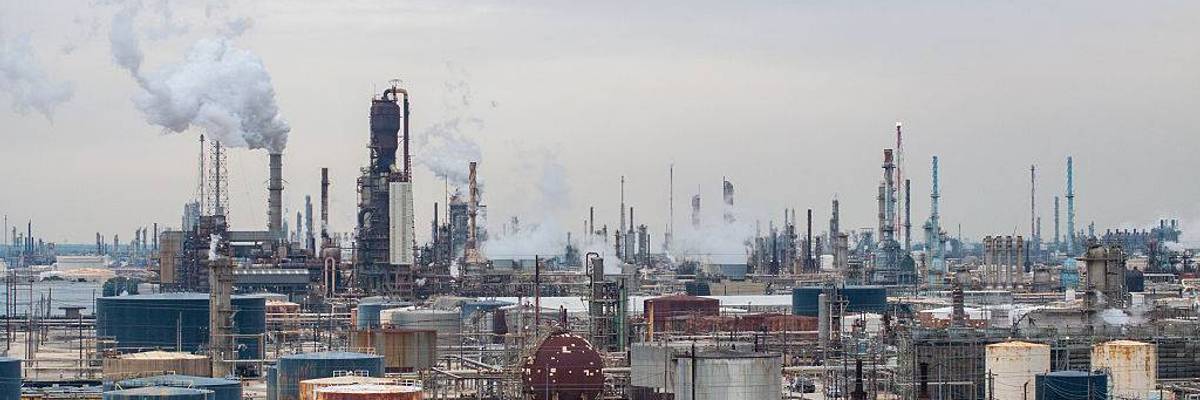
In an aerial view, the ExxonMobil Baytown Refinery is seen on January 13, 2026 in Baytown, Texas.
"Big Oil’s climate lies are the most consequential and harmful corporate deception campaign in history."
The US Supreme Court on Monday agreed to hear a case that could effectively crush efforts to hold the fossil fuel industry accountable for the climate crisis.
As reported by the New York Times, the court has agreed to hear arguments related to a petition filed by ExxonMobil and Canadian energy firm Suncor related to a 2018 lawsuit by the city of Boulder, Colorado that seeks financial damages from the companies for their role in causing global climate change.
The Times report noted that dozens of similar lawsuits have been filed by states and municipalities over the last decade, and they generally seek money from energy firms to help mitigate or repair damage done by extreme weather exacerbated by the climate crisis.
According to the Associated Press, attorneys for the energy companies are petitioning to have the case moved from state courts to federal courts that have in the past dismissed similar complaints.
“The use of state law to address global climate change represents a serious threat to one of our nation’s most critical sectors,” the attorneys claimed.
The Supreme Court's decision to hear the case comes months after the Colorado Supreme Court ruled that Boulder's lawsuit could initiate the discovery process and move toward a trial.
In an interview with the Colorado Sun, Boulder County Commissioner Ashley Stolzmann said that the city wasn't backing down from its efforts make the fossil fuel industry pay for the damage it's done.
"The oil companies have tried every avenue to delay our climate accountability case or move it to an out-of-state court system,” said Stolzmann. “As everyone continues to face rising costs that put budgets under pressure, we must hold oil companies accountable for the significant harm they’ve caused our communities."
Richard Wiles, president of the Center for Climate Integrity, said that the merits of the Boulder lawsuit are clear, regardless of the Supreme Court's intervention.
"Big Oil’s climate lies are the most consequential and harmful corporate deception campaign in history," Wiles said, "and the communities paying the price for that deception deserve to put these companies on trial. Exxon’s desperation to escape accountability does not change the evidence of their wrongdoing or the law that lower courts agree is on Boulder’s side."
Alyssa Johl, vice president of legal and general counsel at the Center for Climate Integrity, said the Supreme Court should simply affirm lower court rulings stating that "communities like Boulder have the right to seek accountability in their state courts when corporations have knowingly caused local harms."
Dear Common Dreams reader, It’s been nearly 30 years since I co-founded Common Dreams with my late wife, Lina Newhouser. We had the radical notion that journalism should serve the public good, not corporate profits. It was clear to us from the outset what it would take to build such a project. No paid advertisements. No corporate sponsors. No millionaire publisher telling us what to think or do. Many people said we wouldn't last a year, but we proved those doubters wrong. Together with a tremendous team of journalists and dedicated staff, we built an independent media outlet free from the constraints of profits and corporate control. Our mission has always been simple: To inform. To inspire. To ignite change for the common good. Building Common Dreams was not easy. Our survival was never guaranteed. When you take on the most powerful forces—Wall Street greed, fossil fuel industry destruction, Big Tech lobbyists, and uber-rich oligarchs who have spent billions upon billions rigging the economy and democracy in their favor—the only bulwark you have is supporters who believe in your work. But here’s the urgent message from me today. It's never been this bad out there. And it's never been this hard to keep us going. At the very moment Common Dreams is most needed, the threats we face are intensifying. We need your support now more than ever. We don't accept corporate advertising and never will. We don't have a paywall because we don't think people should be blocked from critical news based on their ability to pay. Everything we do is funded by the donations of readers like you. When everyone does the little they can afford, we are strong. But if that support retreats or dries up, so do we. Will you donate now to make sure Common Dreams not only survives but thrives? —Craig Brown, Co-founder |
The US Supreme Court on Monday agreed to hear a case that could effectively crush efforts to hold the fossil fuel industry accountable for the climate crisis.
As reported by the New York Times, the court has agreed to hear arguments related to a petition filed by ExxonMobil and Canadian energy firm Suncor related to a 2018 lawsuit by the city of Boulder, Colorado that seeks financial damages from the companies for their role in causing global climate change.
The Times report noted that dozens of similar lawsuits have been filed by states and municipalities over the last decade, and they generally seek money from energy firms to help mitigate or repair damage done by extreme weather exacerbated by the climate crisis.
According to the Associated Press, attorneys for the energy companies are petitioning to have the case moved from state courts to federal courts that have in the past dismissed similar complaints.
“The use of state law to address global climate change represents a serious threat to one of our nation’s most critical sectors,” the attorneys claimed.
The Supreme Court's decision to hear the case comes months after the Colorado Supreme Court ruled that Boulder's lawsuit could initiate the discovery process and move toward a trial.
In an interview with the Colorado Sun, Boulder County Commissioner Ashley Stolzmann said that the city wasn't backing down from its efforts make the fossil fuel industry pay for the damage it's done.
"The oil companies have tried every avenue to delay our climate accountability case or move it to an out-of-state court system,” said Stolzmann. “As everyone continues to face rising costs that put budgets under pressure, we must hold oil companies accountable for the significant harm they’ve caused our communities."
Richard Wiles, president of the Center for Climate Integrity, said that the merits of the Boulder lawsuit are clear, regardless of the Supreme Court's intervention.
"Big Oil’s climate lies are the most consequential and harmful corporate deception campaign in history," Wiles said, "and the communities paying the price for that deception deserve to put these companies on trial. Exxon’s desperation to escape accountability does not change the evidence of their wrongdoing or the law that lower courts agree is on Boulder’s side."
Alyssa Johl, vice president of legal and general counsel at the Center for Climate Integrity, said the Supreme Court should simply affirm lower court rulings stating that "communities like Boulder have the right to seek accountability in their state courts when corporations have knowingly caused local harms."
The US Supreme Court on Monday agreed to hear a case that could effectively crush efforts to hold the fossil fuel industry accountable for the climate crisis.
As reported by the New York Times, the court has agreed to hear arguments related to a petition filed by ExxonMobil and Canadian energy firm Suncor related to a 2018 lawsuit by the city of Boulder, Colorado that seeks financial damages from the companies for their role in causing global climate change.
The Times report noted that dozens of similar lawsuits have been filed by states and municipalities over the last decade, and they generally seek money from energy firms to help mitigate or repair damage done by extreme weather exacerbated by the climate crisis.
According to the Associated Press, attorneys for the energy companies are petitioning to have the case moved from state courts to federal courts that have in the past dismissed similar complaints.
“The use of state law to address global climate change represents a serious threat to one of our nation’s most critical sectors,” the attorneys claimed.
The Supreme Court's decision to hear the case comes months after the Colorado Supreme Court ruled that Boulder's lawsuit could initiate the discovery process and move toward a trial.
In an interview with the Colorado Sun, Boulder County Commissioner Ashley Stolzmann said that the city wasn't backing down from its efforts make the fossil fuel industry pay for the damage it's done.
"The oil companies have tried every avenue to delay our climate accountability case or move it to an out-of-state court system,” said Stolzmann. “As everyone continues to face rising costs that put budgets under pressure, we must hold oil companies accountable for the significant harm they’ve caused our communities."
Richard Wiles, president of the Center for Climate Integrity, said that the merits of the Boulder lawsuit are clear, regardless of the Supreme Court's intervention.
"Big Oil’s climate lies are the most consequential and harmful corporate deception campaign in history," Wiles said, "and the communities paying the price for that deception deserve to put these companies on trial. Exxon’s desperation to escape accountability does not change the evidence of their wrongdoing or the law that lower courts agree is on Boulder’s side."
Alyssa Johl, vice president of legal and general counsel at the Center for Climate Integrity, said the Supreme Court should simply affirm lower court rulings stating that "communities like Boulder have the right to seek accountability in their state courts when corporations have knowingly caused local harms."