

SUBSCRIBE TO OUR FREE NEWSLETTER
Daily news & progressive opinion—funded by the people, not the corporations—delivered straight to your inbox.
5
#000000
#FFFFFF
To donate by check, phone, or other method, see our More Ways to Give page.
Daily news & progressive opinion—funded by the people, not the corporations—delivered straight to your inbox.
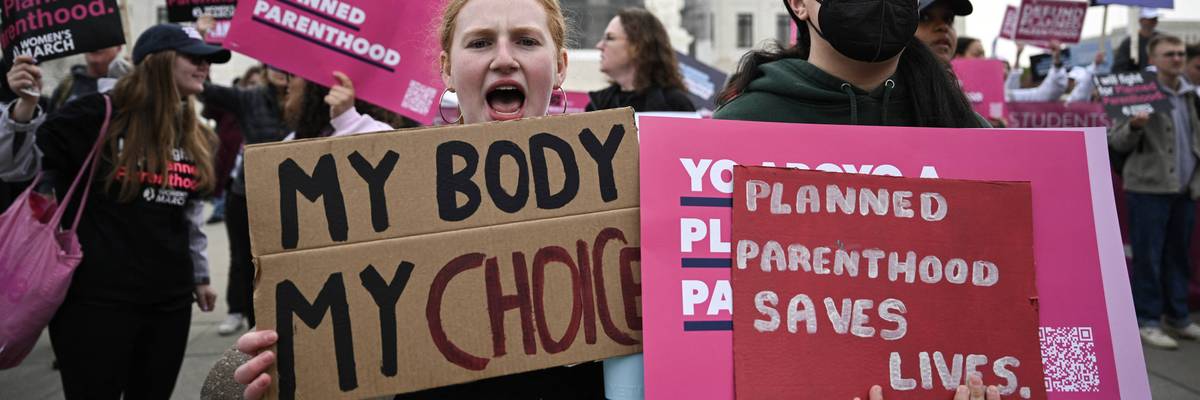
Pro-choice advocates rally outside the US Supreme Court on April 2, 2025, in Washington, DC, as the justices hear oral arguments in Medina v. Planned Parenthood South Atlantic.
States that deny people's bodily autonomy limit "their ability to pursue the education and career options that are right for them, and to build financial stability," said the Institute for Women's Policy Research president.
Reproductive rights advocates and experts have long highlighted the dangers of abortion bans to people's health, but amid a wave of new state-level restrictions in the wake of Roe v. Wade's reversal, some have also recently emphasized the economic impact, as detailed in an analysis published Tuesday by the Institute for Women's Policy Research.
"IWPR's latest estimates show that states with the most restrictive abortion policies could cost the national economy nearly $68 billion annually in lost earnings, up from $64 billion in last year's estimate," according to the analysis. "Historically, legal abortion access has increased women's labor force participation and earnings. IWPR's analyses suggest that abortion restrictions continue to erode those gains nationwide, reducing women's labor force participation and earnings potential while weakening state and national economies in the process."
"Those losses—amounting to billions of dollars—could otherwise support what families actually need: affordable healthcare, caregiving, higher wages, business growth, and new jobs that strengthen local communities and state economies," the report notes. "This $68 billion estimate reflects only the impact of the most severe restrictions, including total bans and six-week gestational bans, that were in effect in 16 states in 2025."
The publication points out that "many other states may not have banned abortion outright, but still impose barriers that make abortion care harder to access, like waiting periods, mandated counseling, or targeted regulations on abortion providers that delay or deny care altogether. When accounting for all state-level restrictions on abortion access, combined with the federal funding prohibitions and the absence of federal protections, the annual average economic cost now exceeds $140 billion nationwide."
The overall figure is nearly $7 billion more than IWPR's estimate from last year. Putting that figure into context, the report explains that $7 billion "could fund Supplemental Nutrition Assistance Program (SNAP) benefits for about 1 million American families with children for an entire year. This is a striking figure considering the so-called 'One Big Beautiful Bill's' cuts to the program, which are projected to reduce or eliminate benefits for many low-income households."
Removing barriers to reproductive care on a national scale "could mean nearly 325,000 more women participating in the labor force each year, with the largest increases concentrated in states with some of the most restrictive abortion policies," IWPR estimated. For example, in Alabama, Kentucky, and Louisiana, their labor force participation could be over 1.3% higher, while in Mississippi, it could be up 1.5%.
If more women joined the workforce thanks to policies allowing reproductive freedom, IWPR projected that "national gross domestic product (GDP) could rise by 0.5%, and the economic gains would be largest in states such as Alabama, Arkansas, South Carolina, and West Virginia, which rank poorly on both abortion protections and per capita GDP. These states could potentially see their GDP grow by nearly 1% annually."
Like previous analyses, the publication also acknowledges that "Black and Latina women are more likely to experience the consequences of restrictive abortion policies and confront additional economic and structural barriers to accessing care that their White counterparts do not—even as abortion restrictions harm all women and the economy more broadly."
IWPR president and CEO Jamila K. Taylor stressed in a Tuesday statement that "this is fundamentally about human rights and economic justice."
"We know that legal access to abortion care increases women's autonomy to be able to participate in the labor force, which supports the stability of our entire economy," Taylor said. "When states deny people their bodily autonomy, they're also limiting their ability to pursue the education and career options that are right for them and to build financial stability for their family and community. Abortion restrictions don't just harm those who may become pregnant—they harm everyone."
President Donald Trump delivered mixed messages during the last campaign cycle: bragging about being the one to appoint the justices who helped reverse Roe with the Dobbs v. Jackson Women's Health Organization decision, but also suggesting that he wasn't in favor of a nationwide ban on abortion and that the issue doesn't really matter to Americans.
Since returning to the White House, the Republican and his allies in Congress have taken steps to reduce access to reproductive healthcare, and although the right-wing Supreme Court last month declined to restrict access to mifepristone, at least for now, Trump's Food and Drug Administration (FDA) is currently reviewing the medication, which is commonly used in abortion and miscarriage care.
Reproductive rights advocates have sounded the alarm over the FDA review. In response to reporting on it earlier this month, Planned Parenthood CEO Alexis McGill Johnson called it "a politically motivated farce."
"Mifepristone is safe and effective. We know it, the FDA knows it, and the more than 7.5 million people who've used mifepristone for abortion and miscarriage care over the past 25 years know it too," Johnson said. "But the Trump administration is bulldozing the overwhelming body of medical research and evidence to try to make it harder for everyone, everywhere to get an abortion. It's time for every American to take this threat seriously."
Dear Common Dreams reader, It’s been nearly 30 years since I co-founded Common Dreams with my late wife, Lina Newhouser. We had the radical notion that journalism should serve the public good, not corporate profits. It was clear to us from the outset what it would take to build such a project. No paid advertisements. No corporate sponsors. No millionaire publisher telling us what to think or do. Many people said we wouldn't last a year, but we proved those doubters wrong. Together with a tremendous team of journalists and dedicated staff, we built an independent media outlet free from the constraints of profits and corporate control. Our mission has always been simple: To inform. To inspire. To ignite change for the common good. Building Common Dreams was not easy. Our survival was never guaranteed. When you take on the most powerful forces—Wall Street greed, fossil fuel industry destruction, Big Tech lobbyists, and uber-rich oligarchs who have spent billions upon billions rigging the economy and democracy in their favor—the only bulwark you have is supporters who believe in your work. But here’s the urgent message from me today. It's never been this bad out there. And it's never been this hard to keep us going. At the very moment Common Dreams is most needed, the threats we face are intensifying. We need your support now more than ever. We don't accept corporate advertising and never will. We don't have a paywall because we don't think people should be blocked from critical news based on their ability to pay. Everything we do is funded by the donations of readers like you. When everyone does the little they can afford, we are strong. But if that support retreats or dries up, so do we. Will you donate now to make sure Common Dreams not only survives but thrives? —Craig Brown, Co-founder |
Reproductive rights advocates and experts have long highlighted the dangers of abortion bans to people's health, but amid a wave of new state-level restrictions in the wake of Roe v. Wade's reversal, some have also recently emphasized the economic impact, as detailed in an analysis published Tuesday by the Institute for Women's Policy Research.
"IWPR's latest estimates show that states with the most restrictive abortion policies could cost the national economy nearly $68 billion annually in lost earnings, up from $64 billion in last year's estimate," according to the analysis. "Historically, legal abortion access has increased women's labor force participation and earnings. IWPR's analyses suggest that abortion restrictions continue to erode those gains nationwide, reducing women's labor force participation and earnings potential while weakening state and national economies in the process."
"Those losses—amounting to billions of dollars—could otherwise support what families actually need: affordable healthcare, caregiving, higher wages, business growth, and new jobs that strengthen local communities and state economies," the report notes. "This $68 billion estimate reflects only the impact of the most severe restrictions, including total bans and six-week gestational bans, that were in effect in 16 states in 2025."
The publication points out that "many other states may not have banned abortion outright, but still impose barriers that make abortion care harder to access, like waiting periods, mandated counseling, or targeted regulations on abortion providers that delay or deny care altogether. When accounting for all state-level restrictions on abortion access, combined with the federal funding prohibitions and the absence of federal protections, the annual average economic cost now exceeds $140 billion nationwide."
The overall figure is nearly $7 billion more than IWPR's estimate from last year. Putting that figure into context, the report explains that $7 billion "could fund Supplemental Nutrition Assistance Program (SNAP) benefits for about 1 million American families with children for an entire year. This is a striking figure considering the so-called 'One Big Beautiful Bill's' cuts to the program, which are projected to reduce or eliminate benefits for many low-income households."
Removing barriers to reproductive care on a national scale "could mean nearly 325,000 more women participating in the labor force each year, with the largest increases concentrated in states with some of the most restrictive abortion policies," IWPR estimated. For example, in Alabama, Kentucky, and Louisiana, their labor force participation could be over 1.3% higher, while in Mississippi, it could be up 1.5%.
If more women joined the workforce thanks to policies allowing reproductive freedom, IWPR projected that "national gross domestic product (GDP) could rise by 0.5%, and the economic gains would be largest in states such as Alabama, Arkansas, South Carolina, and West Virginia, which rank poorly on both abortion protections and per capita GDP. These states could potentially see their GDP grow by nearly 1% annually."
Like previous analyses, the publication also acknowledges that "Black and Latina women are more likely to experience the consequences of restrictive abortion policies and confront additional economic and structural barriers to accessing care that their White counterparts do not—even as abortion restrictions harm all women and the economy more broadly."
IWPR president and CEO Jamila K. Taylor stressed in a Tuesday statement that "this is fundamentally about human rights and economic justice."
"We know that legal access to abortion care increases women's autonomy to be able to participate in the labor force, which supports the stability of our entire economy," Taylor said. "When states deny people their bodily autonomy, they're also limiting their ability to pursue the education and career options that are right for them and to build financial stability for their family and community. Abortion restrictions don't just harm those who may become pregnant—they harm everyone."
President Donald Trump delivered mixed messages during the last campaign cycle: bragging about being the one to appoint the justices who helped reverse Roe with the Dobbs v. Jackson Women's Health Organization decision, but also suggesting that he wasn't in favor of a nationwide ban on abortion and that the issue doesn't really matter to Americans.
Since returning to the White House, the Republican and his allies in Congress have taken steps to reduce access to reproductive healthcare, and although the right-wing Supreme Court last month declined to restrict access to mifepristone, at least for now, Trump's Food and Drug Administration (FDA) is currently reviewing the medication, which is commonly used in abortion and miscarriage care.
Reproductive rights advocates have sounded the alarm over the FDA review. In response to reporting on it earlier this month, Planned Parenthood CEO Alexis McGill Johnson called it "a politically motivated farce."
"Mifepristone is safe and effective. We know it, the FDA knows it, and the more than 7.5 million people who've used mifepristone for abortion and miscarriage care over the past 25 years know it too," Johnson said. "But the Trump administration is bulldozing the overwhelming body of medical research and evidence to try to make it harder for everyone, everywhere to get an abortion. It's time for every American to take this threat seriously."
Reproductive rights advocates and experts have long highlighted the dangers of abortion bans to people's health, but amid a wave of new state-level restrictions in the wake of Roe v. Wade's reversal, some have also recently emphasized the economic impact, as detailed in an analysis published Tuesday by the Institute for Women's Policy Research.
"IWPR's latest estimates show that states with the most restrictive abortion policies could cost the national economy nearly $68 billion annually in lost earnings, up from $64 billion in last year's estimate," according to the analysis. "Historically, legal abortion access has increased women's labor force participation and earnings. IWPR's analyses suggest that abortion restrictions continue to erode those gains nationwide, reducing women's labor force participation and earnings potential while weakening state and national economies in the process."
"Those losses—amounting to billions of dollars—could otherwise support what families actually need: affordable healthcare, caregiving, higher wages, business growth, and new jobs that strengthen local communities and state economies," the report notes. "This $68 billion estimate reflects only the impact of the most severe restrictions, including total bans and six-week gestational bans, that were in effect in 16 states in 2025."
The publication points out that "many other states may not have banned abortion outright, but still impose barriers that make abortion care harder to access, like waiting periods, mandated counseling, or targeted regulations on abortion providers that delay or deny care altogether. When accounting for all state-level restrictions on abortion access, combined with the federal funding prohibitions and the absence of federal protections, the annual average economic cost now exceeds $140 billion nationwide."
The overall figure is nearly $7 billion more than IWPR's estimate from last year. Putting that figure into context, the report explains that $7 billion "could fund Supplemental Nutrition Assistance Program (SNAP) benefits for about 1 million American families with children for an entire year. This is a striking figure considering the so-called 'One Big Beautiful Bill's' cuts to the program, which are projected to reduce or eliminate benefits for many low-income households."
Removing barriers to reproductive care on a national scale "could mean nearly 325,000 more women participating in the labor force each year, with the largest increases concentrated in states with some of the most restrictive abortion policies," IWPR estimated. For example, in Alabama, Kentucky, and Louisiana, their labor force participation could be over 1.3% higher, while in Mississippi, it could be up 1.5%.
If more women joined the workforce thanks to policies allowing reproductive freedom, IWPR projected that "national gross domestic product (GDP) could rise by 0.5%, and the economic gains would be largest in states such as Alabama, Arkansas, South Carolina, and West Virginia, which rank poorly on both abortion protections and per capita GDP. These states could potentially see their GDP grow by nearly 1% annually."
Like previous analyses, the publication also acknowledges that "Black and Latina women are more likely to experience the consequences of restrictive abortion policies and confront additional economic and structural barriers to accessing care that their White counterparts do not—even as abortion restrictions harm all women and the economy more broadly."
IWPR president and CEO Jamila K. Taylor stressed in a Tuesday statement that "this is fundamentally about human rights and economic justice."
"We know that legal access to abortion care increases women's autonomy to be able to participate in the labor force, which supports the stability of our entire economy," Taylor said. "When states deny people their bodily autonomy, they're also limiting their ability to pursue the education and career options that are right for them and to build financial stability for their family and community. Abortion restrictions don't just harm those who may become pregnant—they harm everyone."
President Donald Trump delivered mixed messages during the last campaign cycle: bragging about being the one to appoint the justices who helped reverse Roe with the Dobbs v. Jackson Women's Health Organization decision, but also suggesting that he wasn't in favor of a nationwide ban on abortion and that the issue doesn't really matter to Americans.
Since returning to the White House, the Republican and his allies in Congress have taken steps to reduce access to reproductive healthcare, and although the right-wing Supreme Court last month declined to restrict access to mifepristone, at least for now, Trump's Food and Drug Administration (FDA) is currently reviewing the medication, which is commonly used in abortion and miscarriage care.
Reproductive rights advocates have sounded the alarm over the FDA review. In response to reporting on it earlier this month, Planned Parenthood CEO Alexis McGill Johnson called it "a politically motivated farce."
"Mifepristone is safe and effective. We know it, the FDA knows it, and the more than 7.5 million people who've used mifepristone for abortion and miscarriage care over the past 25 years know it too," Johnson said. "But the Trump administration is bulldozing the overwhelming body of medical research and evidence to try to make it harder for everyone, everywhere to get an abortion. It's time for every American to take this threat seriously."

