

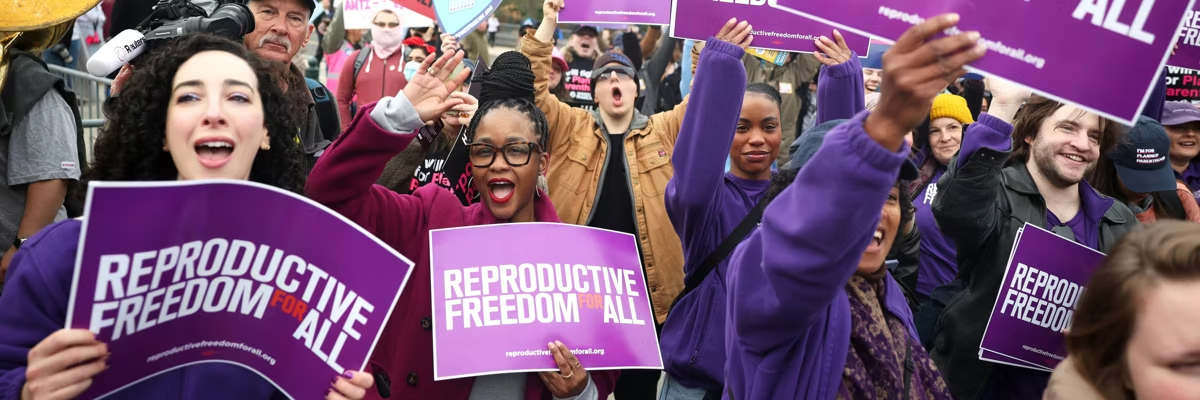
Abortion rights protestors demonstrate outside the US Supreme Court as oral arguments are delivered in Medina v. Planned Parenthood South Atlantic on April 2, 2025 in Washington DC.
New Research Details 'Human and Economic Toll' of US Abortion Bans
"Abortion bans don't stay in exam rooms," said the Center for Reproductive Rights president. "They reshape communities, workplaces, and state economies."
With attention directed at President Donald Trump's war on immigrants across the United States and various international conflicts, including the assault on Iran, there hasn't been much prominent news coverage in recent weeks about a key issue of the 2024 campaign—GOP abortion bans—but people nationwide continue to endure the impacts of such policies, as revealed in a Monday report from the Center for Reproductive Rights.
The Price of Safety: Stories of Abortions Denied, Careers Disrupted, and States Left Behind features various profiles demonstrating "the human and economic toll" of abortion bans, which right-wing policymakers have enacted or intensified since the US Supreme Court reversed Roe v. Wade with its Dobbs v. Jackson Women's Health Organization decision in 2022.
The anthology uses stories from patients, doctors, business leaders, and others to "show the real-world consequences of laws that criminalize standard medical care," said Nancy Northup, the center's president, in a statement. "Abortion bans don't stay in exam rooms. They reshape communities, workplaces, and state economies. As long as politicians keep restricting care, families will keep moving, clinicians will keep leaving, and states will keep watching their competitive edge slip away."
"Our daughter's spine was severely abnormal, her brain hadn't formed correctly, and she only had one kidney... I did everything by the book medically, but the experience still made me feel like a criminal for seeking evidence-based care for a lethal fetal diagnosis."
Dani Mathisen, "a Fort Worth native from a family of physicians," discovered during a routine anatomy scan with her OB-GYN, who is also her aunt, that she needed an abortion, 18 weeks into a planned pregnancy. As she explained, "Our daughter's spine was severely abnormal, her brain hadn't formed correctly, and she only had one kidney."
Texas had banned abortions after six weeks and allowed private citizens to sue anyone who helped a pregnant person access care. According to Mathisen: "My mom, also a doctor, stepped in anyway. She found a clinic in New Mexico, booked the flights and hotel, called the staff, and handed us an envelope of cash. We paid for the abortion with cash out of fear of leaving a paper trail tying Texas credit cards to out-of-state abortion care. I did everything by the book medically, but the experience still made me feel like a criminal for seeking evidence-based care for a lethal fetal diagnosis."
"I had always imagined building my career in Texas," she added. "After this, I chose an OB-GYN residency in Hawaii because I needed full-spectrum training—including abortion care—and I couldn't get that in Texas."
Mathisen wasn't alone in fleeing that state. Amanda Ducach, CEO and co-founder of an artificial intelligence startup focused on women's health, shared how she "built Ema in Houston, and Texas shaped our earliest users and our mission," but when Roe fell, she "was seven and a half months into a high-risk pregnancy."
"Suddenly, even if I were to face a life-threatening emergency, I wasn't sure I'd receive timely care. My doctors weren't sure either," Ducach detailed. "It also changed how I thought about my company, and our responsibility to the people who rely on us through our partner platforms."
"After months of legal review and deep conversations with my team, I decided to relocate both my family and Ema's headquarters to Massachusetts where abortion access is protected under state law," she continued. "I also gave employees the option to work from any location, which brought immediate relief."
"Suddenly, even if I were to face a life-threatening emergency, I wasn't sure I'd receive timely care. My doctors weren't sure either."
Elizabeth Weller also left Texas. She said that "the decision cost us $25,000+ in income, distanced us from our community, and upended the future we had envisioned. But after the pregnancy complications I faced, it was painfully clear: Texas no longer provided the basic medical care necessary to have a child."
So did Dr. Judy Levison, who spent over two decades practicing and teaching obstetrics and gynecology in the state. After "watching abortion bans turn routine medical care into a legal minefield," she retired, moved to Colorado, and "began volunteering with an abortion support group."
It's not just Texas. Kayla Smith said that she left Idaho—"where I'd lived for 13 years, gone to college, met my husband, built our careers, and wanted to grow our family"—for Washington state. She explained that just 48 hours after Idaho's ban took effect and "19 weeks into my pregnancy with my second child, we discovered that our baby had a severe, inoperable heart defect."
Tracy Young, "a first-generation American, a mother of four, and the co-founder of two technology companies," highlighted how abortion bans also outlaw proper treatment for people experiencing miscarriages. While she is based in San Francisco, California, Young began "losing a pregnancy I had deeply wanted" while traveling for work in Louisiana.
"Back home in California, my doctors told me that my body had not completed the miscarriage naturally. They prescribed misoprostol, and when that wasn't enough, performed a surgical procedure to prevent infection and complications," she said. "Today, abortion bans have made that same care illegal or heavily restricted in many states, including Louisiana where I miscarried."
Another business leader, Chris Webb, CEO and co-founder of ChowNow—an online ordering platform with offices in California and Missouri—publicly supported abortion access in 2019 by signing on to a coalition's "Don't Ban Equality" letter. After Roe's reversal, he sent out a company-wide email disclosing a girlfriend's abortion and offering to personally cover the travel costs of any employee who needed such care.
"Leaders owe employees honesty about where they stand—and action when basic rights are on the line," he said. "Abortion policies aren't just about healthcare. They're good for employers and good for people. When more companies speak up, there is safety in numbers. And in the long run, protecting your team protects your business—and is just the right thing to do."
"Reproductive rights are so crucial that Americans are uprooting their lives to ensure they have access to care."
The report's release coincided with the publication of a paper adapted from one prepared for the center by researchers who estimated "the market value of reproductive rights as capitalized into US housing markets."
The paper, published by the National Bureau of Economic Research, shows that "total abortion bans reduced rents by an average of 2.2% from July 2022 through June 2025, with the effect reaching 4.0% in the most recent year. Over the same horizon, bans increased rental vacancy rates by an average of 1.1 percentage points, with the effect reaching 1.8 percentage points in the most recent year. Estimates for home values and homeowner vacancy rates are similar in magnitude but less precise."
The center's senior director, Julia Taylor Kennedy, said that "the economic data and the firsthand accounts are telling the same story... Reproductive rights are so crucial that Americans are uprooting their lives to ensure they have access to care. That means that, for employers and policymakers, abortion bans carry measurable workforce and competitiveness implications."
Despite such findings, Republican state and federal policymakers continue to restrict reproductive freedom. In recent months, the Trump administration quietly imposed an abortion ban at the US Department of Veterans Affairs and expanded the global gag rule.
Meanwhile, at the state level last month, Tennessee Republicans introduced legislation to make abortion a capital offense, and a sheriff's office in South Carolina launched an investigation into a fetus, estimated to be just 13-15 weeks, found at a water treatment plant, highlighting the rising criminalization of pregnancy loss.
Last week, the Marion County Superior Court granted a permanent injunction preventing enforcement of Indiana's near-total abortion ban, and Republican Attorney General Todd Rokita swiftly appealed.
We are at a crossroads
This country and this world are at a monumental crossroads. In a few short weeks, US voters will have an opportunity to beat back the forces of fascism and confront the billionaires who are rigging the economy, our media system, and our democracy, making it increasingly impossible for ordinary people to get by. We’re not just talking about the election. We’re talking about what must be done once these fascist elements are vanquished from power. We need a bolder set of solutions than what either major party has so far been willing to offer and a working-class movement ready to fight like hell for it. Trump didn't emerge from nowhere. The conditions that fueled MAGA authoritarianism were created by decades of radical neoliberal economic policies and a corrupt political system dominated by corporate interests. They slashed taxes on the super-rich, promising that the benefits would trickle down. They said giveaways to the corporate titans would make life more affordable for the rest of us. It was all bullshit. And when a bitter, betrayed populace searches for someone to blame, right-wing demagogues have little trouble finding scapegoats. People know when they're being lied to, but you won't hear any of this from the corporate media. Only independent journalism—powered and funded by people who believe in building a better world—can deliver truly trustworthy daily news. Our Fall Campaign is underway, and we need your help. To power our newsroom through the rest of the year, we need to raise $125,000 by midnight on October 31. So if you share our vision, please contribute whatever you can to sustain our work. |
With attention directed at President Donald Trump's war on immigrants across the United States and various international conflicts, including the assault on Iran, there hasn't been much prominent news coverage in recent weeks about a key issue of the 2024 campaign—GOP abortion bans—but people nationwide continue to endure the impacts of such policies, as revealed in a Monday report from the Center for Reproductive Rights.
The Price of Safety: Stories of Abortions Denied, Careers Disrupted, and States Left Behind features various profiles demonstrating "the human and economic toll" of abortion bans, which right-wing policymakers have enacted or intensified since the US Supreme Court reversed Roe v. Wade with its Dobbs v. Jackson Women's Health Organization decision in 2022.
The anthology uses stories from patients, doctors, business leaders, and others to "show the real-world consequences of laws that criminalize standard medical care," said Nancy Northup, the center's president, in a statement. "Abortion bans don't stay in exam rooms. They reshape communities, workplaces, and state economies. As long as politicians keep restricting care, families will keep moving, clinicians will keep leaving, and states will keep watching their competitive edge slip away."
"Our daughter's spine was severely abnormal, her brain hadn't formed correctly, and she only had one kidney... I did everything by the book medically, but the experience still made me feel like a criminal for seeking evidence-based care for a lethal fetal diagnosis."
Dani Mathisen, "a Fort Worth native from a family of physicians," discovered during a routine anatomy scan with her OB-GYN, who is also her aunt, that she needed an abortion, 18 weeks into a planned pregnancy. As she explained, "Our daughter's spine was severely abnormal, her brain hadn't formed correctly, and she only had one kidney."
Texas had banned abortions after six weeks and allowed private citizens to sue anyone who helped a pregnant person access care. According to Mathisen: "My mom, also a doctor, stepped in anyway. She found a clinic in New Mexico, booked the flights and hotel, called the staff, and handed us an envelope of cash. We paid for the abortion with cash out of fear of leaving a paper trail tying Texas credit cards to out-of-state abortion care. I did everything by the book medically, but the experience still made me feel like a criminal for seeking evidence-based care for a lethal fetal diagnosis."
"I had always imagined building my career in Texas," she added. "After this, I chose an OB-GYN residency in Hawaii because I needed full-spectrum training—including abortion care—and I couldn't get that in Texas."
Mathisen wasn't alone in fleeing that state. Amanda Ducach, CEO and co-founder of an artificial intelligence startup focused on women's health, shared how she "built Ema in Houston, and Texas shaped our earliest users and our mission," but when Roe fell, she "was seven and a half months into a high-risk pregnancy."
"Suddenly, even if I were to face a life-threatening emergency, I wasn't sure I'd receive timely care. My doctors weren't sure either," Ducach detailed. "It also changed how I thought about my company, and our responsibility to the people who rely on us through our partner platforms."
"After months of legal review and deep conversations with my team, I decided to relocate both my family and Ema's headquarters to Massachusetts where abortion access is protected under state law," she continued. "I also gave employees the option to work from any location, which brought immediate relief."
"Suddenly, even if I were to face a life-threatening emergency, I wasn't sure I'd receive timely care. My doctors weren't sure either."
Elizabeth Weller also left Texas. She said that "the decision cost us $25,000+ in income, distanced us from our community, and upended the future we had envisioned. But after the pregnancy complications I faced, it was painfully clear: Texas no longer provided the basic medical care necessary to have a child."
So did Dr. Judy Levison, who spent over two decades practicing and teaching obstetrics and gynecology in the state. After "watching abortion bans turn routine medical care into a legal minefield," she retired, moved to Colorado, and "began volunteering with an abortion support group."
It's not just Texas. Kayla Smith said that she left Idaho—"where I'd lived for 13 years, gone to college, met my husband, built our careers, and wanted to grow our family"—for Washington state. She explained that just 48 hours after Idaho's ban took effect and "19 weeks into my pregnancy with my second child, we discovered that our baby had a severe, inoperable heart defect."
Tracy Young, "a first-generation American, a mother of four, and the co-founder of two technology companies," highlighted how abortion bans also outlaw proper treatment for people experiencing miscarriages. While she is based in San Francisco, California, Young began "losing a pregnancy I had deeply wanted" while traveling for work in Louisiana.
"Back home in California, my doctors told me that my body had not completed the miscarriage naturally. They prescribed misoprostol, and when that wasn't enough, performed a surgical procedure to prevent infection and complications," she said. "Today, abortion bans have made that same care illegal or heavily restricted in many states, including Louisiana where I miscarried."
Another business leader, Chris Webb, CEO and co-founder of ChowNow—an online ordering platform with offices in California and Missouri—publicly supported abortion access in 2019 by signing on to a coalition's "Don't Ban Equality" letter. After Roe's reversal, he sent out a company-wide email disclosing a girlfriend's abortion and offering to personally cover the travel costs of any employee who needed such care.
"Leaders owe employees honesty about where they stand—and action when basic rights are on the line," he said. "Abortion policies aren't just about healthcare. They're good for employers and good for people. When more companies speak up, there is safety in numbers. And in the long run, protecting your team protects your business—and is just the right thing to do."
"Reproductive rights are so crucial that Americans are uprooting their lives to ensure they have access to care."
The report's release coincided with the publication of a paper adapted from one prepared for the center by researchers who estimated "the market value of reproductive rights as capitalized into US housing markets."
The paper, published by the National Bureau of Economic Research, shows that "total abortion bans reduced rents by an average of 2.2% from July 2022 through June 2025, with the effect reaching 4.0% in the most recent year. Over the same horizon, bans increased rental vacancy rates by an average of 1.1 percentage points, with the effect reaching 1.8 percentage points in the most recent year. Estimates for home values and homeowner vacancy rates are similar in magnitude but less precise."
The center's senior director, Julia Taylor Kennedy, said that "the economic data and the firsthand accounts are telling the same story... Reproductive rights are so crucial that Americans are uprooting their lives to ensure they have access to care. That means that, for employers and policymakers, abortion bans carry measurable workforce and competitiveness implications."
Despite such findings, Republican state and federal policymakers continue to restrict reproductive freedom. In recent months, the Trump administration quietly imposed an abortion ban at the US Department of Veterans Affairs and expanded the global gag rule.
Meanwhile, at the state level last month, Tennessee Republicans introduced legislation to make abortion a capital offense, and a sheriff's office in South Carolina launched an investigation into a fetus, estimated to be just 13-15 weeks, found at a water treatment plant, highlighting the rising criminalization of pregnancy loss.
Last week, the Marion County Superior Court granted a permanent injunction preventing enforcement of Indiana's near-total abortion ban, and Republican Attorney General Todd Rokita swiftly appealed.
- Abortion Bans Are Part of GOP Plan to Disempower Working Class: Analysis ›
- Abortion Bans in GOP-Led States 'Violate Human Rights,' Says Amnesty ›
- Senate Plans Hearing on 'Healthcare Nightmare' From GOP Abortion Bans ›
- 'MAGA Abortion Bans Kill Women': Pregnant Texas Teen Dead After Care Denied ›
- 'Brain Drain': Study Shows Workers Fleeing States With Abortion Bans ›
- Opinion | Separating Abortion and Pregnancy-Loss Care Harms Everyone | Common Dreams ›
- Opinion | A Public Health Emergency: How Abortion Bans Are Fueling Maternal Deaths in America | Common Dreams ›
- Abortion Bans Not Only Harm Patients, But Cost US Economy $140 Billion: Analysis | Common Dreams ›
With attention directed at President Donald Trump's war on immigrants across the United States and various international conflicts, including the assault on Iran, there hasn't been much prominent news coverage in recent weeks about a key issue of the 2024 campaign—GOP abortion bans—but people nationwide continue to endure the impacts of such policies, as revealed in a Monday report from the Center for Reproductive Rights.
The Price of Safety: Stories of Abortions Denied, Careers Disrupted, and States Left Behind features various profiles demonstrating "the human and economic toll" of abortion bans, which right-wing policymakers have enacted or intensified since the US Supreme Court reversed Roe v. Wade with its Dobbs v. Jackson Women's Health Organization decision in 2022.
The anthology uses stories from patients, doctors, business leaders, and others to "show the real-world consequences of laws that criminalize standard medical care," said Nancy Northup, the center's president, in a statement. "Abortion bans don't stay in exam rooms. They reshape communities, workplaces, and state economies. As long as politicians keep restricting care, families will keep moving, clinicians will keep leaving, and states will keep watching their competitive edge slip away."
"Our daughter's spine was severely abnormal, her brain hadn't formed correctly, and she only had one kidney... I did everything by the book medically, but the experience still made me feel like a criminal for seeking evidence-based care for a lethal fetal diagnosis."
Dani Mathisen, "a Fort Worth native from a family of physicians," discovered during a routine anatomy scan with her OB-GYN, who is also her aunt, that she needed an abortion, 18 weeks into a planned pregnancy. As she explained, "Our daughter's spine was severely abnormal, her brain hadn't formed correctly, and she only had one kidney."
Texas had banned abortions after six weeks and allowed private citizens to sue anyone who helped a pregnant person access care. According to Mathisen: "My mom, also a doctor, stepped in anyway. She found a clinic in New Mexico, booked the flights and hotel, called the staff, and handed us an envelope of cash. We paid for the abortion with cash out of fear of leaving a paper trail tying Texas credit cards to out-of-state abortion care. I did everything by the book medically, but the experience still made me feel like a criminal for seeking evidence-based care for a lethal fetal diagnosis."
"I had always imagined building my career in Texas," she added. "After this, I chose an OB-GYN residency in Hawaii because I needed full-spectrum training—including abortion care—and I couldn't get that in Texas."
Mathisen wasn't alone in fleeing that state. Amanda Ducach, CEO and co-founder of an artificial intelligence startup focused on women's health, shared how she "built Ema in Houston, and Texas shaped our earliest users and our mission," but when Roe fell, she "was seven and a half months into a high-risk pregnancy."
"Suddenly, even if I were to face a life-threatening emergency, I wasn't sure I'd receive timely care. My doctors weren't sure either," Ducach detailed. "It also changed how I thought about my company, and our responsibility to the people who rely on us through our partner platforms."
"After months of legal review and deep conversations with my team, I decided to relocate both my family and Ema's headquarters to Massachusetts where abortion access is protected under state law," she continued. "I also gave employees the option to work from any location, which brought immediate relief."
"Suddenly, even if I were to face a life-threatening emergency, I wasn't sure I'd receive timely care. My doctors weren't sure either."
Elizabeth Weller also left Texas. She said that "the decision cost us $25,000+ in income, distanced us from our community, and upended the future we had envisioned. But after the pregnancy complications I faced, it was painfully clear: Texas no longer provided the basic medical care necessary to have a child."
So did Dr. Judy Levison, who spent over two decades practicing and teaching obstetrics and gynecology in the state. After "watching abortion bans turn routine medical care into a legal minefield," she retired, moved to Colorado, and "began volunteering with an abortion support group."
It's not just Texas. Kayla Smith said that she left Idaho—"where I'd lived for 13 years, gone to college, met my husband, built our careers, and wanted to grow our family"—for Washington state. She explained that just 48 hours after Idaho's ban took effect and "19 weeks into my pregnancy with my second child, we discovered that our baby had a severe, inoperable heart defect."
Tracy Young, "a first-generation American, a mother of four, and the co-founder of two technology companies," highlighted how abortion bans also outlaw proper treatment for people experiencing miscarriages. While she is based in San Francisco, California, Young began "losing a pregnancy I had deeply wanted" while traveling for work in Louisiana.
"Back home in California, my doctors told me that my body had not completed the miscarriage naturally. They prescribed misoprostol, and when that wasn't enough, performed a surgical procedure to prevent infection and complications," she said. "Today, abortion bans have made that same care illegal or heavily restricted in many states, including Louisiana where I miscarried."
Another business leader, Chris Webb, CEO and co-founder of ChowNow—an online ordering platform with offices in California and Missouri—publicly supported abortion access in 2019 by signing on to a coalition's "Don't Ban Equality" letter. After Roe's reversal, he sent out a company-wide email disclosing a girlfriend's abortion and offering to personally cover the travel costs of any employee who needed such care.
"Leaders owe employees honesty about where they stand—and action when basic rights are on the line," he said. "Abortion policies aren't just about healthcare. They're good for employers and good for people. When more companies speak up, there is safety in numbers. And in the long run, protecting your team protects your business—and is just the right thing to do."
"Reproductive rights are so crucial that Americans are uprooting their lives to ensure they have access to care."
The report's release coincided with the publication of a paper adapted from one prepared for the center by researchers who estimated "the market value of reproductive rights as capitalized into US housing markets."
The paper, published by the National Bureau of Economic Research, shows that "total abortion bans reduced rents by an average of 2.2% from July 2022 through June 2025, with the effect reaching 4.0% in the most recent year. Over the same horizon, bans increased rental vacancy rates by an average of 1.1 percentage points, with the effect reaching 1.8 percentage points in the most recent year. Estimates for home values and homeowner vacancy rates are similar in magnitude but less precise."
The center's senior director, Julia Taylor Kennedy, said that "the economic data and the firsthand accounts are telling the same story... Reproductive rights are so crucial that Americans are uprooting their lives to ensure they have access to care. That means that, for employers and policymakers, abortion bans carry measurable workforce and competitiveness implications."
Despite such findings, Republican state and federal policymakers continue to restrict reproductive freedom. In recent months, the Trump administration quietly imposed an abortion ban at the US Department of Veterans Affairs and expanded the global gag rule.
Meanwhile, at the state level last month, Tennessee Republicans introduced legislation to make abortion a capital offense, and a sheriff's office in South Carolina launched an investigation into a fetus, estimated to be just 13-15 weeks, found at a water treatment plant, highlighting the rising criminalization of pregnancy loss.
Last week, the Marion County Superior Court granted a permanent injunction preventing enforcement of Indiana's near-total abortion ban, and Republican Attorney General Todd Rokita swiftly appealed.
- Abortion Bans Are Part of GOP Plan to Disempower Working Class: Analysis ›
- Abortion Bans in GOP-Led States 'Violate Human Rights,' Says Amnesty ›
- Senate Plans Hearing on 'Healthcare Nightmare' From GOP Abortion Bans ›
- 'MAGA Abortion Bans Kill Women': Pregnant Texas Teen Dead After Care Denied ›
- 'Brain Drain': Study Shows Workers Fleeing States With Abortion Bans ›
- Opinion | Separating Abortion and Pregnancy-Loss Care Harms Everyone | Common Dreams ›
- Opinion | A Public Health Emergency: How Abortion Bans Are Fueling Maternal Deaths in America | Common Dreams ›
- Abortion Bans Not Only Harm Patients, But Cost US Economy $140 Billion: Analysis | Common Dreams ›