SUBSCRIBE TO OUR FREE NEWSLETTER
Daily news & progressive opinion—funded by the people, not the corporations—delivered straight to your inbox.
5
#000000
#FFFFFF
To donate by check, phone, or other method, see our More Ways to Give page.
Daily news & progressive opinion—funded by the people, not the corporations—delivered straight to your inbox.
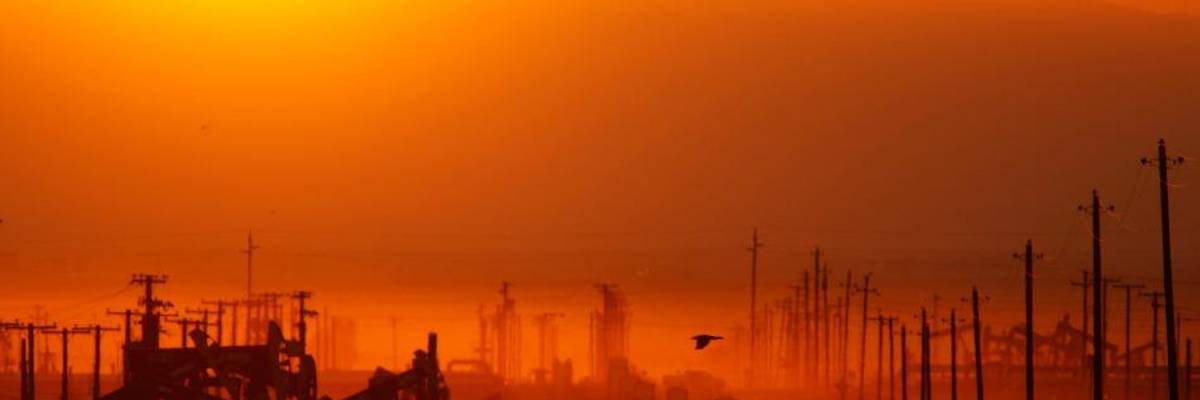
The sun rises over an oil field over the Monterey Shale formation where gas and oil fracking takes place near Lost Hills, California. On top of the financial burden from burning fossil fuels, a report (pdf) published Tuesday by Oil Change International (OCI) found that industry subsidies cost U.S. taxpayers more than $20 billion each year, $14.7 billion at the federal level and $5.8 billion at the state level. (Photo by David McNew/Getty Images)
In the midst of a hurricane season that shows just how expensive inaction on climate change can be, two new reports highlight how massive taxpayer-funded subsidies for fossil fuel companies are propping up an industry that refuses to take responsibility for the destructive and costly chaos it has played an enormous role in creating.
"Every dollar spent subsidizing this industry takes us further away from achieving internationally agreed emissions goals, and maintaining a stable climate."
-- Oil Change InternationalA recent analysis found that damage from extreme weather intensified by climate change and the health impacts from using gas, oil, and coal have cost the U.S. economy an annual average of $240 billion in the past decade. Between now and 2028, that figure is expected to rise to $360 billion annually--more than half of the economy's growth--and that doesn't even account for the cost of industry subsidies.
On top of the financial burden from burning fossil fuels, a report (pdf) published Tuesday by Oil Change International (OCI) found that industry subsidies cost U.S. taxpayers more than $20 billion each year, $14.7 billion at the federal level and $5.8 billion at the state level. These subsidies take several forms--including financial handouts, flexible liability policies, and tax breaks--and, researchers argue, "waste billions of dollars propping up an industry incompatible with safe climate limits."
A separate study by Stockholm Environment Institute (SEI), published Monday in the journal Nature, examined the impact of subsidies on U.S. crude oil production, and concluded that subsidies to oil companies encourage them to drill oil fields that would otherwise be unprofitable.
Over the next few decades, SEI researchers estimate, "tax preferences and other subsidies push nearly half of new, yet-to-be-developed oil investments into profitability, potentially increasing U.S. oil production by 17 billion barrels" that, once burned, will release about 6 billion tonnes of carbon dioxide, or CO2, into the atmosphere.
"This is oil we don't need and it takes the U.S. further away from its climate goals of reducing CO2 emissions," report co-author Peter Erickson, a senior scientist at SEI's U.S. center, told Motherboard. The U.S. currently ranks second, behind only China, in global CO2 emissions.
Similarly, the OCI report concludes that "every dollar spent subsidizing this industry takes us further away from achieving internationally agreed emissions goals, and maintaining a stable climate." It also notes that without a rapid reduction in U.S. fossil fuel reliance, the world will likely fail the meet goals outlined in the 2015 Paris climate accord, in which nearly every nation on Earth agreed to reduce greenhouse gas emissions in hopes of limiting global average temperature rise to below 2degC, while aiming for below 1.5degC.
Eliminating industry subsidies, however, faces strong political resistance in the U.S. Subsidies, the OCI report notes, "have been defended by a Congress influenced by $350 million in campaign contributions and lobbying expenditures by the fossil fuel industry," which reseachers estimate "equates to a 8,200 percent return on investment."
"For members of Congress who consider themselves climate champions, eliminating the subsidies that drive fossil fuel expansion and climate pollution is a critical starting point," said Janet Redman, OCI' s U.S. policy director and principal author of the report.
Congress, though, is not the only political barrier to curbing U.S. emissions. President Donald Trump, in June, vowed to withdraw from the Paris climate agreement, and since then the U.S. has sidelined itself in discussions about reducing emissions globally.
"While the rest of the world moves toward a renewable energy future, dirty energy defenders in the Trump administration are using our taxpayer dollars to promote dangerous new fossil fuel development," Redman added. "Until we separate oil and state, the dirty energy money cycle of fossil fuel contributions going into Congress and oil, gas, and coal subsidies coming out will stymie our chances at revolutionizing the energy sector and staving off worsening climate disasters."
To achieve that, Tim McDonnell argued in a Washington Post analysis published Monday, "forget the Paris agreement. The real solution to climate change is in the U.S. tax code." Noting that fossil fuel industry lobbyists are celebrating the new Republican tax plan, released last week, as "a win," McDonnell concludes "tax reform can help fight climate change--just not the kind of tax reform Trump and Republicans are proposing."
This country and this world are at a monumental crossroads. US voters have an opportunity to beat back the forces of fascism and confront the billionaires who are rigging the economy, our media system, and our democracy, making it increasingly impossible for ordinary people to get by. We’re not just talking about the election. We’re talking about what must be done once these fascist elements are vanquished from power. We need a bolder set of solutions than what either major party has so far been willing to offer and a working-class movement ready to fight like hell for it. Trump didn't emerge from nowhere. The conditions that fueled MAGA authoritarianism were created by decades of radical neoliberal economic policies and a corrupt political system dominated by corporate interests. They slashed taxes on the super-rich, promising that the benefits would trickle down. They said giveaways to the corporate titans would make life more affordable for the rest of us. It was all bullshit. And when a bitter, betrayed populace searches for someone to blame, right-wing demagogues have little trouble finding scapegoats. People know when they're being lied to, but you won't hear any of this from the corporate media. Only independent journalism—powered and funded by people who believe in building a better world—can deliver truly trustworthy daily news. If you share our vision, please contribute whatever you can to sustain our work. |
In the midst of a hurricane season that shows just how expensive inaction on climate change can be, two new reports highlight how massive taxpayer-funded subsidies for fossil fuel companies are propping up an industry that refuses to take responsibility for the destructive and costly chaos it has played an enormous role in creating.
"Every dollar spent subsidizing this industry takes us further away from achieving internationally agreed emissions goals, and maintaining a stable climate."
-- Oil Change InternationalA recent analysis found that damage from extreme weather intensified by climate change and the health impacts from using gas, oil, and coal have cost the U.S. economy an annual average of $240 billion in the past decade. Between now and 2028, that figure is expected to rise to $360 billion annually--more than half of the economy's growth--and that doesn't even account for the cost of industry subsidies.
On top of the financial burden from burning fossil fuels, a report (pdf) published Tuesday by Oil Change International (OCI) found that industry subsidies cost U.S. taxpayers more than $20 billion each year, $14.7 billion at the federal level and $5.8 billion at the state level. These subsidies take several forms--including financial handouts, flexible liability policies, and tax breaks--and, researchers argue, "waste billions of dollars propping up an industry incompatible with safe climate limits."
A separate study by Stockholm Environment Institute (SEI), published Monday in the journal Nature, examined the impact of subsidies on U.S. crude oil production, and concluded that subsidies to oil companies encourage them to drill oil fields that would otherwise be unprofitable.
Over the next few decades, SEI researchers estimate, "tax preferences and other subsidies push nearly half of new, yet-to-be-developed oil investments into profitability, potentially increasing U.S. oil production by 17 billion barrels" that, once burned, will release about 6 billion tonnes of carbon dioxide, or CO2, into the atmosphere.
"This is oil we don't need and it takes the U.S. further away from its climate goals of reducing CO2 emissions," report co-author Peter Erickson, a senior scientist at SEI's U.S. center, told Motherboard. The U.S. currently ranks second, behind only China, in global CO2 emissions.
Similarly, the OCI report concludes that "every dollar spent subsidizing this industry takes us further away from achieving internationally agreed emissions goals, and maintaining a stable climate." It also notes that without a rapid reduction in U.S. fossil fuel reliance, the world will likely fail the meet goals outlined in the 2015 Paris climate accord, in which nearly every nation on Earth agreed to reduce greenhouse gas emissions in hopes of limiting global average temperature rise to below 2degC, while aiming for below 1.5degC.
Eliminating industry subsidies, however, faces strong political resistance in the U.S. Subsidies, the OCI report notes, "have been defended by a Congress influenced by $350 million in campaign contributions and lobbying expenditures by the fossil fuel industry," which reseachers estimate "equates to a 8,200 percent return on investment."
"For members of Congress who consider themselves climate champions, eliminating the subsidies that drive fossil fuel expansion and climate pollution is a critical starting point," said Janet Redman, OCI' s U.S. policy director and principal author of the report.
Congress, though, is not the only political barrier to curbing U.S. emissions. President Donald Trump, in June, vowed to withdraw from the Paris climate agreement, and since then the U.S. has sidelined itself in discussions about reducing emissions globally.
"While the rest of the world moves toward a renewable energy future, dirty energy defenders in the Trump administration are using our taxpayer dollars to promote dangerous new fossil fuel development," Redman added. "Until we separate oil and state, the dirty energy money cycle of fossil fuel contributions going into Congress and oil, gas, and coal subsidies coming out will stymie our chances at revolutionizing the energy sector and staving off worsening climate disasters."
To achieve that, Tim McDonnell argued in a Washington Post analysis published Monday, "forget the Paris agreement. The real solution to climate change is in the U.S. tax code." Noting that fossil fuel industry lobbyists are celebrating the new Republican tax plan, released last week, as "a win," McDonnell concludes "tax reform can help fight climate change--just not the kind of tax reform Trump and Republicans are proposing."