SUBSCRIBE TO OUR FREE NEWSLETTER
Daily news & progressive opinion—funded by the people, not the corporations—delivered straight to your inbox.
5
#000000
#FFFFFF
To donate by check, phone, or other method, see our More Ways to Give page.
Daily news & progressive opinion—funded by the people, not the corporations—delivered straight to your inbox.
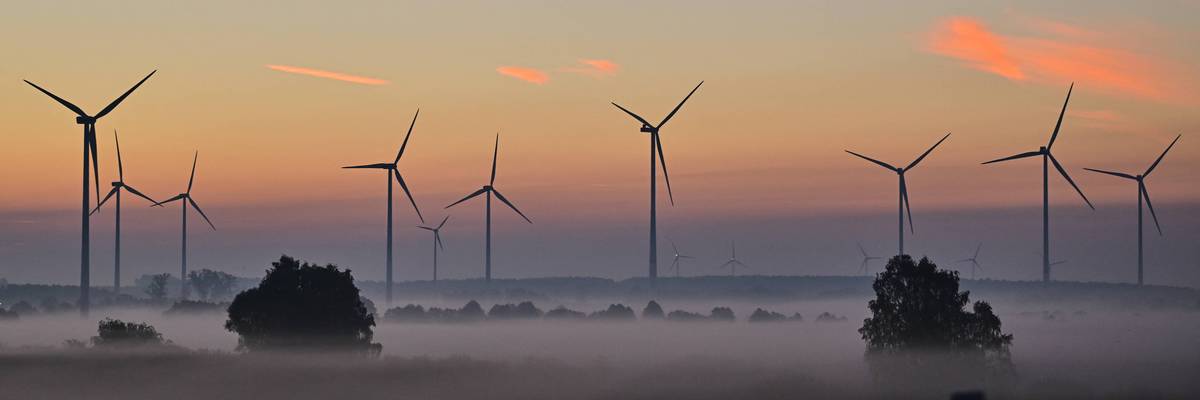
Wind turbines rise above thick fog at dawn in Jacobsdorf, Germany, on October 7, 2026.
"Laggards, including the United States and Japan, are continuing to prop up the fossil fuel industry."
For the first time on record, major international public financial institutions are providing more financing for clean energy around the world than for fossil fuels. But wealthy nations, including the United States, continue to pour billions into oil and gas, hampering the global energy transition, according to a new report.
On Wednesday, two environmental advocacy groups—Oil Change International and Friends of the Earth US—published an analysis of new data on public financing from Group of 20 (G20) nations and multilateral development banks for clean energy projects, such as wind and solar, and planet-warming fossil fuels, including oil, gas, and coal.
They found that from 2023-25, public financing for clean energy averaged at least $52.7 billion annually, compared with just $36.3 billion for fossil fuels. The report attributes the shift mostly to multilateral development banks, while G20 nations' own development and export financing continued to favor fossil fuels.
“This new dataset represents a tipping point. Clean energy financing overtaking fossil fuel financing for the first time is an important milestone," said Claire O'Manique, public finance researcher at Oil Change International. "But it doesn't mean we can sit back and count our wins.”
The level of clean energy financing, the group said, is still far below what is needed to limit global warming to 1.5°C above preindustrial levels, a threshold beyond which the risks of devastating climate impacts increase.
That's largely thanks to four main culprits. Canada, Japan, the United States, and Italy accounted for around 75% of fossil fuel financing from G20 countries during this period.
Canada provided an annual average of $12.5 billion in fossil fuel financing—mostly for domestic projects. Japan averaged about $4.5 billion annually despite a G7 commitment to end public support for new international fossil fuel projects by 2022. Italy likewise averaged $3.8 billion annually, breaking a pledge to end international fossil fuel financing.
Over the same period, the US provided an annual average of about $3.6 billion in fossil fuel financing, mostly through its Export-Import Bank, compared with just $1.5 billion for clean energy.
The data from 2025, the first year of President Donald Trump's second term, is particularly striking. That year, the US provided nearly $8 billion in financing for fossil fuel projects compared with just $2.5 million for clean energy—roughly 3,200 times as much.
This included a loan of up to $4.7 billion for a liquefied natural gas project in Mozambique, despite allegations that soldiers guarding the project committed war crimes. British and Dutch backing has since been withdrawn from the project.
"Important progress is being made to move the world’s largest economies away from supporting fossil fuels and shift that financing toward renewable energy projects," said Kate DeAngelis, economic policy deputy director at Friends of the Earth US. "Unfortunately, laggards, including the United States and Japan, are continuing to prop up the fossil fuel industry instead of helping countries transition to sustainable economies.”
The report also found that less than 2% of the clean energy financing tracked reached low-income countries, despite their unmet energy needs. Meanwhile, nearly half of the funds went toward projects in the highest-income countries, according to World Bank classifications.
The five largest recipients of clean energy financing were all high- or middle-income countries: France, Poland, and Spain fall into the former category, while Brazil and India fall into the latter.
"A just transition will not happen at the scale required without governments actively steering it through redirecting and mobilizing public finance," O’Manique said. "Wealthy governments must move first and fastest to phase out fossil fuels at home and meet their climate finance obligations."
"We are running out of time," she said. "Without a fossil fuel phaseout and public finance being redirected to drive a just energy transition, we will continue to see escalating climate disasters that come at a huge human and economic cost, such as the deadly glacial flood disaster in Nepal.”
Dear Common Dreams reader, It’s been nearly 30 years since I co-founded Common Dreams with my late wife, Lina Newhouser. We had the radical notion that journalism should serve the public good, not corporate profits. It was clear to us from the outset what it would take to build such a project. No paid advertisements. No corporate sponsors. No millionaire publisher telling us what to think or do. Many people said we wouldn't last a year, but we proved those doubters wrong. Together with a tremendous team of journalists and dedicated staff, we built an independent media outlet free from the constraints of profits and corporate control. Our mission has always been simple: To inform. To inspire. To ignite change for the common good. Building Common Dreams was not easy. Our survival was never guaranteed. When you take on the most powerful forces—Wall Street greed, fossil fuel industry destruction, Big Tech lobbyists, and uber-rich oligarchs who have spent billions upon billions rigging the economy and democracy in their favor—the only bulwark you have is supporters who believe in your work. But here’s the urgent message from me today. It's never been this bad out there. And it's never been this hard to keep us going. At the very moment Common Dreams is most needed, the threats we face are intensifying. We need your support now more than ever. We don't accept corporate advertising and never will. We don't have a paywall because we don't think people should be blocked from critical news based on their ability to pay. Everything we do is funded by the donations of readers like you. When everyone does the little they can afford, we are strong. But if that support retreats or dries up, so do we. Will you donate now to make sure Common Dreams not only survives but thrives? —Craig Brown, Co-founder |
For the first time on record, major international public financial institutions are providing more financing for clean energy around the world than for fossil fuels. But wealthy nations, including the United States, continue to pour billions into oil and gas, hampering the global energy transition, according to a new report.
On Wednesday, two environmental advocacy groups—Oil Change International and Friends of the Earth US—published an analysis of new data on public financing from Group of 20 (G20) nations and multilateral development banks for clean energy projects, such as wind and solar, and planet-warming fossil fuels, including oil, gas, and coal.
They found that from 2023-25, public financing for clean energy averaged at least $52.7 billion annually, compared with just $36.3 billion for fossil fuels. The report attributes the shift mostly to multilateral development banks, while G20 nations' own development and export financing continued to favor fossil fuels.
“This new dataset represents a tipping point. Clean energy financing overtaking fossil fuel financing for the first time is an important milestone," said Claire O'Manique, public finance researcher at Oil Change International. "But it doesn't mean we can sit back and count our wins.”
The level of clean energy financing, the group said, is still far below what is needed to limit global warming to 1.5°C above preindustrial levels, a threshold beyond which the risks of devastating climate impacts increase.
That's largely thanks to four main culprits. Canada, Japan, the United States, and Italy accounted for around 75% of fossil fuel financing from G20 countries during this period.
Canada provided an annual average of $12.5 billion in fossil fuel financing—mostly for domestic projects. Japan averaged about $4.5 billion annually despite a G7 commitment to end public support for new international fossil fuel projects by 2022. Italy likewise averaged $3.8 billion annually, breaking a pledge to end international fossil fuel financing.
Over the same period, the US provided an annual average of about $3.6 billion in fossil fuel financing, mostly through its Export-Import Bank, compared with just $1.5 billion for clean energy.
The data from 2025, the first year of President Donald Trump's second term, is particularly striking. That year, the US provided nearly $8 billion in financing for fossil fuel projects compared with just $2.5 million for clean energy—roughly 3,200 times as much.
This included a loan of up to $4.7 billion for a liquefied natural gas project in Mozambique, despite allegations that soldiers guarding the project committed war crimes. British and Dutch backing has since been withdrawn from the project.
"Important progress is being made to move the world’s largest economies away from supporting fossil fuels and shift that financing toward renewable energy projects," said Kate DeAngelis, economic policy deputy director at Friends of the Earth US. "Unfortunately, laggards, including the United States and Japan, are continuing to prop up the fossil fuel industry instead of helping countries transition to sustainable economies.”
The report also found that less than 2% of the clean energy financing tracked reached low-income countries, despite their unmet energy needs. Meanwhile, nearly half of the funds went toward projects in the highest-income countries, according to World Bank classifications.
The five largest recipients of clean energy financing were all high- or middle-income countries: France, Poland, and Spain fall into the former category, while Brazil and India fall into the latter.
"A just transition will not happen at the scale required without governments actively steering it through redirecting and mobilizing public finance," O’Manique said. "Wealthy governments must move first and fastest to phase out fossil fuels at home and meet their climate finance obligations."
"We are running out of time," she said. "Without a fossil fuel phaseout and public finance being redirected to drive a just energy transition, we will continue to see escalating climate disasters that come at a huge human and economic cost, such as the deadly glacial flood disaster in Nepal.”
For the first time on record, major international public financial institutions are providing more financing for clean energy around the world than for fossil fuels. But wealthy nations, including the United States, continue to pour billions into oil and gas, hampering the global energy transition, according to a new report.
On Wednesday, two environmental advocacy groups—Oil Change International and Friends of the Earth US—published an analysis of new data on public financing from Group of 20 (G20) nations and multilateral development banks for clean energy projects, such as wind and solar, and planet-warming fossil fuels, including oil, gas, and coal.
They found that from 2023-25, public financing for clean energy averaged at least $52.7 billion annually, compared with just $36.3 billion for fossil fuels. The report attributes the shift mostly to multilateral development banks, while G20 nations' own development and export financing continued to favor fossil fuels.
“This new dataset represents a tipping point. Clean energy financing overtaking fossil fuel financing for the first time is an important milestone," said Claire O'Manique, public finance researcher at Oil Change International. "But it doesn't mean we can sit back and count our wins.”
The level of clean energy financing, the group said, is still far below what is needed to limit global warming to 1.5°C above preindustrial levels, a threshold beyond which the risks of devastating climate impacts increase.
That's largely thanks to four main culprits. Canada, Japan, the United States, and Italy accounted for around 75% of fossil fuel financing from G20 countries during this period.
Canada provided an annual average of $12.5 billion in fossil fuel financing—mostly for domestic projects. Japan averaged about $4.5 billion annually despite a G7 commitment to end public support for new international fossil fuel projects by 2022. Italy likewise averaged $3.8 billion annually, breaking a pledge to end international fossil fuel financing.
Over the same period, the US provided an annual average of about $3.6 billion in fossil fuel financing, mostly through its Export-Import Bank, compared with just $1.5 billion for clean energy.
The data from 2025, the first year of President Donald Trump's second term, is particularly striking. That year, the US provided nearly $8 billion in financing for fossil fuel projects compared with just $2.5 million for clean energy—roughly 3,200 times as much.
This included a loan of up to $4.7 billion for a liquefied natural gas project in Mozambique, despite allegations that soldiers guarding the project committed war crimes. British and Dutch backing has since been withdrawn from the project.
"Important progress is being made to move the world’s largest economies away from supporting fossil fuels and shift that financing toward renewable energy projects," said Kate DeAngelis, economic policy deputy director at Friends of the Earth US. "Unfortunately, laggards, including the United States and Japan, are continuing to prop up the fossil fuel industry instead of helping countries transition to sustainable economies.”
The report also found that less than 2% of the clean energy financing tracked reached low-income countries, despite their unmet energy needs. Meanwhile, nearly half of the funds went toward projects in the highest-income countries, according to World Bank classifications.
The five largest recipients of clean energy financing were all high- or middle-income countries: France, Poland, and Spain fall into the former category, while Brazil and India fall into the latter.
"A just transition will not happen at the scale required without governments actively steering it through redirecting and mobilizing public finance," O’Manique said. "Wealthy governments must move first and fastest to phase out fossil fuels at home and meet their climate finance obligations."
"We are running out of time," she said. "Without a fossil fuel phaseout and public finance being redirected to drive a just energy transition, we will continue to see escalating climate disasters that come at a huge human and economic cost, such as the deadly glacial flood disaster in Nepal.”