

SUBSCRIBE TO OUR FREE NEWSLETTER
Daily news & progressive opinion—funded by the people, not the corporations—delivered straight to your inbox.
5
#000000
#FFFFFF
To donate by check, phone, or other method, see our More Ways to Give page.
Daily news & progressive opinion—funded by the people, not the corporations—delivered straight to your inbox.

The American Civil Liberties Union, the Electronic Frontier Foundation, and the ACLU of Massachusetts sued the Department of Homeland Security today on behalf of 11 travelers whose smartphones and laptops were searched without warrants at the U.S. border.
The plaintiffs in the case are 10 U.S. citizens and one lawful permanent resident who hail from seven states and come from a variety of backgrounds. The lawsuit challenges the government's fast-growing practice of searching travelers' electronic devices without a warrant. It seeks to establish that the government must have a warrant based on probable cause to suspect a violation of immigration or customs laws before conducting such searches.
The plaintiffs include a military veteran, journalists, students, an artist, a NASA engineer, and a business owner. Several are Muslims or people of color. All were reentering the country from business or personal travel when border officers searched their devices. They were not subsequently accused of any wrongdoing. Officers also confiscated and kept the devices of several plaintiffs for weeks or months -- DHS has held one plaintiff's device since January.
"The government cannot use the border as a dragnet to search through our private data," said ACLU attorney Esha Bhandari. "Our electronic devices contain massive amounts of information that can paint a detailed picture of our personal lives, including emails, texts, contact lists, photos, work documents, and medical or financial records. The Fourth Amendment requires that the government get a warrant before it can search the contents of smartphones and laptops at the border."
Plaintiff Diane Maye, a college professor and retired U.S. Air Force officer, was detained for two hours at Miami International Airport when coming home from a vacation in Europe in June. "I felt humiliated and violated. I worried that border officers would read my email messages and texts, and look at my photos," she said. "This was my life, and a border officer held it in the palm of his hand. I joined this lawsuit because I strongly believe the government shouldn't have the unfettered power to invade your privacy."
Plaintiff Sidd Bikkannavar, an engineer for NASA's Jet Propulsion Laboratory in California, was detained at the Houston airport on the way home from vacation in Chile. A U.S. Customs and Border Protection (CPB) officer demanded that he reveal the password for his phone. The officer returned the phone a half-hour later, saying that it had been searched using "algorithms."
Another plaintiff was subjected to violence. Akram Shibly, an independent filmmaker who lives in upstate New York, was crossing the U.S.-Canada border after a social outing in the Toronto area in January when a CBP officer ordered him to hand over his phone. CBP had just searched his phone three days earlier when he was returning from a work trip in Toronto, so Shibly declined. Officers then physically restrained him, with one choking him and another holding his legs, and took his phone from his pocket. They kept the phone, which was already unlocked, for over an hour before giving it back.
"I joined this lawsuit so other people don't have to have to go through what happened to me," Shibly said. "Border agents should not be able to coerce people into providing access to their phones, physically or otherwise."
The number of electronic device searches at the border began increasing in 2016 and has grown even more under the Trump administration. CBP officers conducted nearly 15,000 electronic device searches in the first half of fiscal year 2017, putting CBP on track to conduct more than three times the number of searches than in fiscal year 2015 (8,503) and some 50 percent more than in fiscal year 2016 (19,033).
"People now store their whole lives, including extremely sensitive personal and business matters, on their phones, tablets, and laptops, and it's reasonable for them to carry these with them when they travel. It's high time that the courts require the government to stop treating the border as a place where they can end-run the Constitution," said EFF Staff Attorney Sophia Cope.
Below is a full list of the plaintiffs along with links to their individual stories, which are also collected here:
The case, Alasaad v. Duke, was filed in the U.S. District Court for the District of Massachusetts.
Today's complaint is here:
https://www.aclu.org/legal-document/alasaad-v-duke-complaint
The American Civil Liberties Union was founded in 1920 and is our nation's guardian of liberty. The ACLU works in the courts, legislatures and communities to defend and preserve the individual rights and liberties guaranteed to all people in this country by the Constitution and laws of the United States.
(212) 549-2666
"People who really, really need SNAP could potentially no longer receive it and not have a way to buy their groceries," warned one anti-hunger campaigner.
Maine taxpayers could be on the hook for around $50 million per year in spending on federal nutrition assistance under the Republican budget law that Sen. Susan Collins voted to advance as it moved through Congress last year.
The GOP law requires states to pay a portion of Supplemental Nutrition Assistance Program (SNAP) benefit costs for the first time in the program's history, starting in October 2027. The size of states' obligation will range between 5% and 15% of their benefit costs; states with higher payment error rates—which experts say largely reflect administrative mistakes rather than fraud or abuse, as the Trump administration claims—will be forced to pay a larger percentage of benefit costs.
According to the latest data from the US Department of Agriculture, Maine's SNAP payment error rate in Fiscal Year 2025 was 10.81%—just above the national average of 10.62%. Maine's error rate puts the state in the 15% category for benefit cost obligations, according to the Center on Budget and Policy Priorities (CBPP).
“It’s shocking, and it’s wildly unfair,” Anna Korsen, deputy director of the Maine-based advocacy group Full Plates Full Potential, told Maine Morning Star last week. “If the state can’t find a way to pay for these benefits, that will mean that eligible people will go hungry. People who really, really need SNAP could potentially no longer receive it and not have a way to buy their groceries.”
Facing criticism from Democratic challenger Graham Platner—whose campaign has accused Collins of siding with President Donald Trump to give "billionaires and corporations a handout paid for by cuts to Medicaid and SNAP"—the Republican incumbent has emphasized that she voted against final passage of the Republican budget package.
But last June, Collins cast what Maine Public Radio described at the time as a "pivotal vote to begin debating" the budget measure, which will cut SNAP and Medicaid by roughly $1 trillion combined over the next decade. Thousands of Mainers—and millions of people nationwide—have lost SNAP and Medicaid benefits since the Republican law's enactment last summer.
Advocates have warned that the unprecedented shift of a portion of SNAP benefit costs onto states could be devastating, potentially forcing governments to cut SNAP benefits further, slash spending on education and other priorities, or potentially end their participation in the program completely.
Democrats are working to include a provision in the annual Farm Bill that would delay the SNAP cost-shift to give states more time to prepare. Last month, as Common Dreams reported, Senate Republicans unveiled legislation that omitted Democrats' proposed delay.
CBPP estimated in a recent analysis that states "may soon face a collective bill of roughly $9 billion, threatening benefits for millions of SNAP households, 79% of which include a child, a senior, or a person with a disability, who count on SNAP to help them meet their basic needs."
"Without immediate congressional action to delay this cost shift for all states," the think tank warned, "the unfolding emergency will only worsen as more people lose the SNAP benefits they need to afford groceries."
George Kelemen, senior vice president of the national No Kid Hungry campaign, called the GOP law's cost-shift "an existential threat to our most powerful anti-hunger program."
"Most states could be forced to cut funding for SNAP or other essential services, and at least four states have said they may be unable to continue administering SNAP entirely if this benefit cost shift goes into effect," Kelemen said last month. "This means millions of eligible kids and their families will lose access to vital grocery benefits."
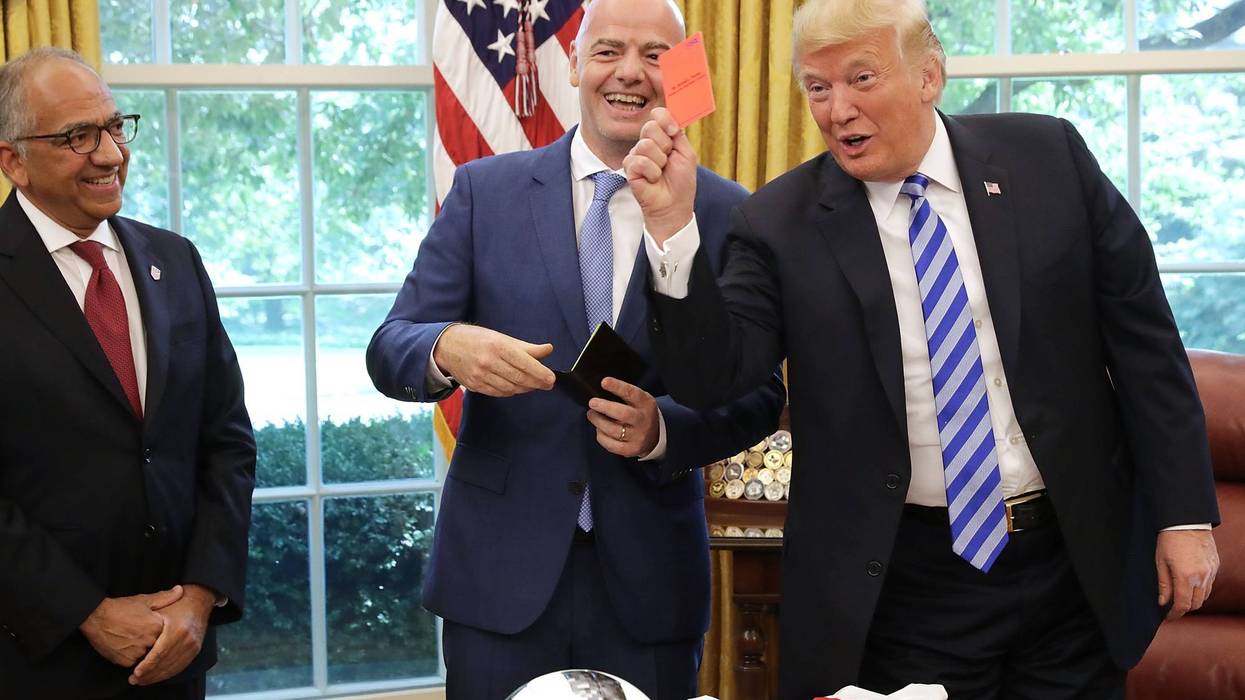
FIFA president Gianni Infantino, said one UK sports broadcaster, “needs to resign, he needs to resign today."
The world football governing body FIFA is facing international condemnation for its decision to suspend—at the reported urging of President Donald Trump—a one-game ban for Folarin Balogun, a top player on the US Men's National Team currently competing in the World Cup.
According to numerous reports, the Trump administration last week undertook a pressure campaign against FIFA to overturn Balogun's suspension, which included a personal phone call from Trump to FIFA president Gianni Infantino where the American president urged him to review the referees' decision.
On Sunday, FIFA shocked soccer fans by announcing that Balogun would be eligible to play in Monday’s World Cup match against Belgium. The decision—especially in light of the US being one of the host nation's for this year's Cup and the chummy relationship that Infantino has cultivated with Trump—drew widespread accusations of corruption and favoritism.
The Union of European Football Associations (UEFA) on Monday issued a statement accusing FIFA of "crossing a red line" by overturning Balogun's suspension, which it said damaged the World Cup's reputation.
"When the certainty of rules is no longer guaranteed by its guardians, the integrity of the game is at stake and the credibility of a competition is undermined," said UEFA. "Equally, such decision creates a precedent in the ongoing tournament, where similar situations will now require an equal treatment, to the detriment of the competition."
"We express our disbelief," the group added, "at such an unprecedented, incomprehensible, and unjustifiable decision."
UK sports broadcaster Jeff Sterling was among those in the world of football commentary who ripped into FIFA’s decision, which he labeled a "disgrace."
"To me, Gianni Infantino needs to resign, he needs to resign today," Sterling said during a Monday episode of talkSPORT's morning program. "He's the man who came up with the great idea of the FIFA Peace Prize and gave it to his mate, Donald Trump. And of course, his mate is the one who tries to influence this decision and have this suspension overturned."
Sterling said Infantino's position as FIFA president was rendered "untenable" by the decision.
"The smell of corruption allegations is particularly unpleasant," he added.
😡 "A disgrace!"
😡 "Infantino needs to resign!"
😡 "Shameless!"
Jeff Stelling is furious with Gianni Infantino after FIFA decided Folarin Balogun can play for the USA vs Belgium! 😤#FIFAWorldCup pic.twitter.com/z1p7PtViEN
— talkSPORT (@talkSPORT) July 6, 2026
Former UK football star Wayne Rooney delivered a similarly scathing assessment during a Sunday BBC broadcast.
"I think is an absolute disgrace and Infantino, he should be ashamed of this because I think for the sportsmanship of this game is in question here," said Rooney. "If I'm the USA's opponent I'd be absolutely fuming. I just think it's wrong in every way. I think it's an absolute disgrace."
"I think it's an absolute disgrace." 😡
Wayne Rooney questioned the call around Florian Balogun’s suspended red card for the USA. pic.twitter.com/beDcgnWNHO
— Match of the Day (@BBCMOTD) July 6, 2026
Other current and former football professionals also slammed FIFA's decision.
Norway coach Stale Solbakken described the overturned suspension as "a bad, bad, bad, bad, bad decision that will hurt the World Cup."
Former Manchester United players Gary Neville and Roy Keane joined with Arsenal great Ian Wright in decrying FIFA's handling of the matter.
- YouTube youtube.com
For his part, Keane said that the overturned suspension “seems unfair because it is unfair.”
Irish former professional footballer Roy Keane said that the overturned suspension "seems unfair because it is unfair."
The Royal Belgian Football Association (RBFA) declared itself "astonished by FIFA's decision," and demanded that the organization provide a justification for its actions.
RBFA also accused FIFA of trying to sabotage any efforts by Belgium to challenge the overturned suspension by only giving it "a few hours" to submit an appeal and by not responding to its request that FIFA provide justification for the original decision.
"For an appeal to be admissible, FIFA’s own regulations state that the reasoned decision must first have been communicated to the appellant," RBFA said. "While the RBFA was merely seeking legitimate explanations, FIFA itself created an appeal and immediately ensured that it would be declared inadmissible.

"The Supreme Court’s attacks on voting rights are about rigging elections for Republicans," said Rep. Greg Casar, the chair of the Congressional Progressive Caucus.
US President Donald Trump on Sunday attacked a pro-democracy resolution recently introduced by key House caucus leaders, warning that the measure's adoption would strike a fatal blow to the Republican Party.
"They do this, and the Republican Party is DEAD!" Trump wrote in a social media post, citing a Politico story on the resolution. The proposal, unveiled last month by the heads of the Congressional Progressive Caucus (CPC), Congressional Black Caucus, Congressional Hispanic Caucus, and Congressional Asian Pacific American Caucus, calls for the restoration and strengthening of voter protections gutted by the US Supreme Court as well as court reforms—including possible expansion of the number of justices and term limits.
Rep. Greg Casar (D-Texas), chair of the CPC, wrote Sunday that Trump's post amounted to an acknowledgment that "the Supreme Court’s attacks on voting rights are about rigging elections for Republicans."
"At least he admits it," the progressive leader wrote on social media.
This is what Trump says about my resolution with @RepYvetteClarke, @RepEspaillat, and @RepGraceMeng to restore voting rights, end the filibuster, and reform the Supreme Court.
At least he admits it: the Supreme Court’s attacks on voting rights are about rigging elections for Rs. pic.twitter.com/GgQzhlwo4Q
— Congressman Greg Casar (@RepCasar) July 5, 2026
Politico reported that while the resolution "stands virtually no chance of adoption" in the current GOP-controlled Congress, "it is the latest indicator of how the Congressional Black Caucus and other key Democrats want to respond to the April decision that cleared the way for Republican states to redraw their congressional maps and eliminate majority-minority districts"—a reference to the Supreme Court's 6-3 ruling in Louisiana v. Callais.
Trump seized on the ruling to push state-level Republicans to aggressively gerrymander their maps ahead of the critical 2026 midterm elections. The president is also pressuring congressional Republicans to force through legislation known as the SAVE America Act, which would impose strict voter ID and documentation requirements nationwide, potentially blocking millions of American citizens from casting ballots under the pretext of cracking down on noncitizen voting—something that is already illegal and rare.
Trump is currently holding a bipartisan housing affordability bill hostage in a bid to get the stalled SAVE America Act through Congress.
House Speaker Mike Johnson (R-La.) affirmed on Sunday that Republicans intend to attach the assault on voting rights to a filibuster-proof budget reconciliation package in a last-ditch effort to get the measure through the Senate, where it has not received enough support to clear the upper chamber's 60-vote threshold. Trump has called for elimination of the filibuster to pass the SAVE America Act, but Senate Republicans have thus far declined to remove the barrier.
The progressive resolution that Trump attacked on Sunday also proposes "the elimination of the 60-vote threshold in the Senate"—but it specifies that the action should only be taken "under the next pro-democracy governing moment."