SUBSCRIBE TO OUR FREE NEWSLETTER
Daily news & progressive opinion—funded by the people, not the corporations—delivered straight to your inbox.
5
#000000
#FFFFFF
To donate by check, phone, or other method, see our More Ways to Give page.
Daily news & progressive opinion—funded by the people, not the corporations—delivered straight to your inbox.
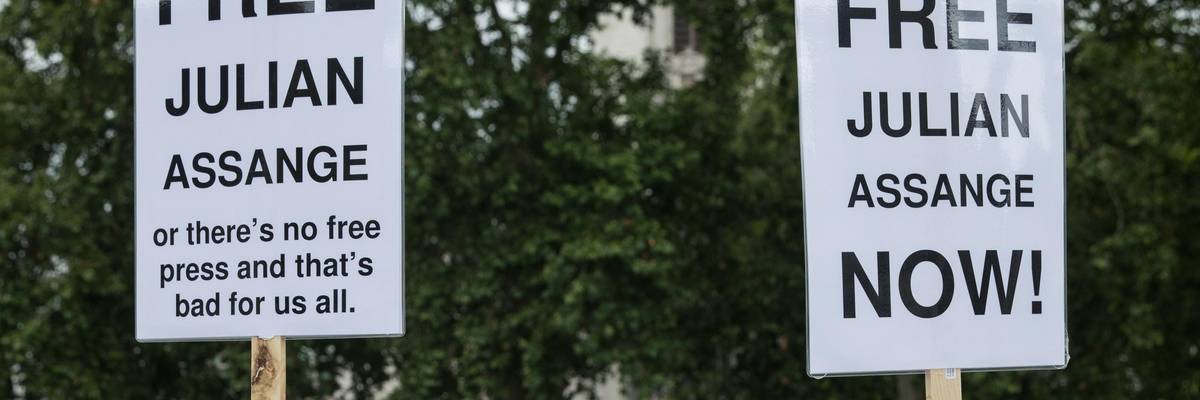
A campaigner holds two placards calling for the release of Wikileaks founder Julian Assange during a picnic in Parliament Square on the occasion of his 50th birthday on 3rd July 2021 in London, United Kingdom. An English court refused a request from the United States to extradite Assange earlier this year and campaigners have since urged President Biden to drop charges against him under the Espionage Act. (photo by Mark Kerrison/In Pictures via Getty Images)
When the Trump administration indicted WikiLeaks publisher Julian Assange under the infamous 1917 Espionage Act, journalists and other public figures sounded the alarms, warning of a war on the free press.
Biden's Justice Department has not called off the attack. On the contrary, it is moving full speed ahead with the prosecution. So where is the chorus of voices who denounced the indictments in 2019? They've gone quiet this year. Members of Congress have been silent. They should speak up now, as the case hangs in the balance.
The 18-count indictment against Assange, along with a corresponding extradition appeal to the British judiciary, has kept him in prison for nearly two years without trial. A United Nations expert has called the conditions of his imprisonment "psychological torture."
It looks like government officials want to intimidate journalists so that they will be afraid to publish classified information that reveals crimes or other activity that officials do not want the public to know about.
America's most prominent organizations concerned with human rights, freedom of the press and civil liberties haven't lost sight of the threat that this indictment and continued prosecution of Assange pose to fundamental press freedoms. They wrote a letter to the Justice Department in February calling it a "grave threat to press freedom both in the United States and abroad," which could "jeopardize journalism that is crucial to democracy."
The signatories to the letter included the American Civil Liberties Union, Human Rights Watch, Amnesty International and the Committee to Protect Journalists.
For the first time in more than a century, a journalist could be tried and imprisoned--the charges carry a maximum of 175 years in prison--for publishing facts that the U.S. government did not want published. Assange is not charged with stealing classified information. And although he is indicted under the infamous 1917 Espionage Act, he is not charged with any collusion with a foreign power.
The 17 charges under the Espionage Act stem from Assange's role in 2010-2011 in publishing hundreds of thousands of classified military and diplomatic documents, which were given to WikiLeaks. There is also one count of "conspiracy to commit computer intrusion."
The information that Assange published--for which he faces a possible life sentence--is not even classified as top secret. And the indictment does not allege that anyone was killed or harmed as a result of anything that he did.
It was the Trump administration that, in 2019, decided to embark on this new, groundbreaking "direct assault on the 1st Amendment," as the ACLU has called it. This prosecution is in keeping with Trump's authoritarian contempt for a free press and the rule of law generally. But why would the Biden administration carry it forward?
To anyone following the story, in the U.S. or around the world, it looks "bad, bad, bad," as MSNBC's Chris Hayes described the indictment. It looks like government officials want to intimidate journalists so that they will be afraid to publish classified information that reveals crimes or other activity that officials do not want the public to know about.
In 2010 WikiLeaks released the viral "Collateral Murder" video. It was filmed in Iraq in 2007 from an American Apache helicopter, as it mows down at least 12 civilians, including two employees of Reuters. Other U.S. documents published by WikiLeaks showed more than 15,000 civilian deaths in the Iraq war that the Pentagon did not disclose. More than 600 civilians were shown to have been killed by U.S. forces at checkpoints. The documents also show evidence that U.S. forces "handed over detainees to a notorious Iraqi torture squad," which was created and supported by the U.S.
American military files from Afghanistan show hundreds of civilians killed by coalition forces. Files on the Guantanamo Bay detention center showed, among other things, that 150 innocent people were imprisoned there for years.
Journalists say the prosecution of Assange threatens the freedoms that they need to do their jobs--to find and report such uncomfortable truths. The top editors of the New York Times, the Wall Street Journal and USA Today objected immediately to the 2019 indictment, which Washington Post editor Marty Baron said was "criminalizing common practices in journalism that have long served the public interest." The Los Angeles Times editorial board expressed concern of a chilling effect on journalists, who might think twice before accepting classified information.
We will pay a high price if this case continues, and if Assange is extradited--or held in jail indefinitely. This is possible as the Justice Department pursues further appeals. If extradited, he could be held in isolation, under Special Administrative Procedures. The British judge who refused to extradite Assange in January did so on the grounds that he was at risk of suicide if sent to the U.S.
Advocates for human rights and press freedom, as well as members of Congress, all need to raise their voices in this case before it is too late. President Biden has recently had much to say about the worldwide struggle for democracy; how it thrives "when a free and independent press pursues the truth," as he said on Memorial Day. But democracy, a free press and human rights begin at home.
Dear Common Dreams reader, It’s been nearly 30 years since I co-founded Common Dreams with my late wife, Lina Newhouser. We had the radical notion that journalism should serve the public good, not corporate profits. It was clear to us from the outset what it would take to build such a project. No paid advertisements. No corporate sponsors. No millionaire publisher telling us what to think or do. Many people said we wouldn't last a year, but we proved those doubters wrong. Together with a tremendous team of journalists and dedicated staff, we built an independent media outlet free from the constraints of profits and corporate control. Our mission has always been simple: To inform. To inspire. To ignite change for the common good. Building Common Dreams was not easy. Our survival was never guaranteed. When you take on the most powerful forces—Wall Street greed, fossil fuel industry destruction, Big Tech lobbyists, and uber-rich oligarchs who have spent billions upon billions rigging the economy and democracy in their favor—the only bulwark you have is supporters who believe in your work. But here’s the urgent message from me today. It's never been this bad out there. And it's never been this hard to keep us going. At the very moment Common Dreams is most needed, the threats we face are intensifying. We need your support now more than ever. We don't accept corporate advertising and never will. We don't have a paywall because we don't think people should be blocked from critical news based on their ability to pay. Everything we do is funded by the donations of readers like you. When everyone does the little they can afford, we are strong. But if that support retreats or dries up, so do we. Will you donate now to make sure Common Dreams not only survives but thrives? —Craig Brown, Co-founder |
When the Trump administration indicted WikiLeaks publisher Julian Assange under the infamous 1917 Espionage Act, journalists and other public figures sounded the alarms, warning of a war on the free press.
Biden's Justice Department has not called off the attack. On the contrary, it is moving full speed ahead with the prosecution. So where is the chorus of voices who denounced the indictments in 2019? They've gone quiet this year. Members of Congress have been silent. They should speak up now, as the case hangs in the balance.
The 18-count indictment against Assange, along with a corresponding extradition appeal to the British judiciary, has kept him in prison for nearly two years without trial. A United Nations expert has called the conditions of his imprisonment "psychological torture."
It looks like government officials want to intimidate journalists so that they will be afraid to publish classified information that reveals crimes or other activity that officials do not want the public to know about.
America's most prominent organizations concerned with human rights, freedom of the press and civil liberties haven't lost sight of the threat that this indictment and continued prosecution of Assange pose to fundamental press freedoms. They wrote a letter to the Justice Department in February calling it a "grave threat to press freedom both in the United States and abroad," which could "jeopardize journalism that is crucial to democracy."
The signatories to the letter included the American Civil Liberties Union, Human Rights Watch, Amnesty International and the Committee to Protect Journalists.
For the first time in more than a century, a journalist could be tried and imprisoned--the charges carry a maximum of 175 years in prison--for publishing facts that the U.S. government did not want published. Assange is not charged with stealing classified information. And although he is indicted under the infamous 1917 Espionage Act, he is not charged with any collusion with a foreign power.
The 17 charges under the Espionage Act stem from Assange's role in 2010-2011 in publishing hundreds of thousands of classified military and diplomatic documents, which were given to WikiLeaks. There is also one count of "conspiracy to commit computer intrusion."
The information that Assange published--for which he faces a possible life sentence--is not even classified as top secret. And the indictment does not allege that anyone was killed or harmed as a result of anything that he did.
It was the Trump administration that, in 2019, decided to embark on this new, groundbreaking "direct assault on the 1st Amendment," as the ACLU has called it. This prosecution is in keeping with Trump's authoritarian contempt for a free press and the rule of law generally. But why would the Biden administration carry it forward?
To anyone following the story, in the U.S. or around the world, it looks "bad, bad, bad," as MSNBC's Chris Hayes described the indictment. It looks like government officials want to intimidate journalists so that they will be afraid to publish classified information that reveals crimes or other activity that officials do not want the public to know about.
In 2010 WikiLeaks released the viral "Collateral Murder" video. It was filmed in Iraq in 2007 from an American Apache helicopter, as it mows down at least 12 civilians, including two employees of Reuters. Other U.S. documents published by WikiLeaks showed more than 15,000 civilian deaths in the Iraq war that the Pentagon did not disclose. More than 600 civilians were shown to have been killed by U.S. forces at checkpoints. The documents also show evidence that U.S. forces "handed over detainees to a notorious Iraqi torture squad," which was created and supported by the U.S.
American military files from Afghanistan show hundreds of civilians killed by coalition forces. Files on the Guantanamo Bay detention center showed, among other things, that 150 innocent people were imprisoned there for years.
Journalists say the prosecution of Assange threatens the freedoms that they need to do their jobs--to find and report such uncomfortable truths. The top editors of the New York Times, the Wall Street Journal and USA Today objected immediately to the 2019 indictment, which Washington Post editor Marty Baron said was "criminalizing common practices in journalism that have long served the public interest." The Los Angeles Times editorial board expressed concern of a chilling effect on journalists, who might think twice before accepting classified information.
We will pay a high price if this case continues, and if Assange is extradited--or held in jail indefinitely. This is possible as the Justice Department pursues further appeals. If extradited, he could be held in isolation, under Special Administrative Procedures. The British judge who refused to extradite Assange in January did so on the grounds that he was at risk of suicide if sent to the U.S.
Advocates for human rights and press freedom, as well as members of Congress, all need to raise their voices in this case before it is too late. President Biden has recently had much to say about the worldwide struggle for democracy; how it thrives "when a free and independent press pursues the truth," as he said on Memorial Day. But democracy, a free press and human rights begin at home.
When the Trump administration indicted WikiLeaks publisher Julian Assange under the infamous 1917 Espionage Act, journalists and other public figures sounded the alarms, warning of a war on the free press.
Biden's Justice Department has not called off the attack. On the contrary, it is moving full speed ahead with the prosecution. So where is the chorus of voices who denounced the indictments in 2019? They've gone quiet this year. Members of Congress have been silent. They should speak up now, as the case hangs in the balance.
The 18-count indictment against Assange, along with a corresponding extradition appeal to the British judiciary, has kept him in prison for nearly two years without trial. A United Nations expert has called the conditions of his imprisonment "psychological torture."
It looks like government officials want to intimidate journalists so that they will be afraid to publish classified information that reveals crimes or other activity that officials do not want the public to know about.
America's most prominent organizations concerned with human rights, freedom of the press and civil liberties haven't lost sight of the threat that this indictment and continued prosecution of Assange pose to fundamental press freedoms. They wrote a letter to the Justice Department in February calling it a "grave threat to press freedom both in the United States and abroad," which could "jeopardize journalism that is crucial to democracy."
The signatories to the letter included the American Civil Liberties Union, Human Rights Watch, Amnesty International and the Committee to Protect Journalists.
For the first time in more than a century, a journalist could be tried and imprisoned--the charges carry a maximum of 175 years in prison--for publishing facts that the U.S. government did not want published. Assange is not charged with stealing classified information. And although he is indicted under the infamous 1917 Espionage Act, he is not charged with any collusion with a foreign power.
The 17 charges under the Espionage Act stem from Assange's role in 2010-2011 in publishing hundreds of thousands of classified military and diplomatic documents, which were given to WikiLeaks. There is also one count of "conspiracy to commit computer intrusion."
The information that Assange published--for which he faces a possible life sentence--is not even classified as top secret. And the indictment does not allege that anyone was killed or harmed as a result of anything that he did.
It was the Trump administration that, in 2019, decided to embark on this new, groundbreaking "direct assault on the 1st Amendment," as the ACLU has called it. This prosecution is in keeping with Trump's authoritarian contempt for a free press and the rule of law generally. But why would the Biden administration carry it forward?
To anyone following the story, in the U.S. or around the world, it looks "bad, bad, bad," as MSNBC's Chris Hayes described the indictment. It looks like government officials want to intimidate journalists so that they will be afraid to publish classified information that reveals crimes or other activity that officials do not want the public to know about.
In 2010 WikiLeaks released the viral "Collateral Murder" video. It was filmed in Iraq in 2007 from an American Apache helicopter, as it mows down at least 12 civilians, including two employees of Reuters. Other U.S. documents published by WikiLeaks showed more than 15,000 civilian deaths in the Iraq war that the Pentagon did not disclose. More than 600 civilians were shown to have been killed by U.S. forces at checkpoints. The documents also show evidence that U.S. forces "handed over detainees to a notorious Iraqi torture squad," which was created and supported by the U.S.
American military files from Afghanistan show hundreds of civilians killed by coalition forces. Files on the Guantanamo Bay detention center showed, among other things, that 150 innocent people were imprisoned there for years.
Journalists say the prosecution of Assange threatens the freedoms that they need to do their jobs--to find and report such uncomfortable truths. The top editors of the New York Times, the Wall Street Journal and USA Today objected immediately to the 2019 indictment, which Washington Post editor Marty Baron said was "criminalizing common practices in journalism that have long served the public interest." The Los Angeles Times editorial board expressed concern of a chilling effect on journalists, who might think twice before accepting classified information.
We will pay a high price if this case continues, and if Assange is extradited--or held in jail indefinitely. This is possible as the Justice Department pursues further appeals. If extradited, he could be held in isolation, under Special Administrative Procedures. The British judge who refused to extradite Assange in January did so on the grounds that he was at risk of suicide if sent to the U.S.
Advocates for human rights and press freedom, as well as members of Congress, all need to raise their voices in this case before it is too late. President Biden has recently had much to say about the worldwide struggle for democracy; how it thrives "when a free and independent press pursues the truth," as he said on Memorial Day. But democracy, a free press and human rights begin at home.