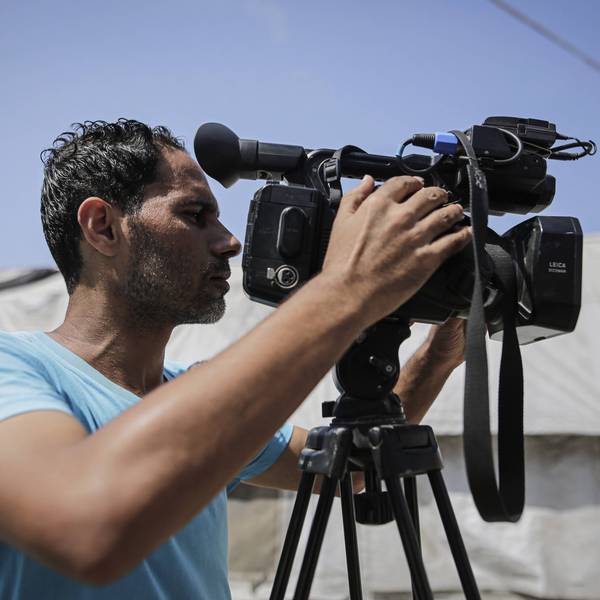
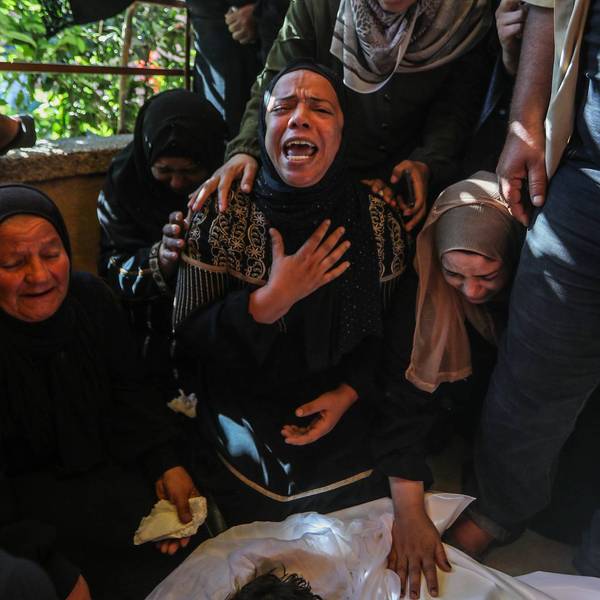

Many U.S. citizens have begun to wonder whether they really want their tax dollars funding Israel's occupation of Palestine and its military assault on Gaza. (Photo: Screen shot / Twitter)
What Solidarity With Palestine Means
As global solidarity with Palestinians continues to grow, how can the lessons of this movement benefit other colonized and oppressed peoples?
The world's attention has been transfixed by Israel's most recent attack on Gaza. Palestinian voices and narratives have begun to filter through U.S. media channels that have suppressed their voices for decades.
While global solidarity with Palestinians is growing, colonized people elsewhere in the world have also expressed their frustration with the left's heavy focus on Palestine, as if this were the only site of colonial occupation and exploitation.
When the Israeli military bombed al-Jalaa Tower, which housed the offices of the Associated Press and Al Jazeera in Gaza on May 15, 2021, it seemed to mark a turning point in wider public opinion. On the day of that bombing, which followed the destruction of two other large residential buildings in Gaza, U.S. Congressmembers Alexandria Ocasio-Cortez, Rashida Tlaib, and Cori Bush tweeted a simple yet powerful message: "Apartheid states aren't democracies."
Never before had so many U.S. politicians endorsed the conclusion that had been drawn in a recent April report by Human Rights Watch and a January position paper by B'Tselem: Israel is an apartheid state, which has institutionalized the separate and unequal treatment of Israelis and Palestinians. The Associated Press denied the Israeli Defense Force's claim that its offices, which the IDF bombed, were located in a Hamas headquarters and asked them to back up their claims with evidence.
The ruling class of the world's most powerful democracies have remained ignorant to the public outrage, but popular opinion is shifting. Many U.S. citizens have begun to wonder whether they really want their tax dollars funding Israel's occupation of Palestine and its military assault on Gaza. Palestine has become particularly central to leftist internationalism, which is increasingly unified around this issue, as witnessed by the protests that have erupted around the world during the eleven-day-long Israeli attack on Gaza.
While global solidarity with Palestinians is growing, colonized people elsewhere in the world have also expressed their frustration with the left's heavy focus on Palestine, as if this were the only site of colonial occupation and exploitation.
How can we use this solidarity, and channel the energies collected in this struggle, to pursue other liberation struggles, beyond Palestine/Israel, which have even more thoroughly evaded the world's attention?
When Iran's Foreign Minister Javad Zarif (a figure who is widely despised by leftist Iranians), tweeted on May 6 that "Palestine is a yardstick for justice. Few measure up," it was difficult for many of us familiar with the injustices being perpetrated and justified within the contemporary Islamic Republic to take his words at face value. As Iranian scholar Kamran Matin tweeted a few days after Zarif's tweet amid the escalation of the latest round of Israeli violence, "Israel's occupation, dispossession & killing of Palestinians recurrently demonstrates not only colonialism's absolute violence but also Eurocentric anti-colonialism of many on the (Iranian) left whose solidarity with colonially oppressed peoples begins & ends with Palestine."
The issue is not that leftist solidarity has coalesced around Palestine, but that it often coalesces exclusively around Palestine, while ignoring other global injustices.
On May 10, the very day when Israel's aerial bombardment of Gaza began, a girls' school was bombed in Afghanistan, killing eighty-five people, many of whom were children attending the school. It is difficult to imagine a more brutal attack on female education and gender equality. And yet this story was barely covered at all in the mainstream media outlets of Europe and the United States. The world's attention was squarely focused on Gaza.
What justifies the disproportionate focus on Palestine in the Euro-American imagination, particularly among leftists? Whether they occur in Afghanistan, Yemen, Syria, Kashmir, Iran, China, Chechnya, or Palestine, atrocities always call into question the very possibility of an "appropriate" or "proportionate" response. Still, it is worth considering the implications of the world's disproportionate focus on Palestine and Israel amid the many forms of apartheid currently being perpetrated across the Middle East and beyond.
Of course, several factors do set Palestine apart from other atrocities around the world. First, the United States and other western democracies such as the United Kingdom are Israel's biggest supporters and weapons suppliers. The support these countries give to Israel includes the weapons Israel used to bomb Gaza.
Second, the roots of the conflict--which centers on two peoples with a history of co-existence whose history has come into conflict in the twentieth century due to issues beyond their control--draws in many external stakeholders: Jews who feel connected to Israel (or who are repelled by it); U.S. taxpayers concerned about what is being done with their money; and the Arab world, whose solidarity with Palestine is often not represented in the policies and practices of their own countries.
Third, the duration of this conflict exceeds that of most contemporary atrocities. While the persecution of the Uyghurs, the bombing of Afghanistan, and the rampant imprisonment of dissidents in Iran share some common ground with what is going on in Palestine, the duration of the Israel-Palestine conflict (with the exception of India's militarization of Kashmir) is in a class of its own. For Palestinians, the nakba--the 1948 displacement of Palestinians to create the state of Israel--is an ongoing event, and a perpetual attestation to a settler colonial reality.
With all of these factors taken together, it is unsurprising that the world's attention has been fixated specifically on Palestinians, sometimes to the exclusion of other oppressed peoples. This disproportionality is in part a response to the uncritical support for Israel by a long succession of U.S. administrations. This bias is reflected in the $735 million military aid package for Israel that the Biden Administration approved in the very midst of Israel's assault on Gaza.
Given that the disproportionate focus on Israel and Palestine is likely to feature in our geopolitical landscape for the foreseeable future, what should those of us who are in solidarity with Palestinians, yet who do not want the world's attention to be diverted from other global atrocities, do? How can we use this solidarity, and channel the energies collected in this struggle, to pursue other liberation struggles, beyond Palestine/Israel, which have even more thoroughly evaded the world's attention?
It is in this specific sense--and not in the sense intended by Zarif--that Palestine is a yardstick of justice. Solidarity with Palestine is a litmus test, not of a person's individual conscience, but of our collective ability to change a global narrative that has legitimated oppression for many decades. If popular opinion can shape the actions of the world's leaders with respect to the occupation , that would send a sign to the rulers of this world that the injustices they perpetrate anywhere, on any people, will come back to haunt them.
The struggle for justice in Palestine can teach the left how to pressure our leaders on a wider scale, on matters beyond Israel-Palestine. This is why justice for Palestinians means justice for everyone.
We are at a crossroads
This country and this world are at a monumental crossroads. In a few short weeks, US voters will have an opportunity to beat back the forces of fascism and confront the billionaires who are rigging the economy, our media system, and our democracy, making it increasingly impossible for ordinary people to get by. We’re not just talking about the election. We’re talking about what must be done once these fascist elements are vanquished from power. We need a bolder set of solutions than what either major party has so far been willing to offer and a working-class movement ready to fight like hell for it. Trump didn't emerge from nowhere. The conditions that fueled MAGA authoritarianism were created by decades of radical neoliberal economic policies and a corrupt political system dominated by corporate interests. They slashed taxes on the super-rich, promising that the benefits would trickle down. They said giveaways to the corporate titans would make life more affordable for the rest of us. It was all bullshit. And when a bitter, betrayed populace searches for someone to blame, right-wing demagogues have little trouble finding scapegoats. People know when they're being lied to, but you won't hear any of this from the corporate media. Only independent journalism—powered and funded by people who believe in building a better world—can deliver truly trustworthy daily news. Our Fall Campaign is underway, and we need your help. To power our newsroom through the rest of the year, we need to raise $125,000 by midnight on October 31. So if you share our vision, please contribute whatever you can to sustain our work. |
The world's attention has been transfixed by Israel's most recent attack on Gaza. Palestinian voices and narratives have begun to filter through U.S. media channels that have suppressed their voices for decades.
While global solidarity with Palestinians is growing, colonized people elsewhere in the world have also expressed their frustration with the left's heavy focus on Palestine, as if this were the only site of colonial occupation and exploitation.
When the Israeli military bombed al-Jalaa Tower, which housed the offices of the Associated Press and Al Jazeera in Gaza on May 15, 2021, it seemed to mark a turning point in wider public opinion. On the day of that bombing, which followed the destruction of two other large residential buildings in Gaza, U.S. Congressmembers Alexandria Ocasio-Cortez, Rashida Tlaib, and Cori Bush tweeted a simple yet powerful message: "Apartheid states aren't democracies."
Never before had so many U.S. politicians endorsed the conclusion that had been drawn in a recent April report by Human Rights Watch and a January position paper by B'Tselem: Israel is an apartheid state, which has institutionalized the separate and unequal treatment of Israelis and Palestinians. The Associated Press denied the Israeli Defense Force's claim that its offices, which the IDF bombed, were located in a Hamas headquarters and asked them to back up their claims with evidence.
The ruling class of the world's most powerful democracies have remained ignorant to the public outrage, but popular opinion is shifting. Many U.S. citizens have begun to wonder whether they really want their tax dollars funding Israel's occupation of Palestine and its military assault on Gaza. Palestine has become particularly central to leftist internationalism, which is increasingly unified around this issue, as witnessed by the protests that have erupted around the world during the eleven-day-long Israeli attack on Gaza.
While global solidarity with Palestinians is growing, colonized people elsewhere in the world have also expressed their frustration with the left's heavy focus on Palestine, as if this were the only site of colonial occupation and exploitation.
How can we use this solidarity, and channel the energies collected in this struggle, to pursue other liberation struggles, beyond Palestine/Israel, which have even more thoroughly evaded the world's attention?
When Iran's Foreign Minister Javad Zarif (a figure who is widely despised by leftist Iranians), tweeted on May 6 that "Palestine is a yardstick for justice. Few measure up," it was difficult for many of us familiar with the injustices being perpetrated and justified within the contemporary Islamic Republic to take his words at face value. As Iranian scholar Kamran Matin tweeted a few days after Zarif's tweet amid the escalation of the latest round of Israeli violence, "Israel's occupation, dispossession & killing of Palestinians recurrently demonstrates not only colonialism's absolute violence but also Eurocentric anti-colonialism of many on the (Iranian) left whose solidarity with colonially oppressed peoples begins & ends with Palestine."
The issue is not that leftist solidarity has coalesced around Palestine, but that it often coalesces exclusively around Palestine, while ignoring other global injustices.
On May 10, the very day when Israel's aerial bombardment of Gaza began, a girls' school was bombed in Afghanistan, killing eighty-five people, many of whom were children attending the school. It is difficult to imagine a more brutal attack on female education and gender equality. And yet this story was barely covered at all in the mainstream media outlets of Europe and the United States. The world's attention was squarely focused on Gaza.
What justifies the disproportionate focus on Palestine in the Euro-American imagination, particularly among leftists? Whether they occur in Afghanistan, Yemen, Syria, Kashmir, Iran, China, Chechnya, or Palestine, atrocities always call into question the very possibility of an "appropriate" or "proportionate" response. Still, it is worth considering the implications of the world's disproportionate focus on Palestine and Israel amid the many forms of apartheid currently being perpetrated across the Middle East and beyond.
Of course, several factors do set Palestine apart from other atrocities around the world. First, the United States and other western democracies such as the United Kingdom are Israel's biggest supporters and weapons suppliers. The support these countries give to Israel includes the weapons Israel used to bomb Gaza.
Second, the roots of the conflict--which centers on two peoples with a history of co-existence whose history has come into conflict in the twentieth century due to issues beyond their control--draws in many external stakeholders: Jews who feel connected to Israel (or who are repelled by it); U.S. taxpayers concerned about what is being done with their money; and the Arab world, whose solidarity with Palestine is often not represented in the policies and practices of their own countries.
Third, the duration of this conflict exceeds that of most contemporary atrocities. While the persecution of the Uyghurs, the bombing of Afghanistan, and the rampant imprisonment of dissidents in Iran share some common ground with what is going on in Palestine, the duration of the Israel-Palestine conflict (with the exception of India's militarization of Kashmir) is in a class of its own. For Palestinians, the nakba--the 1948 displacement of Palestinians to create the state of Israel--is an ongoing event, and a perpetual attestation to a settler colonial reality.
With all of these factors taken together, it is unsurprising that the world's attention has been fixated specifically on Palestinians, sometimes to the exclusion of other oppressed peoples. This disproportionality is in part a response to the uncritical support for Israel by a long succession of U.S. administrations. This bias is reflected in the $735 million military aid package for Israel that the Biden Administration approved in the very midst of Israel's assault on Gaza.
Given that the disproportionate focus on Israel and Palestine is likely to feature in our geopolitical landscape for the foreseeable future, what should those of us who are in solidarity with Palestinians, yet who do not want the world's attention to be diverted from other global atrocities, do? How can we use this solidarity, and channel the energies collected in this struggle, to pursue other liberation struggles, beyond Palestine/Israel, which have even more thoroughly evaded the world's attention?
It is in this specific sense--and not in the sense intended by Zarif--that Palestine is a yardstick of justice. Solidarity with Palestine is a litmus test, not of a person's individual conscience, but of our collective ability to change a global narrative that has legitimated oppression for many decades. If popular opinion can shape the actions of the world's leaders with respect to the occupation , that would send a sign to the rulers of this world that the injustices they perpetrate anywhere, on any people, will come back to haunt them.
The struggle for justice in Palestine can teach the left how to pressure our leaders on a wider scale, on matters beyond Israel-Palestine. This is why justice for Palestinians means justice for everyone.
- 'We Will Not Be Silenced': Tlaib Headlines DC Nakba Event Despite McCarthy Meddling ›
- Opinion | Israel Wants Palestinians to Remember the Nakba—But Not Commemorate It | Common Dreams ›
- Opinion | How the International Community Can Be in Solidarity With the New Palestine | Common Dreams ›
- Opinion | Be Worried About the Push to Ban TikTok Over Palestine Solidarity Posts | Common Dreams ›
- "+t.documentTitle+" ›
- Opinion | From Namibia to Gaza With Love | Common Dreams ›
- Opinion | Gaza Demands Solidarity From All Oppressed People | Common Dreams ›
- Opinion | Whose Narrative Will Shape the Future of Palestine? | Common Dreams ›
- Opinion | Jewish and Arab-American Solidarity Is More Important Than Ever | Common Dreams ›