SUBSCRIBE TO OUR FREE NEWSLETTER
Daily news & progressive opinion—funded by the people, not the corporations—delivered straight to your inbox.
5
#000000
#FFFFFF
To donate by check, phone, or other method, see our More Ways to Give page.
Daily news & progressive opinion—funded by the people, not the corporations—delivered straight to your inbox.

Children hold a Palestinian flag as they stand on rubble while Palestinians in the Bureij Refugee Camp strive to maintain their routines under challenging conditions, surrounded by destroyed buildings, as the implementation of a ceasefire agreement is anticipated in the coming days in Gaza City, Gaza on January 17, 2025.
As long as the pro-Palestine narrative lacks the tools to enforce its principles, Israel and its Western backers will see no reason to alter course.
Three dominant narratives contend for the future of Gaza and occupied Palestine, yet only one is being translated into consequential action: the Israeli narrative of domination and genocide. This singular, violent vision is the only one backed by the brute force of policy and fact.
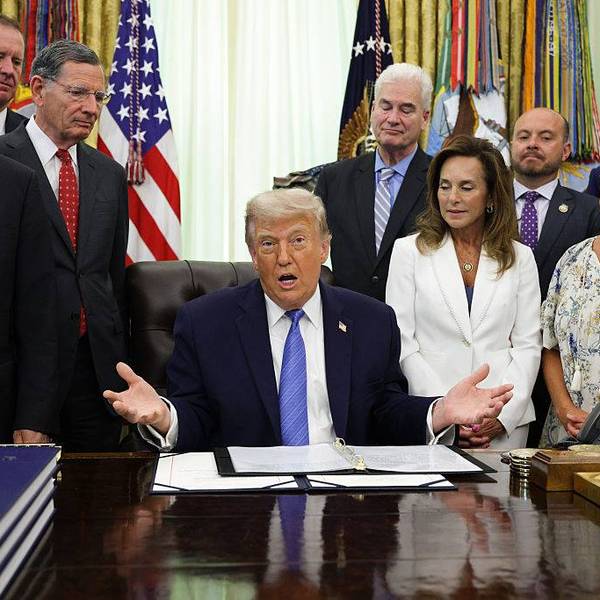
The first narrative belongs to the Trump administration, largely embraced by the US Western allies. It rests on the self-serving claim that US President Donald Trump personally solved the Middle East crisis, ushering in a peace that has supposedly eluded the region for thousands of years. Figures like Trump, his son-in-law Jared Kushner, and US-Israel Ambassador Mike Huckabee are presented as architects of a new regional order.
This narrative is exclusive, domineering, and US-centric. It was exemplified by Trump himself when he declared the Gaza conflict "over" and presented a "peace plan" that strategically avoided any clear commitment to Palestinian statehood. The entire vision is built on transactional diplomacy and a dismissal of international legal consensus, positioning US approval as the sole measure of legitimacy.
The second narrative is that of the Palestinians, supported by Arab nations and much of the Global South. Here, the goal is Palestinian freedom and rights grounded in international law and humanitarian principles.
A lasting peace can only be built on the foundation of justice, not on the military reality established by an aggressor that does not hesitate to employ genocide in the service of its political designs.
This discourse is frequently shaped by statements from top Arab officials. Egyptian Foreign Minister Badr Abdelatty, for example, asserted last April that the two-state solution is “the only way to achieve security and stability in this region,” adding a warning: “If we disregard international law... this will open the way for the law of the jungle to prevail.” This narrative continues to insist on international law as central to true regional peace.
The third narrative is Israel’s—and it is the only one backed by concrete, aggressive policy. This vision is written through sustained, systematic violence against civilians, aggressive land seizures, deliberate home demolitions, and explicit government declarations that a Palestinian state will never be permitted. Its actors operate with chilling impunity, rapidly creating irreversible facts on the ground. Crucially, the failure to enforce accountability for this pervasive violence is the primary reason Israel has been able to sustain its devastating genocide in Gaza for two full years.
This narrative is not theoretical; it is articulated through the chilling acts and legislative pushes of the highest-ranking government officials.
On December 8, Israel’s National Security Minister Itamar Ben-Gvir appeared in a Knesset session wearing a noose-shaped pin while pushing for a death penalty bill targeting Palestinian prisoners. The minister stated openly that the noose was "just one of the options" through which they would implement the death penalty, listing “the option of hanging, the electric chair, and... lethal injection.”
Finance Minister Bezalel Smotrich, meanwhile, announced an allocation of $843 million to expand illegal settlements over the next five years, a massive step toward formal annexation. This unprecedented funding is specifically earmarked to relocate military bases, establish absorption clusters of mobile homes, and create a dedicated land registry to formalize Israeli governmental control over the occupied Palestinian territory.
This policy of territorial expansion is cemented by the ideological head of government, as Israeli Prime Minister Benjamin Netanyahu himself made it clear that “there will not be a Palestinian state. It’s very simple: it will not be established,” calling its potential creation “an existential threat to Israel.” This unequivocal rejection confirms that the official Israeli government strategy is outright territorial expansion and the permanent denial of Palestinian self-determination.
None of these Israeli officials shows the slightest interest in Trump’s “peace plan” or in the Palestinian vision of statehood. Netanyahu’s core objective is ensuring that international law is never implemented, that no semblance of Palestinian sovereignty is established, and that Israel can contravene the law at a time and manner of its choosing.
The fact is, these narratives cannot continue to coexist. Only real accountability—through political, legal, and economic pressure—can halt Israel’s advance toward continuing its genocidal campaign, destruction, and punitive legislation. This must include the swift imposition of sanctions on Israel and its top officials, comprehensive arms embargoes against Tel Aviv to end ongoing wars, and fullaccountability at the International Criminal Court (ICC) and International Court of Justice (ICJ).
As long as the pro-Palestine narrative lacks the tools to enforce its principles, Israel and its Western backers will see no reason to alter course. States must replace symbolic gestures and prioritize aggressive, proactive accountability measures. This means moving beyond simple verbal condemnation and applying concrete legal and economic pressure.
Israel is now more isolated than ever, with public opinion rapidly collapsing globally. This isolation must be leveraged by pro-Palestine forces through coordinated, decisive diplomatic action, pushing for a unified global front that demands the enforcement of international law and holding Israel and its many war criminals accountable for their ongoing crimes.
A lasting peace can only be built on the foundation of justice, not on the military reality established by an aggressor that does not hesitate to employ genocide in the service of its political designs. This is the undeniable moral frontier: confronting and dismantling the impunity that allows a state to pursue extermination as a political tool.
Dear Common Dreams reader, It’s been nearly 30 years since I co-founded Common Dreams with my late wife, Lina Newhouser. We had the radical notion that journalism should serve the public good, not corporate profits. It was clear to us from the outset what it would take to build such a project. No paid advertisements. No corporate sponsors. No millionaire publisher telling us what to think or do. Many people said we wouldn't last a year, but we proved those doubters wrong. Together with a tremendous team of journalists and dedicated staff, we built an independent media outlet free from the constraints of profits and corporate control. Our mission has always been simple: To inform. To inspire. To ignite change for the common good. Building Common Dreams was not easy. Our survival was never guaranteed. When you take on the most powerful forces—Wall Street greed, fossil fuel industry destruction, Big Tech lobbyists, and uber-rich oligarchs who have spent billions upon billions rigging the economy and democracy in their favor—the only bulwark you have is supporters who believe in your work. But here’s the urgent message from me today. It's never been this bad out there. And it's never been this hard to keep us going. At the very moment Common Dreams is most needed, the threats we face are intensifying. We need your support now more than ever. We don't accept corporate advertising and never will. We don't have a paywall because we don't think people should be blocked from critical news based on their ability to pay. Everything we do is funded by the donations of readers like you. When everyone does the little they can afford, we are strong. But if that support retreats or dries up, so do we. Will you donate now to make sure Common Dreams not only survives but thrives? —Craig Brown, Co-founder |
Three dominant narratives contend for the future of Gaza and occupied Palestine, yet only one is being translated into consequential action: the Israeli narrative of domination and genocide. This singular, violent vision is the only one backed by the brute force of policy and fact.
The first narrative belongs to the Trump administration, largely embraced by the US Western allies. It rests on the self-serving claim that US President Donald Trump personally solved the Middle East crisis, ushering in a peace that has supposedly eluded the region for thousands of years. Figures like Trump, his son-in-law Jared Kushner, and US-Israel Ambassador Mike Huckabee are presented as architects of a new regional order.
This narrative is exclusive, domineering, and US-centric. It was exemplified by Trump himself when he declared the Gaza conflict "over" and presented a "peace plan" that strategically avoided any clear commitment to Palestinian statehood. The entire vision is built on transactional diplomacy and a dismissal of international legal consensus, positioning US approval as the sole measure of legitimacy.
The second narrative is that of the Palestinians, supported by Arab nations and much of the Global South. Here, the goal is Palestinian freedom and rights grounded in international law and humanitarian principles.
A lasting peace can only be built on the foundation of justice, not on the military reality established by an aggressor that does not hesitate to employ genocide in the service of its political designs.
This discourse is frequently shaped by statements from top Arab officials. Egyptian Foreign Minister Badr Abdelatty, for example, asserted last April that the two-state solution is “the only way to achieve security and stability in this region,” adding a warning: “If we disregard international law... this will open the way for the law of the jungle to prevail.” This narrative continues to insist on international law as central to true regional peace.
The third narrative is Israel’s—and it is the only one backed by concrete, aggressive policy. This vision is written through sustained, systematic violence against civilians, aggressive land seizures, deliberate home demolitions, and explicit government declarations that a Palestinian state will never be permitted. Its actors operate with chilling impunity, rapidly creating irreversible facts on the ground. Crucially, the failure to enforce accountability for this pervasive violence is the primary reason Israel has been able to sustain its devastating genocide in Gaza for two full years.
This narrative is not theoretical; it is articulated through the chilling acts and legislative pushes of the highest-ranking government officials.
On December 8, Israel’s National Security Minister Itamar Ben-Gvir appeared in a Knesset session wearing a noose-shaped pin while pushing for a death penalty bill targeting Palestinian prisoners. The minister stated openly that the noose was "just one of the options" through which they would implement the death penalty, listing “the option of hanging, the electric chair, and... lethal injection.”
Finance Minister Bezalel Smotrich, meanwhile, announced an allocation of $843 million to expand illegal settlements over the next five years, a massive step toward formal annexation. This unprecedented funding is specifically earmarked to relocate military bases, establish absorption clusters of mobile homes, and create a dedicated land registry to formalize Israeli governmental control over the occupied Palestinian territory.
This policy of territorial expansion is cemented by the ideological head of government, as Israeli Prime Minister Benjamin Netanyahu himself made it clear that “there will not be a Palestinian state. It’s very simple: it will not be established,” calling its potential creation “an existential threat to Israel.” This unequivocal rejection confirms that the official Israeli government strategy is outright territorial expansion and the permanent denial of Palestinian self-determination.
None of these Israeli officials shows the slightest interest in Trump’s “peace plan” or in the Palestinian vision of statehood. Netanyahu’s core objective is ensuring that international law is never implemented, that no semblance of Palestinian sovereignty is established, and that Israel can contravene the law at a time and manner of its choosing.
The fact is, these narratives cannot continue to coexist. Only real accountability—through political, legal, and economic pressure—can halt Israel’s advance toward continuing its genocidal campaign, destruction, and punitive legislation. This must include the swift imposition of sanctions on Israel and its top officials, comprehensive arms embargoes against Tel Aviv to end ongoing wars, and fullaccountability at the International Criminal Court (ICC) and International Court of Justice (ICJ).
As long as the pro-Palestine narrative lacks the tools to enforce its principles, Israel and its Western backers will see no reason to alter course. States must replace symbolic gestures and prioritize aggressive, proactive accountability measures. This means moving beyond simple verbal condemnation and applying concrete legal and economic pressure.
Israel is now more isolated than ever, with public opinion rapidly collapsing globally. This isolation must be leveraged by pro-Palestine forces through coordinated, decisive diplomatic action, pushing for a unified global front that demands the enforcement of international law and holding Israel and its many war criminals accountable for their ongoing crimes.
A lasting peace can only be built on the foundation of justice, not on the military reality established by an aggressor that does not hesitate to employ genocide in the service of its political designs. This is the undeniable moral frontier: confronting and dismantling the impunity that allows a state to pursue extermination as a political tool.
Three dominant narratives contend for the future of Gaza and occupied Palestine, yet only one is being translated into consequential action: the Israeli narrative of domination and genocide. This singular, violent vision is the only one backed by the brute force of policy and fact.
The first narrative belongs to the Trump administration, largely embraced by the US Western allies. It rests on the self-serving claim that US President Donald Trump personally solved the Middle East crisis, ushering in a peace that has supposedly eluded the region for thousands of years. Figures like Trump, his son-in-law Jared Kushner, and US-Israel Ambassador Mike Huckabee are presented as architects of a new regional order.
This narrative is exclusive, domineering, and US-centric. It was exemplified by Trump himself when he declared the Gaza conflict "over" and presented a "peace plan" that strategically avoided any clear commitment to Palestinian statehood. The entire vision is built on transactional diplomacy and a dismissal of international legal consensus, positioning US approval as the sole measure of legitimacy.
The second narrative is that of the Palestinians, supported by Arab nations and much of the Global South. Here, the goal is Palestinian freedom and rights grounded in international law and humanitarian principles.
A lasting peace can only be built on the foundation of justice, not on the military reality established by an aggressor that does not hesitate to employ genocide in the service of its political designs.
This discourse is frequently shaped by statements from top Arab officials. Egyptian Foreign Minister Badr Abdelatty, for example, asserted last April that the two-state solution is “the only way to achieve security and stability in this region,” adding a warning: “If we disregard international law... this will open the way for the law of the jungle to prevail.” This narrative continues to insist on international law as central to true regional peace.
The third narrative is Israel’s—and it is the only one backed by concrete, aggressive policy. This vision is written through sustained, systematic violence against civilians, aggressive land seizures, deliberate home demolitions, and explicit government declarations that a Palestinian state will never be permitted. Its actors operate with chilling impunity, rapidly creating irreversible facts on the ground. Crucially, the failure to enforce accountability for this pervasive violence is the primary reason Israel has been able to sustain its devastating genocide in Gaza for two full years.
This narrative is not theoretical; it is articulated through the chilling acts and legislative pushes of the highest-ranking government officials.
On December 8, Israel’s National Security Minister Itamar Ben-Gvir appeared in a Knesset session wearing a noose-shaped pin while pushing for a death penalty bill targeting Palestinian prisoners. The minister stated openly that the noose was "just one of the options" through which they would implement the death penalty, listing “the option of hanging, the electric chair, and... lethal injection.”
Finance Minister Bezalel Smotrich, meanwhile, announced an allocation of $843 million to expand illegal settlements over the next five years, a massive step toward formal annexation. This unprecedented funding is specifically earmarked to relocate military bases, establish absorption clusters of mobile homes, and create a dedicated land registry to formalize Israeli governmental control over the occupied Palestinian territory.
This policy of territorial expansion is cemented by the ideological head of government, as Israeli Prime Minister Benjamin Netanyahu himself made it clear that “there will not be a Palestinian state. It’s very simple: it will not be established,” calling its potential creation “an existential threat to Israel.” This unequivocal rejection confirms that the official Israeli government strategy is outright territorial expansion and the permanent denial of Palestinian self-determination.
None of these Israeli officials shows the slightest interest in Trump’s “peace plan” or in the Palestinian vision of statehood. Netanyahu’s core objective is ensuring that international law is never implemented, that no semblance of Palestinian sovereignty is established, and that Israel can contravene the law at a time and manner of its choosing.
The fact is, these narratives cannot continue to coexist. Only real accountability—through political, legal, and economic pressure—can halt Israel’s advance toward continuing its genocidal campaign, destruction, and punitive legislation. This must include the swift imposition of sanctions on Israel and its top officials, comprehensive arms embargoes against Tel Aviv to end ongoing wars, and fullaccountability at the International Criminal Court (ICC) and International Court of Justice (ICJ).
As long as the pro-Palestine narrative lacks the tools to enforce its principles, Israel and its Western backers will see no reason to alter course. States must replace symbolic gestures and prioritize aggressive, proactive accountability measures. This means moving beyond simple verbal condemnation and applying concrete legal and economic pressure.
Israel is now more isolated than ever, with public opinion rapidly collapsing globally. This isolation must be leveraged by pro-Palestine forces through coordinated, decisive diplomatic action, pushing for a unified global front that demands the enforcement of international law and holding Israel and its many war criminals accountable for their ongoing crimes.
A lasting peace can only be built on the foundation of justice, not on the military reality established by an aggressor that does not hesitate to employ genocide in the service of its political designs. This is the undeniable moral frontier: confronting and dismantling the impunity that allows a state to pursue extermination as a political tool.