SUBSCRIBE TO OUR FREE NEWSLETTER
Daily news & progressive opinion—funded by the people, not the corporations—delivered straight to your inbox.
5
#000000
#FFFFFF
To donate by check, phone, or other method, see our More Ways to Give page.
Daily news & progressive opinion—funded by the people, not the corporations—delivered straight to your inbox.
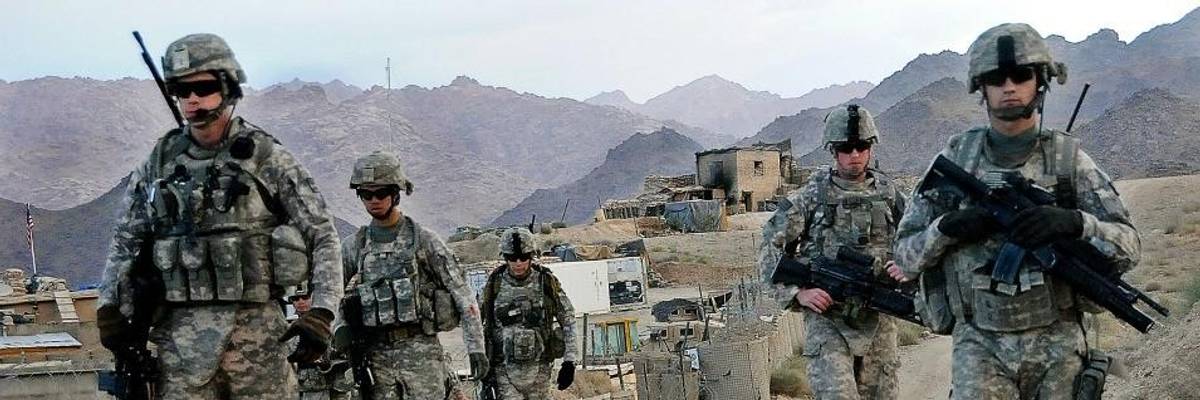
U.S. troops patrol near Forward Operating Base Baylough in Zabul province, Afghanistan. (Photo: U.S. Army/Public Domain)
House Democrats are leading a charge to repeal the 2002 Authorization for Use of Military Force that President Bush used to invade Iraq in 2003, that Obama used for a host of anti-ISIS air campaigns over eight years, and President Trump cited to justify a 2020 drone strike on Iranian General Qassem Soleimani.
Dismantling the AUMFs that are used to wage wars that are increasingly attenuated from the original intent of those authorizations is important. But if wars like Afghanistan are not also brought to an end, then they will inevitably be made to fit new and more narrow authorizations making it even harder to end them in the future.
If President Biden refuses to leave Afghanistan, then a war with no achievable end state will likely be grandfathered into any future and purportedly more narrow AUMF.
Press secretary Jen Psaki recently indicated that President Biden welcomes an effort by Congress to replace the 2001 and 2002 AUMFs with a "narrow and specific framework that will ensure we can protect Americans from terrorist threats while ending the forever wars."
But he is not the first president to cast doubt on the utility of AUMFs that are now nearly two decades old. In a 2013 speech at the National Defense University, President Obama remarked, "[s]o I look forward to engaging Congress and the American people in efforts to refine, and ultimately repeal, the AUMF's mandate." But this inclination did not stop the Obama administration from using the 2001 AUMF to justify attacks on ISIS in Syria by arguing that the group was essentially cut from the same cloth as al-Qaeda. Similarly, President Biden's appeal for oversight did not stop him from ordering an airstrike in Syria and citing his Article II powers as Commander-in-Chief, nor has it led him to end the war in Afghanistan.
That President Biden continues to deploy U.S. military force abroad while also calling for more restrictive AUMFs is not surprising. He may feel political pressure to continue to use the broad powers authorized to him until Congress hopefully relieves him of this burden and takes more responsibility over America's wars. This is precisely why narrower AUMFs will not end America's forever wars without additional steps. Truly ending forever wars will require leaders and the "NatSec"community to prioritize the proven costs of engaging in forever war over the future risks of not taking military action.
Afghanistan is a good place to start. If President Biden refuses to leave Afghanistan, then a war with no achievable end state will likely be grandfathered into any future and purportedly more narrow AUMF. This may not occur explicitly in the authorization's text but through its application. Much needed repeals of the current AUMFs will be reduced to little more than Congressional virtue signaling. If the U.S. cannot walk away from the war in Afghanistan, then it is difficult to imagine how Washington will prioritize other threats without getting dragged into perpetual conflicts of choice.
Others have also argued that merely replacing or passing a new AUMF does not amount to Congressional oversight. In 2018, Richard Fontaine and Vance Serchuk warned, "[l]awmakers who portray passage of an AUMF as the ultimate fulfillment of their war-powers responsibilities therefore risk elevating constitutional form over national security substance." Rather than pass an AUMF and let it sit untouched for years, they assert that Congressional oversight should be "continuous" and occur "independent from any AUMF mechanism." Jack Goldsmith and Samuel Moyn argue that, "Congress must do more than withdraw old permission slips" and instead "cut off funding for discretionary presidential wars after a short period, absent congressional permission or a defined emergency."
Thus, genuine oversight must function as a threshold rather than a loophole. This will inherently require America's leaders to accept manageable degrees of risk to avoid neverending wars. Afghanistan represents the clearest test of this approach. Leaving Afghanistan militarily will force the United States to find new ways to respond to potential terrorism threats on U.S. targets in the region. But these threats no longer present the same risk they once did and the capacity to disrupt attacks within the United States is far greater than on the morning of 9/11. The cost of continuing to wage endless wars long ago surpassed any security benefits.
Dear Common Dreams reader, It’s been nearly 30 years since I co-founded Common Dreams with my late wife, Lina Newhouser. We had the radical notion that journalism should serve the public good, not corporate profits. It was clear to us from the outset what it would take to build such a project. No paid advertisements. No corporate sponsors. No millionaire publisher telling us what to think or do. Many people said we wouldn't last a year, but we proved those doubters wrong. Together with a tremendous team of journalists and dedicated staff, we built an independent media outlet free from the constraints of profits and corporate control. Our mission has always been simple: To inform. To inspire. To ignite change for the common good. Building Common Dreams was not easy. Our survival was never guaranteed. When you take on the most powerful forces—Wall Street greed, fossil fuel industry destruction, Big Tech lobbyists, and uber-rich oligarchs who have spent billions upon billions rigging the economy and democracy in their favor—the only bulwark you have is supporters who believe in your work. But here’s the urgent message from me today. It's never been this bad out there. And it's never been this hard to keep us going. At the very moment Common Dreams is most needed, the threats we face are intensifying. We need your support now more than ever. We don't accept corporate advertising and never will. We don't have a paywall because we don't think people should be blocked from critical news based on their ability to pay. Everything we do is funded by the donations of readers like you. When everyone does the little they can afford, we are strong. But if that support retreats or dries up, so do we. Will you donate now to make sure Common Dreams not only survives but thrives? —Craig Brown, Co-founder |
House Democrats are leading a charge to repeal the 2002 Authorization for Use of Military Force that President Bush used to invade Iraq in 2003, that Obama used for a host of anti-ISIS air campaigns over eight years, and President Trump cited to justify a 2020 drone strike on Iranian General Qassem Soleimani.
Dismantling the AUMFs that are used to wage wars that are increasingly attenuated from the original intent of those authorizations is important. But if wars like Afghanistan are not also brought to an end, then they will inevitably be made to fit new and more narrow authorizations making it even harder to end them in the future.
If President Biden refuses to leave Afghanistan, then a war with no achievable end state will likely be grandfathered into any future and purportedly more narrow AUMF.
Press secretary Jen Psaki recently indicated that President Biden welcomes an effort by Congress to replace the 2001 and 2002 AUMFs with a "narrow and specific framework that will ensure we can protect Americans from terrorist threats while ending the forever wars."
But he is not the first president to cast doubt on the utility of AUMFs that are now nearly two decades old. In a 2013 speech at the National Defense University, President Obama remarked, "[s]o I look forward to engaging Congress and the American people in efforts to refine, and ultimately repeal, the AUMF's mandate." But this inclination did not stop the Obama administration from using the 2001 AUMF to justify attacks on ISIS in Syria by arguing that the group was essentially cut from the same cloth as al-Qaeda. Similarly, President Biden's appeal for oversight did not stop him from ordering an airstrike in Syria and citing his Article II powers as Commander-in-Chief, nor has it led him to end the war in Afghanistan.
That President Biden continues to deploy U.S. military force abroad while also calling for more restrictive AUMFs is not surprising. He may feel political pressure to continue to use the broad powers authorized to him until Congress hopefully relieves him of this burden and takes more responsibility over America's wars. This is precisely why narrower AUMFs will not end America's forever wars without additional steps. Truly ending forever wars will require leaders and the "NatSec"community to prioritize the proven costs of engaging in forever war over the future risks of not taking military action.
Afghanistan is a good place to start. If President Biden refuses to leave Afghanistan, then a war with no achievable end state will likely be grandfathered into any future and purportedly more narrow AUMF. This may not occur explicitly in the authorization's text but through its application. Much needed repeals of the current AUMFs will be reduced to little more than Congressional virtue signaling. If the U.S. cannot walk away from the war in Afghanistan, then it is difficult to imagine how Washington will prioritize other threats without getting dragged into perpetual conflicts of choice.
Others have also argued that merely replacing or passing a new AUMF does not amount to Congressional oversight. In 2018, Richard Fontaine and Vance Serchuk warned, "[l]awmakers who portray passage of an AUMF as the ultimate fulfillment of their war-powers responsibilities therefore risk elevating constitutional form over national security substance." Rather than pass an AUMF and let it sit untouched for years, they assert that Congressional oversight should be "continuous" and occur "independent from any AUMF mechanism." Jack Goldsmith and Samuel Moyn argue that, "Congress must do more than withdraw old permission slips" and instead "cut off funding for discretionary presidential wars after a short period, absent congressional permission or a defined emergency."
Thus, genuine oversight must function as a threshold rather than a loophole. This will inherently require America's leaders to accept manageable degrees of risk to avoid neverending wars. Afghanistan represents the clearest test of this approach. Leaving Afghanistan militarily will force the United States to find new ways to respond to potential terrorism threats on U.S. targets in the region. But these threats no longer present the same risk they once did and the capacity to disrupt attacks within the United States is far greater than on the morning of 9/11. The cost of continuing to wage endless wars long ago surpassed any security benefits.
House Democrats are leading a charge to repeal the 2002 Authorization for Use of Military Force that President Bush used to invade Iraq in 2003, that Obama used for a host of anti-ISIS air campaigns over eight years, and President Trump cited to justify a 2020 drone strike on Iranian General Qassem Soleimani.
Dismantling the AUMFs that are used to wage wars that are increasingly attenuated from the original intent of those authorizations is important. But if wars like Afghanistan are not also brought to an end, then they will inevitably be made to fit new and more narrow authorizations making it even harder to end them in the future.
If President Biden refuses to leave Afghanistan, then a war with no achievable end state will likely be grandfathered into any future and purportedly more narrow AUMF.
Press secretary Jen Psaki recently indicated that President Biden welcomes an effort by Congress to replace the 2001 and 2002 AUMFs with a "narrow and specific framework that will ensure we can protect Americans from terrorist threats while ending the forever wars."
But he is not the first president to cast doubt on the utility of AUMFs that are now nearly two decades old. In a 2013 speech at the National Defense University, President Obama remarked, "[s]o I look forward to engaging Congress and the American people in efforts to refine, and ultimately repeal, the AUMF's mandate." But this inclination did not stop the Obama administration from using the 2001 AUMF to justify attacks on ISIS in Syria by arguing that the group was essentially cut from the same cloth as al-Qaeda. Similarly, President Biden's appeal for oversight did not stop him from ordering an airstrike in Syria and citing his Article II powers as Commander-in-Chief, nor has it led him to end the war in Afghanistan.
That President Biden continues to deploy U.S. military force abroad while also calling for more restrictive AUMFs is not surprising. He may feel political pressure to continue to use the broad powers authorized to him until Congress hopefully relieves him of this burden and takes more responsibility over America's wars. This is precisely why narrower AUMFs will not end America's forever wars without additional steps. Truly ending forever wars will require leaders and the "NatSec"community to prioritize the proven costs of engaging in forever war over the future risks of not taking military action.
Afghanistan is a good place to start. If President Biden refuses to leave Afghanistan, then a war with no achievable end state will likely be grandfathered into any future and purportedly more narrow AUMF. This may not occur explicitly in the authorization's text but through its application. Much needed repeals of the current AUMFs will be reduced to little more than Congressional virtue signaling. If the U.S. cannot walk away from the war in Afghanistan, then it is difficult to imagine how Washington will prioritize other threats without getting dragged into perpetual conflicts of choice.
Others have also argued that merely replacing or passing a new AUMF does not amount to Congressional oversight. In 2018, Richard Fontaine and Vance Serchuk warned, "[l]awmakers who portray passage of an AUMF as the ultimate fulfillment of their war-powers responsibilities therefore risk elevating constitutional form over national security substance." Rather than pass an AUMF and let it sit untouched for years, they assert that Congressional oversight should be "continuous" and occur "independent from any AUMF mechanism." Jack Goldsmith and Samuel Moyn argue that, "Congress must do more than withdraw old permission slips" and instead "cut off funding for discretionary presidential wars after a short period, absent congressional permission or a defined emergency."
Thus, genuine oversight must function as a threshold rather than a loophole. This will inherently require America's leaders to accept manageable degrees of risk to avoid neverending wars. Afghanistan represents the clearest test of this approach. Leaving Afghanistan militarily will force the United States to find new ways to respond to potential terrorism threats on U.S. targets in the region. But these threats no longer present the same risk they once did and the capacity to disrupt attacks within the United States is far greater than on the morning of 9/11. The cost of continuing to wage endless wars long ago surpassed any security benefits.