
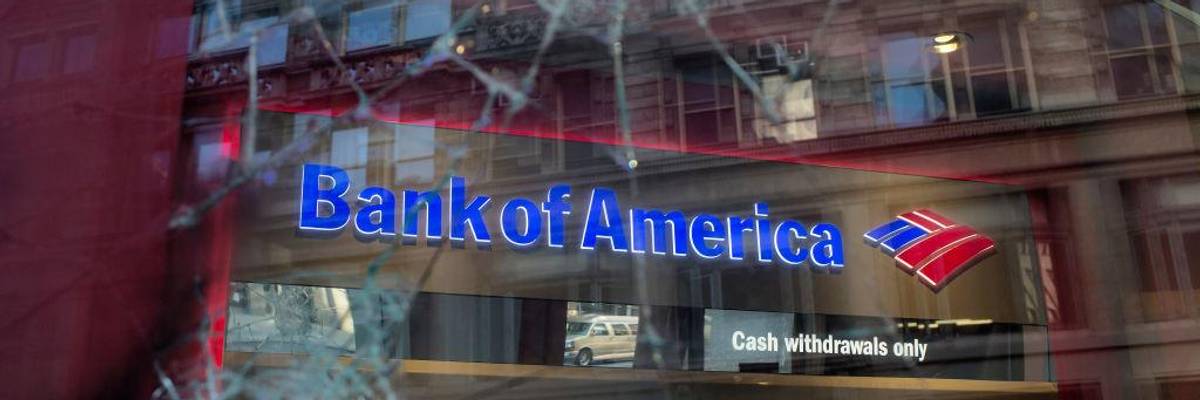
Bank of America is the only major American bank that has not yet ruled out funding for destructive drilling in the Arctic National Wildlife Refuge. (Photo by Andrew Lichtenstein/Corbis via Getty Images)
Why Is Bank of America Still Open to Funding the Destruction of Our Homelands in the Arctic?
We stand together, the Iñupiat and the Gwich’in, in calling on Bank of America to listen to Indigenous people, protect our homelands, and stay out of the Arctic Refuge.
Bank of America's customers may have noticed that recently the bank has been standing out from the rest of its peers. Unfortunately, it hasn't been in a good way. Right now, Bank of America is the only major American bank that has not yet ruled out funding for destructive drilling in the Arctic National Wildlife Refuge.
Over the last year, every other major American bank--Goldman Sachs, Wells Fargo, Chase, Citi, and Morgan Stanley--have joined more than two dozen financial institutions worldwide in updating their lending policies to exclude funding for new drilling in the Arctic, including the Arctic Refuge. Indigenous human rights are being upheld in these new policies and pave the way towards a just transition into a sustainable economy.
As a growing number of major banks are making the right decision, all eyes are on Bank of America to see whether they will follow their peers or continue to stand out in their disregard for the rights of Alaska's Indigenous people.
For thousands of years, the coastal plain of the Arctic Refuge has sustained life for the Porcupine Caribou Herd, and other relatives on and off the land, that sustain the food security and ways of life of the Inupiat and Gwich'in people as well as other Alaska Native Tribes. Any disruption of this area would pose an existential threat to not just food security, but our identity as Inupiat and Gwich'in People. Drilling in the Arctic Refuge would also pose an increased public health threat to communities on Alaska's North Slope that already experience severe health disparities directly tied to the oil production surrounding their community.
Drilling in the Arctic Refuge violates Indigenous rights, and is a threat to the bottom line of any bank that funds this destructive activity. As the world increasingly recognizes the urgent need to move away from polluting fossil fuels, investments in expensive new drilling projects are growing riskier. By ruling out support for Arctic drilling, banks have recognized that investing in a project that would threaten human rights and worsen the climate crisis is a risk that's not worth taking.
Pro-drilling politicians that have long sought to sell off the coastal plain for drilling have predictably pushed back on this growing trend, even going so far as to point to support from corporations like Arctic Slope Regional Corporation to claim that Alaska Native people support drilling, or that the Gwich'in are alone in their opposition to drilling while the Inupiat people or members of other Tribes support it. We recently had the opportunity to meet with Bank of America executives to correct the record and explain that these claims couldn't be further from the truth.
We let them know that both Gwich'in and Inupiat Peoples have made official resolutions to protect the Arctic Refuge, and that Alaska Native corporations are just that: corporations. They are not accountable to Tribal members, and they do not speak for us. Neither does Alaska's Congressional delegation, whose push for drilling and disingenuous claims that the destruction of the Arctic Refuge would help Native communities have made it clear that they care more about corporate profits than our health or human rights.
We know that we can't count on these politicians to do the right thing to defend our land and our communities, and the Trump administration is pushing ahead to try to sell off the coastal plain for drilling by the end of the year. That's why it's more important than ever that financial institutions like Bank of America recognize the role they play in helping destroy this sacred place or keeping it intact.
As a growing number of major banks are making the right decision, all eyes are on Bank of America to see whether they will follow their peers or continue to stand out in their disregard for the rights of Alaska's Indigenous people. We stand together, the Inupiat and the Gwich'in, in calling on Bank of America to listen to Indigenous people, protect our homelands, and stay out of the Arctic Refuge.
We are at a crossroads
This country and this world are at a monumental crossroads. In a few short weeks, US voters will have an opportunity to beat back the forces of fascism and confront the billionaires who are rigging the economy, our media system, and our democracy, making it increasingly impossible for ordinary people to get by. We’re not just talking about the election. We’re talking about what must be done once these fascist elements are vanquished from power. We need a bolder set of solutions than what either major party has so far been willing to offer and a working-class movement ready to fight like hell for it. Trump didn't emerge from nowhere. The conditions that fueled MAGA authoritarianism were created by decades of radical neoliberal economic policies and a corrupt political system dominated by corporate interests. They slashed taxes on the super-rich, promising that the benefits would trickle down. They said giveaways to the corporate titans would make life more affordable for the rest of us. It was all bullshit. And when a bitter, betrayed populace searches for someone to blame, right-wing demagogues have little trouble finding scapegoats. People know when they're being lied to, but you won't hear any of this from the corporate media. Only independent journalism—powered and funded by people who believe in building a better world—can deliver truly trustworthy daily news. Our Fall Campaign is underway, and we need your help. To power our newsroom through the rest of the year, we need to raise $125,000 by midnight on October 31. So if you share our vision, please contribute whatever you can to sustain our work. |
Bank of America's customers may have noticed that recently the bank has been standing out from the rest of its peers. Unfortunately, it hasn't been in a good way. Right now, Bank of America is the only major American bank that has not yet ruled out funding for destructive drilling in the Arctic National Wildlife Refuge.
Over the last year, every other major American bank--Goldman Sachs, Wells Fargo, Chase, Citi, and Morgan Stanley--have joined more than two dozen financial institutions worldwide in updating their lending policies to exclude funding for new drilling in the Arctic, including the Arctic Refuge. Indigenous human rights are being upheld in these new policies and pave the way towards a just transition into a sustainable economy.
As a growing number of major banks are making the right decision, all eyes are on Bank of America to see whether they will follow their peers or continue to stand out in their disregard for the rights of Alaska's Indigenous people.
For thousands of years, the coastal plain of the Arctic Refuge has sustained life for the Porcupine Caribou Herd, and other relatives on and off the land, that sustain the food security and ways of life of the Inupiat and Gwich'in people as well as other Alaska Native Tribes. Any disruption of this area would pose an existential threat to not just food security, but our identity as Inupiat and Gwich'in People. Drilling in the Arctic Refuge would also pose an increased public health threat to communities on Alaska's North Slope that already experience severe health disparities directly tied to the oil production surrounding their community.
Drilling in the Arctic Refuge violates Indigenous rights, and is a threat to the bottom line of any bank that funds this destructive activity. As the world increasingly recognizes the urgent need to move away from polluting fossil fuels, investments in expensive new drilling projects are growing riskier. By ruling out support for Arctic drilling, banks have recognized that investing in a project that would threaten human rights and worsen the climate crisis is a risk that's not worth taking.
Pro-drilling politicians that have long sought to sell off the coastal plain for drilling have predictably pushed back on this growing trend, even going so far as to point to support from corporations like Arctic Slope Regional Corporation to claim that Alaska Native people support drilling, or that the Gwich'in are alone in their opposition to drilling while the Inupiat people or members of other Tribes support it. We recently had the opportunity to meet with Bank of America executives to correct the record and explain that these claims couldn't be further from the truth.
We let them know that both Gwich'in and Inupiat Peoples have made official resolutions to protect the Arctic Refuge, and that Alaska Native corporations are just that: corporations. They are not accountable to Tribal members, and they do not speak for us. Neither does Alaska's Congressional delegation, whose push for drilling and disingenuous claims that the destruction of the Arctic Refuge would help Native communities have made it clear that they care more about corporate profits than our health or human rights.
We know that we can't count on these politicians to do the right thing to defend our land and our communities, and the Trump administration is pushing ahead to try to sell off the coastal plain for drilling by the end of the year. That's why it's more important than ever that financial institutions like Bank of America recognize the role they play in helping destroy this sacred place or keeping it intact.
As a growing number of major banks are making the right decision, all eyes are on Bank of America to see whether they will follow their peers or continue to stand out in their disregard for the rights of Alaska's Indigenous people. We stand together, the Inupiat and the Gwich'in, in calling on Bank of America to listen to Indigenous people, protect our homelands, and stay out of the Arctic Refuge.