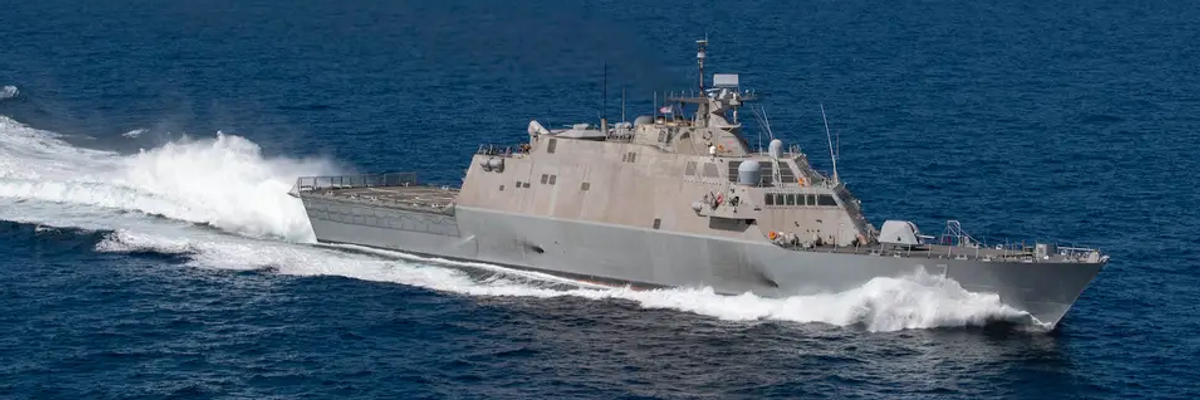
Littoral combat ship USS Detroit off the coast of Venezuela. (Photo: US Navy/DoD)
Threatening Military Intervention in Venezuela During a Pandemic?
With cities in Venezuela under lockdown and the country struggling to address a looming public health crisis and yet another economic shock, it is clear that the Trump administration sees a new opportunity to exercise "maximum pressure" to try to achieve regime change.
Unbeknownst to most Americans--and as we are grapple with this terrifying pandemic--the Trump administration is currently carrying out the largest military operation in Latin America in 30 years, and has made it clear that alleged Venezuelan "narco-terrorism" is the target. It's worth noting that the last deployment of similar size took place at the time of the 1989 U.S. military intervention in Panama to remove General Manuel Noriega.
President Trump announced the deployment at the beginning of an April 1 COVID-19 press conference. According to Defense Secretary Mark Esper, "included in this force package are Navy destroyers and littoral combat ships, Coast Guard Cutters, P.A. patrol aircraft, and elements of an Army security force assistance brigade." General Mark Milley, Chairman of the Joint Chiefs of Staff, added that there are "thousands of sailors, Coast Guardsman, soldiers, airmen, Marines involved in this operation."
The announcement came a week after U.S. Attorney General William Barr unsealed an indictment against President Nicolas Maduro and 13 other current or former Venezuelan officials. The officials were accused of "narco-terrorism" and millions of dollars in cash rewards were offered for information leading to their capture, including a $15 million reward for Maduro.
"Trump has been threatening military intervention since 2017, and this massive deployment of naval assets in the vicinity of Venezuela takes the U.S. one step closer to an armed attack."
In their remarks during the press conference, Trump administration officials made it clear that the main target of this massive military mission is, in the words of Esper, "the illegitimate Maduro regime in Venezuela" that relies "on the profits derived from the sale of narcotics to maintain its oppressive hold on power." National Security Advisor Robert O'Brian said "we will continue to execute our maximum pressure policy to counter the Maduro regime's malign activities, including drug trafficking."
With cities in Venezuela under lockdown and the country struggling to address a looming public health crisis and yet another economic shock, it is clear that the Trump administration sees a new opportunity to exercise "maximum pressure" to try to achieve regime change. President Trump has been threatening military intervention since 2017, and this massive deployment of naval assets in the vicinity of Venezuela takes the U.S. one step closer to an armed attack. William Brownfield, former U.S. ambassador to Venezuela and one of the architects of the strategy to undermine the Venezuelan government, called the deployment "the application of [Trump's] military option."
According to Foreign Policy, the U.S. Defense Department opposed deploying such a great quantity of military assets to the Caribbean, especially at a time when the U.S. military is having to confront the spread of Covid-19 (as witnessed recently aboard the USS Theodore Roosevelt). According to a former senior government official, Trump's decision to deploy these assets over the objections of DOD commanders was driven entirely by "politics."
A senior official at the Pentagon told Newsweek that "the premise of the operation is a surge against drug trafficking--but when have you ever heard of using that type of force for drugs? (...) The underlying purpose is to pressurize the Maduro regime." This pressure could come in the form of the U.S. Navy boarding and seizing Venezuelan oil tankers, according to a senior Maduro government official. This is a valid worry, as the Pentagon has claimed--without offering any evidence--that drugs are trafficked "using naval vessels from Venezuela to Cuba." Given the U.S. government's targeting and sanction of ships that transport oil from Cuba to Venezuela, it hardly beggars belief that Venezuelan oil tankers could be boarded by the U.S. military.
As a recent report by the Washington Office on Latin America reveals, the U.S. government's own data has shown that only a small fraction of Colombian cocaine shipments pass through Venezuela on their way to the U.S. According to this data, six times more cocaine transited through Guatemala than Venezuela in 2018.
Venezuela is battling COVID-19 within its own borders, as we are doing here at home. The country is also experiencing a deep economic crisis and facing severe shortages of medical supplies, a situation that has been compounded by U.S. unilateral economic sanctions. President Trump has no business deploying U.S. military assets against Venezuela, a country that in no shape or form represents a threat to the security of the United States, especially not now when a pandemic is raging around the world and in our own country.
We are at a crossroads
This country and this world are at a monumental crossroads. In a few short weeks, US voters will have an opportunity to beat back the forces of fascism and confront the billionaires who are rigging the economy, our media system, and our democracy, making it increasingly impossible for ordinary people to get by. We’re not just talking about the election. We’re talking about what must be done once these fascist elements are vanquished from power. We need a bolder set of solutions than what either major party has so far been willing to offer and a working-class movement ready to fight like hell for it. Trump didn't emerge from nowhere. The conditions that fueled MAGA authoritarianism were created by decades of radical neoliberal economic policies and a corrupt political system dominated by corporate interests. They slashed taxes on the super-rich, promising that the benefits would trickle down. They said giveaways to the corporate titans would make life more affordable for the rest of us. It was all bullshit. And when a bitter, betrayed populace searches for someone to blame, right-wing demagogues have little trouble finding scapegoats. People know when they're being lied to, but you won't hear any of this from the corporate media. Only independent journalism—powered and funded by people who believe in building a better world—can deliver truly trustworthy daily news. Our Fall Campaign is underway, and we need your help. To power our newsroom through the rest of the year, we need to raise $125,000 by midnight on October 31. So if you share our vision, please contribute whatever you can to sustain our work. |
Unbeknownst to most Americans--and as we are grapple with this terrifying pandemic--the Trump administration is currently carrying out the largest military operation in Latin America in 30 years, and has made it clear that alleged Venezuelan "narco-terrorism" is the target. It's worth noting that the last deployment of similar size took place at the time of the 1989 U.S. military intervention in Panama to remove General Manuel Noriega.
President Trump announced the deployment at the beginning of an April 1 COVID-19 press conference. According to Defense Secretary Mark Esper, "included in this force package are Navy destroyers and littoral combat ships, Coast Guard Cutters, P.A. patrol aircraft, and elements of an Army security force assistance brigade." General Mark Milley, Chairman of the Joint Chiefs of Staff, added that there are "thousands of sailors, Coast Guardsman, soldiers, airmen, Marines involved in this operation."
The announcement came a week after U.S. Attorney General William Barr unsealed an indictment against President Nicolas Maduro and 13 other current or former Venezuelan officials. The officials were accused of "narco-terrorism" and millions of dollars in cash rewards were offered for information leading to their capture, including a $15 million reward for Maduro.
"Trump has been threatening military intervention since 2017, and this massive deployment of naval assets in the vicinity of Venezuela takes the U.S. one step closer to an armed attack."
In their remarks during the press conference, Trump administration officials made it clear that the main target of this massive military mission is, in the words of Esper, "the illegitimate Maduro regime in Venezuela" that relies "on the profits derived from the sale of narcotics to maintain its oppressive hold on power." National Security Advisor Robert O'Brian said "we will continue to execute our maximum pressure policy to counter the Maduro regime's malign activities, including drug trafficking."
With cities in Venezuela under lockdown and the country struggling to address a looming public health crisis and yet another economic shock, it is clear that the Trump administration sees a new opportunity to exercise "maximum pressure" to try to achieve regime change. President Trump has been threatening military intervention since 2017, and this massive deployment of naval assets in the vicinity of Venezuela takes the U.S. one step closer to an armed attack. William Brownfield, former U.S. ambassador to Venezuela and one of the architects of the strategy to undermine the Venezuelan government, called the deployment "the application of [Trump's] military option."
According to Foreign Policy, the U.S. Defense Department opposed deploying such a great quantity of military assets to the Caribbean, especially at a time when the U.S. military is having to confront the spread of Covid-19 (as witnessed recently aboard the USS Theodore Roosevelt). According to a former senior government official, Trump's decision to deploy these assets over the objections of DOD commanders was driven entirely by "politics."
A senior official at the Pentagon told Newsweek that "the premise of the operation is a surge against drug trafficking--but when have you ever heard of using that type of force for drugs? (...) The underlying purpose is to pressurize the Maduro regime." This pressure could come in the form of the U.S. Navy boarding and seizing Venezuelan oil tankers, according to a senior Maduro government official. This is a valid worry, as the Pentagon has claimed--without offering any evidence--that drugs are trafficked "using naval vessels from Venezuela to Cuba." Given the U.S. government's targeting and sanction of ships that transport oil from Cuba to Venezuela, it hardly beggars belief that Venezuelan oil tankers could be boarded by the U.S. military.
As a recent report by the Washington Office on Latin America reveals, the U.S. government's own data has shown that only a small fraction of Colombian cocaine shipments pass through Venezuela on their way to the U.S. According to this data, six times more cocaine transited through Guatemala than Venezuela in 2018.
Venezuela is battling COVID-19 within its own borders, as we are doing here at home. The country is also experiencing a deep economic crisis and facing severe shortages of medical supplies, a situation that has been compounded by U.S. unilateral economic sanctions. President Trump has no business deploying U.S. military assets against Venezuela, a country that in no shape or form represents a threat to the security of the United States, especially not now when a pandemic is raging around the world and in our own country.