SUBSCRIBE TO OUR FREE NEWSLETTER
Daily news & progressive opinion—funded by the people, not the corporations—delivered straight to your inbox.
5
#000000
#FFFFFF
To donate by check, phone, or other method, see our More Ways to Give page.
Daily news & progressive opinion—funded by the people, not the corporations—delivered straight to your inbox.
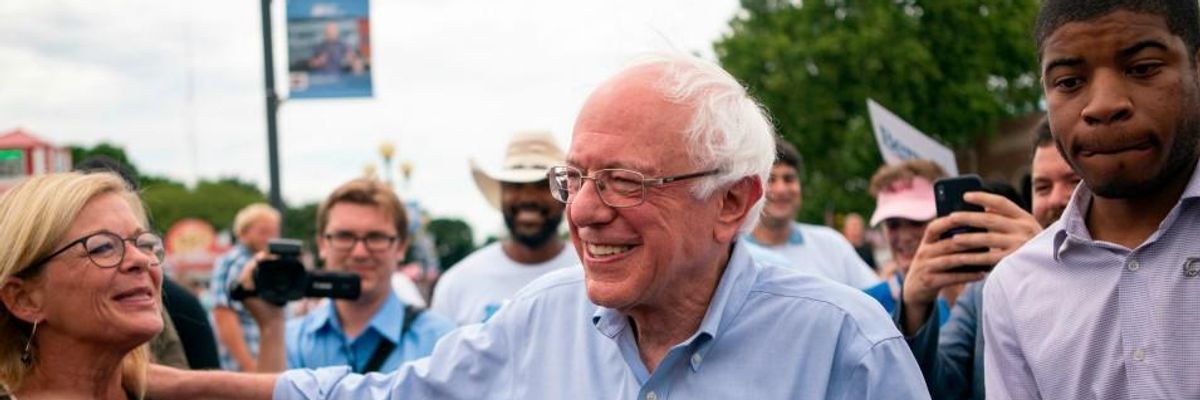
How can our society thrive if we condemn the best of the next generation to a life burdened by debt? (Photo: Alex Edelman/AFP/Getty Images)
"Too radical, impractical, too costly, impossible, can't pass the Senate."
Those are the terms centrist Democrats use to describe the bold reform ideas put forth by Bernie Sanders and Elizabeth Warren in the Democratic presidential primaries.
" Venezuela, socialist, communist tripe, crazy" are the jibes preferred by President Donald Trump and Republicans.
All this begs the same question: What do they plan to do to meet the challenges we face?
For most Americans, this isn't a rhetorical question. The economy, Trump boasts, is as good as it has ever been in terms of the top line unemployment figures, but it still doesn't work for most Americans.
Wages have been inching up, but they aren't rising as fast as the cost of basics--housing, college, health care. Working families--whether middle or low income--are struggling simply to stay afloat.
Depths of despair are soaring, particularly among the young. Illness is still the leading cause of bankruptcy.
Half of all Americans have no retirement plan other than Social Security. The climate emergency is a clear and present danger, costing more lives, more displacement and billions in damage each year.
If we are going to address these challenges, we need reforms that correspond with the size of the problem. An adhesive bandage won't stop a leg hemorrhage. A wall can't shut out the cataclysmic storms, droughts, floods and tides of the climate emergency.
The Green New Deal--mocked by Trump and Republicans who continue to deny the existence of manmade climate change--is ambitious and costly--but only because it tries to meet the goals that scientists say are necessary if we are not to become an endangered species.
Getting to a clean energy, zero carbon emissions economy requires massive investment, new innovation and dramatic changes in transportation, housing, energy and more.
The transition will generate millions of new jobs, while displacing some from old jobs. The Green New Deal proposes a job guarantee to make certain that no one is left out in the transition.
Critics say it costs too much--but it costs far less than the price we will pay if we don't act boldly and now.
Or consider higher education. Student loan debt continues to rise, now over $1 trillion, exceeding even credit card debt.
More students have to put off college or drop out for years in order to earn enough to get the education that all agree is vital to our country and to their future.
More students graduate with debt that will burden their lives, making it harder to afford to have children, to save for a house, to put money away for retirement.
Debt is crushing a generation that tries to do the right thing. It is particularly brutal on people of color who have less of a chance to have parents with the wealth to help pay for tuition.
These basic reforms--the right to adequate health care, the right to an education, the addressing of the existential threat posed by the climate emergency--are not left or right. They represent the moral center.
Tuition-free college--mocked as a costly giveaway--simply argues that publicly provided education or advanced training should be extended beyond kindergarten through 12th grade.
At a time when college education or advanced training is deemed essential not simply for the individual but for the country, why wouldn't we make that available for all who qualify?
How can our society thrive if we condemn the best of the next generation to a life burdened by debt?
This is one of the richest countries in the world. We can afford these things. With inequality reaching new extremes, and corporations and the wealthy rigging the tax code to their benefit, we can pay for them without raising taxes on middle- and low-income Americans.
The argument that these necessary reforms are not "practical" makes no sense.
Centrists suggest that only modest, piecemeal, admittedly inadequate reforms have a chance to gain the support needed to pass. But pre-emptive compromise doesn't inspire fear or fervor.
What's needed is a clarion call that lays out what is essential--and builds the public support necessary to tackle those standing in the way.
Republicans opposed Social Security and Medicare as socialism, or communist notions. They passed because Roosevelt and Johnson built the majorities and claimed the mandate to get them passed.
The argument that these reforms are too radical, too "left" also fails on its face.
These basic reforms--the right to adequate health care, the right to an education, the addressing of the existential threat posed by the climate emergency--are not left or right.
They represent the moral center. The values they express are not un-American; they are central to the American dream.
It isn't radical to suggest that all have health care, or all have access to a good education. It is just common sense. And we are badly in need of a strong dose of that.
Dear Common Dreams reader, It’s been nearly 30 years since I co-founded Common Dreams with my late wife, Lina Newhouser. We had the radical notion that journalism should serve the public good, not corporate profits. It was clear to us from the outset what it would take to build such a project. No paid advertisements. No corporate sponsors. No millionaire publisher telling us what to think or do. Many people said we wouldn't last a year, but we proved those doubters wrong. Together with a tremendous team of journalists and dedicated staff, we built an independent media outlet free from the constraints of profits and corporate control. Our mission has always been simple: To inform. To inspire. To ignite change for the common good. Building Common Dreams was not easy. Our survival was never guaranteed. When you take on the most powerful forces—Wall Street greed, fossil fuel industry destruction, Big Tech lobbyists, and uber-rich oligarchs who have spent billions upon billions rigging the economy and democracy in their favor—the only bulwark you have is supporters who believe in your work. But here’s the urgent message from me today. It's never been this bad out there. And it's never been this hard to keep us going. At the very moment Common Dreams is most needed, the threats we face are intensifying. We need your support now more than ever. We don't accept corporate advertising and never will. We don't have a paywall because we don't think people should be blocked from critical news based on their ability to pay. Everything we do is funded by the donations of readers like you. When everyone does the little they can afford, we are strong. But if that support retreats or dries up, so do we. Will you donate now to make sure Common Dreams not only survives but thrives? —Craig Brown, Co-founder |
"Too radical, impractical, too costly, impossible, can't pass the Senate."
Those are the terms centrist Democrats use to describe the bold reform ideas put forth by Bernie Sanders and Elizabeth Warren in the Democratic presidential primaries.
" Venezuela, socialist, communist tripe, crazy" are the jibes preferred by President Donald Trump and Republicans.
All this begs the same question: What do they plan to do to meet the challenges we face?
For most Americans, this isn't a rhetorical question. The economy, Trump boasts, is as good as it has ever been in terms of the top line unemployment figures, but it still doesn't work for most Americans.
Wages have been inching up, but they aren't rising as fast as the cost of basics--housing, college, health care. Working families--whether middle or low income--are struggling simply to stay afloat.
Depths of despair are soaring, particularly among the young. Illness is still the leading cause of bankruptcy.
Half of all Americans have no retirement plan other than Social Security. The climate emergency is a clear and present danger, costing more lives, more displacement and billions in damage each year.
If we are going to address these challenges, we need reforms that correspond with the size of the problem. An adhesive bandage won't stop a leg hemorrhage. A wall can't shut out the cataclysmic storms, droughts, floods and tides of the climate emergency.
The Green New Deal--mocked by Trump and Republicans who continue to deny the existence of manmade climate change--is ambitious and costly--but only because it tries to meet the goals that scientists say are necessary if we are not to become an endangered species.
Getting to a clean energy, zero carbon emissions economy requires massive investment, new innovation and dramatic changes in transportation, housing, energy and more.
The transition will generate millions of new jobs, while displacing some from old jobs. The Green New Deal proposes a job guarantee to make certain that no one is left out in the transition.
Critics say it costs too much--but it costs far less than the price we will pay if we don't act boldly and now.
Or consider higher education. Student loan debt continues to rise, now over $1 trillion, exceeding even credit card debt.
More students have to put off college or drop out for years in order to earn enough to get the education that all agree is vital to our country and to their future.
More students graduate with debt that will burden their lives, making it harder to afford to have children, to save for a house, to put money away for retirement.
Debt is crushing a generation that tries to do the right thing. It is particularly brutal on people of color who have less of a chance to have parents with the wealth to help pay for tuition.
These basic reforms--the right to adequate health care, the right to an education, the addressing of the existential threat posed by the climate emergency--are not left or right. They represent the moral center.
Tuition-free college--mocked as a costly giveaway--simply argues that publicly provided education or advanced training should be extended beyond kindergarten through 12th grade.
At a time when college education or advanced training is deemed essential not simply for the individual but for the country, why wouldn't we make that available for all who qualify?
How can our society thrive if we condemn the best of the next generation to a life burdened by debt?
This is one of the richest countries in the world. We can afford these things. With inequality reaching new extremes, and corporations and the wealthy rigging the tax code to their benefit, we can pay for them without raising taxes on middle- and low-income Americans.
The argument that these necessary reforms are not "practical" makes no sense.
Centrists suggest that only modest, piecemeal, admittedly inadequate reforms have a chance to gain the support needed to pass. But pre-emptive compromise doesn't inspire fear or fervor.
What's needed is a clarion call that lays out what is essential--and builds the public support necessary to tackle those standing in the way.
Republicans opposed Social Security and Medicare as socialism, or communist notions. They passed because Roosevelt and Johnson built the majorities and claimed the mandate to get them passed.
The argument that these reforms are too radical, too "left" also fails on its face.
These basic reforms--the right to adequate health care, the right to an education, the addressing of the existential threat posed by the climate emergency--are not left or right.
They represent the moral center. The values they express are not un-American; they are central to the American dream.
It isn't radical to suggest that all have health care, or all have access to a good education. It is just common sense. And we are badly in need of a strong dose of that.
"Too radical, impractical, too costly, impossible, can't pass the Senate."
Those are the terms centrist Democrats use to describe the bold reform ideas put forth by Bernie Sanders and Elizabeth Warren in the Democratic presidential primaries.
" Venezuela, socialist, communist tripe, crazy" are the jibes preferred by President Donald Trump and Republicans.
All this begs the same question: What do they plan to do to meet the challenges we face?
For most Americans, this isn't a rhetorical question. The economy, Trump boasts, is as good as it has ever been in terms of the top line unemployment figures, but it still doesn't work for most Americans.
Wages have been inching up, but they aren't rising as fast as the cost of basics--housing, college, health care. Working families--whether middle or low income--are struggling simply to stay afloat.
Depths of despair are soaring, particularly among the young. Illness is still the leading cause of bankruptcy.
Half of all Americans have no retirement plan other than Social Security. The climate emergency is a clear and present danger, costing more lives, more displacement and billions in damage each year.
If we are going to address these challenges, we need reforms that correspond with the size of the problem. An adhesive bandage won't stop a leg hemorrhage. A wall can't shut out the cataclysmic storms, droughts, floods and tides of the climate emergency.
The Green New Deal--mocked by Trump and Republicans who continue to deny the existence of manmade climate change--is ambitious and costly--but only because it tries to meet the goals that scientists say are necessary if we are not to become an endangered species.
Getting to a clean energy, zero carbon emissions economy requires massive investment, new innovation and dramatic changes in transportation, housing, energy and more.
The transition will generate millions of new jobs, while displacing some from old jobs. The Green New Deal proposes a job guarantee to make certain that no one is left out in the transition.
Critics say it costs too much--but it costs far less than the price we will pay if we don't act boldly and now.
Or consider higher education. Student loan debt continues to rise, now over $1 trillion, exceeding even credit card debt.
More students have to put off college or drop out for years in order to earn enough to get the education that all agree is vital to our country and to their future.
More students graduate with debt that will burden their lives, making it harder to afford to have children, to save for a house, to put money away for retirement.
Debt is crushing a generation that tries to do the right thing. It is particularly brutal on people of color who have less of a chance to have parents with the wealth to help pay for tuition.
These basic reforms--the right to adequate health care, the right to an education, the addressing of the existential threat posed by the climate emergency--are not left or right. They represent the moral center.
Tuition-free college--mocked as a costly giveaway--simply argues that publicly provided education or advanced training should be extended beyond kindergarten through 12th grade.
At a time when college education or advanced training is deemed essential not simply for the individual but for the country, why wouldn't we make that available for all who qualify?
How can our society thrive if we condemn the best of the next generation to a life burdened by debt?
This is one of the richest countries in the world. We can afford these things. With inequality reaching new extremes, and corporations and the wealthy rigging the tax code to their benefit, we can pay for them without raising taxes on middle- and low-income Americans.
The argument that these necessary reforms are not "practical" makes no sense.
Centrists suggest that only modest, piecemeal, admittedly inadequate reforms have a chance to gain the support needed to pass. But pre-emptive compromise doesn't inspire fear or fervor.
What's needed is a clarion call that lays out what is essential--and builds the public support necessary to tackle those standing in the way.
Republicans opposed Social Security and Medicare as socialism, or communist notions. They passed because Roosevelt and Johnson built the majorities and claimed the mandate to get them passed.
The argument that these reforms are too radical, too "left" also fails on its face.
These basic reforms--the right to adequate health care, the right to an education, the addressing of the existential threat posed by the climate emergency--are not left or right.
They represent the moral center. The values they express are not un-American; they are central to the American dream.
It isn't radical to suggest that all have health care, or all have access to a good education. It is just common sense. And we are badly in need of a strong dose of that.