
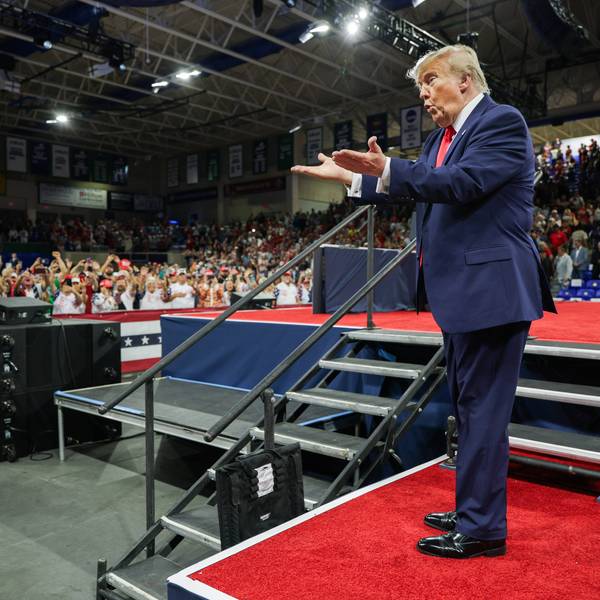

Secretary of State Mike Pompeo, in the State Department briefing room on Thursday. (Photo: Win McNamee / Getty Images)
Trump Blames Iran for the Tanker Attacks. But Let's be Skeptical of his Administration's Pro-War Bluster
The speed in which the U.S. government officially blamed Iran should give us pause, given our own history in the region
The Trump administration was quick to point fingers at Iran after explosions on two oil tankers from Japan and Norway in the Gulf of Oman.
Undoubtedly, Iran is a plausible suspect. It has repeatedly threatened to strangle the flow of Persian Gulf oil from Saudi Arabia, Kuwait, Qatar, Bahrain, Iraq and the UAE if the U.S. embargoes Iranian oil. But the presence of a potential motive does not amount to the presence of evidence, and the owner of the Japanese tanker is already contesting the U.S. explanations.
But, if anything, the speed in which the Trump administration officially blamed Iran should give us pause, given John Bolton's long history of fabricating intelligence in favor of war. The mere process of gathering evidence -- let alone conclusive evidence -- of how the attack on Thursday was conducted and who was behind it would take days and weeks, not hours.
In his press conference Thursday, Secretary of State Mike Pompeo, in fact, carefully avoided claiming the existence of any evidence and presented his accusations as a "government assessment," which is different from a U.S. intelligence assessment, of which this administration is historically rather skeptical. (Of course, that raises another question: If the administration doesn't possess evidence and can only offer a "government" assessment -- a theory, really -- why give a press conference in the first place?)
Instead of evidence, Pompeo presented a series of accusations of past alleged activities by Iran. He repeated his previous allegation -- still not supported by any public evidence -- that Iran was behind the attack on four other commercial ships near the Strait of Hormuz on May 12. He cited as suspicious the movement of Iranian missiles earlier this month, after Trump threatened Iran with genocide over Twitter. (Bolton, the national security adviser, had earlier tried to present these measures as offensive, even though U.S. intelligence had interpreted them as defensive maneuvers.) And Pompeo even suggested that an attack against U.S. troops in Afghanistan conducted by the Taliban -- a long-sworn enemy of Iran -- was evidence of Iranian aggression.
But given the Trump administration's complicated relationship with the truth, including Bolton's history of manipulating intelligence, these accusations must be subject to intense scrutiny.
Nevertheless, eyes understandably turned to Tehran as news of the explosions spread: Iran's longstanding position has been that either all countries can sell their oil through the Strait of Hormuz, or no one can. With the U.S. forcing more and more countries to cease buying Iranian oil, Tehran has appeared closer than ever to actualizing its threats.
Rising Persian Gulf tensions would likely lead to a surge in oil prices, which benefits Iran in three ways: It increases Tehran's revenue from the oil it still sells, makes the U.S.'s "maximum pressure" strategy on Iran more costly to Trump, and could make some countries more inclined to circumvent the sanctions if they prove too costly.
And, creating a crisis may serve Iran's larger interests. The European Union's promises that Tehran would receive the economic benefits that it was promised under the nuclear deal have all proven empty, while Trump's sanctions have been very painful to Iran. But the U.S. has paid no cost for this bellicose policy so, by counter-escalating and accelerating matters toward a showdown, Tehran potentially shifts some of the risks of his sanctions policy onto Trump.
Still, all this context leaves many questions about the explosions unanswered.
Iran can achieve most -- if not all -- of their objectives through much more measured moves than attacks on oil tankers. It could, for instance, slowly expand its nuclear program and approach the limits of what the nuclear deal that Trump abrogated allows. Tehran did so last month when it threatened to disregard some of the limits imposed by the nuclear accord, unless the E.U. provided it with the economic benefits it had been promised.
Attacking tankers in the Strait of Hormuz, on the other hand, provides Iran with few additional economic or diplomatic benefits while drastically increasing the downsides. Iran has little to gain from a violent escalation in which it will be seen as the aggressor, let alone one that allows the Trump administration to portray its bellicose policy as defensive and justified.
Beyond that, the fact that one of the tankers, the Kokuka Courageous, belongs to a Japanese company raises additional questions.
The attack against it occurred while Japan's Prime Minister Shinzo Abe was meeting with Iran's Ayatollah Ali Khamenei. If the Iranian government were behind the attack, it would appear to have been designed to humiliate Abe. What Iran would gain from such unprovoked hostility, however, remains unclear. If Tehran had been uninterested in Abe's offer of mediation, it could have simply declined his request to visit the country; there would have been no need to humiliate him and thus sour Iranian-Japanese relations.
Could a different faction of the Iranian government have been behind the attack in order to embarrass President Hassan Rouhani's pro-diplomacy administration? Certainly, Iranian hard-line factions have a history of sabotaging Iran's diplomacy with the West. But if that was the goal, the attack should have occurred while Abe was meeting with Rouhani, not Ayatollah Khamenei. While Iranian hard-liners rarely miss an opportunity to embarrass Rouhani, there is no history of them going rogue to shame Iran's supreme leader.
Again, Iran may very well have been behind the attacks; a case can be made that it has a strong motive. The potential motive, though, does not mean, as the president said on Friday, that "it's got essentially Iran written all over it." What the United States does in Iran is, after all, potentially a matter of war and peace -- and the architects of the "government assessment" have a stated preference for one over the other.
We are at a crossroads
This country and this world are at a monumental crossroads. US voters have an opportunity to beat back the forces of fascism and confront the billionaires who are rigging the economy, our media system, and our democracy, making it increasingly impossible for ordinary people to get by. We’re not just talking about the election. We’re talking about what must be done once these fascist elements are vanquished from power. We need a bolder set of solutions than what either major party has so far been willing to offer and a working-class movement ready to fight like hell for it. Trump didn't emerge from nowhere. The conditions that fueled MAGA authoritarianism were created by decades of radical neoliberal economic policies and a corrupt political system dominated by corporate interests. They slashed taxes on the super-rich, promising that the benefits would trickle down. They said giveaways to the corporate titans would make life more affordable for the rest of us. It was all bullshit. And when a bitter, betrayed populace searches for someone to blame, right-wing demagogues have little trouble finding scapegoats. People know when they're being lied to, but you won't hear any of this from the corporate media. Only independent journalism—powered and funded by people who believe in building a better world—can deliver truly trustworthy daily news. Our Fall Campaign is underway, and we need your help. To power our newsroom through the rest of the year, we need to raise $125,000 by midnight on October 31. So if you share our vision, please contribute whatever you can to sustain our work. |
The Trump administration was quick to point fingers at Iran after explosions on two oil tankers from Japan and Norway in the Gulf of Oman.
Undoubtedly, Iran is a plausible suspect. It has repeatedly threatened to strangle the flow of Persian Gulf oil from Saudi Arabia, Kuwait, Qatar, Bahrain, Iraq and the UAE if the U.S. embargoes Iranian oil. But the presence of a potential motive does not amount to the presence of evidence, and the owner of the Japanese tanker is already contesting the U.S. explanations.
But, if anything, the speed in which the Trump administration officially blamed Iran should give us pause, given John Bolton's long history of fabricating intelligence in favor of war. The mere process of gathering evidence -- let alone conclusive evidence -- of how the attack on Thursday was conducted and who was behind it would take days and weeks, not hours.
In his press conference Thursday, Secretary of State Mike Pompeo, in fact, carefully avoided claiming the existence of any evidence and presented his accusations as a "government assessment," which is different from a U.S. intelligence assessment, of which this administration is historically rather skeptical. (Of course, that raises another question: If the administration doesn't possess evidence and can only offer a "government" assessment -- a theory, really -- why give a press conference in the first place?)
Instead of evidence, Pompeo presented a series of accusations of past alleged activities by Iran. He repeated his previous allegation -- still not supported by any public evidence -- that Iran was behind the attack on four other commercial ships near the Strait of Hormuz on May 12. He cited as suspicious the movement of Iranian missiles earlier this month, after Trump threatened Iran with genocide over Twitter. (Bolton, the national security adviser, had earlier tried to present these measures as offensive, even though U.S. intelligence had interpreted them as defensive maneuvers.) And Pompeo even suggested that an attack against U.S. troops in Afghanistan conducted by the Taliban -- a long-sworn enemy of Iran -- was evidence of Iranian aggression.
But given the Trump administration's complicated relationship with the truth, including Bolton's history of manipulating intelligence, these accusations must be subject to intense scrutiny.
Nevertheless, eyes understandably turned to Tehran as news of the explosions spread: Iran's longstanding position has been that either all countries can sell their oil through the Strait of Hormuz, or no one can. With the U.S. forcing more and more countries to cease buying Iranian oil, Tehran has appeared closer than ever to actualizing its threats.
Rising Persian Gulf tensions would likely lead to a surge in oil prices, which benefits Iran in three ways: It increases Tehran's revenue from the oil it still sells, makes the U.S.'s "maximum pressure" strategy on Iran more costly to Trump, and could make some countries more inclined to circumvent the sanctions if they prove too costly.
And, creating a crisis may serve Iran's larger interests. The European Union's promises that Tehran would receive the economic benefits that it was promised under the nuclear deal have all proven empty, while Trump's sanctions have been very painful to Iran. But the U.S. has paid no cost for this bellicose policy so, by counter-escalating and accelerating matters toward a showdown, Tehran potentially shifts some of the risks of his sanctions policy onto Trump.
Still, all this context leaves many questions about the explosions unanswered.
Iran can achieve most -- if not all -- of their objectives through much more measured moves than attacks on oil tankers. It could, for instance, slowly expand its nuclear program and approach the limits of what the nuclear deal that Trump abrogated allows. Tehran did so last month when it threatened to disregard some of the limits imposed by the nuclear accord, unless the E.U. provided it with the economic benefits it had been promised.
Attacking tankers in the Strait of Hormuz, on the other hand, provides Iran with few additional economic or diplomatic benefits while drastically increasing the downsides. Iran has little to gain from a violent escalation in which it will be seen as the aggressor, let alone one that allows the Trump administration to portray its bellicose policy as defensive and justified.
Beyond that, the fact that one of the tankers, the Kokuka Courageous, belongs to a Japanese company raises additional questions.
The attack against it occurred while Japan's Prime Minister Shinzo Abe was meeting with Iran's Ayatollah Ali Khamenei. If the Iranian government were behind the attack, it would appear to have been designed to humiliate Abe. What Iran would gain from such unprovoked hostility, however, remains unclear. If Tehran had been uninterested in Abe's offer of mediation, it could have simply declined his request to visit the country; there would have been no need to humiliate him and thus sour Iranian-Japanese relations.
Could a different faction of the Iranian government have been behind the attack in order to embarrass President Hassan Rouhani's pro-diplomacy administration? Certainly, Iranian hard-line factions have a history of sabotaging Iran's diplomacy with the West. But if that was the goal, the attack should have occurred while Abe was meeting with Rouhani, not Ayatollah Khamenei. While Iranian hard-liners rarely miss an opportunity to embarrass Rouhani, there is no history of them going rogue to shame Iran's supreme leader.
Again, Iran may very well have been behind the attacks; a case can be made that it has a strong motive. The potential motive, though, does not mean, as the president said on Friday, that "it's got essentially Iran written all over it." What the United States does in Iran is, after all, potentially a matter of war and peace -- and the architects of the "government assessment" have a stated preference for one over the other.