SUBSCRIBE TO OUR FREE NEWSLETTER
Daily news & progressive opinion—funded by the people, not the corporations—delivered straight to your inbox.
5
#000000
#FFFFFF
To donate by check, phone, or other method, see our More Ways to Give page.
Edward Snowden revealed himself this week as the whistleblower responsible for perhaps the most significant release of secret government documents in U.S. history. The former CIA staffer and analyst for the private intelligence consulting firm Booz Allen Hamilton spoke to journalists Glenn Greenwald, Laura Poitras and Barton Gellman in Hong Kong, providing convincing evidence that the U.S. government, primarily the National Security Agency, is conducting massive, unconstitutional surveillance globally, and perhaps most controversially, on almost all, if not all, U.S. citizens.
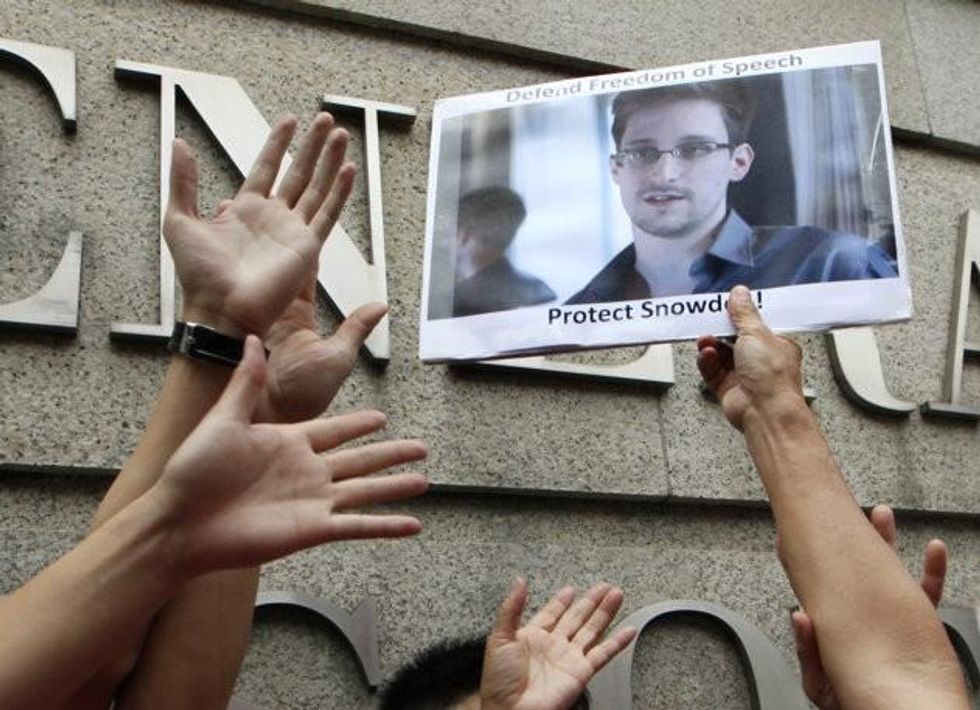
The chorus of establishment condemnation was swift and unrelenting. Jeffrey Toobin, legal pundit, quickly blogged that Snowden is "a grandiose narcissist who deserves to be in prison." New York Times columnists chimed in, with Thomas Friedman writing, "I don't believe that Edward Snowden, the leaker of all this secret material, is some heroic whistle-blower." His colleague David Brooks engaged in speculative psychoanalysis of Snowden, opining, "[t]hough obviously terrifically bright, he could not successfully work his way through the institution of high school. Then he failed to navigate his way through community college."
Snowden's educational path has attracted significant attention. U.S. senators oh-so-gently questioned NSA Director Gen. Keith B. Alexander and others at a Senate Appropriations Committee hearing, including liberal Democratic Sen. Dick Durbin of Illinois, echoing Brooks' incredulity that someone with a GED could possibly hoodwink the entire U.S. intelligence apparatus. Alexander confessed, "In the IT arena, in the cyber arena, some of these people have skills to operate networks. That was his job for the most part; he had great skills in the area. The rest of it you've hit on the head. We do need to go back and look at the processes - where we went wrong."
Legendary whistleblower Daniel Ellsberg countered the criticism, writing, "In my estimation, there has not been in American history a more important leak than Edward Snowden's release of NSA material--and that definitely includes the Pentagon Papers 40 years ago. Snowden's whistleblowing gives us the possibility to roll back a key part of what has amounted to an 'executive coup' against the U.S. Constitution."
Snowden's historic leak revealed what he calls an "architecture of oppression"--a series of top-secret surveillance programs that go far beyond what has been publicly known to date. The first was an order from the U.S. Foreign Intelligence Surveillance Court requesting a division of the phone giant Verizon to hand over "all call detail records" for calls from the U.S. to locations abroad, or all calls within the U.S., including local calls. In other words, metadata for every phone call that Verizon Business Network Services processed was to be delivered to the NSA on a daily basis. Another document was a slide presentation revealing a program dubbed "PRISM," which allegedly empowers NSA snoops access to all the private data stored by Internet giants like Microsoft, AOL, Skype, Google, Apple and Facebook, including email, video chats, photos, files transfers and more.
Snowden released Presidential Policy Directive 20--a top-secret memo from President Barack Obama directing U.S. intelligence agencies to draw up a list of targets for U.S. cyberattacks. Finally came proof of the program called "Boundless Informant," which creates a global "heat map" detailing the source countries of the 97 billion intercepted electronic records collected by the NSA in the month of March 2013. Among the top targets were Iran, Pakistan, Egypt and Jordan. The leaked map color-codes countries: red for "hot," then yellow and green. Last March, the U.S. was yellow, providing the NSA with close to 2.9 billion intercepts.
The American Civil Liberties Union filed a lawsuit immediately after the programs were revealed, arguing that the "practice is akin to snatching every American's address book--with annotations detailing whom we spoke to, when we talked, for how long, and from where. It gives the government a comprehensive record of our associations and public movements, revealing a wealth of detail about our familial, political, professional, religious, and intimate associations."
Edward Snowden, at the time of this writing, is in hiding, presumably still in Hong Kong, where he told the South China Morning Post, "I am not here to hide from justice; I am here to reveal criminality." In the videotaped interview he gave to Greenwald and Poitras, Snowden spoke of his reasons behind the leak: "Sitting at my desk, [I] certainly had the authorities to wiretap anyone, from you or your accountant to a federal judge, to even the president. ... This is something that's not our place to decide. The public needs to decide whether these programs and policies are right or wrong."
Edward Snowden revealed himself this week as the whistleblower responsible for perhaps the most significant release of secret government documents in U.S. history. The former CIA staffer and analyst for the private intelligence consulting firm Booz Allen Hamilton spoke to journalists Glenn Greenwald, Laura Poitras and Barton Gellman in Hong Kong, providing convincing evidence that the U.S. government, primarily the National Security Agency, is conducting massive, unconstitutional surveillance globally, and perhaps most controversially, on almost all, if not all, U.S. citizens.
The chorus of establishment condemnation was swift and unrelenting. Jeffrey Toobin, legal pundit, quickly blogged that Snowden is "a grandiose narcissist who deserves to be in prison." New York Times columnists chimed in, with Thomas Friedman writing, "I don't believe that Edward Snowden, the leaker of all this secret material, is some heroic whistle-blower." His colleague David Brooks engaged in speculative psychoanalysis of Snowden, opining, "[t]hough obviously terrifically bright, he could not successfully work his way through the institution of high school. Then he failed to navigate his way through community college."
Snowden's educational path has attracted significant attention. U.S. senators oh-so-gently questioned NSA Director Gen. Keith B. Alexander and others at a Senate Appropriations Committee hearing, including liberal Democratic Sen. Dick Durbin of Illinois, echoing Brooks' incredulity that someone with a GED could possibly hoodwink the entire U.S. intelligence apparatus. Alexander confessed, "In the IT arena, in the cyber arena, some of these people have skills to operate networks. That was his job for the most part; he had great skills in the area. The rest of it you've hit on the head. We do need to go back and look at the processes - where we went wrong."
Legendary whistleblower Daniel Ellsberg countered the criticism, writing, "In my estimation, there has not been in American history a more important leak than Edward Snowden's release of NSA material--and that definitely includes the Pentagon Papers 40 years ago. Snowden's whistleblowing gives us the possibility to roll back a key part of what has amounted to an 'executive coup' against the U.S. Constitution."
Snowden's historic leak revealed what he calls an "architecture of oppression"--a series of top-secret surveillance programs that go far beyond what has been publicly known to date. The first was an order from the U.S. Foreign Intelligence Surveillance Court requesting a division of the phone giant Verizon to hand over "all call detail records" for calls from the U.S. to locations abroad, or all calls within the U.S., including local calls. In other words, metadata for every phone call that Verizon Business Network Services processed was to be delivered to the NSA on a daily basis. Another document was a slide presentation revealing a program dubbed "PRISM," which allegedly empowers NSA snoops access to all the private data stored by Internet giants like Microsoft, AOL, Skype, Google, Apple and Facebook, including email, video chats, photos, files transfers and more.
Snowden released Presidential Policy Directive 20--a top-secret memo from President Barack Obama directing U.S. intelligence agencies to draw up a list of targets for U.S. cyberattacks. Finally came proof of the program called "Boundless Informant," which creates a global "heat map" detailing the source countries of the 97 billion intercepted electronic records collected by the NSA in the month of March 2013. Among the top targets were Iran, Pakistan, Egypt and Jordan. The leaked map color-codes countries: red for "hot," then yellow and green. Last March, the U.S. was yellow, providing the NSA with close to 2.9 billion intercepts.
The American Civil Liberties Union filed a lawsuit immediately after the programs were revealed, arguing that the "practice is akin to snatching every American's address book--with annotations detailing whom we spoke to, when we talked, for how long, and from where. It gives the government a comprehensive record of our associations and public movements, revealing a wealth of detail about our familial, political, professional, religious, and intimate associations."
Edward Snowden, at the time of this writing, is in hiding, presumably still in Hong Kong, where he told the South China Morning Post, "I am not here to hide from justice; I am here to reveal criminality." In the videotaped interview he gave to Greenwald and Poitras, Snowden spoke of his reasons behind the leak: "Sitting at my desk, [I] certainly had the authorities to wiretap anyone, from you or your accountant to a federal judge, to even the president. ... This is something that's not our place to decide. The public needs to decide whether these programs and policies are right or wrong."
Edward Snowden revealed himself this week as the whistleblower responsible for perhaps the most significant release of secret government documents in U.S. history. The former CIA staffer and analyst for the private intelligence consulting firm Booz Allen Hamilton spoke to journalists Glenn Greenwald, Laura Poitras and Barton Gellman in Hong Kong, providing convincing evidence that the U.S. government, primarily the National Security Agency, is conducting massive, unconstitutional surveillance globally, and perhaps most controversially, on almost all, if not all, U.S. citizens.
The chorus of establishment condemnation was swift and unrelenting. Jeffrey Toobin, legal pundit, quickly blogged that Snowden is "a grandiose narcissist who deserves to be in prison." New York Times columnists chimed in, with Thomas Friedman writing, "I don't believe that Edward Snowden, the leaker of all this secret material, is some heroic whistle-blower." His colleague David Brooks engaged in speculative psychoanalysis of Snowden, opining, "[t]hough obviously terrifically bright, he could not successfully work his way through the institution of high school. Then he failed to navigate his way through community college."
Snowden's educational path has attracted significant attention. U.S. senators oh-so-gently questioned NSA Director Gen. Keith B. Alexander and others at a Senate Appropriations Committee hearing, including liberal Democratic Sen. Dick Durbin of Illinois, echoing Brooks' incredulity that someone with a GED could possibly hoodwink the entire U.S. intelligence apparatus. Alexander confessed, "In the IT arena, in the cyber arena, some of these people have skills to operate networks. That was his job for the most part; he had great skills in the area. The rest of it you've hit on the head. We do need to go back and look at the processes - where we went wrong."
Legendary whistleblower Daniel Ellsberg countered the criticism, writing, "In my estimation, there has not been in American history a more important leak than Edward Snowden's release of NSA material--and that definitely includes the Pentagon Papers 40 years ago. Snowden's whistleblowing gives us the possibility to roll back a key part of what has amounted to an 'executive coup' against the U.S. Constitution."
Snowden's historic leak revealed what he calls an "architecture of oppression"--a series of top-secret surveillance programs that go far beyond what has been publicly known to date. The first was an order from the U.S. Foreign Intelligence Surveillance Court requesting a division of the phone giant Verizon to hand over "all call detail records" for calls from the U.S. to locations abroad, or all calls within the U.S., including local calls. In other words, metadata for every phone call that Verizon Business Network Services processed was to be delivered to the NSA on a daily basis. Another document was a slide presentation revealing a program dubbed "PRISM," which allegedly empowers NSA snoops access to all the private data stored by Internet giants like Microsoft, AOL, Skype, Google, Apple and Facebook, including email, video chats, photos, files transfers and more.
Snowden released Presidential Policy Directive 20--a top-secret memo from President Barack Obama directing U.S. intelligence agencies to draw up a list of targets for U.S. cyberattacks. Finally came proof of the program called "Boundless Informant," which creates a global "heat map" detailing the source countries of the 97 billion intercepted electronic records collected by the NSA in the month of March 2013. Among the top targets were Iran, Pakistan, Egypt and Jordan. The leaked map color-codes countries: red for "hot," then yellow and green. Last March, the U.S. was yellow, providing the NSA with close to 2.9 billion intercepts.
The American Civil Liberties Union filed a lawsuit immediately after the programs were revealed, arguing that the "practice is akin to snatching every American's address book--with annotations detailing whom we spoke to, when we talked, for how long, and from where. It gives the government a comprehensive record of our associations and public movements, revealing a wealth of detail about our familial, political, professional, religious, and intimate associations."
Edward Snowden, at the time of this writing, is in hiding, presumably still in Hong Kong, where he told the South China Morning Post, "I am not here to hide from justice; I am here to reveal criminality." In the videotaped interview he gave to Greenwald and Poitras, Snowden spoke of his reasons behind the leak: "Sitting at my desk, [I] certainly had the authorities to wiretap anyone, from you or your accountant to a federal judge, to even the president. ... This is something that's not our place to decide. The public needs to decide whether these programs and policies are right or wrong."