
SUBSCRIBE TO OUR FREE NEWSLETTER
Daily news & progressive opinion—funded by the people, not the corporations—delivered straight to your inbox.
5
#000000
#FFFFFF
To donate by check, phone, or other method, see our More Ways to Give page.


Daily news & progressive opinion—funded by the people, not the corporations—delivered straight to your inbox.
"When the Trump administration declares a crisis ‘under control’, it’s time to brace for the worst yet to come," said one critic.
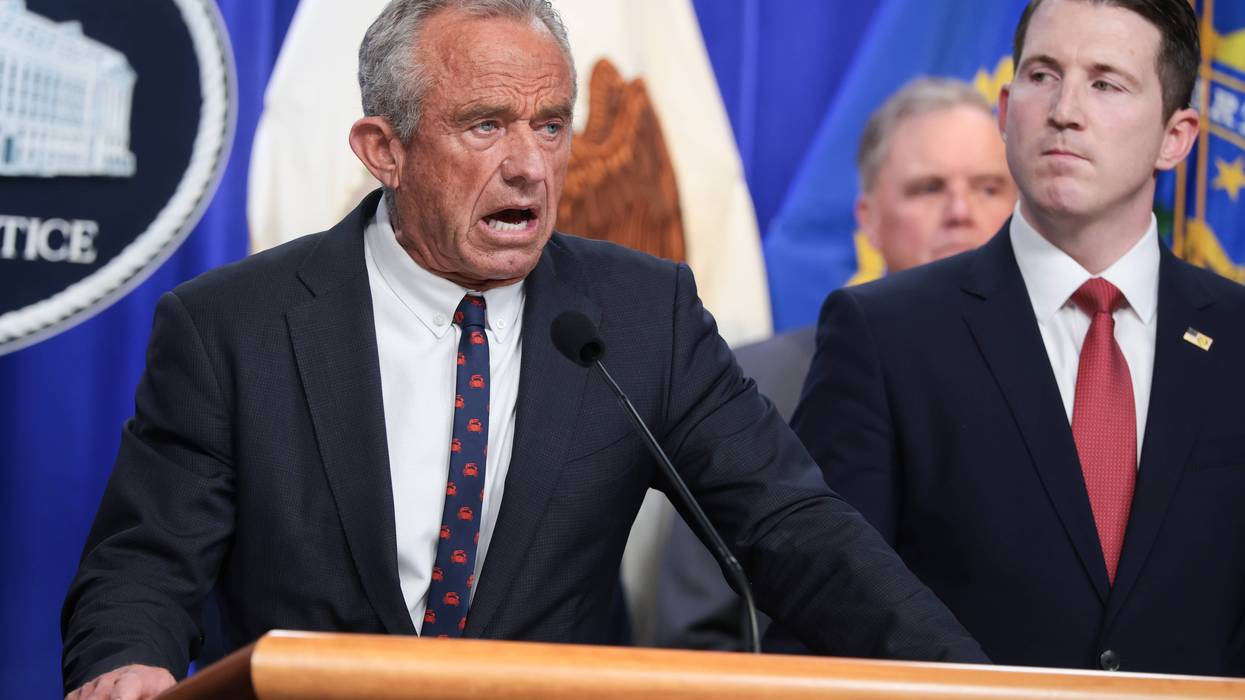
The United States under Trump-appointed Health and Human Services Secretary Robert F. Kennedy Jr. is currently experiencing major public health crises, including record-high measles cases, an outbreak of a parasite that causes explosive diarrhea, and potential salmonella contamination that led to a recall of nearly two million egg cartons.
Numbers released by the US Centers for Disease Control and Prevention (CDC) on Friday revealed that there have been 2,318 recorded cases of measles this year, the highest number of cases recorded since the virus was declared eliminated in the country more than two decades ago.
Some public health experts who spoke with The New York Times said that lower uptake of the measles vaccine was to blame for the outbreak.
Jennifer Nuzzo, director of the Pandemic Center at the Brown University School of Public Health, told the Times that "this is just going to keep happening" in the US unless vaccination rates improve.
"It’s going to mean living in a perpetual state of vulnerability and risk until we get vaccination levels up," Nuzzo emphasized.
Dr. Jonathan Temte, a former chairman of the CDC’s vaccine advisory committee, placed blame for the outbreaks on the US Department of Health and Human Services (HHS) under the leadership of Kennedy, who prior to becoming America's top public health official was best known as an anti-vaccine conspiracy theorist.
“We have seen virtually no national messaging," said Temte. "We’ve seen no ad campaigns... I think that really tells us something about their priorities."
Brad Woodhouse, president of Protect Our Care, also slammed Kennedy's leadership at NHS, accusing him and President Donald Trump of being on "a suicide mission to scare America families away from vaccines without cause or evidence."
"What they’ve accomplished is a huge dip in vaccination rates and the worst measles crisis in 35 years," Woodhouse added. "While the nation’s measles elimination status is doomed, the Trump CDC apparently has not spent a dime on public service ads promoting the one thing that will get us out of the woods: the measles vaccine."
Measles isn't the only disease spreading throughout the country, as the US Food and Drug Administration (FDA) announced on Friday that "four new states... are now considered part" of the outbreak of cyclosporiasis, a foodborne illness that causes explosive diarrhea.
The FDA has said that iceberg lettuce sourced from Taylor Farms de Mexico is likely the source of the outbreak, which so far has led to nearly 2,000 infections and almost 100 hospitalizations.
News about the continued spread of the outbreak came two days after the FDA revealed it was investigating another potential source of cyclospora, the parasitic bacteria that causes cyclosporiasis.
Sen. Jon Ossoff (D-Ga.), who earlier this week demanded answers from Kennedy about his decision to terminate the CDC's previously required surveillance of cyclospora, sent the HHS secretary a letter on Friday ripping his leadership of the department.
"Your silence amidst an ongoing outbreak of diarrheal disease," Ossoff wrote, "is indicative of the reckless arrogance with which you demolished America's public health defense."
Woodhouse, in a statement released Thursday, noted that Kennedy had declared the outbreak "under control" this week even though federal data shows it growing.
"If history is any judge, when the Trump administration declares a crisis ‘under control’, it’s time to brace for the worst yet to come," said Woodhouse.
The FDA also announced on Wednesday that Midwest Poultry Services was voluntarily recalling nearly 1.6 million cartons of eggs over potential contamination by the bacteria salmonella.
As the FDA noted, salmonella infections often result in a number of unpleasant conditions, including "fever, diarrhea (which may be bloody), nausea, vomiting, and abdominal pain."
Economist Dean Baker summed up the current situation in the US in a Friday social media post: "War, diarrhea, measles, and now salmonella, that's pretty damn MAGA!"
"We stand firmly against this report and other efforts by the Trump administration to weaponize the federal government against dissent, which is a patriotic tradition."
President Donald Trump's escalating claims that Cuba and its supporters poses a threat to US security have been denounced as "laughable" and "crazy," but progressive lawmakers are warning that the State Department's report alleging that the country of roughly 10 million people aims to "conquer" the United States and is backing "left-wing terrorism on American soil" represents a genuine attack on Trump's perceived political enemies.
"Trump appears hell-bent on taking America back 70 years to the height of Cold War McCarthyism, when hawkish foreign policy was paired with unsubstantiated accusations of communist subversion and political repression against dissidents at home," said a group of Democrats led by progressive Rep. Ilhan Omar (D-Minn.), chair of the Congressional Progressive Caucus Peace and Security Taskforce. “We condemn this report’s attack on Americans’ constitutional rights to free speech and assembly."
Omar on Thursday was joined by 10 other lawmakers, including Reps. Alexandria Ocasio-Cortez (D-NY), Jim McGovern (D-Mass.), Delia Ramirez (D-Ill.), and Rashida Tlaib (D-Mich.), in speaking out days after the State Department released its report titled “Cuba: The Capital of 21st Century Communism."
The report, said the lawmakers, was a "McCarthyite attack on Americans’ free speech rights."
The 100-page document claims that Cuba's communist government "has waged a sustained campaign of subversion against the United States" and recruited "generations" of activists in the US, listing by name people who have participated in solidarity campaigns in support of Cuban people as the Trump administration has imposed a destructive oil blockade on the island nation.
"Trump appears hell-bent on taking America back 70 years to the height of Cold War McCarthyism."
In January, Trump issued an executive order declaring that Cuba posed an "extraordinary threat" to US national security and threatened countries with tariffs should they provide oil to the Cuban government. The administration had already cut off Cuba's top source of energy by taking control of Venezuela's vast oil reserves. The blockade has left the Cuban healthcare and education systems and other daily public services struggling to operate.
US groups and citizens named in the report as having spoken out against the administration's blockade and its threats of military action against Cuba include commentator Hasan Piker, Amazon Labor Union founder Christian Smalls, the National Lawyers Guild, and campus activist Isra Hirsi—Omar's daughter.
"We denounce this administration’s irresponsible attacks against civil society organizations, activists, journalists, labor leaders, members of Congress, elected officials, and private individuals based on their advocacy for peaceful foreign policy and social justice at home," said Omar and the Democrats who joined her in the statement.
The lawmakers said they would use their "full oversight power as members of Congress and elected officials to stop the persecution of Trump’s perceived political enemies," including those who speak out publicly against the president's policies in Cuba—activity that is protected by the First Amendment.
"We stand firmly against this report and other efforts by the Trump administration to weaponize the federal government against dissent, which is a patriotic tradition," they said.
The report is the administration's latest attack on the free speech rights that are integral to the US Constitution and American history. The White House has pushed to deport foreign students who protested the US-backed Israel war on Gaza, designated anti-fascist organizers as "terrorists," and, nearly a year after issuing a presidential memo demanding a strategy to "disrupt" left-wing networks, recently convened a summit to launch a "global offensive against the transnational threat of Radical Left terrorism."
Meanwhile, said Omar on Thursday, Trump and Secretary of State Marco Rubio—the son of Cuban immigrants and a long-time proponent of regime change on the island—"are intensifying decades of economic war" against the people of Cuba and deliberately depriving "the entire island’s population of adequate food, fuel, and medicine."
Along with ending his attacks on those who oppose his policies, said Omar, "it is past time for Trump to obey the Constitution and end the dangerous, cruel, and illegal naval blockade causing collective punishment against Cuba.”
"Abdul is the best candidate to win Michigan in November because he is the one who has the capacity to build the grassroots movement that is going to power Democrats to victory," Smith said.
With less than two weeks left before Michigan’s Democratic primary, Senate hopeful Dr. Abdul El-Sayed earned support from another US senator on Thursday, with Sen. Tina Smith praising the progressive as "a fighter."
The endorsement comes as El-Sayed's opponent, Rep. Haley Stevens, rakes in massive support from large super PACs but continues to be massively outraised by him among small donors.
Smith (D-Minn.), who is not seeking reelection in 2026, is nevertheless the fourth member of the chamber to endorse El-Sayed, following Sens. Bernie Sanders (I-Vt.), Chris Van Hollen (D-Md.) and Elizabeth Warren (D-Mass.).
"I've been a United States senator for nearly nine years. And in that time, I have seen there are basically two kinds of senators," Smith said in a video posted to social media. "There are the ones who go along to get along, that hoard their power, and do everything they can to pacify big money. And then there are the fighters—the ones that are ready to challenge the status quo and fight a system that too often seems like it's rigged for the rich and the powerful."
El-Sayed, she said, was one of the latter, crediting his support for Medicare for All, his longtime union membership, and his refusal to accept corporate PAC money.
"Abdul is the best candidate to win Michigan in November," Smith said, "because he is the one who has the capacity to build the grassroots movement that is going to power Democrats to victory."
The endorsement comes as new Federal Election Commission filings released Thursday showed El-Sayed's grassroots fundraising advantage. Between July 1-15, he raised over $2.3 million from individual donors compared to about $921,000 for Stevens during the same period.
The divide is even starker among small donors, where El-Sayed leads Stevens by nearly 9-to-1.
Stevens still has the vast funding advantage thanks to the intervention of powerful outside groups. According to OpenSecrets, the United Democracy Project, the political spending arm of the American Israel Public Affairs Committee (AIPAC), has poured nearly $20 million to push her over the line.
Another super PAC, known as A Stronger Michigan, has spent an additional $14 million on ads promoting Stevens. The dark money group that provides nearly all of its funding, Center Forward, has not disclosed its donors and won't be required to do so until after the August 4 primary.
This wave of outside money has helped Stevens remain competitive against El-Sayed. But her struggles to raise money from voters have raised concerns about her ability to perform in the general election against Republican former Rep. Mike Rogers, who would be expected to suck up the AIPAC funding currently going to Stevens.
While Smith may not have the star power of other Democrats who have backed El-Sayed, journalist Zaid Jilani argued that her endorsement “is a big one” and “a sign [Democrats] think Abdul has a good chance of winning.”
"AIPAC is bailing [Stevens] out right now," he wrote. "But I don’t see why they’d spend on her in a general when Mike Rogers is even friendlier to them."
Journalist Ryan Grim asserted that without AIPAC money for a potential Stevens general election campaign, the Democrats could be forced to pull funding from "Ohio, and Iowa, and Alaska, and so on."
"El-Sayed, meanwhile, has a built-in fundraising base, because he has regular people supporting him, not a super PAC that doesn’t care about Michigan or the Democratic Party," said Grim.
Recent polls show El-Sayed with a slightly larger polling lead over Rogers than the one enjoyed by Stevens. Recent polls for next month's Democratic primary, however, have been more challenging to parse, with some showing El-Sayed far in front and others showing leads for Stevens.
David Dulio, a political science professor at Oakland University, described the race to OpenSecrets as a “battle for the future of the Democratic Party” between powerful donors and the grassroots.
"The story right now… is that Stevens is dominating with outside funding,” Dulio said. “El-Sayed has momentum, and Stevens has money.”
"Congress should not respond to an escalating occupational hazard by permanently removing the Department of Labor’s authority to address it."
A Republican-controlled House committee passed legislation earlier this week that would prevent the US Labor Department from enacting federal standards to protect workers from extreme heat, a move that came amid sweltering heat across the country.
The Heat Workforce Standards Act, led by Rep. Mark Messmer (R-Ind.), passed the House Education and Workforce Committee on Tuesday in a 18-15 vote along party lines. If enacted, the legislation would bar the Occupational Safety and Health Administration (OSHA) from implementing nationwide heat protections for workers—including those proposed by the Biden administration in 2024.
The Biden Labor Department estimated that its proposed rules would protect around 36 million workers. Trump's Labor Department has done nothing to move forward with the Biden-era proposal.
The AFL-CIO, the largest labor federation in the US, has condemned the GOP bill, noting that "extreme heat is one of the deadliest workplace hazards in America."
"House lawmakers are considering legislation that would block OSHA from issuing or enforcing a federal heat safety standard," the labor group said earlier this week. "That's the wrong direction when workers' lives are on the line."
Ahead of Tuesday's vote, a coalition of labor unions and advocacy groups wrote in a letter to members of Congress that the Republican legislation "would permanently remove the federal government’s authority to address a workplace hazard that is already resulting in worker fatalities."
"The Bureau of Labor Statistics recorded 55 worker deaths from heat exposure in 2023, a number that safety researchers widely consider to be an undercount due to frequent misclassification or underreporting of heat-related illnesses and fatalities," the coalition wrote. "More broadly, heat-related deaths in the United States have more than doubled since 1999, and extreme heat now claims more lives each year than any other weather-related hazard."
"Workers have no control over extreme heat, and many are unable to refuse hazardous assignments without jeopardizing their livelihoods," the groups added. "Congress should not respond to an escalating occupational hazard by permanently removing the Department of Labor’s authority to address it."
The Groundwork Collaborative, Workshop, and Harvard Law School’s Center for Labor and a Just Economy estimated in a report published earlier this year that basic, federal workplace heat protections could save up to 1,500 lives annually. The report observed that major industry groups, including the US Chamber of Commerce, have mobilized against proposed national heat protections.
"Companies like Amazon and the United Parcel Service (UPS) that employ hundreds of thousands of workers subjected to extreme workplace temperatures make public statements about their commitments to worker safety while actively lobbying to weaken or block heat regulations," the report noted. "As extreme heat intensifies, the cost of inaction will be measured in lives lost. The question facing policymakers is no longer whether effective protections exist, but whether they have the political will to stand up to those unscrupulous employers lobbying hard to block them."
"The American people are disgusted with an economic system in which one guy on top, Elon Musk, owns more wealth than the bottom half of American society."
Sen. Bernie Sanders on Thursday explained to Fox Business reporter Chase Williams why candidates backed by the Democratic Socialists of America have been racking up victories in Democratic primaries throughout the US.
While walking the halls of the US Capitol building, Williams asked Sanders (I-Vt.) if he believed DSA-backed candidates would hurt the Democratic Party's chances of retaking Congress from Republicans this fall.
Sanders said he didn't think so and then offered his opinion on why many voters are attracted to democratic socialism.
"The American people are disgusted with an economic system in which one guy on top, Elon Musk, owns more wealth than the bottom half of American society," Sanders said. "They're tired of a situation where 60% of our people live paycheck-to-paycheck... they are tired of a corrupt political system in which billionaires buy elections."
NEW: I asked Sen. Bernie Sanders whether the rise of Democratic Socialist candidates could hurt Democrats politically in November.
"No," Sanders replied. "The American people are disgusted with an economic system in which one guy on top - Elon Musk - owns more wealth than the… pic.twitter.com/eYb41K3o3h
— Chase Williams (@ChaseWilliams_) July 23, 2026
Williams attempted to interject, but Sanders kept speaking.
"They want change," he continued. "They want candidates and members of Congress with the guts to stand up for working families and not simply take big checks and not simply have super PACs elect... the next senators and members of Congress."
Williams again pressed Sanders if he thought democratic socialists were a liability for the Democratic Party.
"No," Sanders replied. "I think that if you have candidates who are standing up for the working class, and explaining that there is something wrong when the billionaire class is getting richer and richer, while so many Americans can't afford groceries, they can't afford housing, they can't afford healthcare. That's not the kind of economy the American people want."
As the Trump administration’s crusade against democracy and our nation’s public health and healthcare systems continue, we can learn from the lives of Denise Oliver-Velez and Walt Odets.
Two recent deaths highlighted the importance of earlier activist leaders to struggles for health and social justice. Denise Oliver-Velez, who died on July 15, was a founder of the Young Lords Party in New York, a group that mobilized Puerto Rican and other communities to fight for their health and dignity. She also helped set the stage for alignments between movements for the rights of people of color and those focused on the rights of women.
Walt Odets, a psychologist, died on July 5th in Berkeley where he had provided therapy for gay men for decades. His activism had focused on how best to prevent AIDS and ending the stigma that this country imposes on LGBTQI people.
Their stories remind us of the important role activists play in combating injustice and reversing cruel and harmful policies. As the Trump administration’s crusade against democracy and our nation’s public health and healthcare systems continue, we can learn from these two lives lessons for today’s activists who can bring the values and passions of Oliver-Velez and Odets into the present period.
Through the campaigns she helped to organize, Oliver-Velez brought to life an alternative vision of a healthcare system that put serving people first. In 1970, the Young Lords occupied Lincoln Hospital, an underfunded, understaffed public hospital with decaying facilities and low quality of care, known in the community as the Butcher Shop. The Young Lords sent members into the hospital lobby to collect complaints from patients, which they then presented to hospital administrators. When conditions did not improve, the group occupied the hospital, winning an agreement to hire more Puerto Rican doctors committed to serving their community and to support the Lords to set up new community health and substance use programs. At a time when the city was closing public hospitals to save money, Lincoln was rebuilt and a new modern hospital was opened, in part due to persistent pressure from the Young Lords and their healthcare worker allies.
Between them, these two very different activist leaders demonstrated some of the qualities today’s activists most need to fight current threats to health and social justice.
Oliver-Velez was attracted to the Lords because they were “a puente,” a “bridge between groups, the cultural/nationalists, the Marxists, the whites, the Black and the Asians.” She also wanted to overcome the machismo that divided so many radical groups. She wrote that she and other women in the Lords “made it very clear that we were not going to be just secretaries, that we were warriors too.” Oliver, Iris Morales, and other women leaders in the Young Lords organized a Women’s Caucus which moved the Young Lords Party to adopt feminist principles as central to their political agenda.
These women led campaigns on reproductive justice; against sterilization abuse; for safe, legal abortion; and raised awareness about the institutional oppression of women. Much of their work focused on health—breakfast programs for school children, a campaign to force the city to combat lead poisoning more aggressively, and the fights to improve Lincoln Hospital. Decades before “health for all” became an international rallying call, the Young Lords showed how ordinary people can force government to translate this aspiration into action.
Odets’ practice and tactics were different. He criticized the gay movement’s approach to AIDS prevention, arguing that its guidance on safe sex was ambiguous and failed to prevent infection. He insisted movements had to tell the truth about evidence. He also championed the needs of HIV-negative men, arguing that a movement seeking health for the gay community as a whole at had to consider the needs of these men, even if their lives were not in as imminent peril as those who were HIV+.
“For gay lives,” Odets wrote “the granting of legal rights and authentic acceptance are two different issues in a society steeped in phobic aversion to real diversity.” Odets distinguished between the legal fight for societal recognition, i.e., gay marriage, and the psychological fight for self-acceptance and the rejection of social stigma. He hoped to engage the gay community in addressing both the political and emotional requirement for building solidarity and to prepare gay men to both fight for their rights and insist on their self-worth. Rather than separating these two domains, he strove to integrate them.
Between them, these two very different activist leaders demonstrated some of the qualities today’s activists most need to fight current threats to health and social justice. Both found ways to connect their personal experience to their political beliefs, a prerequisite for authenticity in organizing others.
Oliver-Velez showed the power of bringing people together across the racial-ethnic and gender divides that characterize our society and enable those in power to divide us. Odets emphasized the importance of paying attention to both the political and the psychological dimensions of activism. Activists who appeal to the mind and the heart are more likely to build the long-term support needed to change policies and systems.
Both were willing to acknowledge differences among activists, then look for ways to bridge these divides . Neither Oliver-Velez nor Odets feared conflict, but they did not demonize fellow travelers who disagreed with them, leaving the door open to build bridges.
I have been studying, teaching, writing about, and participating in health activism for more than 50 years. Never have the threats to human and planetary health seemed starker. Never has the responsibility of government to protect health been under such concerted attack. Fortunately, thousands of young and old activists are organizing to combat today’s threats, showing the possibility of an alternative to the dark and cruel view of well-being coming from leaders in Washington. By applying the lessons learned from Oliver-Velez and Odets to today’s battles, we pay tribute to them by strengthening the fights for a healthier, more just world.
Economic populism goes hand in hand with a clean energy transition.
Temperatures are soaring globally, and wildfire smoke just blanketed much of North America for the second time in a few years. This summer’s heat will likely make this year the hottest ever, and that heat is costing lives. It’s no surprise that concern about climate change among Americans is at one of its highest points since 1989.
But despite the fact that climate change and extreme heat are posing a threat to the health and well-being of Americans, neither major party is offering a serious policy response.
Republicans have become the official party of climate change denial. The Trump administration and its GOP allies in Congress have aggressively attacked renewable energy while boosting fossil fuels. Meanwhile many Democrats have become increasingly silent about climate, leaving voters concerned about the issue with no major political party to represent their values and interests.
In fact, The New York Times recently found that many Democratic candidates are backtracking on their previous opposition to the oil and gas industries. “With voters worried about spiking gas prices and inflation, some of the party’s leaders argue that they should stop trying to throttle oil and gas, which heat the planet when burned,” the paper reported.
Voters recognize that public investments in clean energy, public transit, and other climate-friendly policies ultimately save them money.
This messaging could cost lives and elections.
As a young voter, I saw this sense of abandonment play out in real time. I remember walking proudly around my campus all day in 2024 wearing an “I voted” sticker. I had voted early by mail, as had many of my classmates—or so I thought. What I came to realize throughout the day was that many of my classmates had yet to vote—and had no plan to.
Voting can be time consuming, frustrating, and often unnecessarily complicated. Barriers to voting are even more intimidating when you’re voting for the first time. For these reasons and more, many young people only make the effort to vote if they feel candidates will strongly advocate for the issues they care about.
On my campus, students are given access to all kinds of information about how and why to vote, and they’re given ample time and opportunity to do so. If students with access to so many resources on voting aren’t voting, how can we expect young people in parts of the country where there are larger barriers to voting to turn out en masse?
Over half of voters aged 18-29 didn’t vote in the 2024 presidential election, and 77% of young voters didn’t vote in the 2022 midterms. The 2026 midterm races are already tight, which could make the failure to address climate change a recipe for political as well as ecological disaster.
There’s no contradiction between having a serious climate policy and being responsive to voter concerns about rising costs. Progressive populists like Zohran Mamdani in New York, Janeese Lewis George in Washington, DC, and Melat Kiros in Denver, among others, have all proven that climate-friendly economic populism can be effective at increasing voter turnout, especially among young people.
Economic populism goes hand in hand with a transition to green energy, as 90% of renewable energy is now cheaper than fossil fuels. Voters recognize that public investments in clean energy, public transit, and other climate-friendly policies ultimately save them money.
In New York, one of Mamdani’s core promises—Free, Fast Buses—was proof of this. In DC, a core component of Lewis George’s campaign was affordable energy for all, with a focus on expanding community and government solar to cut electric bills. In Denver, Kiros also campaigned on combining economic and environmental issues with her support of a Green New Deal.
These recent victories owed much to the young people who powered their campaigns. It was also overwhelmingly young people who organized the 75,000 person March To End Fossil Fuels in 2023 and organized 500,000 people around the US against fossil fuels in 2019.
These examples suggest young people aren’t apathetic—they’re just not being heard. They will power campaigns that support a transition to green energy. But they won’t make an effort for those who enable the fossil fuel industry or talk out of both sides of their mouths on the issue.
Now is the time to push for a future with cheaper, greener energy for all. It is not the time to backslide on fossil fuels.
The president's comments revealed how he is "detached from the feelings of working-class communities, in many ways," said one progressive organizer.
Days after his own supporters organized 142 demonstrations against artificial intelligence data centers in 42 states, President Donald Trump claimed that "smart communities" across the US "really want" the facilities known for raising electricity bills, consuming millions of gallons of water daily, and creating few permanent job opportunities.
At an event promoting his "Ratepayer Protection Pledge"—a plan to secure deals with major tech companies to keep household utility bills down in communities with data centers, which experts say is unlikely to produce meaningful savings for families—the president suggested that recent polls showing 7 in 10 Americans oppose data centers in their towns are the result of "propaganda... trying to convince everybody that this isn't a positive thing."
"You have some communities that really want this," said Trump. "And frankly those are the smart communities, because it means a tremendous number of jobs... They're begging for them."
Trump claims that “smart” communities are “begging” for data centers.
Video via: @Acyn pic.twitter.com/mKXo9QlqyZ
— More Perfect Union (@MorePerfectUS) July 23, 2026
Faiz Shakir, founder of the labor-focused media organization More Perfect Union and an adviser to Sen. Bernie Sanders (I-Vt.), who has called for a moratorium on data centers, said the comments showed how Trump is "detached from the feelings of working-class communities, in many ways."
The Tennessee Holler pointed to a recent survey showing that even "cherry red areas" like Johnson City, Tennessee oppose the construction of the facilities that store and process massive amounts of data, for which Trump has pushed to slash regulations.
Trump's comments came as the climate advocacy group 350.org issued a call for a moratorium on new data center construction.
"Right now, ordinary families are paying more on their electricity bills so that data centers can get artificially cheap power, negotiated in secret with almost no accountability for the real costs," said Candice Fortin, US campaigns manager at 350.org. "That's backwards."
According to Consumer Reports, at least 1,489 new data centers are currently being planned or are under construction in the US.
But with grassroots protests in communities in Wisconsin, Michigan, and other states, about 100 data center projects were cancelled last year "or hit major roadblocks, and the rate of cancellations has quadrupled since 2024," said 350.org.
The group, like hundreds of others have recently, called on Congress to pass a national moratorium on data center construction. Sanders and Rep. Alexandria Ocasio-Cortez (D-NY) unveiled a bill in March to halt construction of the facilities. Last week, New York's Democratic governor, Kathy Hochul, signed an executive order imposing a one-year state-level ban on the construction of “hyperscale” data centers that can consume 50 megawatts of power.
"A moratorium isn't about being anti-technology, it's about refusing to let communities and ratepayers be steamrolled into deals that benefit billionaires while everyone else pays," said Fortin. "Data centers are driving up our bills today and locking in fossil fuels for decades to come. That's not innovation. That's a bad deal being forced on every ratepayer in America."
As deputy attorney general and acting attorney general, he’s turned the Justice Department into Trump’s personal favor factory; instead of protecting our rights, he’s lining Trump’s pocket, protecting his personal interests, and carrying out his revenge fantasies.
It’s summer in Washington, DC, but members of the Senate aren’t focused on beaches, hikes, and picnics. Instead, they’re focused on President Donad Trump’s nomination of Todd Blanche to run the Justice Department as attorney general.
It’s a fight worth paying attention to, because it will affect what kind of country we live in.
Attorneys general can change our lives for the better. In the 1960s, Robert Kennedy worked tirelessly to bring civil rights to the South and to dismantle organized crime. In the 1970s, Elliot Richardson resigned rather than carry out President Richard Nixon’s illegal order to fire the special Watergate prosecutor.
Todd Blanche is about as far as you can get from either of them. How do we know? Because as deputy attorney general and acting attorney general, he’s turned the Justice Department into Trump’s personal favor factory. Instead of protecting our rights, he’s lining Trump’s pocket, protecting his personal interests, and carrying out his revenge fantasies.
He has shown how much he is willing to bend the law to line Trump’s pockets.
Blanche was the one who pushed for the $1.8 billion “weaponization” fund that would have allowed taxpayer funds to be doled out, with very little public oversight, to anyone claiming that they’d been victims of the “weaponization” of justice. It looked like a slush fund for insurrectionists and other Trump allies, including those who assaulted police officers on January 6, 2021.
Some Republican senators apparently want assurances that this scheme is dead before they vote for Blanche. But even genuine assurances don’t matter. Blanche still pushed for this corrupt money laundering operation. Giving it up under torrential pressure doesn’t show that he has good judgment and can be trusted with immense power.
The same applies for another scheme Blanche proposed at the same time as the slush fund: An agreement to end a longtime audit of Trump’s taxes (possibly saving Trump $100 million) and a gift of immunity for the president and his associates from future liability for civil or criminal liability for anything they may have done up to that point.
Again, this is about as corrupt as you can get. And again, even if Blanche were to toss the idea in the shredder, it would be too late: He has shown how much he is willing to bend the law to line Trump’s pockets.
Blanche has also transformed the Justice Department into a partisan tool to go after Trump’s enemies. For instance, he’s launched a criminal prosecution against former FBI Director James Comey for posting a photo of seashells spelling out “86 47.” It will never stand up in court, but that’s not the point. The point is to harass Comey and, perhaps more importantly, intimidate other Trump critics from speaking out. It is an unacceptable abuse of power.
Then there are the Epstein files. Before Congress ordered the files released, Blanche was coming up with ideas to make it look like the administration was being open with the records when they really weren’t. He met with Ghislaine Maxwell, who is serving time for her role in sex trafficking for Epstein. Afterward, she got moved to a minimum-security prison, prompting a lot of questions about the deal they may have made.
Then late last year Congress ordered the files to be released, and Blanche was put in charge of making that happen. In February, media reports revealed that the Justice Department had unlawfully withheld multiple Epstein files containing allegations against President Trump. And just a few weeks ago, a federal judge held that Blanche had still not complied with the law.
It’s no surprise that Epstein survivors are urging the Senate not to confirm him.
This country is on the wrong path. Confirming Todd Blanche as attorney general will help Donald Trump’s bottom line. But it won’t do any good for the rest of us.
From the Iran War to the World Cup, President Donald Trump follows his destructive urges.
I want to play sockhim (oh, sorry, sockher) for President Donald Trump. In our world today, there’s nothing, it seems, he can’t fiddle with or kick around or, for that matter, sock. And whenever he feels it’s necessary (or simply has the urge to do so), he’s always been willing to sockthem, whoever they might be. If something then goes wrong, as with Iran and the global economy right now, thanks to his wild and wildly destructive acts, so what? He’s still Donald Trump and can do the equivalent again somewhere else in some other way the next second-minute-hour-day-week-month-year.
I’m thinking, of course, not just about his unbearable urge to bomb Iran for the 940th (9,400th?) time, as oil and gas prices surge once again, but about his relatively recent intervention in the soccer World Cup to ensure that one of the best players on the US team, who had committed a foul, was red-carded off the field by a referee, and then was denied permission to play in the next game against the Belgian team, could instead compete in that very game. And of course, since everything You Know Who does is headlined, you know just what happened next: The World Cup organization, FIFA, gave way instantly, that player was indeed in the next game, and the US team still lost to Belgium by a significant margin.
And Donald J. Trump just rolled right on. No matter what goes wrong, he never loses. (If you think otherwise, ask him and you’ll find out that you couldn’t be more off base!)
I sometimes try to imagine telling my parents, who died deep in the last century, about “our” president. The only way I could do so, I suspect, would be by comparing him to Sen. Joseph McCarthy, the Donald Trump of the early 1950s, who claimed that his opponents were “commies” and, in a distinctly Trumpian fashion, swore that he had a (fictional) list of 205 State Department employees who were members of the American Communist Party and later that the US Army, too, had been infiltrated by commies. His charges would be the focus of the 1954 televised Army-McCarthy Hearings, which did me the great favor (at age 10) of putting a television set in our apartment for the first time so that my mom, Irma Selz, then a well-known political and theatrical caricaturist, could draw McCarthy and crew for the New York Post.
At a time when this planet of ours needed rescuing (from us, of course), the American people reelected a man who continues to openly promise to send us—all too literally—to the blazes.
And yes, he was an all-American monster, distinctly clobbering various figures and destroying certain American lives. Still, in the end, he was condemned by the Senate and essentially drank himself to death, only affecting our all-American world for a few years and (at least in comparison with You Know Who) in a relatively modest way.
Historically speaking, Donald Trump, president (no less!) of the United States of America twice, puts him to shame. Of course, once upon a time (believe it or not), Joseph McCarthy and Donald Trump had the very same adviser (at different moments, of course), Roy Cohn, who, in the (all too literal) end, may have helped create a president from beyond the grave.
McCarthy only had a relatively brief moment at center stage before falling apart in a big-time fashion. Donald Trump, on the other hand, simply goes on and on and (yes!) on, whacking away at so many of the rest of us—Iran being at the top of his list, right now—day after day, week after week, year after year, while our world begins to disintegrate under us. (Oh, sorry, my mistake even to refer in passing to climate change when “our” president considers it a first-class “con job“!)
Joe McCarthy was functionally ejected from his political world and then essentially ejected himself from ours. Unfortunately, Donald Trump took our world by storm, two (out of three) times, while tossing out so many others in the process. And now, at least in climate terms, he seems intent on ejecting us all from Planet Earth.
If I had told you his tale early in this century, you would never have believed me. In fact, you would have thought me an idiot and a half (maybe even three-quarters). Donald Trump, the president of the United States (at least) twice and so many others of us his apprentices? You must be kidding! Once upon a time, that would have seemed beyond inconceivable for even a second, no less at least eight years. You simply wouldn’t have believed that so much of the Republican Party (and all too many other Americans) would ever have become Trumpublicans.
Under the circumstances, can there be any question that we now live in an upside-down, gloom-and-doom version of a fairy-tale world? Why, just as I was writing this, President Trump decided to launch a new series of air strikes against Iran (yes, Iran!), claiming that “we have a score to settle.” And he’s certainly a big-time score-settler, though who really knows what he’s doing or why—probably not even him. He just seems to get the urge to sockittothem and we’re off to the races.
Isn’t it strange that the man who, once upon a time, wrote The Art of the Deal can’t quite seem to imagine making a deal with anyone anymore? Actually, as he said recently when it comes to Iran: “We’re going to have a deal. We may just do it without a deal, because you know what, it’s easier.” Perhaps he should now change the title of his book to The Art of Doing Without a Deal.
And, of course, that shouldn’t be surprising when the people he’s dealing with there are, as he put it recently, “scum. They’re sick people. They’re led by sick people, and they’re vicious, violent people,” He summed things up this way when it comes to Iran, “Far as I’m concerned, it’s just a waste of time dealing with them. They’re liars… there’s something wrong with them. They’re cuckoo. As far as I’m concerned, it’s over.” (No matter at all that, only weeks earlier, he had praised them as “very rational people,” “nice to deal with.”)
And what do you do when you’re dealing with sick scum? You bomb the crap out of them. Or, to put it in sports terms, you sockthem to hell.
At a time when this planet of ours needed rescuing (from us, of course), the American people reelected a man who continues to openly promise to send us—all too literally—to the blazes. He’s simply hot, hot, hot, the very word he used for Trumpian rapper and “White House Barbi” Nicki Minaj. (”We also have a woman that is so respected and so hot and so great and such a great friend of, I don’t say conservative, I say of common sense.”)
You, of course, could say the very same thing about Donald J. Trump. He’s so hot, and the one thing he seems determined to do on this overheating planet of ours is heat ever more of it (which war, of course, accomplishes in a particularly striking fashion).
So, here we all are with a president determined to play sockher, sockhim, sockthem, and sockplanetEarth for at least another two and a half years. And where will we all be then? Sockme if I know?
As more information comes out about lives lost, communities harmed, and an economy hobbled by the loss of critical workers, previously supportive voters may turn against Trump's mass deportation agenda.
The Trump administration is doing everything it can to get rid of what it considers to be “undesirable” people.
The administration has removed temporary protected status (TPS) for more than a million people from over a dozen countries. It is sending people back to active war zones in Sudan and Somalia. It is deporting people to Myanmar, a country under a military dictatorship. In the case of Venezuela, it is returning people to a country struggling to deal with the aftereffects of an earthquake.
Some holders of this status have been in the country for a long time. Nearly 90% of the 170,000 Salvadorans who have TPS, first granted 25 years ago, participate in the US labor force, contributing over US$5 billion to the US economy.
The administration makes no exceptions in its campaign to deport anyone and everyone. Even as it has promised to fight a war on behalf of the people of Iran, it has reportedly provided information about Iranian asylum-seekers to the Iranian government. These details about their lives, such as their sexual orientation and religious beliefs, make it even more likely that they will be persecuted on return. Dozens of Russians, who don’t enjoy TPS, were flown back to Russia, where several were immediately slapped with draft notices.
The administration has tried to tout the successes of its deportation program. But the deaths of citizens and noncitizens alike have put supporters of the president on the defensive.
There is no length to which the administration won’t go to deport people, even American citizens like the children born in the United States who were kicked out of the country along with their parents. So far, the Supreme Court has blocked the administration’s attempt to overturn the “birthright citizenship” clause in the US Constitution. But President Donald Trump is still pushing his allies to take up the fight in Congress to change the law.
The administration even tried to add 2.7 million living people to the “Death Master File,” which is a database of dead people maintained by the Social Security Administration. Trump’s plan was to make life so difficult for people declared “dead” that they would self-deport or, if they showed up to dispute their “death,” to detain them in preparation for deportation. It was only because of a whistleblower that this plan didn’t go into effect.
But the most visible effort by the US government has been to target the approximately 14 million “unauthorized immigrants” who, as of 2023, constituted over 4% of the US population. Such immigrants keep the American economy afloat by picking fruit, slaughtering cows, building houses, and taking care of the elderly.
Trump’s mass deportation campaign, in other words, would wreck the US economy. The undocumented don’t take away jobs from native-born Americans because the latter generally don’t want the jobs that immigrants fill. But the administration is willing to risk economic disaster in its effort to keep America a predominantly white country.
Trump’s anti-immigrant plan has not just evicted people. It has not just locked them away in detention centers. It has killed them.
In recent weeks, Immigration and Customs Enforcement (ICE) agents were involved in two killings. Joan Sebastian Durán Guerrero, a 25-year-old Colombian national living with his wife and young daughter in a small town in Maine, was not the subject of an ICE raid, but ICE agents killed him anyway. Lorenzo Salgado Araujo, a Mexican immigrant, was a businessman and father of three on his way to work in Houston when agents stopped his car and shot him.
More than a dozen people have died in these kinds of interactions with ICE, including two US citizens—Alex Pretti and Renee Nicole Good—protesting ICE actions in Minnesota.
The number of detainees who have died in custody is even higher. Tens of thousands of people are being held in detention facilities that the Trump administration has established around the country. Despite administration claims that it is only deporting dangerous criminals, more than 70% of those detained have no prior criminal convictions.
More than 50 people have died in the detention facilities, a rate that is more than twice as high as Trump’s first term. They have died because of conditions inside the facilities or because they didn’t receive sufficient medical care. Several have died by suicide.
The Trump administration has pledged to deport a million people a year. It hasn’t quite reached that benchmark, with the administration itself claiming around 900,000 deportations as of mid-May. It has also claimed that more than 2 million people have self-deported. However, without transparent data from the Department of Homeland Security, it is difficult to verify the administration’s claims.
These numbers are critical to the administration’s approval rating. On virtually all other policies, Trump is losing popularity. Inflation numbers remain high, and the economy is failing millions of Americans. The war in Iran continues to push up gas prices. The administration is still dogged by controversies around budget cuts, corruption, anti-vaccine policies, and connections to Jeffrey Epstein. The overall approval rating for the administration is around 37%, with a large percentage of independent voters now adopting negative views of the president.
The one issue where a sizable number of Americans still approve of administration policies, however, is immigration. Compared to the economy at 33% and the war in Iran at 29%, 40% of Americans approve of his immigration policies. But even here the numbers are declining, since half of Americans supported his approach to immigration when he took office in 2025.
The administration has tried to tout the successes of its deportation program. But the deaths of citizens and noncitizens alike have put supporters of the president on the defensive. The detention and deportation of key members of communities—hard workers, religious leaders, even those espousing the same conservative family values of the administration—have led to a significant decline in anti-immigrant sentiment among Republicans.
Still, with the economy on the rocks and the war in Iran nowhere near an end, the Republicans will likely try to emphasize the “success” of the administration on immigration policy in the upcoming midterm elections in November. It will be a desperate strategy. As more information comes out about lives lost, communities harmed, and an economy hobbled by the loss of critical workers, the administration’s deportation strategy may turn out to be a failure politically as well for the president and his party.