

SUBSCRIBE TO OUR FREE NEWSLETTER
Daily news & progressive opinion—funded by the people, not the corporations—delivered straight to your inbox.
5
#000000
#FFFFFF
To donate by check, phone, or other method, see our More Ways to Give page.


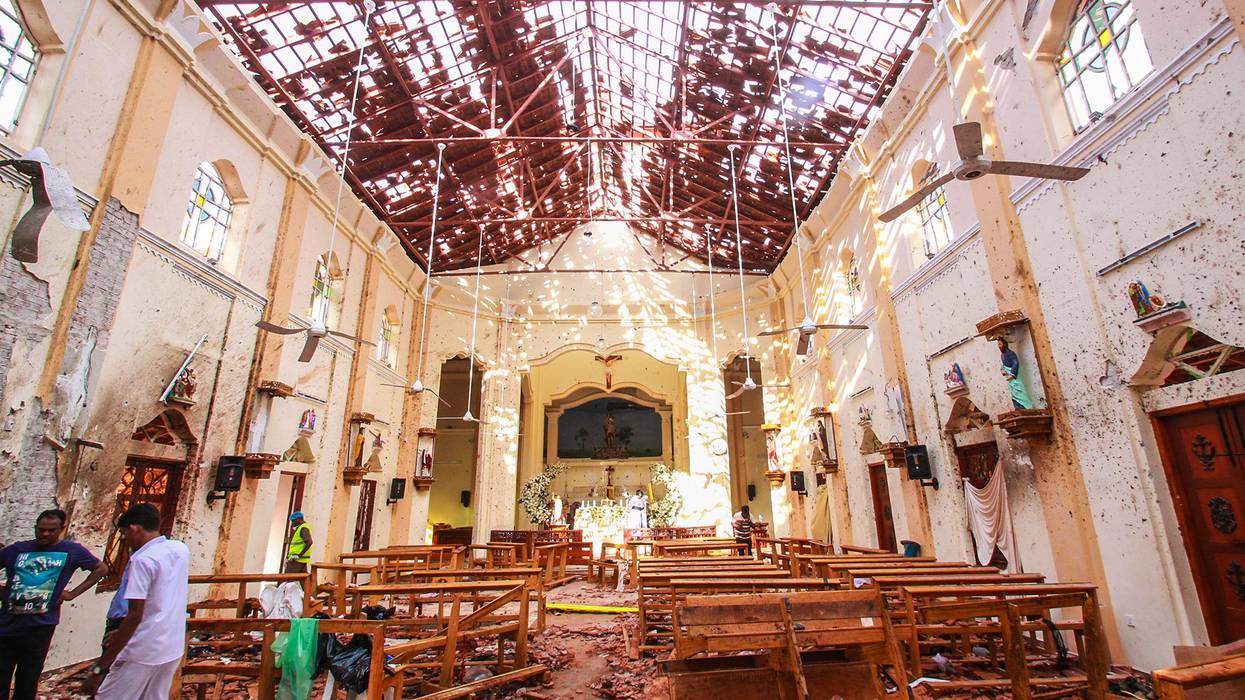
By now the tactic is familiar, if monstrous. These small, fringe groups are frustrated that 99.999 % of Muslims are not interested in their extremism. They commit mindless butchery and terrorism to make the mainstream society hate Muslims, and so can use the backlash against their own acts of terror to recruit Muslims who then feel attacked for no reason. The engine of Islamophobia thus can be revved up and used to radicalize the Muslims in the "grey zone" who had earlier rejected radicalism. The tactic only works if the mainstream society and authorities fall for it by persecuting the Muslims that had nothing to do with the attack.
Hitting Christians was a way of getting an even bigger effect, since it would attract the attention, they thought, of Christians in Europe and the US, promoting Islamophobia there, as well.
Sri Lanka (once called Ceylon) is 70 percent Buddhist, 13% Hindu, about 10% Muslim and 7% or so Christian. It had been roiled in the 1990s and the first part of the 21st century by a guerrilla insurgency among middle class Tamil Hindus of Marxist leanings, the Tamil Tigers, who invented the tactic of suicide bombing used by Tawheed Jamaat on Sunday. Its small Muslim minority had mostly tried to keep its head down. But it sometimes was targeted, as in 1990 when the Tamil Tigers killed 110 Muslims at two mosques.
The rise of stochastic or random terrorism impelled by suggestions made by ISIL militants on the internet has led to small fringe groups franchising with ISIL and carrying out terrorist operations like that on Easter, which has no immediate political goal. That is, stochastic terrorism does not demand some practical step like a change in a law or an end to persecution of a group. Its whole point is to provoke a backlash against Muslims so as to make more radicals.
The death cult in Sri Lanka, like all religious cults, betrayed and defiled the actual values of Muslim scripture.
The Prophet Muhammad (c. 567-632) had good relations with most of the Christians he knew, and I think he supported the Roman Christians against their adversaries, the Zoroastrian Iranians. The Table 5:82 says of the early Muslims, "you will find that the nearest to them in love are those who say 'We are Christians.' That is because they have among them priests and monks, and they are not haughty."
The Qur'an complained about bad relations between Jews and Christians, which sometimes led to the destruction of synagogues and churches.
In 523 AD, a century before the verses of the Qur'an discussed here, the Yemeni, Himyarite king Yusuf Dhu Nuwas, a convert to an apparently militant form of local Arabian Judaism, and then went on to raze churches and commit a pogram against Christians in the city of Najran (today in Saudi Arabia just north of the Yemeni border). Yusuf Dhu Nuwas was probably allied with Sasanian, Zoroastrian Iran, while the Christians in the region had ties to Christian Ethiopia, which was allied with the Christian, Eastern Roman Empire.
The sixth-century Palestinian historian, Procopius (Prokopios) of Caesarea, wrote that the Roman Emperor Justinian urged the Ethiopian king or Negus to intervene in Yemen and secure it for Christendom against Iran, and so shore up trade in silk and other luxury goods with Asia. (The Jewish Himyarite dynasty, being allied with Iran, could harry Roman ships in the Red Sea trying to go to Sri Lanka/ Ceylon for the Asia trade).
The early biographer of the Prophet Ibn Hisham, who edited the work of Ibn Ishaq (d. 760s AD), held that Qur'an 85:4-7 refers to this massacre by Dhu Nuwas, in part because it mentions an obscure word, al-Ukhdud. While this term can mean ditch, it is also a place name just outside Najran.
The Qur'an says, "Cursed by the people of al-Ukhdud: Fire, fed by fuel, when they sat above it. And they were themselves witnesses to what they did to the Believers."
85:10 concludes, "Those who coerce the consciences of the believers and refuse to repent, the torment of the netherworld awaits them, and the agony of hellfire."
If Ibn Ishaq is right, the Qur'an here condemned a historic wrong that resonated even a century later in the Arabian peninsula, in which a ruling elite with biblical commitments attacked the believers and churches of a rival such group.
Now let us fast-forward nearly 100 years. The Iranians invaded the Near East and took Damascus in 613 AD, then conquered Christian Jerusalem in 614 AD.
Christian sources maintain that Jews in Roman First Palestine sided with the Iranians, and that some of them attacked churches.
A Christian polemical work of the 600s aimed at converting Jews, Jacob the Newly Baptized, has Jacob recall the year 614: "When Christians at Ptolemais departed because of the Persian invasion, the Jews found an occasion to burn Christian churches and pillage their houses, harassing and killing many Christians."
On the other hand, the eastern Roman Empire, Christian-ruled, had also attacked synagogues. Emperor Justinian in the 500s had ordered that synagogues be turned into churches. Maybe a few were, in North Africa, but historians actually think synagogues spread extensively and became more central to Jewish life through the 500s.
In the Qur'an, the chapter of the Cow 2:113 castigated Jews and Christians for each denying the truth of the other's religion, even though they both believe in the Bible:
It goes on to scold them for violently attacking one another's religious edifices:
"Who is more of a despot than one who forbids the mention of God's name in the houses of God, and strives to tear them down? They should not have entered them save in fearful reverence. Their lot in this world is disgrace, and in the next they face severe torment."
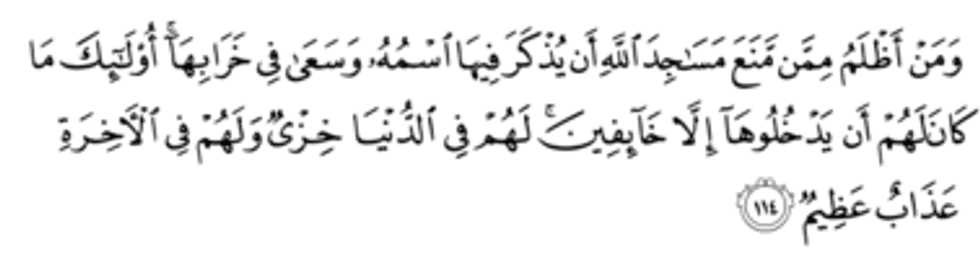
I believe that the context of this instruction that churches and synagogues both be reverenced by Jews and by Christians is the war between Iran and the eastern Roman Empire.

I fully support the aims of the conference. I support the contention that sexual violence is not an inevitable part of conflict. I applaud the call for new attitudes, which remove the stigma, the great shame that comes with these crimes. I support Foreign Secretary Hague and Special Envoy Angelina Jolie's determination to "shatter the culture of impunity for sexual violence." The Foreign Secretary calls ending sexual violence in conflict "a moral issue for our generation." I couldn't agree more.
But regrettably, Foreign Secretary Hague has forgotten about the courageous survivors of sexual violence in Sri Lanka.
Sexual violence in Sri Lanka is not on the conference agenda. More than this, the Stabilization Unit Team of Experts, created by Mr Hague, has not been assigned to the country to investigate. The team is working on both ongoing (DR Congo, Syria) and historic (Libya, Bosnia, Rwanda) cases of sexual violence in conflict -- and has recently expanded its remit to cover more countries including Burma... Yet Sri Lanka, where rape has been used as a weapon of war for many years of brutal civil conflict, is not being examined.
Nor is the UK providing a safe haven for victims of torture and sexual violence in conflict. Refugees are being deported from the UK back to Sri Lanka to face further torture or even death.
I have campaigned for human rights, social justice and environmental protection for over 30 years. I have met many victims of sexual violence, from Bosnia to Guatemala. I was very shaken by the brutal accounts of sexual violence in Sri Lanka. Rape is systematic and widespread against both men and women. Horrific crimes are being committed with total impunity by police and armed forces.
The evidence reveals a chilling pattern -- not opportunistic individual soldiers but a sanctioned coordinated program with different wings of Security forces cooperating in secret camps for torture and sexual violence.
On Friday, June 6, I met with two Tamil survivors of torture and rape in Sri Lanka -- a man and a woman. I felt sickened after listening to their horrific testimonies of unlawful detention, torture, sexual crimes and repeated rape -- the young man was subjected to similar torture and rape as the woman. I have withheld their names and certain details in the accounts below, in order to protect them and their families from reprisals. They are in fear for their lives.
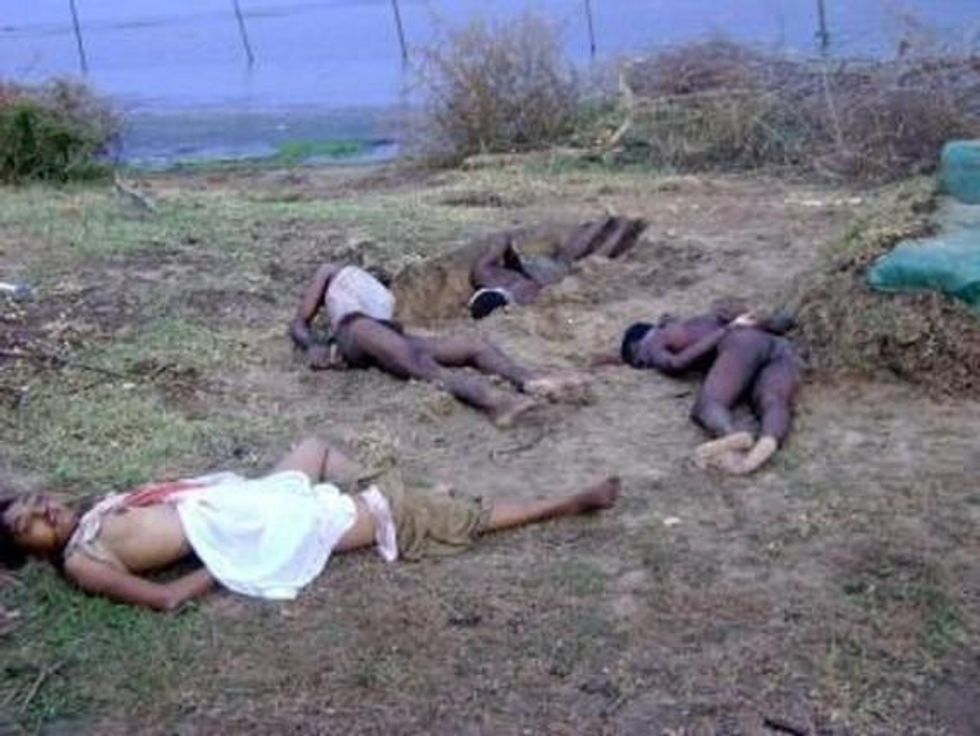
The young woman told me of being dragged from her home in front of her mother by five men in civilian dress, blindfolded and taken in a white van to a place where men and women were screaming and crying behind the walls. She was put in a room with no window, water, toilet, bucket or sink. Two men in cargo pants interrogated her. She was crying so much that she couldn't answer. They tore her dress off as she cried and shouted and slapped them. They burned her with cigarettes on the face and breasts. Then they both raped her. That night she lay on the cement floor, bleeding from the rapes. She was not given food or drink and she didn't sleep. She says she felt very ashamed, that perhaps it would have been better if they had killed her. Through the walls other male and female voices were screaming.
Over the next nine days she was raped repeatedly. She believes it was by many different men. Sometimes there were as many as four at once. She was burned on the face, breasts, thighs, arms, buttocks and back and beaten with a plastic pipe, repeatedly ducked in a barrel of water.
After the ninth day, men came every other day rape her, one at a time. During the time she was held prisoner she never saw a lawyer or a judge.
After 16 days, she was finally freed by a bribe from a family member, who arranged for her to board a flight to London. She was taken into custody on arrival when she could not produce a passport. She told me that the first time she met with the Home Office, she couldn't speak. She is not allowed to work in the UK. She reports to the Home Office once a month. She says she can't sleep. She's always anxious. She's still in pain from her injuries from the rapes and beatings. She feels that the UK is the only place that can protect her. If she is sent back, she says, they won't leave her alive this time. She hopes that what happened to her will not happen to anyone else.
The young man was crying and trembled as he spoke to me. He was frightened, emotionally fragile.
He was at home with his mother and sister when three large men, two in plain clothes and one in a green army uniform, seized him from the yard as his mother and sister screamed. They bundled him into an unmarked white van. He had no shoes. In the van, they beat him until he passed out.
He woke in a small cell with no windows. Over the next five months, he was subjected to torture, including having his genitals squeezed until he passed out. He was beaten, sprayed with a high pressure hose, threatened with cigarettes, urinated on, spat on, and blindfolded. He was fed but not much, and lost a lot of weight.
He was finally released and ordered to report to the police station every two weeks. He had injuries all over his body -- pain in his genitals, back, knees. He returned home but he says he didn't want to do anything, or go anywhere. He was very frightened all the time.
When he routinely reported to the police station again two months later, he was handcuffed and again bundled into a vehicle. He was taken to another place with concrete bunkers and metal sheds, taken into a concrete room and bound to a chair.
He was interrogated. He was kicked with boots, beaten, threatened with cigarettes. He remained in detention for eight months. Sometimes he saw other detainees in the yard but no one spoke. This time the interrogations were different.
He was often stripped and held down while one man squeezed his testicles. On one occasion, a man licked him up and down with his tongue.
He was raped more than three times, including with metal objects, by between three and five men at a time. "They were always wearing army uniform," he said. He remembers screaming and screaming.
During the time he was held prisoner, he never saw a lawyer or a judge.
His family also bribed his way out, and they kept the fact that he had a passport quiet. He was again ordered to report to the police station every two weeks but instead obtained a student visa and came to the UK, where he was detained at Gatwick for two months. He has applied for asylum. It has not been granted.
He was a student, and he says that he thinks if he could study again, it would be better, and that he could move on. He lives with his family, but he has not told them what happened to him. His deportation hearing is coming up at the end of the month. I will be accompanying him to the hearing.
I have met survivors of sexual violence from all over the world. I have never in my experience as a human rights campaigner encountered so much evidence of the rape of men as in Sri Lanka.
Last Friday was a beautiful sunny day in London but it seemed very dark in my living room where I sat with those two survivors. I felt sick, revolted as I listened to the atrocities they had endured. Their suffering was palpable. It was a trauma to recount their experiences, but both said it was a relief to speak of it. There is a stigma surrounding rape and the survivors feel great shame, as of course the perpetrators intended they should.
Cigarette burns and branding are used as a way of ensuring that everyone knows the victims have been raped. Frances Harrison, the author of Still Counting the Dead: Survivors of Sri Lanka's Hidden War, says most survivors never confide in husbands, mothers, sisters, family. These rapes inflict tortures of isolation and suffering years after they are over. She says it's common for the Sri Lankan government to take reprisals against family of those who have fled to the UK. Victims therefore fear to phone their families in Sri Lanka. They are very alone.
The cases I have cited above are not isolated or exceptions. Rape is being used as a weapon of war in Sri Lanka as we speak. The survivors, including the two I have met, are understandably horrified, at a loss to understand why their plight is not being addressed at the Global Summit to End Sexual Violence in Conflict.
I have appealed to William Hague and Angelina Jolie to include sexual violence and torture in Sri Lanka in the agenda to End Sexual Violence in Conflict, and broaden the remit of the Stabilization Unit Team of Experts. It is critical that they include Sri Lanka as one of the countries to which they are assigned. I urge them also to lend their voices to the plight of those survivors who are being sent from the UK back to Sri Lanka to face further torture or death.
Rape has long been used as a weapon of war. For a long time it was seen as inevitable. Talking to those two Sri Lankan survivors brought back horrific memories of the testimonies I heard from Bosnian and Croatian women during my fact finding mission to the former Yugoslavia. In 1993 the Helsinki Commission, U.S. Congress asked to me to document the use of mass rape as a weapon of war by Serb forces as part of their campaign of ethnic cleansing. I traveled through the former Yugoslavia with UNHCR, visited refugee camps and listened to hundreds of shocking testimonies of women who had been raped. Upon my return to the U.S., I testified before the Helsinki Commission. I recall the reluctance of the international community to believe that tens of thousands of women had been victims of rape -- and their reluctance to act. Today, thousands of those women are still waiting for justice in Bosnia.
I cannot fathom why the UK government is not denouncing the Sri Lankan government's atrocities. Why are they not demanding that the perpetrators be brought to justice? Why are they deporting survivors of torture and rape back to Sri Lanka, and endangering their lives?
In November 2013, Prime Minister David Cameron and Foreign Secretary William Hague attended the Commonwealth Summit in Sri Lanka, despite widespread international condemnation of the Sri Lankan government for their human rights abuses. Sri Lanka now holds the presidency of the Commonwealth. Why is the issue of sexual violence in Sri Lanka not included in the agenda for the summit when there is such a wealth of evidence?
In the April 2014, a UN report by UN Secretary General Ban Ki Moon and Zainab Hawa Bangura, the Secretary General's Special Representative on Sexual Violence in Conflict, named Sri Lanka as one of the 21 countries where rape and other sexual violence have been committed during conflicts.
The March 2014 report, "An Unfinished War: Torture and Sexual Violence in Sri Lanka, 2009 - 2014," was produced by human rights lawyer and co-author of the UN Panel of Experts report on mass atrocities in Sri Lanka, Yasmin Sooka. The Bar Human Rights Committee of England and Wales and the International Truth and Justice Project, "Sri Lanka," is a collection of 40 sworn testimonies from witnesses who had been subject to detention in Sri Lanka, now in the UK. The statements are supported by medical and hospital records, and the report was conducted by nine independent, international lawyers. The report found that "the targeting ... was not random and that the patterns of the use of torture, rape and sexual violence makes it likely, we believe that the experiences described a small sample of those crimes likely to have been committed against the Tamil population in Sri Lanka." I urge you to read the report. It states, "[A]lmost half the witnesses interviewed for the report attempted to kill themselves after reaching safety outside Sri Lanka."
The only mention of Sri Lanka in the three-day agenda of the Summit is the participation of Yasmin Sooka, co-author of 'An Unfinished War,' in the panel "Investigating and Documenting sexual violence in conflict." There is no country specific focus on Sri Lanka -- Ms Sooka will speak generally about investigation. There is no mention of Sri Lanka in any of the documents about the official sessions, and no case studies on Sri Lanka.
Channel 4's The Killing Fields documents the last days of the civil war in 2009. A UN report leaked to the BBC at the time, investigating the UN's own conduct during the last months of the conflict states: "Events in Sri Lanka mark a grave failure of the UN."
The 2013 Human Rights Watch report, "We Will Teach You a Lesson" and other reports by the Minority Rights Group, recent interviews on ITV News and the BBC, and the 2014 documentary No Fire Zone, The Killing Fields of Sri Lanka, all suggest that sexual violence against the Tamil community continues to be rife. No Fire Zone also shows that the Tamil journalist Isaipriya was raped and executed while in custody -- the Sri Lankan government has always claimed she died in combat.
Even Foreign Secretary William Hague cited these allegations on November 13, 2013, and urged Sri Lanka to sign the Declaration of Commitment to End Sexual Violence in Conflict and launch an investigation.
Sri Lanka has refused to sign the Declaration despite the urging of Foreign Secretary Hague, and declined his invitation to the conference.
Sri Lanka is not living up to its responsibilities to launch an investigation into the atrocities committed during the civil war. UNHCR voted on March 27, 2014, in the face of fierce opposition from the Sri Lankan government, to launch an international investigation. High Commissioner Navi Pillay had urged the creation of an independent inquiry for years. The lack of progress, she says dryly, "[H]as been a question of political will."
It would have a significant impact if the Foreign Secretary broadened the remit of the Stabilization Unit Team of Experts to include Sri Lanka as one of the countries to which they were assigned.
Sri Lanka is an obvious candidate for inclusion and such a move would send a powerful signal to President Mahinda Rajapaksa and his government that rape is a war crime and that the perpetrators must be brought to justice.
The voluntary Declaration of Commitment to End Sexual Violence in Conflict is a precondition for investigation under current regulations of the Stabilisation Unit. They cannot investigate in Sri Lanka. But as the "An Unfinished War" report demonstrates, and as I have seen for myself, there are victims willing to be interviewed living here in the UK.
I fear that the UK Government's unwillingness to investigate this issue is linked to immigration, border policy and the UK Border Agency. The UK has been deporting victims of sexual violence and torture back to Sri Lanka. Last year the UK government admitted that 15 people had been tortured, escaped to the UK, were deported back to Sri Lanka, tortured again, and then escaped to the UK again. I have read the testimonies of some survivors of sexual violence who have undergone this process, and are once again awaiting deportation in the UK. This could well be the tip of the iceberg.
The Refugee Council's women's advocacy manager, Anna Musgrave told the Observer on the June 7 that it was hypocritical of the government to have the Foreign Office pledging to help to stop rape as a weapon of war while the Home Office was treating its victims so shoddily.
"This summit demonstrates," she said, "there is a dangerous lack of joined-up thinking when it comes to tackling sexual violence against women. On one hand, you've got real progress being made in conflict zones overseas, but when those same victims make it to UK shores it's a completely different story. Women often aren't believed, and instead of being protected they're further traumatised by the asylum system. It's critical that the government tackles this issue with the same gusto at home as it's doing abroad and protects the survivors of sexual violence."
I hope Foreign Secretary William Hague and UN Envoy Angelina Jolie will seize this historic opportunity. I have written them both personal letters urging them to include Sri Lanka in the agenda for the Summit, to shine a light on the plight of the victims of sexual crimes and torture in Sri Lanka, and asking them to meet with survivors.
Angelina Jolie and William Hague said in their joint article in the Sunday Times on the June 8, "It is in our power to remove rape as a weapon of war from the world's arsenal of cruelty. And it is in our hands to treat victims not as social outcasts, but as courageous survivors."
I admire their objectives -- this is a consummation devoutly to be wished. But all the victims of sexual violence in conflict deserve access to justice and our support -- we cannot pick and choose who we extend that justice to.
I am afraid that at the moment, the Sri Lankan survivors are still treated as "outcasts." They are being relegated to the edges of society. Their plight is being ignored by the support systems of the state -- by the Agenda for the Summit and, I am afraid to say, by the UK government. As Mr Hague said in his opening statement to the Summit: 'What would it say about Britain if we chose not to act -- now that we know the facts, how can we turn aside?'
I would like Mr Hague to answer his own question.
Editor's note: William Hague late on Tuesday did respond to charges levied against the UK government about its treatment of Tamil asylum seekers by saying his office will investigate the matter.