

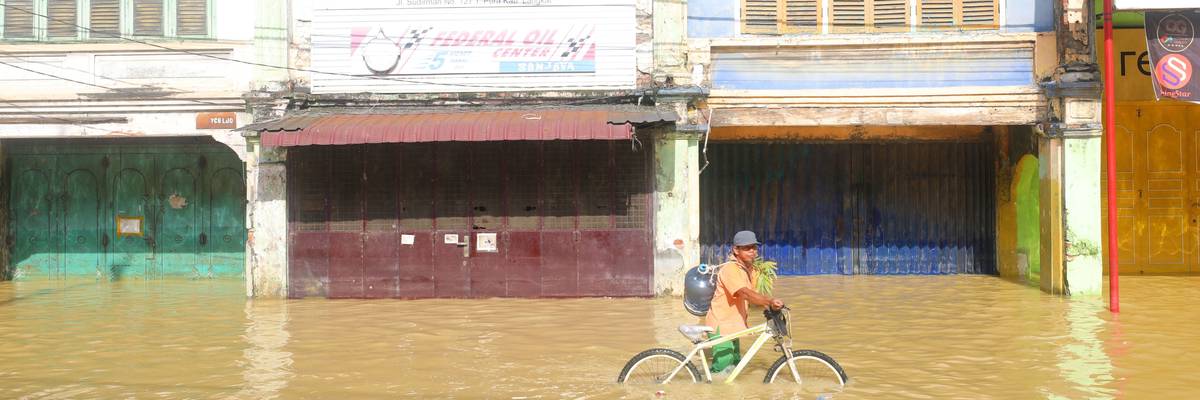
People wade through a flooded road on November 30, 2025, in Sumatra, Indonesia.
Flooding Kills 1,000+ Across South Asia as Climate Crisis Fuels More Extreme Rain
“We need to confront climate change effectively,” Indonesia's president said.
More than 1,100 people across South Asia have died after torrential rains fueled by warming temperatures caused widespread flooding and landslides in recent days.
Following days of unprecedented cyclone conditions, people across Indonesia, Malaysia, and Thailand have been left with their homes destroyed and forced to flee for their lives. A separate cyclone in Sri Lanka has left hundreds more dead.
The worst devastation has been seen in Indonesia, where Cyclone Senyar has claimed over 500 lives as of Sunday. On the island of Sumatra, rescue teams have struggled to reach stranded people as roads have been blocked by mudslides and high floodwaters. Many areas are still reportedly unreachable.
As Reuters reported Monday, more than 28,000 homes have been damaged across the country and 1.4 million people affected, according to government figures. At least 464 were reported missing as of Sunday.
Other countries in the region were also battered. In Thailand, the death toll was reported at 176 as of Monday, and more than 3 million people are reported to be affected. The worst destruction has been in the southern city of Hat Yai, which on November 21 alone experienced 335mm of rain, its single largest recorded rainfall in over 300 years.
At least two more have been killed in Malaysia, where nearly 12,000 people still remain in evacuation centers.
Sri Lanka has witnessed similar devastation in recent days from another storm, Cyclone Ditwah, that formed around the same time as Senyar. Floods and mudslides have similarly killed at least 330 people, and destroyed around 20,000 homes, while leaving around a third of the country without electricity. More than 200 people are missing, and over 108,000 are in state-run shelters, officials say.
Work has begun in Indonesia to restore damaged roads, bridges, and telecommunication services. But after he visited survivors in Sumatra, Indonesian President Prabowo Subianto said that the work will extend beyond merely recovering from the storm.
“We need to confront climate change effectively,” Prabowo told reporters. “Local governments must take a significant role in safeguarding the environment and preparing for the extreme weather conditions that will arise from future climate change.”
Southeast Asia was top-of-mind for many attendees at last month's COP30 climate summit in Brazil. As Winston Chow, a professor of urban climate at Singapore Management University and part of the UN’s Intergovernmental Panel on Climate Change (IPCC), told the Straits Times, this is because the region "is highly vulnerable to climate change."
"As a whole, it faces multiple climate risks and hazards, such as rising temperatures, sea-level rise, increasing droughts and floods, and the intensification of extreme events like typhoons," he continued.
In recent years, the region has been hit by annual devastating heatwaves, resulting in record-shattering temperatures. In Myanmar, where temperatures exceeded 110°F last April, Radio Free Asia reported that 1,473 people died from extreme heat in just one month.
Floods have likewise grown more deadly in recent years. Just this month, floods killed dozens more people in Vietnam, and a pair of typhoons killed hundreds more in the Philippines and forced over a million people to evacuate their homes.
While it's difficult to determine the extent to which any one disaster was caused by climate change, in aggregate, they are growing more intense as the planet warms.
"As the world’s oceans and atmosphere warm at an accelerating rate due to the rise in greenhouse gases from burning fossil fuels, tropical cyclones are expected to become more intense," explained Steve Turton, an adjunct professor of environmental geography at CQUniversity Australia in The Conversation on Sunday. "This is because cyclones get their energy from warm oceans. The warmer the ocean, the more fuel for the storm."
According to the National Centers for Environmental Information, part of the US National Oceanic and Atmospheric Administration, October 2025 was the third-warmest October on record globally and had above-average tropical cyclone activity.
"The warming atmosphere is supercharging the global water cycle, and peak rainfall rates are increasing," Turton said. "When more rain falls in a short time, flash flooding becomes more likely."
At COP30, protesters from across Southeast Asia assembled to demand action from global leaders. On November 10, shortly after her home in Manila was battered by a pair of typhoons, 25-year-old activist Ellenor Bartolome savaged corporations and world leaders who have continued to block global action to reduce fossil fuel usage.
“It gets worse every year, and for every disaster, it is utterly enraging that we are counting hundreds of bodies, hundreds of missing people... while the elite and the corporations are counting money from fossil fuels," she told attendees as they entered the conference.
Ultimately, many climate activists and scientists left the conference enraged yet again, as the final agreement stripped out all language related to fossil fuels.
We are at a crossroads
This country and this world are at a monumental crossroads. In a few short weeks, US voters will have an opportunity to beat back the forces of fascism and confront the billionaires who are rigging the economy, our media system, and our democracy, making it increasingly impossible for ordinary people to get by. We’re not just talking about the election. We’re talking about what must be done once these fascist elements are vanquished from power. We need a bolder set of solutions than what either major party has so far been willing to offer and a working-class movement ready to fight like hell for it. Trump didn't emerge from nowhere. The conditions that fueled MAGA authoritarianism were created by decades of radical neoliberal economic policies and a corrupt political system dominated by corporate interests. They slashed taxes on the super-rich, promising that the benefits would trickle down. They said giveaways to the corporate titans would make life more affordable for the rest of us. It was all bullshit. And when a bitter, betrayed populace searches for someone to blame, right-wing demagogues have little trouble finding scapegoats. People know when they're being lied to, but you won't hear any of this from the corporate media. Only independent journalism—powered and funded by people who believe in building a better world—can deliver truly trustworthy daily news. Our Fall Campaign is underway, and we need your help. To power our newsroom through the rest of the year, we need to raise $125,000 by midnight on October 31. So if you share our vision, please contribute whatever you can to sustain our work. |
More than 1,100 people across South Asia have died after torrential rains fueled by warming temperatures caused widespread flooding and landslides in recent days.
Following days of unprecedented cyclone conditions, people across Indonesia, Malaysia, and Thailand have been left with their homes destroyed and forced to flee for their lives. A separate cyclone in Sri Lanka has left hundreds more dead.
The worst devastation has been seen in Indonesia, where Cyclone Senyar has claimed over 500 lives as of Sunday. On the island of Sumatra, rescue teams have struggled to reach stranded people as roads have been blocked by mudslides and high floodwaters. Many areas are still reportedly unreachable.
As Reuters reported Monday, more than 28,000 homes have been damaged across the country and 1.4 million people affected, according to government figures. At least 464 were reported missing as of Sunday.
Other countries in the region were also battered. In Thailand, the death toll was reported at 176 as of Monday, and more than 3 million people are reported to be affected. The worst destruction has been in the southern city of Hat Yai, which on November 21 alone experienced 335mm of rain, its single largest recorded rainfall in over 300 years.
At least two more have been killed in Malaysia, where nearly 12,000 people still remain in evacuation centers.
Sri Lanka has witnessed similar devastation in recent days from another storm, Cyclone Ditwah, that formed around the same time as Senyar. Floods and mudslides have similarly killed at least 330 people, and destroyed around 20,000 homes, while leaving around a third of the country without electricity. More than 200 people are missing, and over 108,000 are in state-run shelters, officials say.
Work has begun in Indonesia to restore damaged roads, bridges, and telecommunication services. But after he visited survivors in Sumatra, Indonesian President Prabowo Subianto said that the work will extend beyond merely recovering from the storm.
“We need to confront climate change effectively,” Prabowo told reporters. “Local governments must take a significant role in safeguarding the environment and preparing for the extreme weather conditions that will arise from future climate change.”
Southeast Asia was top-of-mind for many attendees at last month's COP30 climate summit in Brazil. As Winston Chow, a professor of urban climate at Singapore Management University and part of the UN’s Intergovernmental Panel on Climate Change (IPCC), told the Straits Times, this is because the region "is highly vulnerable to climate change."
"As a whole, it faces multiple climate risks and hazards, such as rising temperatures, sea-level rise, increasing droughts and floods, and the intensification of extreme events like typhoons," he continued.
In recent years, the region has been hit by annual devastating heatwaves, resulting in record-shattering temperatures. In Myanmar, where temperatures exceeded 110°F last April, Radio Free Asia reported that 1,473 people died from extreme heat in just one month.
Floods have likewise grown more deadly in recent years. Just this month, floods killed dozens more people in Vietnam, and a pair of typhoons killed hundreds more in the Philippines and forced over a million people to evacuate their homes.
While it's difficult to determine the extent to which any one disaster was caused by climate change, in aggregate, they are growing more intense as the planet warms.
"As the world’s oceans and atmosphere warm at an accelerating rate due to the rise in greenhouse gases from burning fossil fuels, tropical cyclones are expected to become more intense," explained Steve Turton, an adjunct professor of environmental geography at CQUniversity Australia in The Conversation on Sunday. "This is because cyclones get their energy from warm oceans. The warmer the ocean, the more fuel for the storm."
According to the National Centers for Environmental Information, part of the US National Oceanic and Atmospheric Administration, October 2025 was the third-warmest October on record globally and had above-average tropical cyclone activity.
"The warming atmosphere is supercharging the global water cycle, and peak rainfall rates are increasing," Turton said. "When more rain falls in a short time, flash flooding becomes more likely."
At COP30, protesters from across Southeast Asia assembled to demand action from global leaders. On November 10, shortly after her home in Manila was battered by a pair of typhoons, 25-year-old activist Ellenor Bartolome savaged corporations and world leaders who have continued to block global action to reduce fossil fuel usage.
“It gets worse every year, and for every disaster, it is utterly enraging that we are counting hundreds of bodies, hundreds of missing people... while the elite and the corporations are counting money from fossil fuels," she told attendees as they entered the conference.
Ultimately, many climate activists and scientists left the conference enraged yet again, as the final agreement stripped out all language related to fossil fuels.
More than 1,100 people across South Asia have died after torrential rains fueled by warming temperatures caused widespread flooding and landslides in recent days.
Following days of unprecedented cyclone conditions, people across Indonesia, Malaysia, and Thailand have been left with their homes destroyed and forced to flee for their lives. A separate cyclone in Sri Lanka has left hundreds more dead.
The worst devastation has been seen in Indonesia, where Cyclone Senyar has claimed over 500 lives as of Sunday. On the island of Sumatra, rescue teams have struggled to reach stranded people as roads have been blocked by mudslides and high floodwaters. Many areas are still reportedly unreachable.
As Reuters reported Monday, more than 28,000 homes have been damaged across the country and 1.4 million people affected, according to government figures. At least 464 were reported missing as of Sunday.
Other countries in the region were also battered. In Thailand, the death toll was reported at 176 as of Monday, and more than 3 million people are reported to be affected. The worst destruction has been in the southern city of Hat Yai, which on November 21 alone experienced 335mm of rain, its single largest recorded rainfall in over 300 years.
At least two more have been killed in Malaysia, where nearly 12,000 people still remain in evacuation centers.
Sri Lanka has witnessed similar devastation in recent days from another storm, Cyclone Ditwah, that formed around the same time as Senyar. Floods and mudslides have similarly killed at least 330 people, and destroyed around 20,000 homes, while leaving around a third of the country without electricity. More than 200 people are missing, and over 108,000 are in state-run shelters, officials say.
Work has begun in Indonesia to restore damaged roads, bridges, and telecommunication services. But after he visited survivors in Sumatra, Indonesian President Prabowo Subianto said that the work will extend beyond merely recovering from the storm.
“We need to confront climate change effectively,” Prabowo told reporters. “Local governments must take a significant role in safeguarding the environment and preparing for the extreme weather conditions that will arise from future climate change.”
Southeast Asia was top-of-mind for many attendees at last month's COP30 climate summit in Brazil. As Winston Chow, a professor of urban climate at Singapore Management University and part of the UN’s Intergovernmental Panel on Climate Change (IPCC), told the Straits Times, this is because the region "is highly vulnerable to climate change."
"As a whole, it faces multiple climate risks and hazards, such as rising temperatures, sea-level rise, increasing droughts and floods, and the intensification of extreme events like typhoons," he continued.
In recent years, the region has been hit by annual devastating heatwaves, resulting in record-shattering temperatures. In Myanmar, where temperatures exceeded 110°F last April, Radio Free Asia reported that 1,473 people died from extreme heat in just one month.
Floods have likewise grown more deadly in recent years. Just this month, floods killed dozens more people in Vietnam, and a pair of typhoons killed hundreds more in the Philippines and forced over a million people to evacuate their homes.
While it's difficult to determine the extent to which any one disaster was caused by climate change, in aggregate, they are growing more intense as the planet warms.
"As the world’s oceans and atmosphere warm at an accelerating rate due to the rise in greenhouse gases from burning fossil fuels, tropical cyclones are expected to become more intense," explained Steve Turton, an adjunct professor of environmental geography at CQUniversity Australia in The Conversation on Sunday. "This is because cyclones get their energy from warm oceans. The warmer the ocean, the more fuel for the storm."
According to the National Centers for Environmental Information, part of the US National Oceanic and Atmospheric Administration, October 2025 was the third-warmest October on record globally and had above-average tropical cyclone activity.
"The warming atmosphere is supercharging the global water cycle, and peak rainfall rates are increasing," Turton said. "When more rain falls in a short time, flash flooding becomes more likely."
At COP30, protesters from across Southeast Asia assembled to demand action from global leaders. On November 10, shortly after her home in Manila was battered by a pair of typhoons, 25-year-old activist Ellenor Bartolome savaged corporations and world leaders who have continued to block global action to reduce fossil fuel usage.
“It gets worse every year, and for every disaster, it is utterly enraging that we are counting hundreds of bodies, hundreds of missing people... while the elite and the corporations are counting money from fossil fuels," she told attendees as they entered the conference.
Ultimately, many climate activists and scientists left the conference enraged yet again, as the final agreement stripped out all language related to fossil fuels.