

SUBSCRIBE TO OUR FREE NEWSLETTER
Daily news & progressive opinion—funded by the people, not the corporations—delivered straight to your inbox.
5
#000000
#FFFFFF
To donate by check, phone, or other method, see our More Ways to Give page.
Daily news & progressive opinion—funded by the people, not the corporations—delivered straight to your inbox.
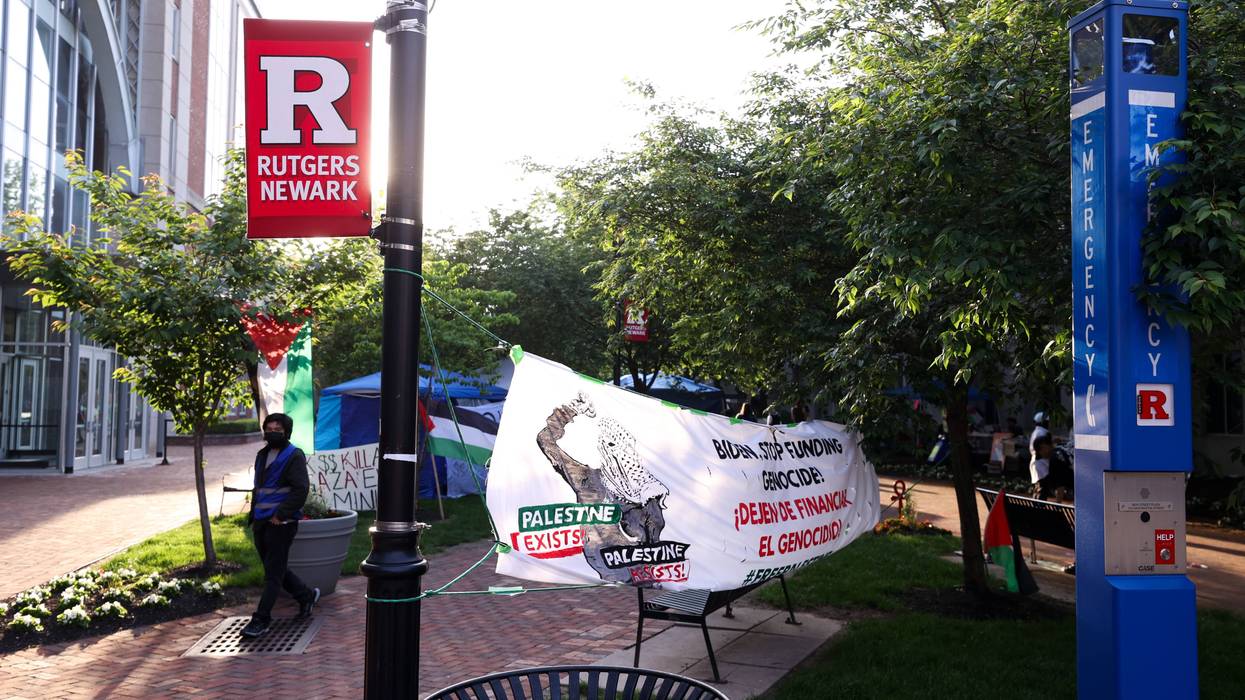
"The message Rutgers is sending to this class and everyone around the country is alarming," said Rami Elghandour. "Don't dare stand for anything. Don't dare speak up."
Faculty members at Rutgers University in New Jersey on Thursday were among those condemning the school's decision to rescind an invitation to Rami Elghandour, a biotech executive and producer of the Gaza-focused film The Voice of Hind Rajab, who had been invited to speak at the School of Engineering commencement next week.
Elghandour said the engineering school's dean, Alberto Cuitiño, had informed him that he was no longer scheduled to give the commencement address after a "few" students told the administration they would not attend the graduation in protest of Elghandour's online advocacy for Palestinian rights.
"Commencement season is here, and with it the usual cycle of silencing voices that stand up for human rights," said Waheed U. Bajwa, a professor at Rutgers in New Brunswick. "This one hits close to home... I publicly call on Rutgers to reverse this!"
Elghandour, a graduate of the engineering school, released a statement saying that the school had "decided that the feelings of a handful of students who said that my social media posts 'opposed their beliefs' were more important than the experience of the entire graduating class, the reputation of the school, the dignity and belonging of Arab and Muslim students, and the First Amendment."
Speaking to the New Jersey Globe, a spokesperson for the university cited a specific post that Elghandour wrote in April on the social media platform X, saying that Israel has "committed genocide" and is "running dungeons where they train dogs to sexually assault prisoners."
"Weapons embargo is the absolute minimum," said Elghandour. "Sanctions and diplomatic isolation are beyond justified."
Leading human rights organizations and Holocaust scholars are among those who have called Israel's assault on Gaza, which began in October 2023 in retaliation for a Hamas-led attack and has killed more than 72,000 Palestinians, a genocide.
Calls for the US to suspend military aid to Israel in light of the war are hardly a fringe view in the US; a Quinnipiac University poll released last August found that 60% of voters across all parties supported a suspension of aid.
Middle East Eye reported in December on Palestinian detainees' allegations that Israeli guards had used dogs to sexually assault them. Rights organizations including the Euro-Mediterranean Human Rights Monitor, the Palestinian Center for Human Rights, and the Council on American-Islamic Relations (CAIR) have also collected testimonies alleging such abuse.
Rutgers spokesperson Dory Devlin told the Globe that some students had accused Elghandour of making an "inflammatory claim" when they said they would not attend the graduation if he spoke.
"Rutgers chose me in part because of my humanitarian work,” said Elghandour in his statement. “They put my role as an executive producer for the Oscar-nominated The Voice of Hind Rajab front and center. They led with my social justice advocacy. Until it was inconvenient. That’s the difference between virtue signaling and principles. One withstands challenge. The other wilts in the slightest breeze.”
"The message Rutgers is sending to this class and everyone around the country is alarming," he added. "Don't dare stand for anything. Don't dare speak up."
He said he plans to record the speech he had been scheduled to give and post it online so students can still hear it.
Hank Kalet, a journalism professor at the school who serves as vice president of the Rutgers Adjunct Faculty Union, told the Globe that the university's actions met "the definition of viewpoint censorship.”
“We have somebody who is offering, in a public way on X, some opinions about genocide in Gaza and being retaliated against because of the opinions that he has,” said Kalet, who is Jewish. He told the outlet that he did not believe Elghandour to be antisemitic.
Naureen Akhter, public affairs director for CAIR-New Jersey, noted that Rutgers had recently hosted Israel Defense Forces soldiers on its campus as part of a national tour called "Triggered: The Ceaseless Tour."
“It is unconscionable that Rutgers rolls out the red carpet to soldiers engaged in genocide yet finds expression of pro-Palestine solidarity from one of their distinguished alumni so objectionable, they refuse to have him address graduates," said Akhter. “We call on Rutgers School of Engineering to reinstate Rami Elghandour as commencement speaker and approach issues of student safety and freedom of expression with more care.”
The Rutgers student body is no stranger to advocacy for Palestinian rights. As on other college campuses across the US, students held a sustained protest in the spring of 2024, demanding the school divest from companies that do business with Israel, terminate its relationship with Tel Aviv University, and take other steps to demonstrate solidarity with Palestinians.
Rutgers-Newark also defended its decision to host pro-Palestinian comedian Ramy Youssef at its 2025 commencement after a state lawmaker claimed his involvement would alienate Jewish students at the university.
The decision to cancel Elghandour's speech came days after the University of Michigan publicly apologized for a graduation speech by Professor Derek Peterson, who had applauded students who spoke out for Palestinian rights in campus protests, saying they exemplified the school's long history of social activism.
“I think [Palestine] is the moral issue of our time, and I believe it’s been used to undermine democratic institutions in the US,” Elghandour told The Guardian on Wednesday.
Bajwa said on social media that "everyone says they'd have stood against slavery, the Holocaust, segregation, and more."
"Easy to be righteous about the past," he said. "But what about now? What moral tests are you failing in your own time? That's the real test of courage."
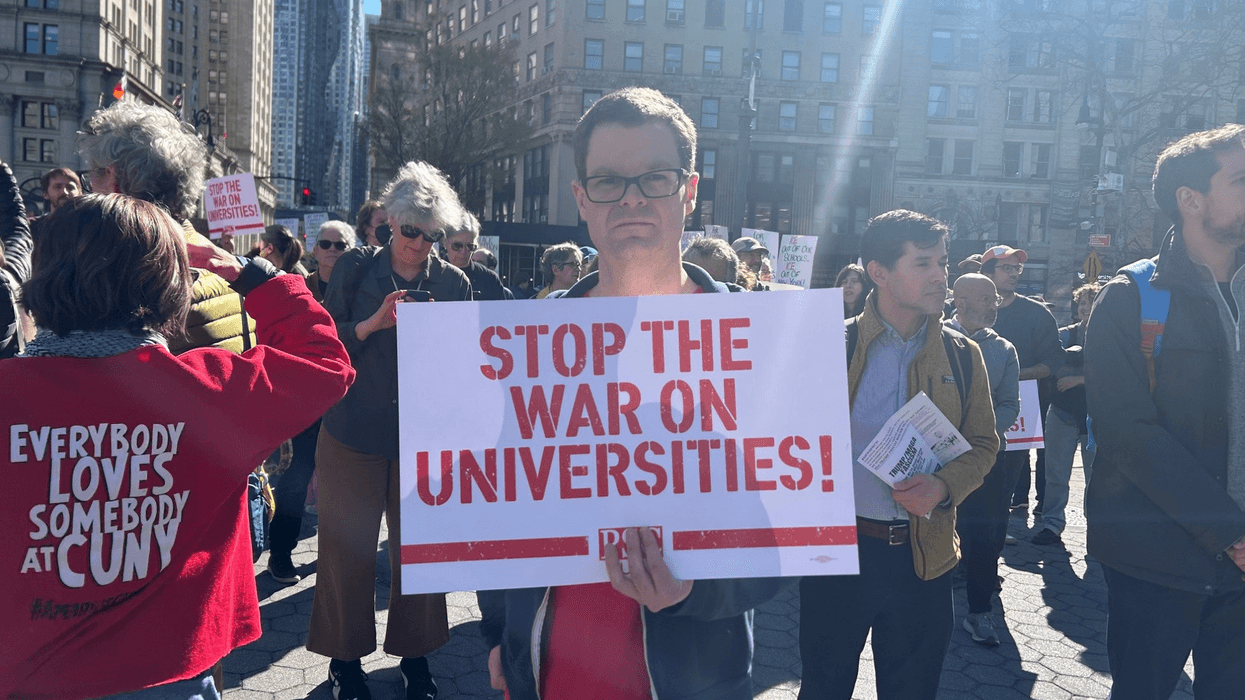
Weeks after the Rutgers University Senate passed a resolution to form a "mutual defense compact" with other Big Ten schools, at least four other schools have pushed forward their own proposals.
Weeks after the Rutgers University Senate passed a resolution to form a "mutual defense compact"—aiming to band together with other universities to protect from the Trump administration's attacks on academic freedom and free speech—university communities' push for their schools to stand up to the White House is gaining momentum.
Labor unions, Palestinian rights groups, and other advocacy groups on Thursday held rallies and events to mark the Day of Action for Higher Education, with students and faculty at more than 150 schools demonstrating against President Donald Trump's funding cuts; attacks on diversity, equity, and inclusion (DEI) initiatives; targeting of academic freedom; and deportation operations in which a number of student organizers have been rounded up in recent weeks.
"[ Immigration and Customs Enforcement] is abducting students," said the Debt Collective, a sponsor of the day of action. "The Trump administration is suppressing free speech. Tuition is rising and workers and staff aren't paid living wages. We need higher education to be a liberation machine, not a deportation and debt-making machine."
The signs displayed at one rally in Pittsburgh reflected the wide array of attacks Trump has launched against higher education—from billions dollars of funding cuts to the National Institutes of Health, impacting biomedical and scientific research at universities across the U.S. to the ICE arrests of international students who have spoken out against Israel's U.S.-funded assault on Gaza.
Like the mutual defense compact proposal that's now gained traction at several schools, the day of action is partially a response to Trump's demand that universities collaborate with the administration to punish students who took part in nationwide Palestinian solidarity protests last year.
Columbia University has drawn ire for reportedly giving the names of students, including organizer Mahmoud Khalil, to the Trump administration before he was detained by ICE; refusing to provide protection to Khalil and his fellow organizer, Mohsen Mahdawi, who was also arrested this week; and revoking degrees from some pro-Palestinian protesters.
In contrast, faculty senates at Big Ten schools including the University of Nebraska at Lincoln, Indiana University at Bloomington, Michigan State University, and the University of Massachusetts at Amherst have joined Rutgers in passing resolutions calling for the creation of mutual defense compacts to protect against the "legal, financial, and political incursion" of the Trump administration.
On Thursday, members of the faculty senate at the University of Michigan, also part of the Big Ten Academic Alliance, advocated for passage of a resolution to defend "academic freedom, institutional integrity, and the research enterprise"—and push back against administrators' closing of the school's DEI office at the behest of Trump's White House.
"The University of Michigan abandoned DEI in-part to avoid the wrath of Trump and most schools, not just ours, have been cowed into this kind of preemptive capitulation. Most schools, not just ours, have gone silent, just when we need them to speak up," sociology and law professor Sandra Levitsky told Michigan Advance on Thursday.
At Indiana University, Jim Sherman, a professor emeritus in psychological and brain sciences, said that while faculty members and students are calling on their institutions to form a coalition against Trump, many administrators at public universities seem to want to draw as little national attention to their schools as possible.
"I think a lot of universities are thinking, basically, 'Boy, I hope they don't come after us.' You know, 'Let them come after Columbia or Harvard or Stanford... Let them go after the big dogs,'" Sherman told Common Dreams. "Maybe if we stay quiet and don't do very much, they'll just ignore us."
But that approach will only worsen the sense of "anxiety, angst, uncertainty, [and] instability" that's spreading across college campuses today, said Sherman.
"When I was an active faculty member, the years and the job were just full of joy," he said. "My collaboration with colleagues across the U.S. and across the world were just incredible. I couldn't have wanted a happier and more fulfilling life."
"Rather than doing your teaching and research," he added, "I think the major goal right now for many of us is protection."
Sherman expressed hope that the growing support for mutual defense compacts will soon leave a critical mass of schools with no choice but to join—and ultimately place pressure on university presidents, who thus far have declined to back the movement.
"If you're in the Big Ten and suddenly five or six universities join, you don't want to be the one who's left out or not [doing] anything," said Sherman.
Outside the Big Ten, Harvard University garnered applause this week when it announced—unlike its Ivy League peer Columbia—that it will not comply with Trump's demands to expel students who took part in pro-Palestinian protest, end its recognition of Palestinian solidarity groups, or audit its programs for "viewpoint diversity." The elite university now faces a threat from Trump to have its tax-exempt status revoked.
The mutual defense compacts that have passed so far call for participating universities to "commit meaningful funding to a shared or distributed defense fund," which could potentially be used in cases like that of Indiana cybersecurity professor Xiaofeng Wang, a Chinese national whose home was raided last month by the Department of Homeland Security and FBI and who was fired by the university, or international students targeted by ICE.
"As long as different universities put their resources together, whether it's sharing information about legal issues, whether it's talking about cases that have been resolved one way or another, whether it's making funds available for the protection of faculty," Sherman said. "I think the biggest goal should simply be unification and coordination and cooperation among as many universities who want to join in as possible."
University presidents are also facing pressure from labor unions to support a mutual defense compact, with a dozen graduate students' unions affiliated with the United Electrical, Radio, and Machine Workers of America releasing a statement Wednesday.
The unions—representing tens of thousands of students at University of Minnesota, Northwestern University, North Carolina State University, and others—urged schools to establish an International Worker Support Fund and to ensure they won't "comply with ICE or other federal agencies initiating unconstitutional requests, such as sharing names and documentation statuses of students and workers or allowing ICE or other federal agents to enter campuses and university buildings."
Paul Boxer, a psychology professor at Rutgers who co-authored the original resolution at the school, emphasized that while university presidents have not yet expressed support for the mutual defense compact, support for defending First Amendment rights, academic freedom, and the diversity that thrives on many college campuses is strong among those who make up university communities.
"We do believe it's extremely important," Boxer told Common Dreams, "that faculty, staff, students, alumni, anyone connected to higher education at all, whether it's public or private, understands that universities—certainly at the level of the individuals who are providing higher education services, who are doing that kind of work, who are invested in the present and future of higher education—we are all committed to this cause."
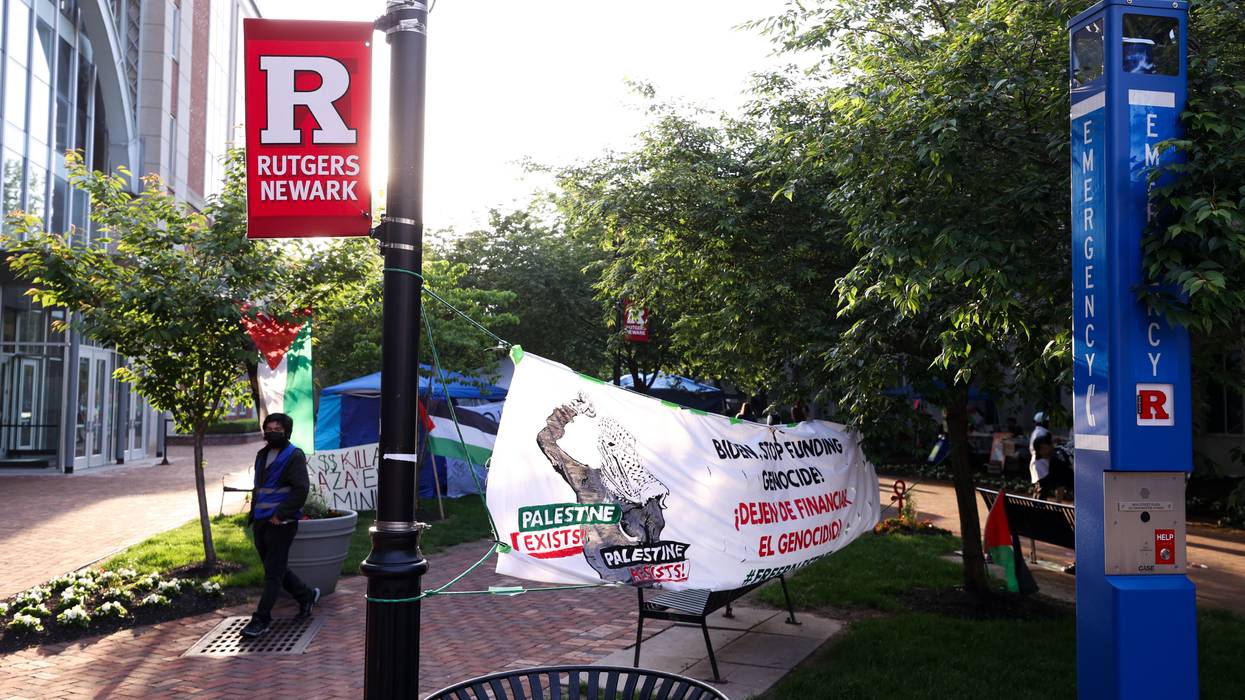
Universities "should be embodying the values of democracy," said one supporter. "And it really becomes clear in times like this how important that is."
A resolution passed by the Rutgers University Senate in response to the Trump administration's crackdown on First Amendment rights is "exactly the kind of model" needed in higher education, said one professor on Sunday as word spread of the document—which was approved amid outcry over other universities' capitulation to the White House's attacks.
"The public is crying out for leadership from somewhere," said Michael Yarbrough, a professor of law and society at John Jay College of Criminal Justice. "Higher ed can provide that and catalyze something bigger. And in the process, we can remind everyone of our true value, something we desperately need to do."
The step toward leadership came in the form of a resolution to form a "mutual defense compact" with other schools that, along with Rutgers, make up the Big Ten Academic Alliance. Under the compact, the schools would "commit meaningful funding to a shared or distributed defense fund" that would provide "immediate and strategic support to any member institution under direct political or legal infringement."
The Rutgers Senate, which includes faculty, students, staff, and alumni, called on the New Jersey institution's president to "take a leading role in convening a summit of Big Ten academic and legal leadership to initiate the implementation of this compact."
The resolution, passed on March 28, was agreed to days after the Rutgers faculty union filed a federal lawsuit against the Trump administration to block its efforts to abduct, detain, and deport international students for expressing support for Palestinian rights, criticism of Israel's U.S.-backed assault on Gaza and the West Bank, and taking part in pro-Palestinian campus protests over the past year.
Under Trump's executive orders to stop what it classifies as "antisemitism" and to deport foreign nationals who "espouse hateful ideology," immigration agents in recent weeks have detained people including Mahmoud Khalil, a former Columbia University graduate student who led negotiations last year calling on the school to divest from companies that profit from Israel's policies; Tufts University Ph.D. candidate Rumeysa Ozturk, who co-wrote an op-ed calling for her school's divestment; and Georgetown University academic Badar Khan Suri, who was detained because "the government suspects that he and his wife oppose U.S. foreign policy toward Israel," according to his lawyers.
"We've all been trying to figure out how to solve this collective action problem. This seems like a very positive big step in the right direction."
"The First Amendment means the government can't arrest, detain, or deport people for lawful political expression—it's as simple as that," said Jameel Jaffer, executive director at the Knight First Amendment Institute, which is representing the Rutgers union and other faculty organizations in the lawsuit. "This practice is one we'd ordinarily associate with the most repressive political regimes, and it should have no place in our democracy."
Under the Rutgers resolution, members of the senate called on participating institutions to "make available, at the request of the
institution under direct political infringement, the services of their legal counsel, governance experts, and public affairs offices to coordinate a unified and vigorous response."
The response could include legal representation, countersuit actions, amicus briefs, legislative advocacy, and "coalition-building," according to the resolution.
"We've all been trying to figure out how to solve this collective action problem," said Elizabeth Wrigley-Field, a professor at University of Minnesota—another member of the Big Ten alliance. "This seems like a very positive big step in the right direction."
A Rutgers Senate member who asked to remain anonymous told Common Dreams on Tuesday that members of the university community have expressed "relief" and "joy" at the news that the body is taking a leadership role in fighting the Trump administration's attacks on higher education.
"People are just feeling like there's something they can hang their hats on that's hopeful," said the member, who was involved in pushing the resolution forward. "Individuals who are concerned about higher education, who are involved in it or connected to it—we're looking to something like this from a big university who can step out and say, 'Let's get something going here to blockade against these attacks.'"
Trump's assault on First Amendment rights are understood to be "existential" by many on university campuses like Rutgers, said the member.
"Proud to be a Rutgers faculty member today," said Michal Raucher, a professor of Jewish studies at Rutgers University—New Brunswick, regarding the passage of the resolution.
Ebony Elizabeth Thomas, chair of the joint program in English and education at University of Michigan—another member of the Big Ten alliance—expressed support for the Rutgers Senate's leadership.
"I greatly admired our Rutgers colleagues' actions of solidarity during the recent waves of campus strikes," said Thomas. "My admiration has increased tenfold."
Last May, about 100 Rutgers faculty members prepared to form a protective circle around students' Palestinian solidarity encampment at the school's New Brunswick, New Jersey campus as a deadline set by administrators approached and officials threatened the students with arrest.
"We are an extremely diverse community," said the Rutgers Senate member. "And I think that we prize that about our community and about our state, because we know that we are elevated by it from the standpoint of having so many different perspectives, weighing on different kinds of issues."
"As the largest public university in the state, as the major land grant university, we take our commitment to the people of New Jersey and to the enterprise of public higher education very seriously," they added. "And we see these kinds of attacks for what they are."
In contrast to the resolution, Columbia administrators have faced harsh rebukes from First Amendment rights advocates for agreeing to the Trump administration's demands when the White House said it was canceling $400 million in government grants and contracts over the school's alleged "continued inaction in the face of persistent harassment of Jewish students."
In response, Columbia—which allowed New York City police to drag students out of a school building and arrest more than 100 people last year during the pro-Palestinian protests—suspended, expelled, and revoked the degrees of some students who had participated in the demonstrations and increased law enforcement presence on campus, among other steps.
The Rutgers Senate member said the body's chair is planning to meet with the university president, Jonathan Holloway, who is set to step down in June, to ask him to sign on to the resolution.
"I think he can make the choice to essentially become legendary in the field and take a strong stand like this and organize his colleagues," said the senate member.
Yarbrough said that Trump's crackdown on protesters, and the capitulation of some institutions, illustrates how education "is really crucial to democracy and to a healthy democracy."
"We should be embodying the values of democracy," said Yarbrough. "And it really becomes clear in times like this how important that is."
While some university administrators are "caving to the Trump administration," he said, "what I think of as the real university of faculty, staff, and students are actually pushing back. And I think that mirrors what we're seeing in the United States more broadly, where most elected leaders and officials are not pushing back the way we would like. But all kinds of people on the ground really are."
"That's what it takes to push back [against] these kinds of authorities and threats," said Yarbrough. "It comes back to the people."
Editor's note: This piece has been updated with additional comments from Michael Yarbrough and a Rutgers Senate member.
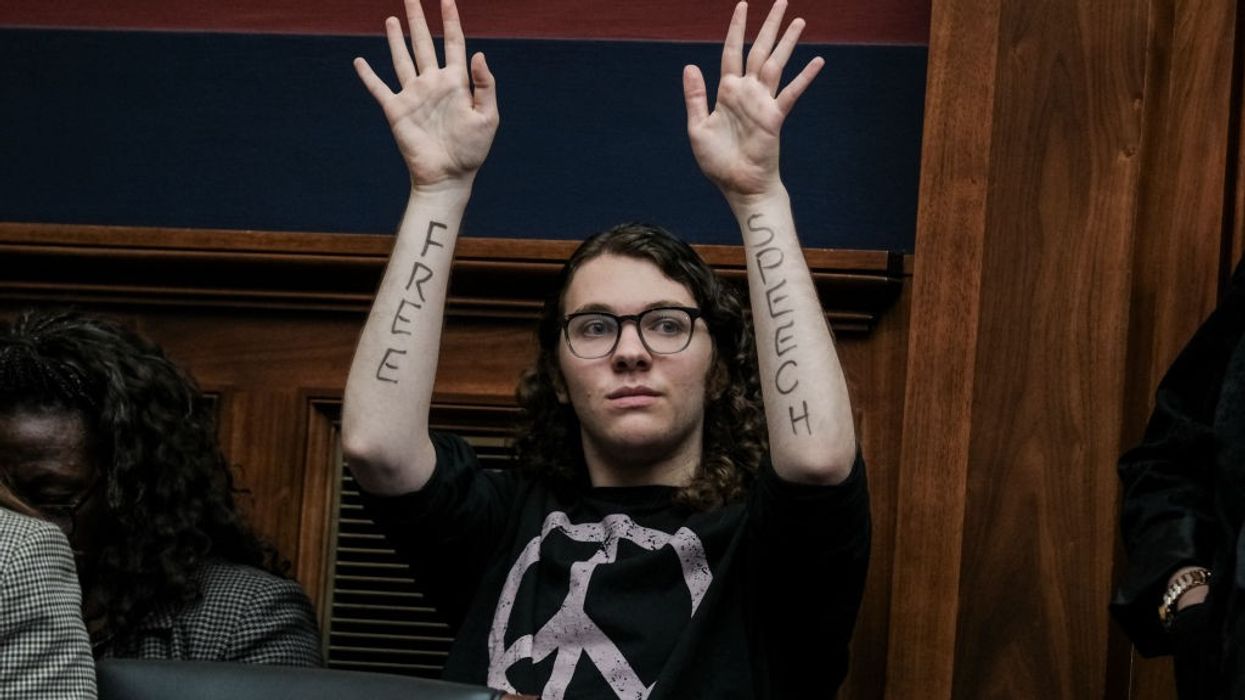
"These hearings are designed to stoke divisions so that we forget who is actually unsafe—the students of Gaza where every university has been destroyed," said one Jewish student who protested at UCLA.
As U.S. House Republicans held yet another hearing about antisemitism and higher education on Thursday, Jewish students and advocacy groups aimed to set the record straight on the threats they face and the largely peaceful protests against genocide.
"This hearing has nothing to do with keeping Jewish students on campus safe, and is solely designed as part of a broader campaign to silence anti-war activism and dissent on college campuses," declared Beth Miller, political director of Jewish Voice for Peace (JVP) Action. "MAGA Republicans are merging attempts to censor students and faculty speaking out for Palestinian rights with a broader culture war campaign against [diversity, equity, and inclusion], critical race theory, LGBTQ rights, and more."
Since Israel launched its U.S.-backed assault of the Gaza Strip in retaliation for the Hamas-led October 7 attack, students and faculty—many of them Jewish—have held demonstrations and set up encampments across the country, demanding that their colleges and universities divest from what critics call a genocidal war against Palestinians.
In addition to enduring violent crackdowns by law enforcement called in by administrators, campus protesters have faced consequences including suspension, expulsion, and not being allowed to graduate—as was the case for 13 seniors at Harvard University, which sparked a commencement walkout by hundreds of students on Thursday.
"I felt completely safe in the encampment until we were attacked by pro-genocide counterprotesters and the police."
The GOP-controlled House Committee on Ways and Means held a hearing on antisemitism and colleges in November—after which House Committee on Education and the Workforce Chair Virginia Foxx (R-N.C.) hosted one December, another last month, and a third on Thursday.
The latest hearing featured testimony from Gene Block, chancellor of the University of California, Los Angeles; Jonathan Holloway, president of Rutgers University; Michael Schill, president of Northwestern University; and Frederick M. Lawrence, secretary and CEO of the Phi Beta Kappa Society.
After students were injured and arrested when Los Angeles police in riot gear attacked a pro-Palestinian encampment at UCLA early this month, Graeme Blair, an associate professor of political science and member of Faculty for Justice in Palestine, said that "their blood is on Gene Block and the UC administration's hands."
Benjamin Kersten, a JVP member pursuing a Ph.D. in Jewish art history, said Thursday that "I am a Jewish student at UCLA who proudly participated in the protest calling on our university to divest from genocide. I felt completely safe in the encampment until we were attacked by pro-genocide counterprotesters and the police. These hearings are designed to stoke divisions so that we forget who is actually unsafe—the students of Gaza where every university has been destroyed."
CNN reported that during Thursday's hearing, Rep. Pramila Jayapal (D-Wash.) took aim at her Republican colleagues.
"Instead of using these hearings for political bullying purposes, which is what the majority seems to do—and if you want to be embarrassed about something, perhaps be embarrassed about the fact that this majority has not been able to govern in this cycle without being
saved by Democrats—I for one am interested in hearing and learning about what successful negotiation and de-escalation looks like in the context of protecting students and free speech," Jayapal said.
Unlike UCLA, Northwestern and Rutgers ended their encampments through negotiations with student protesters. According to The Associated Press, while Foxx said, "Mr. Schill and Dr. Holloway, you should be doubly ashamed for capitulating to the antisemitic rule breakers," the Northwestern president explained that "the police solution was not going to be available to us to keep people safe, and also may not be the wisest solution as we've seen at other campuses across the country."
Paz Baum, a JVP member set to graduate from Northwestern next year, said that "I joined the protests calling out Northwestern's complicity in the Israeli military's destruction of Gaza because as the descendant of people who fled genocide I understand that never again must mean never again for anyone."
"Despite attacks from counterprotests and condemnation from Congress, I will keep calling for an end to genocide," Baum added. "It is what Jewish tradition requires of me."
As of Thursday, Israel's assault on Gaza has killed at least 35,800 people and injured another 80,011, according to Palestinian officials. The war has also devastated civilian infrastructure and left survivors—many displaced multiple times over the past seven months—struggling to find food, water, and medical care.
The International Court of Justice has taken up a South Africa-led genocide case against Israel and International Criminal Court Prosecutor Karim Khan has applied for arrest warrants targeting Israeli Prime Minister Benjamin Netanyahu and Defense Minister Yoav Gallant as well as Hamas leaders Yahya Sinwar, Ismail Haniyeh, and Mohammed Deif.
As the international community and some progressive U.S. political leaders have increasingly expressed alarm about the war and accused Israel of genocide, many other politicians in the United States—across party lines—have backed Netanyahu's assault on Gaza, including with billions of dollars in military support. They have also repeatedly conflated antisemitism and criticism of the Israeli government, despite Jewish Americans' objections.
"It is offensive and dangerous that right-wing Republicans are putting on a show hearing under the pretense of protecting Jewish safety when in fact the only thing they are protecting are the profits of weapons companies and ongoing U.S. complicity in Israeli war crimes," JVP executive director Stefanie Fox said Thursday.
She argued that "Congress is using these hearings to distract from the very point of the principled anti-genocide student movement: The U.S. and Israeli governments continue this genocide despite mass opposition."

"Our picket lines have been and will continue to be a peaceful, nonviolent expression of our determination to make a better Rutgers for our students and workers," said three unions representing faculty and graduate students.
Three unions representing faculty members and graduate student workers at Rutgers University in New Jersey on Tuesday rejected the school president's accusation that their strike, now in its second day following nearly a year of contract negotiations, is disrespectful of Rutgers students.
"Let's be clear: Our picket lines have been and will continue to be a peaceful, nonviolent expression of our determination to make a better Rutgers for our students and workers," said the unions, whose members overwhelmingly voted last month to go on strike.
The work stoppage was announced Sunday and includes about 9,000 union members at the public university, who are represented by Rutgers American Association of University Professors-American Federation of Teachers (Rutgers AAUP-AFT), Rutgers Adjunct Faculty Union, and AAUP-Biomedical and Health Sciences of New Jersey (BHSNJ).
The unions represent full-time faculty, adjunct lecturers, and the faculty of the university's medical, dental, nursing, and public health schools.
The workers have been negotiating with the school since last July and are calling for changes including a 20% pay increase over four years for full-time professors, a minimum salary of $37,150 for graduate workers, guaranteed funding for teaching assistants and graduate students, an increase of new parents' "release time" to 14 weeks, and equal pay for equal work for adjunct instructors, who they say should be paid and eligible for benefits equal to those given to nontenure track faculty.
"We intend for this new contract to be transformative, especially for our lowest-paid and most vulnerable members," Rebecca Givan, the president of Rutgers AAUP-AFT, told The New York Times.
According to the unions, the university has agreed to only a 3% yearly raise followed by smaller pay increases in subsequent years and has "rejected all substantial proposals" regarding funding for graduate students, adjunct teacher pay, job security, and other changes to workers' contracts.
The university's "net unrestricted assets" have skyrocketed in recent years, the unions have said, reaching $818.6 million during the coronavirus pandemic. Union faculty members and their supporters on campus have used the hashtag #RutgersHasTheMoney on social media to build awareness of the school's failure to meet their demands for fair compensation.
One graduate student, Michelle Ling, told the Times that she earns $30,000 per year and that many graduate students struggle to make ends meet.
"A lot of the grads that I know here are on food stamps," she told the newspaper. "A lot of grads I know have secret part-time jobs they don't report to the university because they have to—they have families, they have responsibilities."
Students joined union members in solidarity on Monday and Tuesday as the workers began the work stoppage, with picketers chanting, "No contract, no peace!" and "Together, unite, Rutgers on strike!" at the university's three campuses.
Michael Reagan, who teaches at Rutgers' School of Management and Labor Relations, reported on Twitter that construction workers on the school's New Brunswick campus were stopping work on a project in solidarity with the strike.
In Rutgers president Jonathan Holloway's email to the school community Monday night, he threatened to seek an injunction in court to force the faculty to return to work, claiming strikes by public sector workers are illegal in New Jersey.
While state courts have issued injunctions to stop public sector walkouts before, "there is no state statute that prohibits strikes or work stoppages by public employees, including faculty employed by Rutgers," said the unions. "New Jersey public employees have gone on strike at least 36 times in the past 30 years."
"Rather than threatening us, we urge President Holloway to demand movement from his negotiators, who have repeatedly said no to our core proposals," said the unions.
Union representatives were in Trenton on Tuesday, following an invitation from Democratic Gov. Phil Murphy to the unions and university officials to negotiate in the state capital.
"We are in Trenton today and are bargaining in good faith there, as we have for nearly a year—with the hope that Gov. Murphy will influence the Holloway administration to finally take bargaining seriously," the unions said.
U.S. Sen. Bernie Sanders (I-Vt.) was among the lawmakers who voiced support for the graduate students and faculty members as the strike began Monday.
Rep. Frank Pallone (D-N.J.), whose district includes Rutgers, joined union members on the picket line Monday.
"The [university] administration calls me all the time to try to get more grants and funding for more research," Pallone told the Times. "But I always say if that is going to be the case, we need to make sure that the graduate students who are doing the research, teaching the classes, they have to have a fair wage too."
The defeat of the Harvard University debate team by a team from the Eastern New York Correctional Facility in the Catskills elucidates a truth known intimately by those of us who teach in prisons: that the failure of the American educational system to offer opportunities to the poor and the government's abandonment of families and children living in blighted communities condemn millions of boys and girls, often of color, to a life of suffering, misery, and early death. The income inequality, the trillions of dollars we divert to the war industry, the flight of manufacturing jobs overseas, and the refusal to invest in our infrastructure wrecks life after innocent life.
I spent four years as a graduate student at Harvard University. Privilege, and especially white privilege, I discovered, is the primary prerequisite for attending an Ivy League university. I have also spent several years teaching in prisons. In class after class in prison, there is a core of students who could excel at Harvard. This is not hyperbolic, as the defeat of the Harvard debate team illustrates. But poverty condemned my students before they ever entered school. As poverty expands, inflicting on communities and families a host of maladies, including crime, addiction, rage, despair, and hopelessness, the few remaining institutions that might intervene to lift the poor up are gutted or closed. Even when students in inner-city schools are not the targets of racial insults, racism worms into their lives because the institutions that should help them are nonexistent or deeply dysfunctional.
I stood outside a prison gate in Newark, N.J., at 7 a.m. last April 24. I waited for the release of one of my students, Boris Franklin, who had spent 11 years incarcerated. I had ridden to the gate with his mother, who spent her time reading Bible verses out loud in the car, and his sister. We watched him walk down the road toward us. He was wearing the baggy gray sweatpants, oversized white T-shirt, and white Reeboks that prisoners purchased before their release. Franklin had laid out $50 for his new clothes. A prisoner in New Jersey earns $28 a month working in prison.
Franklin, with broad shoulders and muscular chest and arms that come with years of lifting weights, clutched a manila envelope containing his medical records, instructions for parole, birth certificate, Social Security card, and an ID issued by the Department of Motor Vehicles, his official form of identification. All his prison possessions, including his collection of roughly 100 books, had to be left behind.
The first words he spoke to me as a free man after more than a decade in prison were, "I have to rebuild my library."
"You don't know what to think or feel at that moment," he said to me recently about the moment of his release. "You are just walking. It is almost surreal. You can't believe it. After such a traumatic experience, you are numb. There is no sense of triumph."
Franklin was a student under the New Jersey Scholarship and Transformative Education in Prisons Consortium (NJ-STEP) when he was in prison. Now, at 42, he attends Rutgers under the university's Mountainview Program for ex-offenders. He is seeking a degree in social work and plans to assist the formerly incarcerated. This is an unusual and rare opportunity for a freed prisoner.
Franklin, like many others I have taught, should never have ended up in prison. His brilliance, his hunger to learn and his passion for ideas, if nurtured, would have led him to a very different life. But when you are poor in America, everything conspires to make sure you remain poor. The invisible walls of our internal colonies, keeping the poor penned in like livestock, mirror the physical walls of prison that many in these communities are doomed to experience.
"I started school in Piscataway, N.J.," he said. "It was predominantly white. There was a lot of space. It was clean. There was order. People walked down the halls in lines. I had been prepared in Head Start."
When he was in the second grade, his family moved. He started attending an inner-city school in New Brunswick. The two schools, he said, "were night and day." The classrooms in New Brunswick were shabby, dirty and overcrowded. Many of the children were "loud and disruptive."
"In Piscataway we were taught how to learn, how to read and scan texts for information," he said. "New Brunswick was a zoo. It was mostly black and Hispanic. There were fights all the time. I doubt the teachers were even qualified. It was not an environment where you could teach anything. Kids would come to school and slam things down or turn stuff over. They were angry. I remember seeing a girl in my class, a victim of child abuse, with welts all over her. She later became a drug addict. Your fight-or-flight mechanism as a child is activated even before you walk out of the house. Your blood pressure goes up. There are drugs and alcohol all around you. You see fights on the way to school. You see dope addicts slumped over. You see police jump on someone and beat 'em up. You run into gangs of kids."
"I knew kids who dropped out of school because it was dangerous to be in school," he went on. "If you had a fight they would find out what school you went to and they would be there to retaliate when you got out. We used to take bats and knives to school and put them by the door when we came out in case there was a confrontation. I got my first weapons charge at 14 for a handgun. You are not in a state to learn anything. Of course criminals have low brain arousal. They have been desensitized since childhood. This is how you deal with constant danger. You go numb. And you become a danger to others and yourself."
"The students in my third-grade class were tracing out letters," he said. "They were trying to learn how to write. I was writing in cursive. I could multiply and divide. They did not know how to add and subtract. The two schools were only 20 minutes apart. But in New Brunswick you were not taught how to think. You were taught rote behavior, to obey. I was told to sit in the back of the class, be quiet and wait for the other students to catch up. But they never caught up."
"There was usually drugs in the homes," he said. "I had friends whose homes were raided when they were children. Most of the parents were getting high, including my father. I did not know any child who did not have a drug addict in the home. And if a person was not a drug addict he or she was often suffering from some form of mental illness. It seemed everyone was dealing with something. Those who were left with their grandparents were in the best situation. Kids would say they were living with their grandmother. They would never mention their mother or father. I never saw the fathers of most of my friends. They had disappeared or were in jail."
"I remember when my friend Carl Anderson's father came home from jail," he said. "We were in the seventh grade. We were sitting in the classroom. Somebody said, 'Carl, that's your father outside.' We all turned around. Carl was my best friend. I had never seen his father. He looked like [boxer] Marvin Hagler. He had a leather jacket, a bald head and a goatee. Carl was excited because his dad was home. That same year we were walking home from school and this lady who was getting high ran up to him and said, 'Little Carl, they just locked your father up. He cut somebody's throat down in the projects.' You could see everything drain out of his face. He shut everything down. How do you learn to deal with that? You learn not to care. We were using a lot of misplaced aggression. That night we were probably fighting somebody. I could feel his pain. You want to get it out? We will get it out. That's how you dealt with it. That's how everybody dealt with it. Take it out on somebody else. When I would get hit in the house I would come outside and the first person lookin' at me I would say, 'What you lookin' at?' I would jump them or chase them or something. My mother told my father, 'You can't hit him anymore. You are making him violent.' "
"There is a stigma that comes with being poor," he said. "If you are poor you are bad. You are worthless. You are ridiculed. You are picked on. Markets are built on this. This is how you can sell a kid from the inner city a pair of $200 sneakers. He is buying his identity. He is buying his self-esteem. And that's why poor people hustle. That's why I started hustling [drugs], to buy things. The gratification is immediate. You wear that stuff and it is like you are magically not poor anymore. It is a trigger to go back to selling drugs. I remember when I was struggling. I had grits one night for dinner because that was all that was in the cabinet. I panicked. By the next day I decided I would do something criminal to change my situation."
"What's the best that can happen to you, even if you don't go to jail?" he asked. "Check out bags at Wal-Mart? A warehouse job? That's as far as you can go in this world if you are poor. The only education the poor are given is one where they get to a place where they learn enough to take orders. They are taught to remember what is said. They are taught to repeat the instructions. There is no thinking involved. We are not taught to think. We are educated just enough to occupy the lowest rung on the social ladder."
"No one in prison wanted to admit they were poor," he said. "A friend of mine in prison told all these big-drug-dealer stories. He has been in and out of jail for 20 years. But one day we were walking on the basketball court. He got honest. He told me he had been sleepin' in his car. Sometimes motel rooms. Basically homeless. No education. No connections. The only people he knows are inmates. He does not know anyone in the working world who can help him put in an application and say a word for him. When he got out he went to the guys he knew from jail still in the streets. That was his network. That's most people's network. 'Can you get me some dope? What's the price? Who's moving it?' That's your economy. That's the one you go back to. That's how you survive. His brother is doing 30 years. His nephew is doing 16 years."
"One of my four children went to school in New Brunswick," Franklin said. "And he is in jail. The other three, who did not go to school in New Brunswick, have college degrees or are in college. You go to schools like the one I went to and you enter a pipeline straight to jail. When I walked into the mess hall in prison it looked like my old school lunchroom, including the fights. When I walked into the yard in prison, it looked like my old playground, including the fights. When I was in the projects it looked like prison. When guys get to prison the scenery is familiar. If you grow up poor, then prison is not a culture shock. You have been conditioned your whole life for prison."
His family moved again when he was a child. He entered Franklin High School in Somerset, N.J., but his years in a dysfunctional school meant he was now woefully unprepared, struggling and behind. "Students in Franklin High School had continued in the pace I had started in," he said.
He had become acculturated to poverty. He would not go to college. He would, as so many of his peers did, end up in prison. And it was in prison that he, like many others, found refuge in books and the world of ideas.
"You have a lot of intellectuals in prison," he said. "There are people who think about things, who read things, who try to connect the dots. People read psychology and science to see how things fit together. You see libraries in some cells. You hear people say, 'I got to get my library up.' You would go from one cell with a library to another. It was like a cult. When you first loan a book to someone in prison you loan a tester. You do not loan a valuable book. If the person who borrows the book reads it and talks about it, then they get another book. But if they leave the book sitting on their shelf, if it doesn't get read, they never get another book."
"There are a lot of guys in prison who read everything," he continued. "When I saw that those prisoners won the debate with the Harvard team I was not surprised. I took classes where there were prisoners who had read everything the professor had read. I was intimidated to take classes with certain guys. They read constantly. They retained all the information. And they could relate it to whatever we were talking about. On the outside they never had a chance."
"Look at the faces of the young kids, when they first start out," he said. "They have wide, bright eyes. Then look at the pictures of the faces of people in prison. Their eyes are low, slanted, shifty, beaten. They are worn out. How you do you get from that child to that man? Look at the community. Look at the schools. Look at what is done to the poor."