

SUBSCRIBE TO OUR FREE NEWSLETTER
Daily news & progressive opinion—funded by the people, not the corporations—delivered straight to your inbox.
5
#000000
#FFFFFF
To donate by check, phone, or other method, see our More Ways to Give page.
Daily news & progressive opinion—funded by the people, not the corporations—delivered straight to your inbox.
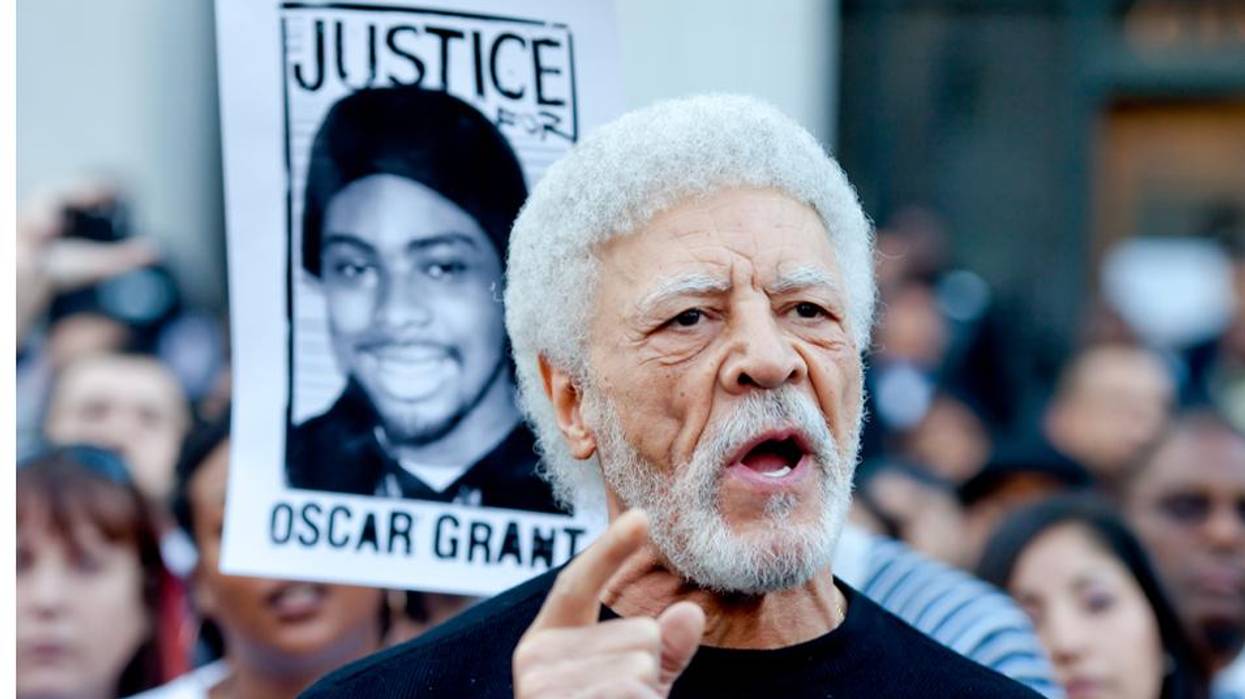
Former Rep. Ronald V. Dellums, a Marine-turned-antiwar activist who represented Oakland in the House and went on to chair the Armed Services Committee, died of cancer early Monday in Washington. He was 82.
Dellums was elected to thirteen terms as a Member of the U.S. House of Representatives and was the first African American elected to Congress from Northern California.
Though he ran as a Democrat, and caucused as a Democrat in Congress, Dellums described himself as a Socialist. He was the first self-described socialist in Congress since Victor L. Berger. In the 1970s, Dellums was a member of the Democratic Socialist Organizing Committee (DSOC), an offshoot of the Socialist Party of America. He later became vice-chair of the Democratic Socialists of America (DSA), which was formed by a merger between the DSOC and the New American Movement, and which works within and outside the Democratic Party.
Known for championing a progressive agenda that put civil rights and programs for people ahead of weapons systems and warfare, his career in politics spanned over 40 years, 27 of them in Congress and four as mayor of Oakland.
"I feel blessed to have called Congressman Dellums my dear friend, predecessor, and mentor. I will miss him tremendously, and I will hold dear to my heart the many lessons I learned from this great public servant," Rep. Barbara Lee said in a statement. Lee had served as Dellums' congressional chief of staff and then succeeded Dellums in the House in 1998 when he retired.
"If being an advocate of peace, justice and humanity toward all human beings is radical, then I'm glad to be called radical. And if it is radical to oppose the use of 70 percent of federal monies for destruction and war, then I am a radical."
- Ron Dellums
Dellums' stance against the Vietnam War earned him a spot on President Richard Nixon's "Enemies List." During his first run for Congress in 1970, Vice President Spiro Agnew labeled him "an out and out radical," according to the San Francisco Chronicle.
"If it's radical to oppose the insanity and cruelty of the Vietnam War, if it's radical to oppose racism and sexism and all other forms of oppression, if it's radical to want to alleviate poverty, hunger, disease, homelessness, and other forms of human misery, then I'm proud to be called a radical," Dellums told reporters in rebuttal.
He demanded a House investigation into American war crimes in Vietnam. When Congress refused, Dellums held his own ad hoc hearings.
When President Ronald Reagan vetoed Dellums' Comprehensive Anti-Apartheid Act of 1986, a Democratic-controlled House and a Republican-controlled Senate overrode Reagan's veto, the first override of a presidential foreign policy veto in the 20th century.
Dellums' voting records in Congress were "almost without exception straight A's" from groups such as the Sierra Club, the National Organization for Women and the AFL-CIO. He received 100% on consumer group Public Citizen's scorecard. In contrast, he received an "F" from conservative NumbersUSA, a group dedicated to limiting immigration.
His New York Times' obituary noted that:
He was an outspoken critic of presidents, Republican and Democratic, and for many Americans beyond his tiny Congressional district, he championed a progressive mantra: Stop war. Cut military spending. Help people. Address the nation's social problems.
He won a dozen re-election campaigns and the sometimes grudging respect of colleagues on both sides of the aisle. His voting record also won virtually straight A's from labor, consumer, women's and environmental groups. Human rights organizations hailed his fights to restrict aid to African nations, like Zaire, Burundi, Liberia and Sudan, whose regimes were openly repressive.
After a 14-year campaign against apartheid in South Africa, he wrote the 1986 legislation that mandated trade embargoes and divestment by American companies and citizens of holdings in South Africa. President Ronald Reagan's veto was overridden by Congress, a 20th-century first in foreign policy. The sanctions were lifted in 1991, when South Africa repealed its apartheid laws.
Mr. Dellums opposed every major American military intervention of his tenure, except for emergency relief in Somalia in 1992. He sued President George H. W. Bush unsuccessfully to stop the Persian Gulf War in 1990-91, saying the invasion did not have congressional authorization. And he voted against the new weapons programs and military budgets of all six presidents in his era.
His "alternative" budgets, written for the Congressional Black Caucus (he was a founding member in 1971 and chairman from 1989 to 1991) proposed spending instead for education, jobs, housing, health care, assistance for the poor and programs to fight drug abuse.
Right-wing critics repeatedly labeled him a Communist, citing his 1970 talk to a world peace conference in Stockholm and his meeting with President Fidel Castro of Cuba in Havana in 1977.
He was unperturbed.
"If being an advocate of peace, justice and humanity toward all human beings is radical, then I'm glad to be called radical," he told The Washington Post. "And if it is radical to oppose the use of 70 percent of federal monies for destruction and war, then I am a radical."
Over time, congressional colleagues came to respect Mr. Dellums's legislative and military expertise. In 1993, the House Democratic Caucus voted 198-10 to name him chairman of the Armed Services Committee, with oversight for defense appropriations and global military operations.
He was the first African-American and the first antiwar activist to hold that post. A fox-in-the-henhouse cartoon portrayed a general and an admiral at the committee door under a banner proclaiming, "Under New Management." Inside, Mr. Dellums brandishes a meat ax. "Call security," one military man says to the other.
In response to his death, Democracy Now! tweeted:
May is historically a month for protests, and first, I'd like to protest the fact that Rev. Daniel Berrigan died last weekend, just a few days shy of what would have been his 95th birthday on May 9.
May, too, was the month in which this outspoken Jesuit poet and peace activist, with his fellow priest and brother Philip, and seven others, staged one of the most significant and symbolic protests against the horrors of Vietnam. On May 17, 1968, they walked into the office of a draft board in Catonsville, Maryland, removed the files of young men eligible for military duty, took them to a parking lot next door, doused them with homemade napalm and set the files ablaze.
"Our apologies, good friends," Dan Berrigan said, "for the fracture of good order, the burning of paper instead of children, the angering of the orderlies in the front parlor of the charnel house. We could not, so help us God, do otherwise."
The Catonsville Nine were tried and convicted for destroying government property. Rather than go to prison, three of them, including Dan and Phil Berrigan, went on the lam, but the brothers soon were caught (while underground, Dan had a habit -- greatly vexing to J. Edgar Hoover and the FBI -- of popping up in public to deliver sermons, then disappearing again). In August 1970, Dan began his three-year sentence at the Federal Correctional Institution in Danbury, Connecticut.
So he wasn't around to offer guidance the following year, in 1971, as many of the more militant in the anti-Vietnam war movement decided that in light of events like Catonsville the time had come to up the ante and move from largely peaceful mass demonstrations to more direct and sometimes even violent acts of civil disobedience.
This, too, was in May, 45 years ago this week, in fact, when thousands came from around the country and gathered in Washington under the slogan, "If the government is not going to stop the war, we will stop the government."
The week before, perhaps as many as half a million had shown up for a Vietnam protest so mellow that many took advantage of a closed-off Pennsylvania Avenue to skateboard and sunbathe along the boulevard on a warm spring Saturday. But now, thousands gathered with the express purpose of physically blocking bridges, main arteries and traffic circles leading into the capital. According to The New York Times, the Nixon White House responded with 12,000 federal troops, 5,100 local police and 1,500 National Guardsmen.
Police broke up an encampment at West Potomac Park, near the Lincoln and Jefferson memorials, and protesters scattered, many of them to the Georgetown University campus, where I was a student. I still remember the helicopters buzzing overhead.
On Monday, May 3, the protesters regrouped and put into action their plan to shut the city down during the morning rush hour, using hit-and-run tactics and any large or small object that came to hand. The police and military pushed back hard.
I was a student reporter and my photographer John and I headed toward Key Bridge near the Georgetown campus. Forever in my memory is the sight of Rhode Island US Senator Claiborne Pell, standing on the steps of his townhouse in robe and pajamas, retrieving his daily copy of The Washington Post and looking completely befuddled by the flying debris and overturned cars around him.
Soon John and I were fleeing through streets and alleys with the demonstrators. We rounded the intersection of Prospect and 36th Streets and ran smack into a wall of tear gas, the worst I had ever experienced. We fell to the pavement, blinded, but soon were taken in hand by volunteer medics and led to a makeshift infirmary in the basement of a university building. Once our eyes had been thoroughly flushed with water and we had a chance to rest a bit and catch our breath, we headed back to the streets and raced to the main campus where police on motor scooters, in total violation of an agreement with the university, fired grenade after grenade of tear gas at protesters and students alike.
Over the course of three days, some 12,000 protesters were taken into custody, the largest mass arrest in American history. There were so many the city's jails couldn't hold them all and most were taken to RFK Stadium. People from the neighborhood threw food and blankets over the security fence.
I wanted to report on what was happening at the stadium but figured the only way to do it was to get arrested myself. I went to a sit-in on the Capitol steps where police were dragging protesters into buses. Get close enough, I thought, and I was certain to be sucked into the vortex. Sure enough, an officer soon had his hand on my arm but just as he tightened his grip, a photographer I knew from the Post pulled my other arm in the opposite direction. "He's with me," the photographer shouted and the cop actually let go. Thanks, I said to my friend, but inside I was screaming, "Stop helping me!"
I never did get into the stadium; ultimately, fewer than a hundred of the arrested were charged, everyone else was quickly released. The debate would continue over whether the violent confrontations were justified -- on the face of it, the attempted shutdown was a failure -- but in retrospect the government's overreaction to the Mayday protests was a misstep, one more proof of a failed policy that was simply delaying the inevitable in Vietnam at the cost of thousands and thousands more lives. Like the Berrigan brothers and their comrades at Catonsville, the attempt to obstruct the streets and bridges of Washington was an act of disobedience designed to throw a wrench in the works of the war machine.
The next year, Dan Berrigan was freed from Danbury after serving half his sentence. I interviewed a number of Jesuits for an article on Dan and Phil in Georgetown University's alumni magazine, modeled on an extraordinary all-Berrigan issue of the Holy Cross Quarterly, then joined the staff of Democrat George McGovern's quixotic, anti-war presidential campaign.
A few weeks after we had gone down to exhausted but noble defeat, I went to a lecture Dan Berrigan was giving at a downtown Washington church. I was nursing what I thought was just a very bad, long-lasting cold. We met afterwards and his greeting, characteristically to the point, was, "You look terrible. Go see a doctor." Sound advice. When I took off my shirt for the ER physician, revealing my fading McGovern tee shirt underneath, he said, "You're the seventh McGovern guy I've had in here since the election." Diagnosis: pneumonia.
Several years later, I had moved to New York. One Friday night, some friends showed up at my tiny apartment for a late dinner and with them was Dan Berrigan. He was in good form. Sufficient alcohol was consumed during the evening that unfortunately I recall little of what actually was said but I do remember Dan's post-midnight recitation of another great Jesuit poet, Gerard Manley Hopkins:
I say more: the just man justices;
Keeps grace: that keeps all his goings graces;
Acts in God's eye what in God's eye he is --
Christ. For Christ plays in ten thousand places,
Lovely in limbs, and lovely in eyes not his
To the Father through the features of men's faces.
In the following years, I lost touch with him and apparently that was not uncommon. He took the advice of the great Catholic philosopher and author Thomas Merton and, in the words of Georgetown senior fellow Paul Elie, became "a figure of radical purity and apartness." The man once so visible, once so potent and public a symbol of dissidence, quietly continued to write and protest (and get arrested), as he kept his vows, studied and taught scripture and humbly ministered to those who needed his faith. The just man justiced and kept grace.
May is historically a month for protests. It's the month of Chicago's Haymarket bombing in 1886; of Paris in 1968, when students and workers almost brought down the government of Charles de Gaulle; of May 1970 and deaths at Kent State and Jackson State, the resulting student strike that closed colleges and universities across the country.
And now in yet another May of turmoil we protest the death of Dan Berrigan, mourn his passing but celebrate all that he did and said and wrote, while celebrating, too, all those like him who speak out and strive to make this country a land of peace and justice that's honest and wise and decent and compassionate. You know, the things that truly make America great.
The shock and disbelief with which many political pundits have responded to Bernie Sanders's description of himself as a "democratic socialist"--a supporter of democratic control of the economy--provide a clear indication of how little they know about the popularity and influence of democratic socialism over the course of American history.
The shock and disbelief with which many political pundits have responded to Bernie Sanders's description of himself as a "democratic socialist"--a supporter of democratic control of the economy--provide a clear indication of how little they know about the popularity and influence of democratic socialism over the course of American history.
How else could they miss the existence of a thriving Socialist Party, led by Eugene Debs (one of the nation's most famous union leaders) and Norman Thomas (a distinguished Presbyterian minister), during the early decades of the twentieth century? Or the democratic socialist administrations elected to govern Milwaukee, Bridgeport, Flint, Minneapolis, Schenectady, Racine, Davenport, Butte, Pasadena, and numerous other U.S. cities? Or the democratic socialists, such as Victor Berger, Meyer London, and Ron Dellums, elected to Congress? Or the programs long championed by democratic socialists that, eventually, were put into place by Republican and Democratic administrations--from the Pure Food and Drug Act to the income tax, from minimum wage laws to maximum hour laws, from unemployment insurance to public power, from Social Security to Medicare?
Most startling of all, they have missed the many prominent Americans who, though now deceased, were democratic socialists during substantial portions of their lives. These include labor leaders like Walter Reuther (president, United Auto Workers and vice-president, AFL-CIO), David Dubinsky (president, International Ladies Garment Workers Union), Sidney Hillman (president, Amalgamated Clothing Workers), Jerry Wurf (president, American Federation of State, County, and Municipal Employees), and William Winpisinger (president, International Association of Machinists). Even Samuel Gompers--the founder and long-time president of the American Federation of Labor who, in the latter part of his life, clashed with Debs and other socialist union leaders--was initially a socialist.
Numerous popular novelists and other writers also embraced democratic socialism, including Jack London, Upton Sinclair, Carl Sandburg, William Carlos Williams, Thorstein Veblen, C. Wright Mills, Erich Fromm, Michael Harrington, Irving Howe, and Howard Zinn. Eminent scientists, too, became democratic socialists, including Charles Steinmetz and Albert Einstein.
Many well-known social reformers also joined the ranks of America's democratic socialists, among them Elizabeth Cady Stanton (women's rights crusader), John Dewey (educator), Helen Keller (author and lecturer), and Margaret Sanger (birth control pioneer). Within the civil rights movement, particularly, a very important role was played by democratic socialists, among them W.E.B. Du Bois, A. Philip Randolph, Bayard Rustin, and James Farmer.
In fact, although very few people know it, even Martin Luther King, Jr. was a democratic socialist. "I am much more socialistic in my economic theory than capitalistic," he wrote to Coretta Scott (soon to become his wife) on July 18, 1952. This belief system continued throughout his life, and, in the late 1960s, contributed to his shift from championing racial equality to championing economic equality. In a 1966 speech to his staff, King declared: "Something is wrong . . . with capitalism." He added: "Call it democracy, or call it democratic socialism, but there must be a better distribution of wealth within this country for all of God's children." Plans for the Poor People's Campaign followed, as did his death while promoting the unionization of Memphis's exploited sanitation workers.
Some might argue that democratic socialism, like these individuals, is dead and gone, replaced by its hierarchical enemies, corporate capitalism on the Right and communism on the Left. But that contention is belied by the continued existence of large, democratic socialist parties that either govern other democratic nations or provide the major opposition to the conservative governments of those nations: the British Labour Party, the French Socialist Party, the Swedish Social Democratic Party, the Australian Labor Party, the Brazilian Democratic Workers Party, the German Social Democratic Party, the Irish Labour Party, Mexico's Party of the Democratic Revolution, South Africa's African National Congress, the Israeli Labor Party, the New Zealand Labour Party, Chile's Socialist Party, and many, many more around the world.
Nor is democratic socialism dead in the United States. In response to rising economic inequality and, particularly, the blatant greed and power of the wealthy and their corporations, Democratic Socialists of America--a descendant of the old Socialist Party of America, though an organization rather than a third party--is growing rapidly. Not surprisingly, it is fervently backing Bernie Sanders's campaign for the presidency. Meanwhile, Democratic Party leaders are suddenly shying away from their corporate dalliances and picking up a few programmatic ideas from Sanders, democratic socialists, and their allies. These include a $15 per hour minimum wage, expansion of Social Security, free college tuition, and opposition to two pro-corporate ventures: the Keystone XL pipeline and the Trans-Pacific Partnership.
If the political pundits would look around, they would even discover a significant number of prominent U.S. democratic socialists at work in a variety of fields. They include muckraking authors like Barbara Ehrenreich, journalists like Harold Meyerson, actors like Ed Asner and Wallace Shawn, intellectuals like Noam Chomsky and Cornel West, documentary film-makers like Michael Moore, TV commentators like Lawrence O'Donnell, science fiction writers like Kim Stanley Robinson, feminist leaders like Gloria Steinem, peace movement veterans like David McReynolds, and academics like Frances Fox Piven.
These and many other democratic socialists, among them Bernie Sanders, have played an important role in American life. It's a shame that so many political "experts" haven't noticed it.
Nelson Mandela's passing last week at the age of 95 has been met with a global outpouring of remembrance and reflection. A giant of modern human history has died. Mandela is rightly remembered for his remarkable ability to reconcile with his oppressors, and the political prescription his forgiveness entailed for the new South Africa. "Never, never and never again shall it be that this beautiful land will again experience the oppression of one by another," Mandela said in his inaugural speech in Pretoria, on May 10, 1994.
Nelson Mandela's passing last week at the age of 95 has been met with a global outpouring of remembrance and reflection. A giant of modern human history has died. Mandela is rightly remembered for his remarkable ability to reconcile with his oppressors, and the political prescription his forgiveness entailed for the new South Africa. "Never, never and never again shall it be that this beautiful land will again experience the oppression of one by another," Mandela said in his inaugural speech in Pretoria, on May 10, 1994. In the same speech, he pledged, going forward, "to liberate all our people from the continuing bondage of poverty, deprivation, suffering, gender and other discrimination." Mandela has passed, but what he has passed on to succeeding generations is his deep belief in the power of movements to make change.
He spent his early years in the African National Congress (ANC) organizing noncooperation, like the Defiance Campaign in 1952, when he was photographed burning his passbook, the dreaded photo documentation without which black South Africans could not travel within their own country. By 1960, following the Sharpeville Massacre, where the white government's police forces killed at least 69 people who were protesting the pass laws and the passbooks, the government banned the ANC. Mandela and others went underground, forming the ANC's armed wing, calling it Umkhonto we Sizwe, or "Spear of the Nation."
They led a campaign of sabotage, using crude bombs to damage and disrupt key elements in South Africa's infrastructure, from rail lines to power plants. In 1962, Mandela was picked up at a police roadblock, disguised as a chauffeur. The New York Times reported in 1990 that it was the U.S. Central Intelligence Agency that provided the South African Special Branch with the specifics of Mandela's whereabouts and appearance. The report went on to say that the CIA spent more on surveillance of the ANC than the apartheid regime did itself. Mandela spent the next 27 years in prison.
At his trial for sabotage with nine others, known now as "The Rivonia Trial," Mandela spoke for the accused, defending their actions. "During my lifetime I have dedicated myself to this struggle of the African people. I have fought against white domination, and I have fought against black domination. I have cherished the ideal of a democratic and free society in which all persons live together in harmony and with equal opportunities," he declared from the dock, facing the death penalty. "It is an ideal which I hope to live for and to achieve. But if needs be, it is an ideal for which I am prepared to die." To the surprise of many, and likely thanks to intense domestic and international attention to the trial, the activists were sentenced not to death, but to life imprisonment on South Africa's notorious Robben Island.
The international campaign to end apartheid began in earnest then. Campaigns to divest from companies doing business in South Africa became a central strategy. In 1970, Caroline Hunter and Ken Williams, two African-American employees at Polaroid in Cambridge, Mass., noticed that their company was supplying the photo technology for the hated passbooks. Hunter and Williams organized a movement of Polaroid workers that forced it to withdraw all its involvement with South Africa.
Under increasing pressure, the apartheid regime cracked down even more on black South Africans, and the violence was broadcast globally, propelling students on campuses to action. A global movement formed, pressuring university boards to pull their endowment funds from South African investments. In Washington, D.C., Randall Robinson, the founder of TransAfrica, began a protest movement in front of the South African embassy. He told us on "Democracy Now!" "Three of us were arrested, followed by 5,000 Americans who came to the embassy over the following years to be arrested ... of course that helped to propel through the Congress the Comprehensive Anti-Apartheid Act of 1986. And then American investments in South Africa began to tumble."
Robinson was referring to the bill that California Congressman Ron Dellums introduced, which passed with bipartisan support. President Ronald Reagan vetoed the bill, but, in a sign of the nation's determination to fight apartheid, both houses of Congress voted to override Reagan's veto, imposing crushing sanctions on the apartheid regime in Pretoria. "That, combined with the internal pressures in the country," Robinson continued, "produced the circumstances in the government there, the readiness to negotiate and to ultimately release Nelson Mandela."
President Barack Obama spoke at Mandela's memorial service in Soweto this week, and provoked a firestorm of criticism back in Washington for shaking the hand of Cuban President Raul Castro. Mandela was a devoted friend of Fidel Castro, who always supported the ANC. The U.S., on the other hand, did not remove Mandela from its "terrorist watch list" until 2008, 14 years after he was elected president of South Africa.
Nelson Mandela ended his autobiography by saying, "When I walked out of prison, that was my mission, to liberate the oppressed and the oppressor both. ... The truth is that we are not yet free; we have merely achieved the freedom to be free."
Denis Moynihan contributed research to this column.
The United States was called into being by a journalist, Tom Paine, who promptly fell out with the regal John Adams, offended George Washington and finally strained his relationship with fellow democrat Thomas Jefferson so thoroughly that the third president stopped responding to his letters. By the time the author of the pamphlets that inspired the anti-colonial armies died, in 1809, his contemporary and compatriot in the revolutionary circle has assumed to the presidency; despite their 35 years of acquaintance,however, James Madison neglected to attend nor officially note the passing.
The clip that will be repeated for as long as broadcast journalism history classes are taught will be of Schorr, broadcasting live from outside the Senate Watergate hearing room with a copy of Richard Nixon's White House "Enemies List." The list of Americans who had gotten on the wrong side of the president had just been revealed and Schorr was reading through the first twenty "enemies." After he finished with California Congressman Ron Dellums, he read the next name - without a dramatic pause or any show of emotion: "Daniel Schorr.. a real media enemy."That is as it should be.
Journalists are not supposed to be friends of presidents.Dan Schorr understood that.
Indeed, few it any modern journalists practiced the Paineite craft of making all the right enemies so ably as did Schorr.
Schorr was not a pamphleteer. Though he was a crisp and efficient writer, Schorr inclined toward the microphone and camera as a CBS correspondent who got run out of Moscow, as the CNN correspondent who got the cable network going with a typically-pointed interview of then President Jimmy Carter and as NPR's resident truth teller until shortly before his death Friday at age 93.
The clip that will be repeated for as long as broadcast journalism history classes are taught will be of Schorr, broadcasting live from outside the Senate Watergate hearing room with a copy of Richard Nixon's White House "Enemies List." The list of Americans who had gotten on the wrong side of the president had just been revealed and Schorr was reading through the first twenty "enemies." After he finished with California Congressman Ron Dellums, he read the next name - without a dramatic pause or any show of emotion: "Daniel Schorr.. a real media enemy."
What was important about Schorr was not that his name was on the enemies list, however. It was what he did to get it there.
Schorr's unofficial beat was always the abuse of power. He challenged Soviet communists and American capitalists (including his bosses at CBS and CNN) with the same relentless questioning. And when he got the story, he got it out - even if his editors refused to let him go with it personally. Famously, in the mid-70s, when Schorr was leaked a copy of the secret "Pike Report" - named for the chair of an House Intelligence Committee inquiry into Central Intelligence Agency intrigues and illegality - CBS refused to go with it. Schorr promptly leaked the report to the Village Voice, a newspaper he was certain would run it.
That was too much for CBS and, despite having won Emmy Awards in three of the four preceding years, Schorr was no longer working for CBS.
At CNN, he clashed with Ted Turner over the cable executive's determination to censor films - a serious issue with Schorr, who forged an unlikely partnership with musician Frank Zappa, another free-speech absolutist. In 1985, his CNN contract was not renewed and Schorr moved to NPR, where we got to know one another.
Schorr was supposed to be a grand old man, delivering kindly comments on Saturday morning and stepping in when some historical perspective was needed from someone born during Woodrow Wilson's first term.
But he refused to play the grand old man role.
My favorite moment came when he was asked his opinion of the decision by a 5-4 Supreme Court majority to stop the Florida recount of 2000 and award the presidency to George W. Bush, who had lost the popular vote by more than 500,000 and who appeared to be on his way to losing Florida and, with it, the Electoral College. The issue had been settled and most journalists were parsing things in a manner that might allow them to get on the good side of the notoriously vengeful Bush-Cheney team.
But Schorr minced no words.
The court decision was, he declared, "a judicial coup" carried out by "the Gang of Five, philosophically led by archconservative Antonin Scalia."
At the age of 84, Schorr was making himself the enemy of another administration by speaking a truth that most journalists would not.
Dick Cheney, Karl Rove and the activist justices were not pleased. But, surely, Tom Paine would have been.
Is it Polyanna-ish to look for hopeful signs in the congressional votes that overwhelmingly supported President Obama's supplemental appropriations request for the Iraq and Afghanistan wars? Perhaps, nonetheless there were a couple. For one, with debate on the Iraq War largely frozen by the government's theoretical commitment to complete troop withdraw by 2012, the growing war in Afghanistan has for the first time surfaced as the focal point of debate.
Is it Polyanna-ish to look for hopeful signs in the congressional votes that overwhelmingly supported President Obama's supplemental appropriations request for the Iraq and Afghanistan wars? Perhaps, nonetheless there were a couple. For one, with debate on the Iraq War largely frozen by the government's theoretical commitment to complete troop withdraw by 2012, the growing war in Afghanistan has for the first time surfaced as the focal point of debate. And with the presence of a Democrat in the White House shrinking the opposition - from the 155 in the House and 26 in the Senate who voted "No" on the last Bush request to 60 and 3 respectively - opponents of these wars do at least know who their real friends are. But what would constitute a significant development would be for this latest vote to serve as a spur to confronting our pro-war congressional representatives where it matters most - at the polls on Election Day - with antiwar candidacies.
By now it's clear that we can't expect to find much by way of a parallel between the course of the anti-Vietnam War movement and the opposition to the current wars. The present movement has never lived up to the hopes engendered by the pre-war level of opposition to the Iraq invasion that was probably without precedent in world history. And, in hindsight, it may have been inevitable that the substantially lower troop levels involved and the absence of a draft would dash hopes of an opposition of Vietnam Era proportions. And yet there are a still a few things about that old antiwar movement that we might want to take a closer look at - for instance, its early electoral challenges.
In 1966, congressional opposition to the Vietnam War was quite weak. With President Lyndon Johnson arguing that maintenance of the war effort was vital to national security, congressional Democrats were reluctant to buck one of their own. So activists in the antiwar movement, then still quite small compared to what it would be just a few years later, opted to take on a number of pro-war Democrats in primaries in various spots around the country.
The candidates varied widely. Ted Weiss, for instance, was already a New York City Councilman when he challenged a pro-war incumbent, James Dinsmoor a University of Indiana professor, and Robert Scheer was editor of Ramparts Magazine. (The magazine's publisher Ed Keating also ran in the Democratic primary in the then Republican district on the peninsula south of San Francisco.) The candidacies varied just as widely. Where Dinsmoor is generally remembered as a single issue candidate (who was even detained by the Indianapolis police for protesting President Johnson's visit to the area during his campaign), Scheer took Berkeley/Oakland, California Representative Jeff Cohelan to task for his stands on environmental and labor issues as well, although the incumbent was generally deemed a solid liberal.
None of the candidates mentioned above won their races, but seems unlikely that too many of their campaign workers felt that their time was wasted. While Scheer would not seek office again despite netting 45 percent of the primary vote, opting instead for a career as a columnist and now editor of online publication Truthdig, four years later Ron Dellums would tip Cohelan from office. And the same year, Bella Abzug knocked off Weiss' 1966 opponent, Leonard Farbstein. (Weiss himself was finally elected to Congress in 1976.) But of equal significance to the groundwork laid for these specific later electoral victories was the role these and other early antiwar candidacies played in opening public debate about the pro-war attitude then dominating Washington.
We still have a reasonable amount of time to consider the potential value of anti-Afghanistan War candidacies before the 2010 primaries are upon us. We have seen several successful anti-Iraq War campaigns mounted over the past couple of election cycles, but we've also seen candidacies muddied by opposition that was seemingly limited to war policies emanating from a Republican President. And as we now know, many of those candidates do not oppose the seemingly never-ending Afghanistan War and its expansion into Pakistan - at least not so long as a Democrat is President.
(While I am obviously taking the point of view that the structure of the American political system makes participation in theDemocratic Party a sensible course of action, I hope that those who consider that foolish or even reprehensible will attempt to demonstrate the rightness of their point of view not in debate but in creating the types of third party or independent anti-Afghanistan War candidacies they think are called for.)
And of course, there's nothing at all that dictates that antiwar candidacies limit themselves to the discussion of that war or that there be any one "look" to them. While Afghanistan may be and remain a remote concern for most Americans, the ongoing economic crisis is not. And while it and the simultaneously developing environmental crisis cry out that we're in a world altering era, the American government seems set to lumber forward in its traditional rut unless we find a way to give voice to a world altering alternative.
The need for change all across the nation's political and economic landscape is as obvious as it's ever been, from finance to health care to transportation to the very way things are made. And yet there is a sense in which the Afghanistan War is central to all of this. Anyone who thinks the US can and should continue racking up half the military spending of the entire world and considers it reasonable to continue bombing countries half way across the planet in order to thwart Osama bin Laden will endorse the Afghanistan War. Anyone who recognizes that America must find a new way in the world will not. Our challenge is to make that clear in the next election cycle. We don't have forever.
After surviving one of the worst presidencies in American history, liberals -- both emboldened and frustrated by the new Democratic president -- came to Washington for a conference where they laid out their visions and formulated strategies to push the new president in a more liberal direction.
I'm not talking about this week's Thinking Big, Thinking Forward conference at the Capital Hilton, which was sponsored by the Prospect, Demos, the Institute for America's Future and the Economic Policy Institute. I'm referring to the Democratic Agenda conference held two blocks away at the Mayflower Hotel in 1977, the first year of Jimmy Carter's presidency. Richard Nixon had been banished to San Clemente, a huge Democratic majority controlled Congress, and hopes were high that two long-sought liberal goals -- national health insurance and a government guarantee of full employment -- could soon be enacted. But doubts about Carter's economic policies were rising, too. His economic team had begun work on the deregulation of trucking and airlines, and his commitment to national health insurance and full employment were in question as well.
So liberals -- about 2,000 of them -- came to the Mayflower. They heard a keynote address from Michael Harrington, a top liberal strategist and leader of a democratic socialist organization that worked openly within the Democratic Party. A brilliant and spellbinding speaker, Harrington made a strategic case for planned full employment. He argued that it would ease the path for environmental legislation, render racial tensions less acute, and make generous foreign aid a political possibility.
In fact, the conference was a landmark in American liberalism chiefly because of the strategic reconciliations it signified. The conference marked a coming together of leaders of the left movements that had emerged in the 1930s -- that is, the progressive unions -- with the leaders of the left movements that had emerged in the '60s -- feminist, civil rights, and environmental.
Democratic Agenda was funded chiefly by the three unions: the United Auto Workers (UAW), the Machinists, and the American Federation of State, County and Municipal Employees (AFSCME). Each had more than a million members, and were deeply at odds with the Cold War politics and ongoing hostility to newer social movements that characterized George Meany's AFL-CIO. There were sizable delegations from the three unions, and their presidents - the UAW's Doug Fraser, the Machinists' William Winpisinger, and AFSCME's Jerry Wurf - all spoke. They also met, I believe for the first time, such 1960s movement leaders as Gloria Steinem, Tom Hayden and Ron Dellums. At the Mayflower, the rifts between the '30s and '60s left movements began to be interred, and a political perspective shared by both began to emerge.
The comparisons between Democratic Agenda and Thinking Big are instructive. Each sounded themes of liberal rebirth; speakers at both conferences combined long-range visions with legislative specifics; both conferences issued a call to arms. But the Democratic Agenda conference, unbeknown to its participants, came at the end of the New Deal era. Reaganism was already abroad in the land, and Carter's deregulatory initiatives were a taste of the laissez-faire policies to come. The full employment bill sponsored by Hubert Humphrey in the Senate and Augustus Hawkins in the House was never enacted. (Full employment legislation was a key demand of American liberals at two points after World War II: First, immediately following the war, when liberals feared a return of the Depression, and then in the mid-1970s, as the broadly shared prosperity of the postwar decades began to wane.) Despite the huge Democratic congressional majorities, national health insurance wasn't established, either. Worse yet, Carter's appointee to head the Federal Reserve, Paul Volcker, took arms against inflation by tightening credit and, as Jeff Madrick noted at Thinking Big, raising the dollar so high that cheaper foreign imports began to swamp the American marketplace. The transformation of the industrial Midwest into America's Rust Belt began during, and was partly caused by, the Carter presidency.
Over the next two years, groups convened by Democratic Agenda organized opposition to Carter's rightward drift on economics. At the Democratic Midterm Convention in Memphis in December of 1978, 40 percent of the delegates opposed resolutions supporting Carter's economic policies. (In response, the Democratic National Committee promptly abolished midterm conventions -- there had been two, in 1974 and 1978.) At Democratic Agenda's rally at that convention, Ted Kennedy broke with Carter over national health care in a memorable speech that had delegates shouting their support for Kennedy's stance. Shortly thereafter, Kennedy embarked on his primary challenge to Carter.
In its attitude towards the new Democratic president, Thinking Big was as different from Democratic Agenda as Barack Obama is from Jimmy Carter, or as the end of the Reagan Age is from its beginning. At this moment, liberal hope looks to be more grounded than it was in 1977. Not only is Obama himself a liberal, which Carter was not, but the urgency of the economic situation is expanding what Harrington called "the limits of the possible" in restructuring the American economy. On one hand, the triumph of radical capitalism over the past three decades means that many of the public policies that progressives envisioned in the mid-1970s, such as a universal governmental health system, are barely spoken of today. That Democrats have to deal with the Blue Dogs in their ranks attests to the power that the Reaganite narrative still wields. On the other hand, the unification of the various parts of the liberal family -- something that Democratic Agenda tried to hasten -- has largely been achieved, and the current economic meltdown has solidified it even further.
Still, as we were reminded by conference organizer and Prospect co-founder Robert Kuttner, Obama's economic advisers are nowhere near as radical as the times demand. (Ironically, the most progressive heavyweight on Obama's economic team may well be Paul Volcker.) But it is early yet. Obama has been president for just over three weeks, and the tone that Thinking Big took toward the president ranged from critical support to, well, just plain support. The doubts that liberals entertain about Obama aren't about the fundamental direction of his presidency, but whether he is moving the nation leftward as far and as fast as it needs to be moved. The doubts liberals entertained about Carter were that he was actually moving the nation rightward.
Thinking Big convened at a more urgent moment in the nation's history than Democratic Agenda did. But in 1977, Harrington conveyed an urgency about the course the nation had charted. He understood that unless liberalism won new victories -- creating universal health care and a greater level of economic security -- that racial divisions and an unchecked capitalism would destroy not just the Democrats' decades-old political majority but also the mixed economy and the broadly shared prosperity that that majority had created.
"We have to go as far beyond Roosevelt as Roosevelt went beyond Hoover," Harrington said at Democratic Agenda, "or we're going back to Hoover." Thirty-two years later, that looks like pretty fair prophecy.