SUBSCRIBE TO OUR FREE NEWSLETTER
Daily news & progressive opinion—funded by the people, not the corporations—delivered straight to your inbox.
5
#000000
#FFFFFF
To donate by check, phone, or other method, see our More Ways to Give page.
Daily news & progressive opinion—funded by the people, not the corporations—delivered straight to your inbox.
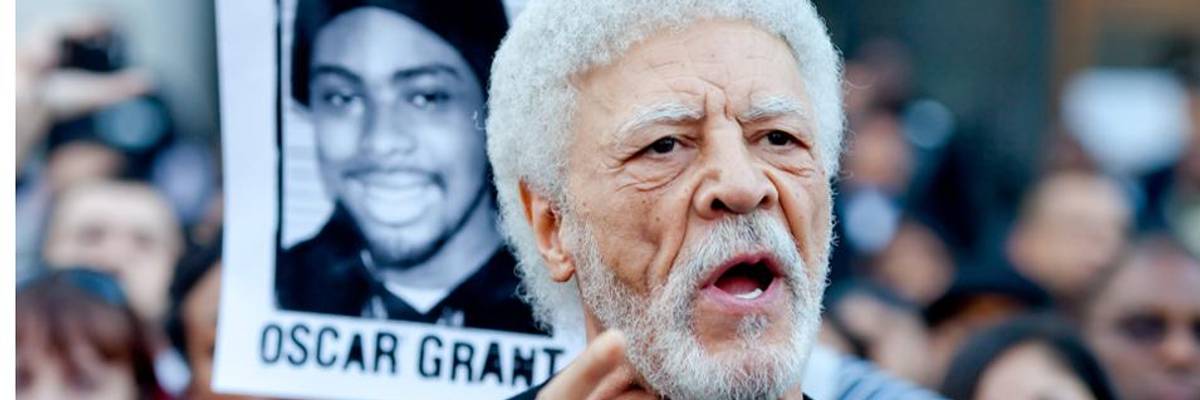
Ron Dellums 1935-2018 (Image/cc/Flickr/ Thomas Hawk)
Former Rep. Ronald V. Dellums, a Marine-turned-antiwar activist who represented Oakland in the House and went on to chair the Armed Services Committee, died of cancer early Monday in Washington. He was 82.
Dellums was elected to thirteen terms as a Member of the U.S. House of Representatives and was the first African American elected to Congress from Northern California.
Though he ran as a Democrat, and caucused as a Democrat in Congress, Dellums described himself as a Socialist. He was the first self-described socialist in Congress since Victor L. Berger. In the 1970s, Dellums was a member of the Democratic Socialist Organizing Committee (DSOC), an offshoot of the Socialist Party of America. He later became vice-chair of the Democratic Socialists of America (DSA), which was formed by a merger between the DSOC and the New American Movement, and which works within and outside the Democratic Party.
Known for championing a progressive agenda that put civil rights and programs for people ahead of weapons systems and warfare, his career in politics spanned over 40 years, 27 of them in Congress and four as mayor of Oakland.
"I feel blessed to have called Congressman Dellums my dear friend, predecessor, and mentor. I will miss him tremendously, and I will hold dear to my heart the many lessons I learned from this great public servant," Rep. Barbara Lee said in a statement. Lee had served as Dellums' congressional chief of staff and then succeeded Dellums in the House in 1998 when he retired.
"If being an advocate of peace, justice and humanity toward all human beings is radical, then I'm glad to be called radical. And if it is radical to oppose the use of 70 percent of federal monies for destruction and war, then I am a radical."
- Ron Dellums
Dellums' stance against the Vietnam War earned him a spot on President Richard Nixon's "Enemies List." During his first run for Congress in 1970, Vice President Spiro Agnew labeled him "an out and out radical," according to the San Francisco Chronicle.
"If it's radical to oppose the insanity and cruelty of the Vietnam War, if it's radical to oppose racism and sexism and all other forms of oppression, if it's radical to want to alleviate poverty, hunger, disease, homelessness, and other forms of human misery, then I'm proud to be called a radical," Dellums told reporters in rebuttal.
He demanded a House investigation into American war crimes in Vietnam. When Congress refused, Dellums held his own ad hoc hearings.
When President Ronald Reagan vetoed Dellums' Comprehensive Anti-Apartheid Act of 1986, a Democratic-controlled House and a Republican-controlled Senate overrode Reagan's veto, the first override of a presidential foreign policy veto in the 20th century.
Dellums' voting records in Congress were "almost without exception straight A's" from groups such as the Sierra Club, the National Organization for Women and the AFL-CIO. He received 100% on consumer group Public Citizen's scorecard. In contrast, he received an "F" from conservative NumbersUSA, a group dedicated to limiting immigration.
His New York Times' obituary noted that:
He was an outspoken critic of presidents, Republican and Democratic, and for many Americans beyond his tiny Congressional district, he championed a progressive mantra: Stop war. Cut military spending. Help people. Address the nation's social problems.
He won a dozen re-election campaigns and the sometimes grudging respect of colleagues on both sides of the aisle. His voting record also won virtually straight A's from labor, consumer, women's and environmental groups. Human rights organizations hailed his fights to restrict aid to African nations, like Zaire, Burundi, Liberia and Sudan, whose regimes were openly repressive.
After a 14-year campaign against apartheid in South Africa, he wrote the 1986 legislation that mandated trade embargoes and divestment by American companies and citizens of holdings in South Africa. President Ronald Reagan's veto was overridden by Congress, a 20th-century first in foreign policy. The sanctions were lifted in 1991, when South Africa repealed its apartheid laws.
Mr. Dellums opposed every major American military intervention of his tenure, except for emergency relief in Somalia in 1992. He sued President George H. W. Bush unsuccessfully to stop the Persian Gulf War in 1990-91, saying the invasion did not have congressional authorization. And he voted against the new weapons programs and military budgets of all six presidents in his era.
His "alternative" budgets, written for the Congressional Black Caucus (he was a founding member in 1971 and chairman from 1989 to 1991) proposed spending instead for education, jobs, housing, health care, assistance for the poor and programs to fight drug abuse.
Right-wing critics repeatedly labeled him a Communist, citing his 1970 talk to a world peace conference in Stockholm and his meeting with President Fidel Castro of Cuba in Havana in 1977.
He was unperturbed.
"If being an advocate of peace, justice and humanity toward all human beings is radical, then I'm glad to be called radical," he told The Washington Post. "And if it is radical to oppose the use of 70 percent of federal monies for destruction and war, then I am a radical."
Over time, congressional colleagues came to respect Mr. Dellums's legislative and military expertise. In 1993, the House Democratic Caucus voted 198-10 to name him chairman of the Armed Services Committee, with oversight for defense appropriations and global military operations.
He was the first African-American and the first antiwar activist to hold that post. A fox-in-the-henhouse cartoon portrayed a general and an admiral at the committee door under a banner proclaiming, "Under New Management." Inside, Mr. Dellums brandishes a meat ax. "Call security," one military man says to the other.
In response to his death, Democracy Now! tweeted:
Dear Common Dreams reader, It’s been nearly 30 years since I co-founded Common Dreams with my late wife, Lina Newhouser. We had the radical notion that journalism should serve the public good, not corporate profits. It was clear to us from the outset what it would take to build such a project. No paid advertisements. No corporate sponsors. No millionaire publisher telling us what to think or do. Many people said we wouldn't last a year, but we proved those doubters wrong. Together with a tremendous team of journalists and dedicated staff, we built an independent media outlet free from the constraints of profits and corporate control. Our mission has always been simple: To inform. To inspire. To ignite change for the common good. Building Common Dreams was not easy. Our survival was never guaranteed. When you take on the most powerful forces—Wall Street greed, fossil fuel industry destruction, Big Tech lobbyists, and uber-rich oligarchs who have spent billions upon billions rigging the economy and democracy in their favor—the only bulwark you have is supporters who believe in your work. But here’s the urgent message from me today. It's never been this bad out there. And it's never been this hard to keep us going. At the very moment Common Dreams is most needed, the threats we face are intensifying. We need your support now more than ever. We don't accept corporate advertising and never will. We don't have a paywall because we don't think people should be blocked from critical news based on their ability to pay. Everything we do is funded by the donations of readers like you. When everyone does the little they can afford, we are strong. But if that support retreats or dries up, so do we. Will you donate now to make sure Common Dreams not only survives but thrives? —Craig Brown, Co-founder |
Former Rep. Ronald V. Dellums, a Marine-turned-antiwar activist who represented Oakland in the House and went on to chair the Armed Services Committee, died of cancer early Monday in Washington. He was 82.
Dellums was elected to thirteen terms as a Member of the U.S. House of Representatives and was the first African American elected to Congress from Northern California.
Though he ran as a Democrat, and caucused as a Democrat in Congress, Dellums described himself as a Socialist. He was the first self-described socialist in Congress since Victor L. Berger. In the 1970s, Dellums was a member of the Democratic Socialist Organizing Committee (DSOC), an offshoot of the Socialist Party of America. He later became vice-chair of the Democratic Socialists of America (DSA), which was formed by a merger between the DSOC and the New American Movement, and which works within and outside the Democratic Party.
Known for championing a progressive agenda that put civil rights and programs for people ahead of weapons systems and warfare, his career in politics spanned over 40 years, 27 of them in Congress and four as mayor of Oakland.
"I feel blessed to have called Congressman Dellums my dear friend, predecessor, and mentor. I will miss him tremendously, and I will hold dear to my heart the many lessons I learned from this great public servant," Rep. Barbara Lee said in a statement. Lee had served as Dellums' congressional chief of staff and then succeeded Dellums in the House in 1998 when he retired.
"If being an advocate of peace, justice and humanity toward all human beings is radical, then I'm glad to be called radical. And if it is radical to oppose the use of 70 percent of federal monies for destruction and war, then I am a radical."
- Ron Dellums
Dellums' stance against the Vietnam War earned him a spot on President Richard Nixon's "Enemies List." During his first run for Congress in 1970, Vice President Spiro Agnew labeled him "an out and out radical," according to the San Francisco Chronicle.
"If it's radical to oppose the insanity and cruelty of the Vietnam War, if it's radical to oppose racism and sexism and all other forms of oppression, if it's radical to want to alleviate poverty, hunger, disease, homelessness, and other forms of human misery, then I'm proud to be called a radical," Dellums told reporters in rebuttal.
He demanded a House investigation into American war crimes in Vietnam. When Congress refused, Dellums held his own ad hoc hearings.
When President Ronald Reagan vetoed Dellums' Comprehensive Anti-Apartheid Act of 1986, a Democratic-controlled House and a Republican-controlled Senate overrode Reagan's veto, the first override of a presidential foreign policy veto in the 20th century.
Dellums' voting records in Congress were "almost without exception straight A's" from groups such as the Sierra Club, the National Organization for Women and the AFL-CIO. He received 100% on consumer group Public Citizen's scorecard. In contrast, he received an "F" from conservative NumbersUSA, a group dedicated to limiting immigration.
His New York Times' obituary noted that:
He was an outspoken critic of presidents, Republican and Democratic, and for many Americans beyond his tiny Congressional district, he championed a progressive mantra: Stop war. Cut military spending. Help people. Address the nation's social problems.
He won a dozen re-election campaigns and the sometimes grudging respect of colleagues on both sides of the aisle. His voting record also won virtually straight A's from labor, consumer, women's and environmental groups. Human rights organizations hailed his fights to restrict aid to African nations, like Zaire, Burundi, Liberia and Sudan, whose regimes were openly repressive.
After a 14-year campaign against apartheid in South Africa, he wrote the 1986 legislation that mandated trade embargoes and divestment by American companies and citizens of holdings in South Africa. President Ronald Reagan's veto was overridden by Congress, a 20th-century first in foreign policy. The sanctions were lifted in 1991, when South Africa repealed its apartheid laws.
Mr. Dellums opposed every major American military intervention of his tenure, except for emergency relief in Somalia in 1992. He sued President George H. W. Bush unsuccessfully to stop the Persian Gulf War in 1990-91, saying the invasion did not have congressional authorization. And he voted against the new weapons programs and military budgets of all six presidents in his era.
His "alternative" budgets, written for the Congressional Black Caucus (he was a founding member in 1971 and chairman from 1989 to 1991) proposed spending instead for education, jobs, housing, health care, assistance for the poor and programs to fight drug abuse.
Right-wing critics repeatedly labeled him a Communist, citing his 1970 talk to a world peace conference in Stockholm and his meeting with President Fidel Castro of Cuba in Havana in 1977.
He was unperturbed.
"If being an advocate of peace, justice and humanity toward all human beings is radical, then I'm glad to be called radical," he told The Washington Post. "And if it is radical to oppose the use of 70 percent of federal monies for destruction and war, then I am a radical."
Over time, congressional colleagues came to respect Mr. Dellums's legislative and military expertise. In 1993, the House Democratic Caucus voted 198-10 to name him chairman of the Armed Services Committee, with oversight for defense appropriations and global military operations.
He was the first African-American and the first antiwar activist to hold that post. A fox-in-the-henhouse cartoon portrayed a general and an admiral at the committee door under a banner proclaiming, "Under New Management." Inside, Mr. Dellums brandishes a meat ax. "Call security," one military man says to the other.
In response to his death, Democracy Now! tweeted:
Former Rep. Ronald V. Dellums, a Marine-turned-antiwar activist who represented Oakland in the House and went on to chair the Armed Services Committee, died of cancer early Monday in Washington. He was 82.
Dellums was elected to thirteen terms as a Member of the U.S. House of Representatives and was the first African American elected to Congress from Northern California.
Though he ran as a Democrat, and caucused as a Democrat in Congress, Dellums described himself as a Socialist. He was the first self-described socialist in Congress since Victor L. Berger. In the 1970s, Dellums was a member of the Democratic Socialist Organizing Committee (DSOC), an offshoot of the Socialist Party of America. He later became vice-chair of the Democratic Socialists of America (DSA), which was formed by a merger between the DSOC and the New American Movement, and which works within and outside the Democratic Party.
Known for championing a progressive agenda that put civil rights and programs for people ahead of weapons systems and warfare, his career in politics spanned over 40 years, 27 of them in Congress and four as mayor of Oakland.
"I feel blessed to have called Congressman Dellums my dear friend, predecessor, and mentor. I will miss him tremendously, and I will hold dear to my heart the many lessons I learned from this great public servant," Rep. Barbara Lee said in a statement. Lee had served as Dellums' congressional chief of staff and then succeeded Dellums in the House in 1998 when he retired.
"If being an advocate of peace, justice and humanity toward all human beings is radical, then I'm glad to be called radical. And if it is radical to oppose the use of 70 percent of federal monies for destruction and war, then I am a radical."
- Ron Dellums
Dellums' stance against the Vietnam War earned him a spot on President Richard Nixon's "Enemies List." During his first run for Congress in 1970, Vice President Spiro Agnew labeled him "an out and out radical," according to the San Francisco Chronicle.
"If it's radical to oppose the insanity and cruelty of the Vietnam War, if it's radical to oppose racism and sexism and all other forms of oppression, if it's radical to want to alleviate poverty, hunger, disease, homelessness, and other forms of human misery, then I'm proud to be called a radical," Dellums told reporters in rebuttal.
He demanded a House investigation into American war crimes in Vietnam. When Congress refused, Dellums held his own ad hoc hearings.
When President Ronald Reagan vetoed Dellums' Comprehensive Anti-Apartheid Act of 1986, a Democratic-controlled House and a Republican-controlled Senate overrode Reagan's veto, the first override of a presidential foreign policy veto in the 20th century.
Dellums' voting records in Congress were "almost without exception straight A's" from groups such as the Sierra Club, the National Organization for Women and the AFL-CIO. He received 100% on consumer group Public Citizen's scorecard. In contrast, he received an "F" from conservative NumbersUSA, a group dedicated to limiting immigration.
His New York Times' obituary noted that:
He was an outspoken critic of presidents, Republican and Democratic, and for many Americans beyond his tiny Congressional district, he championed a progressive mantra: Stop war. Cut military spending. Help people. Address the nation's social problems.
He won a dozen re-election campaigns and the sometimes grudging respect of colleagues on both sides of the aisle. His voting record also won virtually straight A's from labor, consumer, women's and environmental groups. Human rights organizations hailed his fights to restrict aid to African nations, like Zaire, Burundi, Liberia and Sudan, whose regimes were openly repressive.
After a 14-year campaign against apartheid in South Africa, he wrote the 1986 legislation that mandated trade embargoes and divestment by American companies and citizens of holdings in South Africa. President Ronald Reagan's veto was overridden by Congress, a 20th-century first in foreign policy. The sanctions were lifted in 1991, when South Africa repealed its apartheid laws.
Mr. Dellums opposed every major American military intervention of his tenure, except for emergency relief in Somalia in 1992. He sued President George H. W. Bush unsuccessfully to stop the Persian Gulf War in 1990-91, saying the invasion did not have congressional authorization. And he voted against the new weapons programs and military budgets of all six presidents in his era.
His "alternative" budgets, written for the Congressional Black Caucus (he was a founding member in 1971 and chairman from 1989 to 1991) proposed spending instead for education, jobs, housing, health care, assistance for the poor and programs to fight drug abuse.
Right-wing critics repeatedly labeled him a Communist, citing his 1970 talk to a world peace conference in Stockholm and his meeting with President Fidel Castro of Cuba in Havana in 1977.
He was unperturbed.
"If being an advocate of peace, justice and humanity toward all human beings is radical, then I'm glad to be called radical," he told The Washington Post. "And if it is radical to oppose the use of 70 percent of federal monies for destruction and war, then I am a radical."
Over time, congressional colleagues came to respect Mr. Dellums's legislative and military expertise. In 1993, the House Democratic Caucus voted 198-10 to name him chairman of the Armed Services Committee, with oversight for defense appropriations and global military operations.
He was the first African-American and the first antiwar activist to hold that post. A fox-in-the-henhouse cartoon portrayed a general and an admiral at the committee door under a banner proclaiming, "Under New Management." Inside, Mr. Dellums brandishes a meat ax. "Call security," one military man says to the other.
In response to his death, Democracy Now! tweeted: