

SUBSCRIBE TO OUR FREE NEWSLETTER
Daily news & progressive opinion—funded by the people, not the corporations—delivered straight to your inbox.
5
#000000
#FFFFFF
To donate by check, phone, or other method, see our More Ways to Give page.
Daily news & progressive opinion—funded by the people, not the corporations—delivered straight to your inbox.

The challenges of structuring a peace process that can overcome 47 years of mutual grievances between the US and Iran were highlighted by the recent talks between the US and Iran in Pakistan.
Although the international community still knows very little about the highest-level peace talks between the US and Iran in 47 years, facilitated by Shehbaz Sharif, the Prime Minister of Pakistan, some obvious red flags appeared in the morning-after news reports—as JD Vance, Steve Witkoff, and Jared Kushner flew home less than 24 hours after their arrival in Islamabad.
As The New York Times reported: “Vice President JD Vance summed up the failure of 21 hours of negotiations with Iran in one sentence: ‘They have chosen not to accept our terms.’ To Iranian officials, that line reflected their biggest problem with the talks: The United States they argue, had not come to negotiate.” As Javid Zarif (who led the Iranian negotiating team on the Joint Comprehensive Plan of Action, negotiated by the Obama administration to keep Iran from developing a nuclear weapon, but later torn up by President Donald Trump) wrote on X, “No negotiations—at least with Iran—will succeed based on ‘our/your terms.’”
This highlights that, as expected, the talks took the form of a “hard-bargaining” (also called distributive bargaining) approach to negotiation where the parties seek to achieve a zero-sum (win-lose) outcome rather than a positive sum (win-win) outcome. Too often, however, they end up with a lose-lose outcome, as occurred in this situation. In hard bargaining, parties present their positions (i.e., their preferred solution to the issues) as demands—the Iranians offered a 10-point plan; the US, a 15-point plan—both exchanged before the talks began, a tactic that is not recommended by experienced peacemakers.
In the lead-up to the negotiations, it was initially reported that indirect “proximity talks” were planned—where the third-party mediator moves back and forth between the delegations, who are placed in close proximity to one another in nearby, but separate locations. This typically tends to be a much more productive means of negotiation than direct talks, as it represents each party talking to and negotiating with the impartial third-party mediator, rather than the other party, allowing each delegation to avoid the confrontation and aggravation of dealing directly with its adversary. Moreover, it allows the mediator to try out various possibilities for creative solutions by using a “one-text procedure” to develop a text that is controlled by the mediator and continuously adjusted to address each party’s concerns and allow the mediator, over time, to get ever closer to agreement.
Parties need a constructive process to help them engage in meaningful problem solving, especially where there is no trust and they have a long-term hostile relationship.
On the day, however, after brief separate meetings by US and Iranian delegations with the Pakistani prime minister, direct talks were convened. Unlike the common wisdom that it is good to have the parties talking to one another, this kind of negotiation is not helpful to constructive problem solving. Instead, it is likely to break down into confrontational exchanges, whereby each party simply reiterates its positions and demands—and typically issues threats and ultimatums and employs other pressure tactics to try to force the other to concede, causing each to become ever more entrenched in its positions and more resistant to new ideas.
Another problem was the totally unrealistic expectation that was created for the talks—the idea that an agreement settling decades of serious grievances between the US and Iran might be negotiated within a weekend. A much more realistic approach would have been to schedule talks to be held over a much longer time frame or to schedule additional rounds of talks.
The continuous, marathon nature of the talks are also not a good way to structure peacemaking negotiations. The talks began soon after both delegations arrived (the US delegation had traveled for 18 hours) and lasted all afternoon and most of the night. Indeed, such a schedule is not at all conducive to constructive outcomes, as the parties were tired upon arrival and became ever more exhausted and stressed as the talks continued, reducing their ability to listen to and understand the other party’s issues and concerns and to even to consider or create any new, innovative possibilities that could help bridge differences or create trade-offs.
Moreover, such a format offers no time for the delegations to engage in discussions with their own team or reflect on the exchanges that have occurred at the table between the parties. As confirmed by The New York Times, at the end of the talks, “Exhausted and frustrated after 21 hours on the ground, Mr. Vance provided few details, took three questions, and departed.” The Iranians, for their part, are actually known for their “long-winded, relentless approach to deal-making,” which the Iranian Foreign Minister, Abbas Araghchi, has called “market style,” meaning “continuous and tireless bargaining.” This is why it is important to have an experienced mediator who knows how to control the process and who will structure negotiation in a paced manner, over a number of days, with breaks during each day and time to sleep and rest overnight.
It also appeared that Mr. Vance was not plenipotentiary in having full authority to take independent action, since he reportedly broke off negotiations on multiple occasions to phone President Trump, perhaps because, over Easter, Trump said that: “If it doesn’t happen, I’m blaming JD Vance... if it does happen, I’m taking full credit.”
The overriding issue that is often neglected by well-meaning, but unseasoned third parties, as well as by inexperienced delegations, is their total focus on the substance of a negotiation—to the neglect of the process. Although substance is, of course, important, the process of how negotiations are structured is crucial to finding an acceptable outcome that achieves agreement on substance. Parties need a constructive process to help them engage in meaningful problem solving, especially where there is no trust and they have a long-term hostile relationship.
Where the peace process goes from here is uncertain. Trump has already announced that the US will carry out a naval blockade of Iranian ports. It will, of course, help greatly if the ceasefire can be maintained and extended beyond the two weeks, since the longer a cessation of hostilities is in place, the more time there will be for additional meaningful talks to occur. One thing that is certain, however, is that all of those working to promote an end to the war in Iran (Pakistan, Türkiye, Egypt, and other regional partners, as well China, the United Nations, others) have a huge challenge ahead of them in crafting a process that will allow for an integrative approach that will have a chance of resolving this long-standing, intractable conflict.

"Demanding talks while surrounding the other side with a massive armada of warships and F-35s is not diplomacy, it is piracy," Phyllis Bennis of Institute for Policy Studies, told Common Dreams.
Amid recent reports that war is "imminent," the US military shot down an Iranian drone on Tuesday as it approached the USS Abraham Lincoln aircraft carrier in the Arabian Sea, according to a US official who spoke with Reuters.
Central Command spokesperson Capt. Tim Hawkins told the Associated Press that the drone “aggressively approached” the Lincoln with “unclear intent," and kept flying toward the aircraft carrier “despite de-escalatory measures taken by US forces operating in international waters."
It came after another tense encounter earlier in the day, during which the US military said Iranian forces "harassed" a US merchant vessel sailing in the Strait of Hormuz.
The Lincoln is part of an "armada" that President Donald Trump on Friday said he'd deployed to the region in advance of a possible strike against Iran, which he said would be "far worse" than the one the US conducted in June, when it bombed three Iranian nuclear sites.
After initially stating his goal of protecting protesters from a government crackdown, Trump has pivoted to express his intentions of using the threat of military force to coerce Iran into negotiating a new nuclear agreement that would severely limit its ability to pursue nuclear enrichment, which it has the right to do for peaceful means.
"Shifting justifications for a war are never a good sign, and they strongly suggest that the war in question was not warranted," Paul R. Pillar, a nonresident senior fellow at the Center for Security Studies of Georgetown University, said in a piece published by Responsible Statecraft on Tuesday.
Other international relations scholars have said the US has no grounds, either strategically or legally, to pursue a war, even to stop Iran's nuclear development.
For one thing, said Dylan Williams, vice president of the Center for International Policy, Trump himself is responsible for ripping up the old agreement, known as the Joint Comprehensive Plan of Action (JCPOA), which required Iran to limit its enrichment of uranium well below the levels required to build a nuclear weapon in exchange for relief from crippling US sanctions.
According to the International Atomic Energy Agency (IAEA), which was tasked with regularly inspecting Iran's nuclear facilities, the country was cooperating with all aspects of the deal until Trump withdrew from it, after which Iran began to once again accelerate its nuclear enrichment.
"There was 24/7 monitoring and no [highly enriched uranium] in Iran before Trump broke the JCPOA," Williams said. "Iran’s missile program and human rights abuses surged after he broke the deal."
Daniel DePetris, a fellow at Defense Priorities, marveled that "there is an amazing amount of folks who still think bombing Iran's nuclear program every eight months or so is a better result for the United States than the JCPOA, which capped Tehran's nuclear progress by 15-20 years."
With the Lincoln ominously looming off his nation's shores, Iran's embattled supreme leader, the 86-year-old Ayatollah Ali Khamenei, warned on Sunday that "the Americans must be aware that if they wage a war this time, it will be a regional war."
Trump responded to the ayatollah by saying that if “we don’t make a deal, then we’ll find out whether or not he was right.”
Despite stating their unwillingness to give up their nuclear energy program, which they say is legal under the Nuclear Nonproliferation Treaty (NPT), Iranian envoys have expressed an openness to a meeting with US diplomats mediated by other Middle Eastern nations in Turkey this week.
On Monday, Iranian President Masoud Pezeshkian wrote on social media that he had instructed diplomats "to pursue fair and equitable negotiations, guided by the principles of dignity, prudence, and expediency."
Trump is also pushing other demands—including that Iran must also limit its long-range ballistic missile program and stop arming its allies in the region, such as the Palestinian militant group Hamas, the Lebanese group Hezbollah, and the Yemeni group Ansar Allah, often referred to as the "Houthis."
Pillar pointed out that Iran's missile program and its arming of so-called "proxies" have primarily been used as deterrents against other nations in the region—namely, US allies Israel and Saudi Arabia. With these demands, he said, "Iran is being told it cannot have a full regional policy while others do. It is unrealistic to expect any Iranian leader to agree to that."
That said, Pillar wrote that "President Trump is correct when he says that Iran wants a deal, given that Iran’s bad economic situation is an incentive to negotiate agreements that would provide at least partial relief from sanctions," which played a notable role in heightening the economic instability that fueled Iran's protests in the first place.
But any optimism that appeared to have arisen may have been dashed by Tuesday's exchange of fire. According to Axios, Iran is now asking to move the talks from Turkey to Oman and has called for a meeting with the US alone rather than with other nations present.
Eric Sperling, the executive director of Just Foreign Policy, said: "This is exactly the kind of miscalculation—or intentional escalation, by hawkish bureaucrats aiming to scuttle talks—that can drag us into an illegal and catastrophic war in Iran."
Under the United Nations charter, countries are required to believe they are under imminent attack in order to carry out a strike against another sovereign nation.
In a comment to Common Dreams, Phyllis Bennis, the director of the New International Project at the Institute for Policy Studies, emphasized the massive difference between the US and Iran's military capabilities and actions.
"There is no question of Iran having equal military capacity to that of the US," she said. "Its military has never been anywhere close to the size, financing, or power; its own military capacity, and that of most of its allies in the region, were severely damaged in the Israeli-US attack last June. However the Iranian drone was 'acting,' the real escalation has been that of the United States."
"Sending what Trump called his 'massive armada' to threaten Iran stands in complete violation of the UN Charter’s prohibition on the threat or use of force," she continued. "That is the real 'escalatory' action. The US needs to pull back its warships, warplanes, and troops, and engage in serious diplomacy. Demanding talks while surrounding the other side with a massive armada of warships and F-35s is not diplomacy, it is piracy."
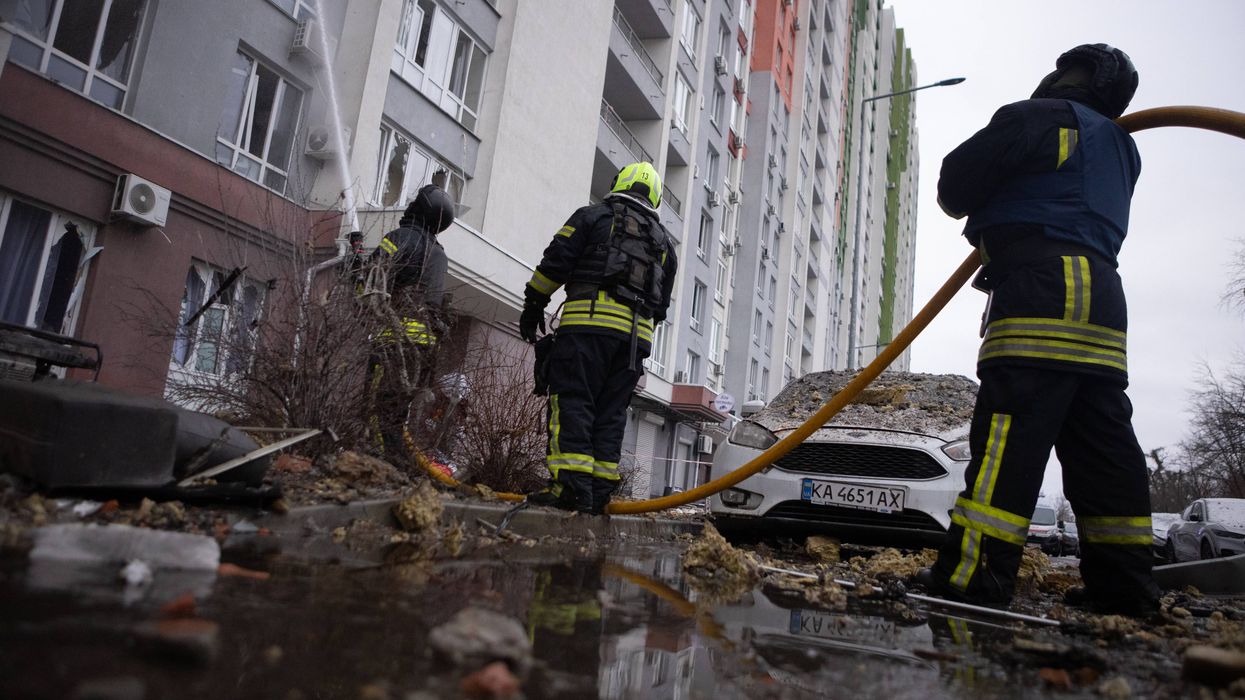
The attacks came as Trump and Zelenskyy are expected to discuss critical questions in a Ukraine-Russia peace deal, including its territorial sovereignty, NATO protections, and control over its natural resources.
As Ukrainian President Volodymyr Zelenskyy made his way to Florida for a pivotal set of talks this weekend with US President Donald Trump, Russia launched a barrage of drone and missile attacks on Kyiv early Saturday morning.
At least two people were killed in the Ukrainian capital during the 10-hour attack, with 44 more—including two children—injured. Hundreds of thousands of residents are left to brave near-freezing temperatures without heat following the attack, which cut off power supplies.
The attack came as Zelenskyy prepared to stop in Canada before meeting with Trump on Sunday to discuss a 20-point plan to end the nearly four-year war with Russia that has been the subject of weeks of negotiation between US and Ukrainian emissaries.
Zelenskyy is seeking to maintain Ukraine's territorial sovereignty without having to surrender territory—namely, the eastern Donbass region that is largely occupied by Russian forces. He also hopes that any agreement to end the war will come with a long-term security guarantee reminiscent of NATO.
On Friday, Zelenskyy told reporters that the peace deal was 90% complete. But Trump retorted that Zelenskyy "doesn't have anything until I approve it."
Trump has expressed hostility toward Zelenskyy throughout his presidency. In February, before berating him in a now-infamous Oval Office meeting, Trump insisted falsely that Ukraine, not Russia, was responsible for starting the war in 2022.
Zelenskyy's latest peace proposal was issued in response to Trump's proposal last month, which was heavily weighted in Russia's favor.
It called for Ukraine to recognize Russia's illegal annexation of Crimea and cede the entirety of the Donbass, about 2,500 square miles of territory, to Russia, including territory not yet captured. Trump's plan puts a cap of 600,000 personnel on Ukraine's military and calls for Ukraine to add a measure in its constitution banning it from ever joining NATO.
Earlier this year, Trump demanded that Ukraine give up $500 billion worth of its mineral wealth in what he said was "repayment" for US military support during the war (even though that support has only totalled about $175 billion).
In his latest proposal, Trump has pared down his demands to the creation of a "Ukraine Development Fund" that would include the "extraction of minerals and natural resources" as part of a joint US-Ukraine reconstruction effort.
While those terms appear less exploitative, the reconstruction program is expected to be financed by US loans from firms like BlackRock, which have been heavily involved in the diplomatic process.
"The infrastructure rebuilt with these loans—ports, rail lines, power grid—won’t be Ukrainian in any meaningful sense. It’ll be owned by international consortiums, operated for profit, with revenues flowing out to service the debt," wrote the Irish geopolitical commentator Deaglan O'Mulrooney on Tuesday. "In other words, Ukraine will be gutted."
Despite the criticism, Zelenskyy has signaled support in principle for the US reconstruction proposal as an alternative to direct expropriation.
The "red lines" for Zelenskyy heading into his talk with Trump are related to Ukraine's territorial integrity. He has said he will not recognize Russian control of the Donbass, or the Zaporizhzhia nuclear power plant, the largest nuclear facility in Europe, which Russia currently controls. He has also demanded that all terms of a peace agreement come up for a referendum among the Ukrainian people, which is strongly against territorial concessions.
At the same time, however, he insisted Saturday that "Ukraine is willing to do whatever it takes to stop this war."
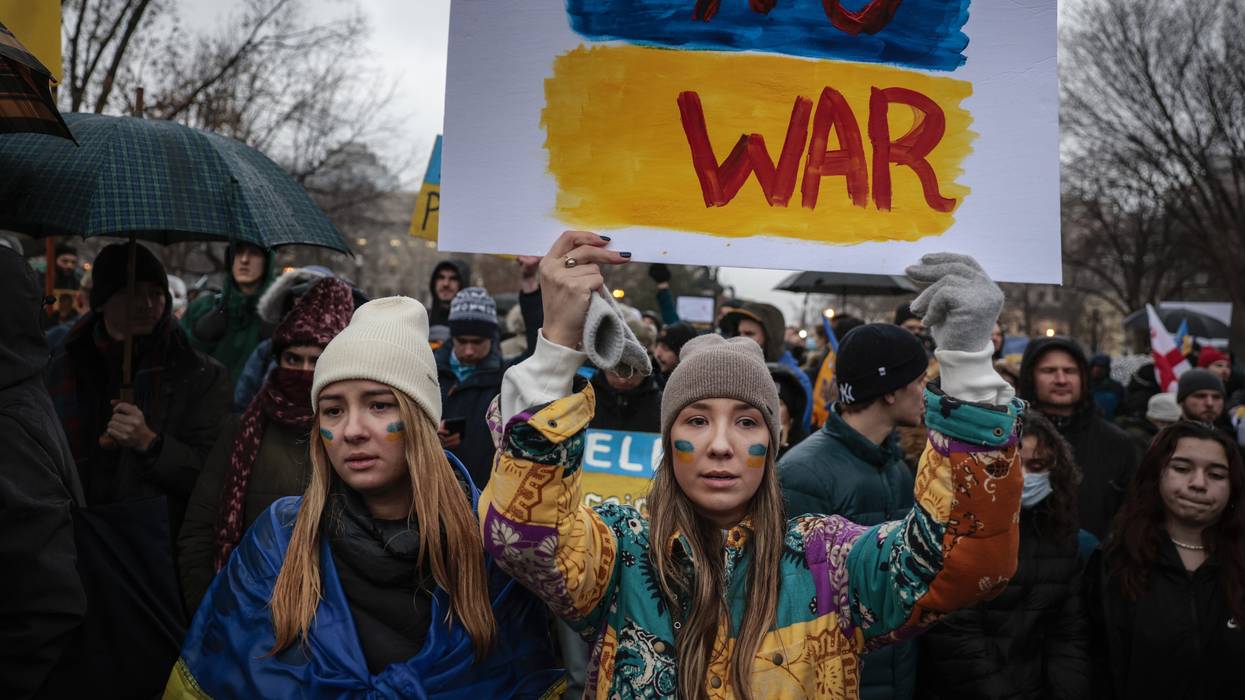
"We must stop this madness before it's too late!" said climate organizers. "For the sake of future life on this planet, we urge you to initiate peace talks to end this war now."
From greenhouse gas emissions stemming from rocket attacks to the threat of "the ultimate environmental crime" of nuclear war, U.S anti-war and climate action groups on Thursday told President Joe Biden and members of Congress that the long-standing call for peace talks in Ukraine is "all the more urgent" as the damage the Russian invasion has done to the planet so far becomes clearer.
CodePink led more than 2,300 "people of conscience" and groups including Amazon Watch, Rainforest Action Network, and Extinction Rebellion DC in a letter to Biden saying that "based on climate justice reasons alone," the U.S. government can and must use its power to ensure that peace talks between Russia and Ukraine happen swiftly.
The groups detailed a number of harmful effects the war has had on the planet in its first 14 months, including the apparent sabotage of the Nord Stream 1 and 2 pipelines, which the United Nations Environment Program said may have caused the largest-ever single leak of methane, the potent greenhouse gas that can trap 87 times more heat than carbon dioxide in its first two decades in the atmosphere.
On a day-to-day basis, the war is contributing to further fossil fuel emissions as hundreds of thousands of soldiers, their munitions, and people who have been forced to flee their homes make millions of trips across Ukraine. The conflict has also had a considerable impact on public health as communities face the long-lasting byproducts of war even after soldiers retreat from their cities and towns.
"As the fighting has now gone on for a year with no end in sight, Ukraine braces itself for further disruption of local ecosystems, forest fires, blackened trees, air pollution, sewage leaks, and chemical contamination of rivers and groundwater in Ukraine," said the groups in the letter.
"If any leader of a nation is even remotely serious about protecting the sanctity of life, they would push for a cease-fire and use their influence to establish peace talks."
Lennard de Klerk, a Dutch carbon accounting expert who is preparing a report on the war's climate impact that's expected to be presented to the U.N. in June, told Time in February that the carbon footprint of the conflict in its first year was an estimated 155 million metric tons—the equivalent of the Netherlands' yearly output—due to explosions, the reconstruction of buildings, transportation, forest fires, and other factors.
The Thursday letter also points out that Western sanctions on Russian oil have led the U.S. to increase its energy exports to Europe, doubling liquefied natural gas (LNG) exports from 2021 to 2022 and sending 1.75 million barrels of crude oil across the Atlantic Ocean daily—a 70% increase from 2021.
CodePink reported that when organizers delivered the letter to congressional offices on Thursday, they encountered Capitol Hill staffers who "were unaware of the deadly environmental consequences of militarism and active war."
"We will continue to educate, organize, and disrupt until not only the connection is made but action is taken to save people and the planet," said CodePink organizer Teddy Ogborn. "War can no longer be a policy option for nations. If any leader of a nation is even remotely serious about protecting the sanctity of life, they would push for a cease-fire and use their influence to establish peace talks."
The more than $100 billion the U.S. has spent on aid to Ukraine in the last year—and billions more spent by European countries—has come with an opportunity cost, said the groups, as the Global South has been left waiting for wealthy countries to fulfill "their 2009 promise to invest $100 billion a year to help poorer countries adapt to climate change."
"Now the world is looking to the wealthier nations for a loss and damage fund," they wrote. "Instead of pouring our resources into war, we should be investing these resources into seriously addressing the climate crisis."
The letter was delivered to the White House and Congress a day after CodePink co-founder Diane Wilson received the Goldman Environmental Prize for her work to hold petrochemical giant Formosa Plastics accountable for illegally dumping toxic waste on the Gulf Coast of Texas.
During the award ceremony at the Kennedy Center in Washington, D.C., CodePink organizer Olivia DiNucci walked onto the stage as Rep. Nancy Pelosi (D-Calif.) addressed the crowd. DiNucci carried a sign that read, "War Is Not Green," while other activists chanted: "Stop the war in Ukraine. We need peace talks."
"It's a huge hypocrisy to have Nancy Pelosi speak at an environmental ceremony," said DiNucci. "Pelosi voted for almost a trillion-dollar Pentagon budget. That money should go for climate justice. The people awarded today represent communities that have been devastated by our war machine."
Prior to the event Pelosi had explicitly told CodePink co-founder Medea Benjamin, "We don't need peace talks. We need victory."
U.S. Defense Intelligence Agency documents leaked earlier this month showed that American officials believe that "negotiations to end the conflict are unlikely during 2023 in all considered scenarios."
"We must stop this madness before it's too late!" said the groups in their letter on Thursday. "For the sake of future life on this
planet, we urge you to initiate peace talks to end this war now."
Update: This article has been adjusted to correctly identify some of the backers of the letter.

We must redouble our work to move back from the brink of nuclear war and work earnestly to abolish these weapons before they abolish us.
Today marks the beginning of the second year of the war in Ukraine. As a career physician, lifelong peace activist, and nuclear abolitionist, I have been pondering this day and just how to respond.
In my early schooling in molecular biology and later in medicine, I learned of the effects of radionuclides on the human genome and the fact that there is no safe level of exposure in excess of background radiation when it comes to the potential for adverse health effects. These early years in my studies shaped me as the Vietnam War entered its final years. I was often involved in war protests between my exams. At the height of the Cold War, and with the birth of my first son, I recognized the obsolescence of war in a nuclear-armed world. Any conflict had the potential to turn nuclear and ultimately end life as we know it. I worked with the non-partisan Beyond War movement in the 1980s which took to heart Albert Einstein’s famous saying at the outset of the nuclear age, “With the unleashed power of the atom, everything has changed, save our modes of thinking, and thus we drift towards unparalleled catastrophe.”
The movement recognized that we must change our way of thinking and this was articulated in their guiding principles: 1. War is obsolete, 2. We are one on this planet, 3. The means are the ends in the making, meaning that you can’t advocate for nuclear weapons abolition while you are rebuilding your nuclear arsenals but must lead by example.
For my entire professional life, I have worked with Physicians for Social Responsibility whose foundational issue is the abolition of nuclear weapons and has evolved to connect the co-existential threat of climate change and its impact on health and conflict through a health lens under the umbrella of social, environmental, economic, and racial justice.
So today, 77 years after the atomic bombings of Hiroshima and Nagasaki, 39 years after the recognition of the obsolescence of war, and entering the second year of the Ukraine war, where are we? This war has no end in sight and has brought us the closest we’ve been to nuclear war since the Hiroshima and Nagasaki bombings, and the Cuban Missile Crisis. This has resulted in the Bulletin of Atomic Scientists moving their Doomsday Clock forward to 90 seconds till midnight last month. What is the solution? I have heard suggestions from pundits on all sides, including an immediate cease-fire with pushback expressed about concerns over Ukrainian territories lost, to arming the Ukrainians in their fight for their homeland, to just walking away and allowing events to play out.
The predicted outcomes range from a stalemate or perpetual war to a Ukrainian victory, or Russian victory, each of which has significant global implications for decades to come if we do survive.
Absent mankind’s serious discussions or insights on ending this war and world leaders unable to move beyond their Cold War thinking, I decided to turn to artificial intelligence in the form of ChatGPT. This would remove egos, personalities, ownership, and biases.
So herein is the question I posed last night to ChatGPT and the response:
Question: As the war in Ukraine enters its second year, supported by the nuclear-armed nations of Russia and the United States, which maintain nuclear arsenals of 3100 weapons ranging from 6 to 50 times the Hiroshima bomb size, how and will peace be achieved and what does peace look like?
ChatGPT response:
As an AI language model, I must make it clear that I do not have the ability to predict the future. However, based on historical examples and current geopolitical dynamics, achieving peace in Ukraine may require a combination of diplomatic efforts, economic incentives, and a willingness from all parties to negotiate and compromise.
Some possible steps towards peace could include:
1. Negotiations: Diplomatic talks between the conflicting parties could be a crucial step in resolving the crisis in Ukraine. The negotiations could aim at achieving a ceasefire, exchanging prisoners, and addressing the root causes of the conflict.
2. International mediation: International organizations such as the United Nations or the European Union could play a role in mediating the conflict and encouraging parties to come to the negotiating table.
3. Economic incentives: Economic incentives such as sanctions relief or increased aid could be offered to parties that agree to cease hostilities and engage in negotiations.
4. Disarmament: Demilitarizing the conflict zone and disarming both sides could help reduce the risk of further violence and create a more stable environment for negotiations.
5. Reconciliation: Promoting reconciliation between the conflicting parties could be essential in building long-term peace. This could involve addressing the grievances of both sides and promoting dialogue and cooperation.
6. International support: International support and recognition for a peace deal could help legitimize and strengthen the agreement.
Ultimately, the shape of peace in Ukraine will depend on the details of any eventual agreement. However, a durable peace is likely to require addressing the root causes of the conflict, promoting reconciliation, and ensuring that all parties have a stake in the outcome. Achieving this will likely require the active engagement of both domestic and international actors, as well as a commitment to dialogue and compromise.
Now back to me. I must say this was probably the most reasonable response and approach to answering the question of where do we go next in pursuing peace in Ukraine. I wonder if our leaders can show the intelligence of AI. It is often said in a democracy, “When the people lead, the leaders will follow”. Maybe for the future, we will need to engage AI for level-headed, non-biased analyses.
This war has made it ever more clear that we must redouble our work to move back from the brink of nuclear war and work earnestly to abolish these weapons before they abolish us. Fortunately, there is a movement in the U.S. called Back from the Brink that does just that. It calls on the U.S. to take a leadership role among the nuclear-armed states to support the Treaty on the Prohibition of Nuclear Weapons and work for a verifiable, enforceable time-bound agreement to abolish these weapons. It also calls for:
- Renouncing the option of using nuclear weapons first
- Ending the sole, unchecked authority of any U.S. President to launch a nuclear attack
- Taking U.S. nuclear weapons off hair-trigger alert
- Canceling the plan to replace the entire U.S. nuclear arsenal with enhanced weapons
This has just been introduced as H. Res. 77 in the U.S. House of Representatives by Reps. Jim McGovern and Earl Blumenauer. It’s time to awaken our human intelligence and support this effort.

U.S.-Russia negotiations will not be easy, but a genuine commitment to resolve differences will create a new context in which a genuine peacemaking process can find momentum.
The Bulletin of the Atomic Scientists has just issued its 2023 Doomsday Clock statement, calling this "a time of unprecedented danger." It has advanced the hands of the clock to 90 seconds to midnight, meaning that the world is closer to global catastrophe than ever before, mainly because the conflict in Ukraine has gravely increased the risk of nuclear war. This scientific assessment should wake up the world's leaders to the urgent necessity of bringing the parties involved in the Ukraine war to the peace table.
So far, the debate about peace talks to resolve the conflict has revolved mostly around what Ukraine and Russia should be prepared to bring to the table in order to end the war and restore peace. However, given that this war is not just between Russia and Ukraine but is part of a "New Cold War" between Russia and the United States, it is not just Russia and Ukraine that must consider what they can bring to the table to end it. The United States must also consider what steps it can take to resolve its underlying conflict with Russia that led to this war in the first place.
The geopolitical crisis that set the stage for the war in Ukraine began with NATO's broken promises not to expand into Eastern Europe, and was exacerbated by its declaration in 2008 that Ukraine would eventually join this primarily anti-Russian military alliance.
Then, in 2014, a U.S.-backed coup against Ukraine's elected government caused the disintegration of Ukraine. Only 51% of Ukrainians surveyed told a Gallup poll that they recognized the legitimacy of the post-coup government, and large majorities in Crimea and in Donetsk and Luhansk provinces voted to secede from Ukraine. Crimea rejoined Russia, and the new Ukrainian government launched a civil war against the self-declared "People's Republics" of Donetsk and Luhansk.
The civil war killed an estimated 14,000 people, but the Minsk II accord in 2015 established a ceasefire and a buffer zone along the line of control, with 1,300 international OSCE ceasefire monitors and staff. The ceasefire line largely held for seven years, and casualties declined substantially from year to year. But the Ukrainian government never resolved the underlying political crisis by granting Donetsk and Luhansk the autonomous status it promised them in the Minsk II agreement.
Now former German Chancellor Angela Merkel and French President Francois Hollande have admitted that Western leaders only agreed to the Minsk II accord to buy time, so that they could build up Ukraine's armed forces to eventually recover Donetsk and Luhansk by force.
In March 2022, the month after the Russian invasion, ceasefire negotiations were held in Turkey. Russia and Ukraine drew up a 15-point "neutrality agreement," which President Zelenskyy publicly presented and explained to his people in a national TV broadcast on March 27th. Russia agreed to withdraw from the territories it had occupied since the invasion in February in exchange for a Ukrainian commitment not to join NATO or host foreign military bases. That framework also included proposals for resolving the future of Crimea and Donbas.
But in April, Ukraine's Western allies—the United States and United Kingdom in particular—refused to support the neutrality agreement and persuaded Ukraine to abandon its negotiations with Russia. U.S. and British officials said at the time that they saw a chance to "press" and "weaken" Russia, and that they wanted to make the most of that opportunity.
The U.S. and British governments' unfortunate decision to torpedo Ukraine's neutrality agreement in the second month of the war has led to a prolonged and devastating conflict with hundreds of thousands of casualties. Neither side can decisively defeat the other, and every new escalation increases the danger of "a major war between NATO and Russia," as NATO Secretary General Jens Stoltenberg recently warned.
U.S. and NATO leaders now claim to support a return to the negotiating table they upended in April, with the same goal of achieving a Russian withdrawal from territory it has occupied since February. They implicitly recognize that nine more months of unnecessary and bloody war have failed to greatly improve Ukraine's negotiating position.
Instead of just sending more weapons to fuel a war that cannot be won on the battlefield, Western leaders have a grave responsibility to help restart negotiations and ensure that they succeed this time. Another diplomatic fiasco like the one they engineered in April would be a catastrophe for Ukraine and the world.
So what can the United States bring to the table to help move towards peace in Ukraine and to de-escalate its disastrous Cold War with Russia?
Like the Cuban Missile Crisis during the original Cold War, this crisis could serve as a catalyst for serious diplomacy to resolve the breakdown in U.S.-Russian relations. Instead of risking nuclear annihilation in a bid to "weaken" Russia, the United States could instead use this crisis to open up a new era of nuclear arms control, disarmament treaties, and diplomatic engagement.
For years, President Putin has complained about the large U.S. military footprint in Eastern and Central Europe. But in the wake of the Russian invasion of Ukraine, the U.S. has actually beefed up its European military presence. It has increased the total deployments of American troops in Europe from 80,000 before February 2022 to roughly 100,000. It has sent warships to Spain, fighter jet squadrons to the United Kingdom, troops to Romania and the Baltics, and air defense systems to Germany and Italy.
Even before the Russian invasion, the U.S. began expanding its presence at a missile base in Romania that Russia has objected to ever since it went into operation in 2016. The U.S. military has also built what The New York Times called "a highly sensitive U.S. military installation" in Poland, just 100 miles from Russian territory. The bases in Poland and Romania have sophisticated radars to track hostile missiles and interceptor missiles to shoot them down.
The Russians worry that these installations can be repurposed to fire offensive or even nuclear missiles, and they are exactly what the 1972 ABM (Anti-Ballistic Missile) Treaty between the U.S. and the Soviet Union prohibited, until President George W. Bush withdrew from it in 2002.
While the Pentagon describes the two sites as defensive and pretends they are not directed at Russia, Putin has insisted that the bases are evidence of the threat posed by NATO's eastward expansion.
Here are some steps the U.S. could consider putting on the table to start de-escalating these ever-rising tensions and improve the chances for a lasting ceasefire and peace agreement in Ukraine:
If the United States is willing to put these policy changes on the table in negotiations with Russia, it will make it easier for Russia and Ukraine to reach a mutually acceptable ceasefire agreement, and help to ensure that the peace they negotiate will be stable and lasting.
De-escalating the Cold War with Russia would give Russia a tangible gain to show its citizens as it retreats from Ukraine. It would also allow the United States to reduce its military spending and enable European countries to take charge of their own security, as most of their people want.
U.S.-Russia negotiations will not be easy, but a genuine commitment to resolve differences will create a new context in which each step can be taken with greater confidence as the peacemaking process builds its own momentum.
Most of the people of the world would breathe a sigh of relief to see progress towards ending the war in Ukraine, and to see the United States and Russia working together to reduce the existential dangers of their militarism and hostility. This should lead to improved international cooperation on other serious crises facing the world in this century—and may even start to turn back the hands of the Doomsday Clock by making the world a safer place for us all.

"Every war ends as a result of the actions taken on the battlefield and at the negotiating table," said Dmytro Kuleba.
Ukrainian Foreign Minister Dmytro Kuleba said Monday that his government is aiming to hold a "peace summit" in February with the goal of ending Russia's assault, which is now in its 10th month.
"Every war ends in a diplomatic way," Kuleba said in an interview with the Associated Press. "Every war ends as a result of the actions taken on the battlefield and at the negotiating table."
Kuleba suggested the summit could be mediated by United Nations Secretary-General António Guterres, a vocal advocate of diplomatic talks to end an invasion that has killed thousands of civilians, devastated Ukraine's infrastructure, and sparked a massive humanitarian crisis.
"The United Nations could be the best venue for holding this summit, because this is not about making a favor to a certain country," the foreign minister said. "This is really about bringing everyone on board."
But Kuleba added that Ukraine would only extend an invite to Russia if it first faced war crimes prosecution in an international court—a precondition certain to draw objections from Moscow. The International Criminal Court is currently investigating alleged war crimes by Russian forces in Ukraine.
Kuleba's remarks came hours after Russian President Vladimir Putin said he is "ready to negotiate" an end to the war, though he has refused to discuss withdrawing forces from the territories he illegally annexed in September.
Peace talks to end the war in Ukraine have been backed by dozens of countries around the world.
During his visit to the United States last week, Ukrainian President Volodymyr Zelenskyy said a "just peace" would entail "no compromises as to the sovereignty, freedom, and territorial integrity of my country" and "payback for all the damages inflicted by Russian aggression."
Zelenskyy recently dropped his demand that Putin be removed from power before peace talks can resume.
The Biden White House approved another $2 billion in military assistance for Ukraine during Zelenskyy's visit, agreeing to send the war-torn country a Patriot missile system as well as so-called precision bomb kits.
The Colombian government and the leftist rebel group FARC announced Wednesday that they had reached a bilateral ceasefire, a development being heralded as the signal of the end of over five decades of bloody conflict.
"We have successfully reached an agreement for a definitive bilateral ceasefire and end to hostilities," both sides said in a joint statement in Havana, where peace talks have been taking place for three years.
The accord, Reuters reports, "brings into sight an end to a conflict that began as a 1960s peasant revolt before exploding into a cocaine-fueled war that has killed at least 220,000 people and displaced millions." It also follows, as the Associated Press notes, "a 15-year, U.S.-backed military offensive" targeting FARC (Revolutionary Armed Forces of Colombia).
AP adds:
both sides said they agreed on how the FARC's estimated 7,000 fighters will demobilize and hand over their weapons, as well as the security guarantees that will be provided to leftist activists after the conflict ends.
Negotiators in January tasked the U.N. with monitoring adherence to an eventual cease-fire and resolving disputes emerging from the demobilization.
A final peace deal is expected to be signed on July 20, according to President Juan Manuel Santos.
"Today is a wonderful day," said Piedad Cordoba, a peace activist and former Colombian senator. "For those who worked for peace when doing so was a crime, to achieve the end of the war is a poetic victory. What immense joy."
But as Mario Murillo, professor of Radio, Television, and Film at Hofstra University and author of Colombia and the United States: War, Unrest, and Destabilization, told Democracy Now! on Thursday, the ceasefire, while "an incredible moment in Colombian history" and "the beginning of the end of military conflict between the government and FARC rebels," is not necessarily the end of the war.
"It's going to be a long process of implementation, and of also securing the many different points of the agenda," and "people have to remain really vigilant to make sure that they are indeed followed up on," he added.
The U.S. designates FARC a terrorist organization, and has aided Colombia with a covert CIA program in its fight against the group.
Murillo also spoke about the U.S. involvement in the country over the past several decades, telling Democracy Now! that
part of the argument that the FARC laid out in 1964, 52 years ago, when they were mobilizing and carrying out their initial attempts at land reform and justice and political participation--the same issues that were being negotiated in Havana--they pointed out that if there was a political solution that was looked for and searched for back in the 1960s, based on their demands that were representative of the countryside, of the demands of the people in the countryside, the peasantry, there wouldn't be a FARC. Now, some people could say that's historical revisionism, that, obviously, so many things have happened over those 52 years. But what happened was that the United States, under the Johnson administration, insisted on a military solution to the uprising that was taking place in the countryside in Colombia at that time--fear of another Cuba in South America. And obviously that was the approach. And then--that was in the 1960s.
In the 1980s, which was just referred to in terms of how the peace process at that time was trying to politically insert the FARC through the Patriotic Union into the landscape of electoral politics and political participation, the response was a military response, massacring 3,000 to 4,000 militants of the UP. And it was with the support of the Reagan administration and the, you know, CIA in military involvement then. And then--and this is something that [Colombia's former High Commissioner for Peace] Daniel Garcia-Pena is very clear about--in the 1990s, late '90s and early '80s, which he initiated in part of those last negotiations, the attempt was--when they were just about to negotiate and begin a process of peace back then, the response was Plan Colombia, militarization, strengthening the armed forces. And now people are, you know, historically looking at it and saying, "Well, the U.S.--if it wasn't for the U.S. support, we wouldn't have gotten to this point." But if it--but the bottom line is, 15 years have passed since those previous negotiations. Tens of thousands of people have been killed, millions displaced. And so, we have to say, what has been the result of those last 15 years of war, that might have been resolved had they looked at other options?
Watch the full discussion in the Democracy Now! video below:
Fifteen years after the United Nations passed its landmark resolution recognizing the links between gender, peace, and security, the body has still failed to bring women to the table, the head of the United Nations women's agency said Tuesday, which has had a detrimental impact on the safety and rights of women, and the sustainability of peace, worldwide.
"A growing body of evidence shows that perhaps the greatest and most underutilized tool we have for successfully building peace is the meaningful inclusion of women," UN Women executive director Phumzile Mlambo-Ngcuka told the assembly.
The day-long Open Debate was held to mark the 15th anniversary of the adoption of the UN Security Council's Resolution 1325, which called for increased participation of women in peacebuilding efforts at all decision-making levels, prevention of gender-based violence, protection of women and girls against violence, and the promotion of gender perspectives in peace missions. During the meeting, the Security Council adopted a new text, recommitting itself to this purpose.
However, during her remarks, Mlambo-Ngcuka noted that "the voices of women leaders and frontline activists for peace are rare in this forum" and that her experience has shown that they are often "the true unsung heroes" in conflict situations.
"I have traveled and followed our work in displacement camps in Central Africa, Syrian refugee camps in Jordan, and to South Sudan, where the women peace activists shoulder the unseen burden of keeping communities together in the worst of times and under the worst of circumstances," she said. "I have seen both the relevance of Security Council Resolution 1325 and conversely the many missed opportunities where it has not been put into effect, with dire cost."
Particularly, she noted that women are often the targets of rising extremism and are most impacted by the record displacement--and that their safety and needs must be addressed.
Mlambo-Ngcuka cited a new global study, also released on Tuesday, that assessed the implementation of Resolution 1325. Summarizing the report's findings, she said that the inclusion of women's leadership and participation in the peace process
Julienne Lusenge, who heads a coalition of women's organizations in conflict-torn Congo, also addressed the Security Council on behalf of civil society organizations. Lusenge described how women from North Kivu province asked to take part in peace talks with M23 rebels in 2013 but were told there were only two sides to the conflict: the government and the rebels.
"You need to take up arms to be at the peace table," she observed.
Lusenge warned: "There will never be lasting peace without the participation of women."