SUBSCRIBE TO OUR FREE NEWSLETTER
Daily news & progressive opinion—funded by the people, not the corporations—delivered straight to your inbox.
5
#000000
#FFFFFF
To donate by check, phone, or other method, see our More Ways to Give page.
Daily news & progressive opinion—funded by the people, not the corporations—delivered straight to your inbox.
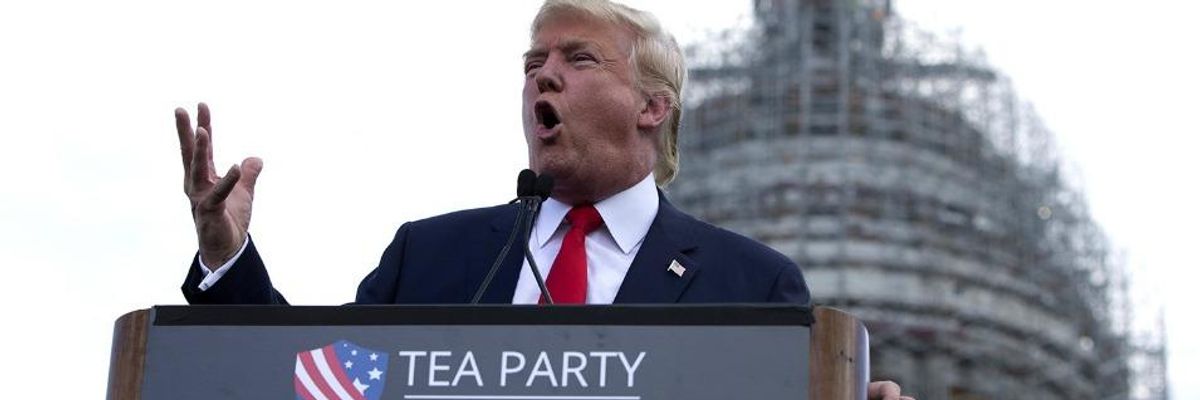
In 2015, President Donald Trump headlined a rally against the Iran nuclear deal on the National Mall in Washington, DC. (Photo: AP/Carolyn Kaster)
In anticipation of President Donald Trump's announcement that he will withdraw the U.S. from its commitment to the Joint Comprehensive Plan of Action (JCPOA) on Tuesday, the following is a statement from Trita Parsi, president of the National Iranian American Council (NIAC):
Donald Trump has committed what will go down as one of the greatest acts of self-sabotage in America's modern history. He has put the United States on a path towards war with Iran and may trigger a wider regional war and nuclear arms race.
This is a crisis of choice. Trump has taken a functioning arms control deal that prevented an Iranian nuclear bomb and turned it into a crisis that can lead to war.
"For decades, Washington has insisted that the Iranian leadership is addicted to enmity with the United States. Now it may become fact for the world that the opposite is true and it is America that is addicted to enmity with Iran."
This is not America first, this is Trump leasing out America's foreign policy interests to the highest bidder. The only parties applauding this move are Benjamin Netanyahu and Mohammed Bin Salman, who have consistently chosen to undermine regional security to advance their own short-sighted political fortunes. Trump's reckless decision is a betrayal of the national interests of the United States of America that could haunt us for generations.
Not only has Trump opened a pandora's box of consequences in the region, we now know the administration hired the private Israeli intelligence firm Black Cube to target former U.S. officials who supported the agreement. This Nixonian campaign was likely an illegal attempt to discredit the Iran deal. Anything short of a full investigation by Congress and the Justice Department of Trump's efforts with Black Cube would be an affront to our democratic system.
Perhaps the most absurd aspect of President Trump's Iran policy is his attempt to claim solidarity with the Iranian people, even as he bans Iranians from the U.S. and his top advisors openly support the MEK terrorist group that is universally reviled by Iranians. The Iranian people overwhelmingly supported the nuclear deal, at least until the sanctions relief that was promised failed to materialize, and will be the party most impacted by Trump's decision.
Many were hopeful that the nuclear deal would facilitate broader change in Iranian society over time by empowering moderate forces in their demand for social and economic justice. By diminishing the excuse of sanctions and raising expectations for economic improvement, the nuclear deal appears to have added pressure on Iran's leaders to meet the public's political expectations. However, a potential opening for accelerated progress in Iran has now been slammed shut by Trump, an action that will redirect attention from the Iranian government to the United States. This will not just empower hardliners, it will force Iran's political elite to paper over fissures on key social and political issues while cracking down further on any dissent. This is potentially the biggest crime of Trump's decision - limiting the agency of Iran's own people to choose peaceful political evolution in order to address their grievances.
It is our profound hope that the Europeans, Russians and Chinese are able to sustain the nuclear accord in spite of Trump's decision - though we recognize that this is a tall task given the effect of U.S. sanctions. We also hope that Congress will shake off the politicization of Iran policy and move to restrict Trump's nuclear sabotage. However, given that Senate Republicans and even a handful of Democrats voted for Iran-hawk Mike Pompeo to join John Bolton on Trump's war cabinet, this may not be possible until a new Congress is sworn in.
Iran has remained compliant with the nuclear deal as verified by the IAEA in 11 reports since January 2016, and its people want more economic relief - not less. Under the JCPOA, Iran's commitment never to pursue a nuclear weapon never expires, while other far-reaching constraints stretch out for decades. After Trump's breach of the accord, the U.S. - not Iran - is now the outlier when it comes to Iran's nuclear program. If the deal dies as is highly likely, the U.S. will find little to no support in addressing Iran's soon to be expanding nuclear program.
For decades, Washington has insisted that the Iranian leadership is addicted to enmity with the United States. Now it may become fact for the world that the opposite is true and it is America that is addicted to enmity with Iran.
For those in and outside of the Iranian-American community who worked for years to prevent war with Iran, and then succeeded in protecting the nuclear deal from sabotage until today, this move comes as a bitter blow. Unfortunately, we must now redouble our efforts to prevent Trump from leading us to war with Iran."
Dear Common Dreams reader, It’s been nearly 30 years since I co-founded Common Dreams with my late wife, Lina Newhouser. We had the radical notion that journalism should serve the public good, not corporate profits. It was clear to us from the outset what it would take to build such a project. No paid advertisements. No corporate sponsors. No millionaire publisher telling us what to think or do. Many people said we wouldn't last a year, but we proved those doubters wrong. Together with a tremendous team of journalists and dedicated staff, we built an independent media outlet free from the constraints of profits and corporate control. Our mission has always been simple: To inform. To inspire. To ignite change for the common good. Building Common Dreams was not easy. Our survival was never guaranteed. When you take on the most powerful forces—Wall Street greed, fossil fuel industry destruction, Big Tech lobbyists, and uber-rich oligarchs who have spent billions upon billions rigging the economy and democracy in their favor—the only bulwark you have is supporters who believe in your work. But here’s the urgent message from me today. It's never been this bad out there. And it's never been this hard to keep us going. At the very moment Common Dreams is most needed, the threats we face are intensifying. We need your support now more than ever. We don't accept corporate advertising and never will. We don't have a paywall because we don't think people should be blocked from critical news based on their ability to pay. Everything we do is funded by the donations of readers like you. When everyone does the little they can afford, we are strong. But if that support retreats or dries up, so do we. Will you donate now to make sure Common Dreams not only survives but thrives? —Craig Brown, Co-founder |
In anticipation of President Donald Trump's announcement that he will withdraw the U.S. from its commitment to the Joint Comprehensive Plan of Action (JCPOA) on Tuesday, the following is a statement from Trita Parsi, president of the National Iranian American Council (NIAC):
Donald Trump has committed what will go down as one of the greatest acts of self-sabotage in America's modern history. He has put the United States on a path towards war with Iran and may trigger a wider regional war and nuclear arms race.
This is a crisis of choice. Trump has taken a functioning arms control deal that prevented an Iranian nuclear bomb and turned it into a crisis that can lead to war.
"For decades, Washington has insisted that the Iranian leadership is addicted to enmity with the United States. Now it may become fact for the world that the opposite is true and it is America that is addicted to enmity with Iran."
This is not America first, this is Trump leasing out America's foreign policy interests to the highest bidder. The only parties applauding this move are Benjamin Netanyahu and Mohammed Bin Salman, who have consistently chosen to undermine regional security to advance their own short-sighted political fortunes. Trump's reckless decision is a betrayal of the national interests of the United States of America that could haunt us for generations.
Not only has Trump opened a pandora's box of consequences in the region, we now know the administration hired the private Israeli intelligence firm Black Cube to target former U.S. officials who supported the agreement. This Nixonian campaign was likely an illegal attempt to discredit the Iran deal. Anything short of a full investigation by Congress and the Justice Department of Trump's efforts with Black Cube would be an affront to our democratic system.
Perhaps the most absurd aspect of President Trump's Iran policy is his attempt to claim solidarity with the Iranian people, even as he bans Iranians from the U.S. and his top advisors openly support the MEK terrorist group that is universally reviled by Iranians. The Iranian people overwhelmingly supported the nuclear deal, at least until the sanctions relief that was promised failed to materialize, and will be the party most impacted by Trump's decision.
Many were hopeful that the nuclear deal would facilitate broader change in Iranian society over time by empowering moderate forces in their demand for social and economic justice. By diminishing the excuse of sanctions and raising expectations for economic improvement, the nuclear deal appears to have added pressure on Iran's leaders to meet the public's political expectations. However, a potential opening for accelerated progress in Iran has now been slammed shut by Trump, an action that will redirect attention from the Iranian government to the United States. This will not just empower hardliners, it will force Iran's political elite to paper over fissures on key social and political issues while cracking down further on any dissent. This is potentially the biggest crime of Trump's decision - limiting the agency of Iran's own people to choose peaceful political evolution in order to address their grievances.
It is our profound hope that the Europeans, Russians and Chinese are able to sustain the nuclear accord in spite of Trump's decision - though we recognize that this is a tall task given the effect of U.S. sanctions. We also hope that Congress will shake off the politicization of Iran policy and move to restrict Trump's nuclear sabotage. However, given that Senate Republicans and even a handful of Democrats voted for Iran-hawk Mike Pompeo to join John Bolton on Trump's war cabinet, this may not be possible until a new Congress is sworn in.
Iran has remained compliant with the nuclear deal as verified by the IAEA in 11 reports since January 2016, and its people want more economic relief - not less. Under the JCPOA, Iran's commitment never to pursue a nuclear weapon never expires, while other far-reaching constraints stretch out for decades. After Trump's breach of the accord, the U.S. - not Iran - is now the outlier when it comes to Iran's nuclear program. If the deal dies as is highly likely, the U.S. will find little to no support in addressing Iran's soon to be expanding nuclear program.
For decades, Washington has insisted that the Iranian leadership is addicted to enmity with the United States. Now it may become fact for the world that the opposite is true and it is America that is addicted to enmity with Iran.
For those in and outside of the Iranian-American community who worked for years to prevent war with Iran, and then succeeded in protecting the nuclear deal from sabotage until today, this move comes as a bitter blow. Unfortunately, we must now redouble our efforts to prevent Trump from leading us to war with Iran."
In anticipation of President Donald Trump's announcement that he will withdraw the U.S. from its commitment to the Joint Comprehensive Plan of Action (JCPOA) on Tuesday, the following is a statement from Trita Parsi, president of the National Iranian American Council (NIAC):
Donald Trump has committed what will go down as one of the greatest acts of self-sabotage in America's modern history. He has put the United States on a path towards war with Iran and may trigger a wider regional war and nuclear arms race.
This is a crisis of choice. Trump has taken a functioning arms control deal that prevented an Iranian nuclear bomb and turned it into a crisis that can lead to war.
"For decades, Washington has insisted that the Iranian leadership is addicted to enmity with the United States. Now it may become fact for the world that the opposite is true and it is America that is addicted to enmity with Iran."
This is not America first, this is Trump leasing out America's foreign policy interests to the highest bidder. The only parties applauding this move are Benjamin Netanyahu and Mohammed Bin Salman, who have consistently chosen to undermine regional security to advance their own short-sighted political fortunes. Trump's reckless decision is a betrayal of the national interests of the United States of America that could haunt us for generations.
Not only has Trump opened a pandora's box of consequences in the region, we now know the administration hired the private Israeli intelligence firm Black Cube to target former U.S. officials who supported the agreement. This Nixonian campaign was likely an illegal attempt to discredit the Iran deal. Anything short of a full investigation by Congress and the Justice Department of Trump's efforts with Black Cube would be an affront to our democratic system.
Perhaps the most absurd aspect of President Trump's Iran policy is his attempt to claim solidarity with the Iranian people, even as he bans Iranians from the U.S. and his top advisors openly support the MEK terrorist group that is universally reviled by Iranians. The Iranian people overwhelmingly supported the nuclear deal, at least until the sanctions relief that was promised failed to materialize, and will be the party most impacted by Trump's decision.
Many were hopeful that the nuclear deal would facilitate broader change in Iranian society over time by empowering moderate forces in their demand for social and economic justice. By diminishing the excuse of sanctions and raising expectations for economic improvement, the nuclear deal appears to have added pressure on Iran's leaders to meet the public's political expectations. However, a potential opening for accelerated progress in Iran has now been slammed shut by Trump, an action that will redirect attention from the Iranian government to the United States. This will not just empower hardliners, it will force Iran's political elite to paper over fissures on key social and political issues while cracking down further on any dissent. This is potentially the biggest crime of Trump's decision - limiting the agency of Iran's own people to choose peaceful political evolution in order to address their grievances.
It is our profound hope that the Europeans, Russians and Chinese are able to sustain the nuclear accord in spite of Trump's decision - though we recognize that this is a tall task given the effect of U.S. sanctions. We also hope that Congress will shake off the politicization of Iran policy and move to restrict Trump's nuclear sabotage. However, given that Senate Republicans and even a handful of Democrats voted for Iran-hawk Mike Pompeo to join John Bolton on Trump's war cabinet, this may not be possible until a new Congress is sworn in.
Iran has remained compliant with the nuclear deal as verified by the IAEA in 11 reports since January 2016, and its people want more economic relief - not less. Under the JCPOA, Iran's commitment never to pursue a nuclear weapon never expires, while other far-reaching constraints stretch out for decades. After Trump's breach of the accord, the U.S. - not Iran - is now the outlier when it comes to Iran's nuclear program. If the deal dies as is highly likely, the U.S. will find little to no support in addressing Iran's soon to be expanding nuclear program.
For decades, Washington has insisted that the Iranian leadership is addicted to enmity with the United States. Now it may become fact for the world that the opposite is true and it is America that is addicted to enmity with Iran.
For those in and outside of the Iranian-American community who worked for years to prevent war with Iran, and then succeeded in protecting the nuclear deal from sabotage until today, this move comes as a bitter blow. Unfortunately, we must now redouble our efforts to prevent Trump from leading us to war with Iran."