SUBSCRIBE TO OUR FREE NEWSLETTER
Daily news & progressive opinion—funded by the people, not the corporations—delivered straight to your inbox.
5
#000000
#FFFFFF
To donate by check, phone, or other method, see our More Ways to Give page.
Daily news & progressive opinion—funded by the people, not the corporations—delivered straight to your inbox.
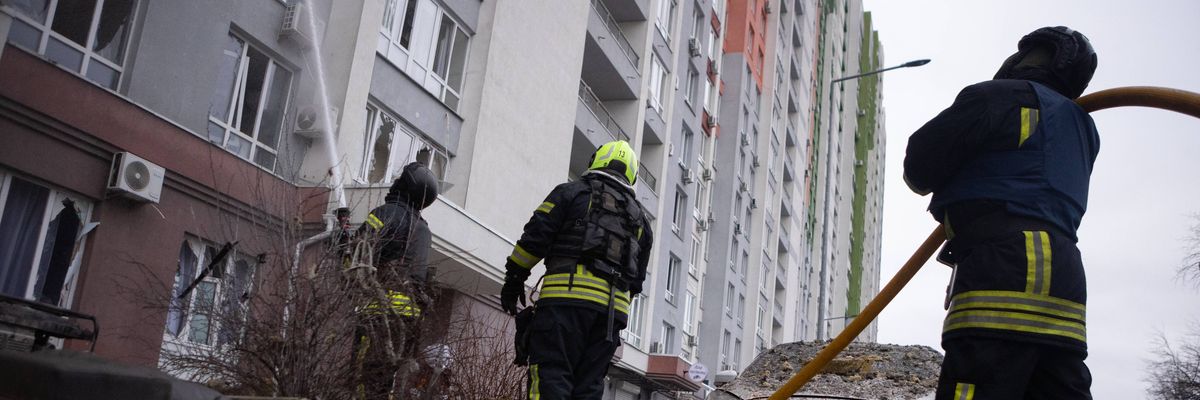
Rescue workers extinguish a fire in a high-rise residential building in the Dniprovskyi district damaged by a Russian drone strike on December 27, 2025 in Kyiv, Ukraine.
The attacks came as Trump and Zelenskyy are expected to discuss critical questions in a Ukraine-Russia peace deal, including its territorial sovereignty, NATO protections, and control over its natural resources.
As Ukrainian President Volodymyr Zelenskyy made his way to Florida for a pivotal set of talks this weekend with US President Donald Trump, Russia launched a barrage of drone and missile attacks on Kyiv early Saturday morning.
At least two people were killed in the Ukrainian capital during the 10-hour attack, with 44 more—including two children—injured. Hundreds of thousands of residents are left to brave near-freezing temperatures without heat following the attack, which cut off power supplies.
The attack came as Zelenskyy prepared to stop in Canada before meeting with Trump on Sunday to discuss a 20-point plan to end the nearly four-year war with Russia that has been the subject of weeks of negotiation between US and Ukrainian emissaries.
Zelenskyy is seeking to maintain Ukraine's territorial sovereignty without having to surrender territory—namely, the eastern Donbass region that is largely occupied by Russian forces. He also hopes that any agreement to end the war will come with a long-term security guarantee reminiscent of NATO.
On Friday, Zelenskyy told reporters that the peace deal was 90% complete. But Trump retorted that Zelenskyy "doesn't have anything until I approve it."
Trump has expressed hostility toward Zelenskyy throughout his presidency. In February, before berating him in a now-infamous Oval Office meeting, Trump insisted falsely that Ukraine, not Russia, was responsible for starting the war in 2022.
Zelenskyy's latest peace proposal was issued in response to Trump's proposal last month, which was heavily weighted in Russia's favor.
It called for Ukraine to recognize Russia's illegal annexation of Crimea and cede the entirety of the Donbass, about 2,500 square miles of territory, to Russia, including territory not yet captured. Trump's plan puts a cap of 600,000 personnel on Ukraine's military and calls for Ukraine to add a measure in its constitution banning it from ever joining NATO.
Earlier this year, Trump demanded that Ukraine give up $500 billion worth of its mineral wealth in what he said was "repayment" for US military support during the war (even though that support has only totalled about $175 billion).
In his latest proposal, Trump has pared down his demands to the creation of a "Ukraine Development Fund" that would include the "extraction of minerals and natural resources" as part of a joint US-Ukraine reconstruction effort.
While those terms appear less exploitative, the reconstruction program is expected to be financed by US loans from firms like BlackRock, which have been heavily involved in the diplomatic process.
"The infrastructure rebuilt with these loans—ports, rail lines, power grid—won’t be Ukrainian in any meaningful sense. It’ll be owned by international consortiums, operated for profit, with revenues flowing out to service the debt," wrote the Irish geopolitical commentator Deaglan O'Mulrooney on Tuesday. "In other words, Ukraine will be gutted."
Despite the criticism, Zelenskyy has signaled support in principle for the US reconstruction proposal as an alternative to direct expropriation.
The "red lines" for Zelenskyy heading into his talk with Trump are related to Ukraine's territorial integrity. He has said he will not recognize Russian control of the Donbass, or the Zaporizhzhia nuclear power plant, the largest nuclear facility in Europe, which Russia currently controls. He has also demanded that all terms of a peace agreement come up for a referendum among the Ukrainian people, which is strongly against territorial concessions.
At the same time, however, he insisted Saturday that "Ukraine is willing to do whatever it takes to stop this war."
Dear Common Dreams reader, It’s been nearly 30 years since I co-founded Common Dreams with my late wife, Lina Newhouser. We had the radical notion that journalism should serve the public good, not corporate profits. It was clear to us from the outset what it would take to build such a project. No paid advertisements. No corporate sponsors. No millionaire publisher telling us what to think or do. Many people said we wouldn't last a year, but we proved those doubters wrong. Together with a tremendous team of journalists and dedicated staff, we built an independent media outlet free from the constraints of profits and corporate control. Our mission has always been simple: To inform. To inspire. To ignite change for the common good. Building Common Dreams was not easy. Our survival was never guaranteed. When you take on the most powerful forces—Wall Street greed, fossil fuel industry destruction, Big Tech lobbyists, and uber-rich oligarchs who have spent billions upon billions rigging the economy and democracy in their favor—the only bulwark you have is supporters who believe in your work. But here’s the urgent message from me today. It's never been this bad out there. And it's never been this hard to keep us going. At the very moment Common Dreams is most needed, the threats we face are intensifying. We need your support now more than ever. We don't accept corporate advertising and never will. We don't have a paywall because we don't think people should be blocked from critical news based on their ability to pay. Everything we do is funded by the donations of readers like you. When everyone does the little they can afford, we are strong. But if that support retreats or dries up, so do we. Will you donate now to make sure Common Dreams not only survives but thrives? —Craig Brown, Co-founder |
As Ukrainian President Volodymyr Zelenskyy made his way to Florida for a pivotal set of talks this weekend with US President Donald Trump, Russia launched a barrage of drone and missile attacks on Kyiv early Saturday morning.
At least two people were killed in the Ukrainian capital during the 10-hour attack, with 44 more—including two children—injured. Hundreds of thousands of residents are left to brave near-freezing temperatures without heat following the attack, which cut off power supplies.
The attack came as Zelenskyy prepared to stop in Canada before meeting with Trump on Sunday to discuss a 20-point plan to end the nearly four-year war with Russia that has been the subject of weeks of negotiation between US and Ukrainian emissaries.
Zelenskyy is seeking to maintain Ukraine's territorial sovereignty without having to surrender territory—namely, the eastern Donbass region that is largely occupied by Russian forces. He also hopes that any agreement to end the war will come with a long-term security guarantee reminiscent of NATO.
On Friday, Zelenskyy told reporters that the peace deal was 90% complete. But Trump retorted that Zelenskyy "doesn't have anything until I approve it."
Trump has expressed hostility toward Zelenskyy throughout his presidency. In February, before berating him in a now-infamous Oval Office meeting, Trump insisted falsely that Ukraine, not Russia, was responsible for starting the war in 2022.
Zelenskyy's latest peace proposal was issued in response to Trump's proposal last month, which was heavily weighted in Russia's favor.
It called for Ukraine to recognize Russia's illegal annexation of Crimea and cede the entirety of the Donbass, about 2,500 square miles of territory, to Russia, including territory not yet captured. Trump's plan puts a cap of 600,000 personnel on Ukraine's military and calls for Ukraine to add a measure in its constitution banning it from ever joining NATO.
Earlier this year, Trump demanded that Ukraine give up $500 billion worth of its mineral wealth in what he said was "repayment" for US military support during the war (even though that support has only totalled about $175 billion).
In his latest proposal, Trump has pared down his demands to the creation of a "Ukraine Development Fund" that would include the "extraction of minerals and natural resources" as part of a joint US-Ukraine reconstruction effort.
While those terms appear less exploitative, the reconstruction program is expected to be financed by US loans from firms like BlackRock, which have been heavily involved in the diplomatic process.
"The infrastructure rebuilt with these loans—ports, rail lines, power grid—won’t be Ukrainian in any meaningful sense. It’ll be owned by international consortiums, operated for profit, with revenues flowing out to service the debt," wrote the Irish geopolitical commentator Deaglan O'Mulrooney on Tuesday. "In other words, Ukraine will be gutted."
Despite the criticism, Zelenskyy has signaled support in principle for the US reconstruction proposal as an alternative to direct expropriation.
The "red lines" for Zelenskyy heading into his talk with Trump are related to Ukraine's territorial integrity. He has said he will not recognize Russian control of the Donbass, or the Zaporizhzhia nuclear power plant, the largest nuclear facility in Europe, which Russia currently controls. He has also demanded that all terms of a peace agreement come up for a referendum among the Ukrainian people, which is strongly against territorial concessions.
At the same time, however, he insisted Saturday that "Ukraine is willing to do whatever it takes to stop this war."
As Ukrainian President Volodymyr Zelenskyy made his way to Florida for a pivotal set of talks this weekend with US President Donald Trump, Russia launched a barrage of drone and missile attacks on Kyiv early Saturday morning.
At least two people were killed in the Ukrainian capital during the 10-hour attack, with 44 more—including two children—injured. Hundreds of thousands of residents are left to brave near-freezing temperatures without heat following the attack, which cut off power supplies.
The attack came as Zelenskyy prepared to stop in Canada before meeting with Trump on Sunday to discuss a 20-point plan to end the nearly four-year war with Russia that has been the subject of weeks of negotiation between US and Ukrainian emissaries.
Zelenskyy is seeking to maintain Ukraine's territorial sovereignty without having to surrender territory—namely, the eastern Donbass region that is largely occupied by Russian forces. He also hopes that any agreement to end the war will come with a long-term security guarantee reminiscent of NATO.
On Friday, Zelenskyy told reporters that the peace deal was 90% complete. But Trump retorted that Zelenskyy "doesn't have anything until I approve it."
Trump has expressed hostility toward Zelenskyy throughout his presidency. In February, before berating him in a now-infamous Oval Office meeting, Trump insisted falsely that Ukraine, not Russia, was responsible for starting the war in 2022.
Zelenskyy's latest peace proposal was issued in response to Trump's proposal last month, which was heavily weighted in Russia's favor.
It called for Ukraine to recognize Russia's illegal annexation of Crimea and cede the entirety of the Donbass, about 2,500 square miles of territory, to Russia, including territory not yet captured. Trump's plan puts a cap of 600,000 personnel on Ukraine's military and calls for Ukraine to add a measure in its constitution banning it from ever joining NATO.
Earlier this year, Trump demanded that Ukraine give up $500 billion worth of its mineral wealth in what he said was "repayment" for US military support during the war (even though that support has only totalled about $175 billion).
In his latest proposal, Trump has pared down his demands to the creation of a "Ukraine Development Fund" that would include the "extraction of minerals and natural resources" as part of a joint US-Ukraine reconstruction effort.
While those terms appear less exploitative, the reconstruction program is expected to be financed by US loans from firms like BlackRock, which have been heavily involved in the diplomatic process.
"The infrastructure rebuilt with these loans—ports, rail lines, power grid—won’t be Ukrainian in any meaningful sense. It’ll be owned by international consortiums, operated for profit, with revenues flowing out to service the debt," wrote the Irish geopolitical commentator Deaglan O'Mulrooney on Tuesday. "In other words, Ukraine will be gutted."
Despite the criticism, Zelenskyy has signaled support in principle for the US reconstruction proposal as an alternative to direct expropriation.
The "red lines" for Zelenskyy heading into his talk with Trump are related to Ukraine's territorial integrity. He has said he will not recognize Russian control of the Donbass, or the Zaporizhzhia nuclear power plant, the largest nuclear facility in Europe, which Russia currently controls. He has also demanded that all terms of a peace agreement come up for a referendum among the Ukrainian people, which is strongly against territorial concessions.
At the same time, however, he insisted Saturday that "Ukraine is willing to do whatever it takes to stop this war."