

SUBSCRIBE TO OUR FREE NEWSLETTER
Daily news & progressive opinion—funded by the people, not the corporations—delivered straight to your inbox.
5
#000000
#FFFFFF
To donate by check, phone, or other method, see our More Ways to Give page.
Daily news & progressive opinion—funded by the people, not the corporations—delivered straight to your inbox.
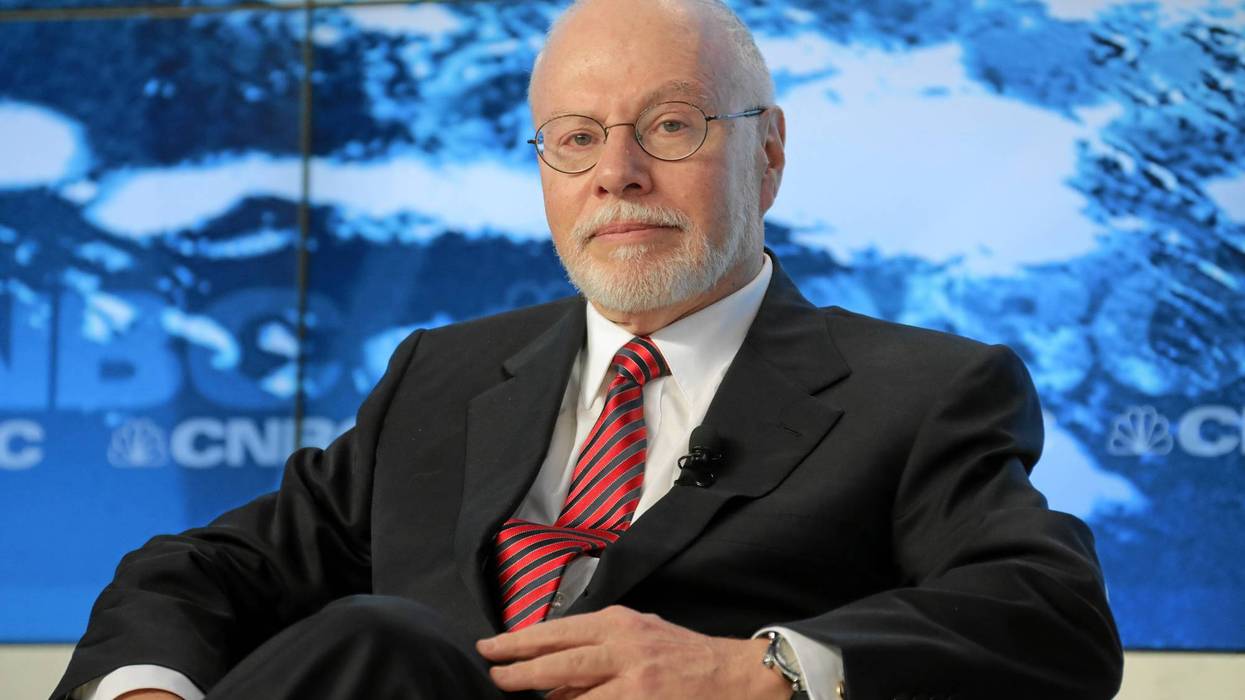
"Paul Singer's shady purchase of Citgo has everything to do with this coup."
One of President Donald Trump's top billionaire donors, who has spent the past several months backing a push for regime change in Venezuela, is about to cash in after the president's kidnapping of the nation's president, Nicolas Maduro, this weekend.
While he declined to tell members of Congress, Trump has said he tipped off oil executives before the illegal attack. At a press conference following the attack, he said the US would have "our very large United States oil companies" go into Venezuela, which he said the US will "run" indefinitely, and "start making money" for the United States.
As Judd Legum reported on Monday for Popular Information, among the biggest beneficiaries will be the billionaire investor Paul Singer:
In 2024, Singer, an 81-year-old with a net worth of $6.7 billion, donated $5 million to Make America Great Again Inc., Trump’s Super PAC. Singer donated tens of millions more in the 2024 cycle to support Trump’s allies, including $37 million to support the election of Republicans to Congress. He also donated an undisclosed amount to fund Trump’s second transition.
Singer is also a major pro-Israel donor, with his foundation having donated more than $3.3 million to groups like the Birthright Israel Foundation, the Israel America Academic Exchange, Boundless Israel, and others in 2021, according to tax filings.
In November 2025, less than two months before Trump's operation to take over Venezuela, Singer's investment firm, Elliott Investment Management, inked a highly fortuitous deal.
It purchased Citgo, the US-based subsidiary of Venezuela's state-owned oil company, for $5.9 billion—a sale that was forced by a Delaware court after Venezuela defaulted on its bond payments.
The court-appointed special master who forced the sale, Robert Pincus, is a member of the board of directors for the American Israel Public Affairs Committee (AIPAC).
Elliott Management hailed the court order requiring the sale in a press release, saying it was "backed by a group of strategic US energy investors."
Singer acquired the Citgo's three massive coastal refineries, 43 oil terminals, and more than 4,000 gas stations at a "major discount" because of its distressed status. Advisers to the court overseeing the sale estimated its value at $11-13 billion, while the Venezuelan government estimated it at $18 billion.
As Legum explained, the Trump administration's embargo on Venezuelan oil imports to the United States bore the primary responsibility for the company's plummeting value:
Citgo’s refiners are purpose-built to process heavy-grade Venezuelan “sour” crude. As a result, Citgo was forced to source oil from more expensive sources in Canada and Colombia. (Oil produced in the United States is generally light-grade.) This made Citgo’s operations far less profitable.
It is the preferred modus operandi for Singer, whose hedge fund is often described as a "vulture" capital group. As Francesca Fiorentini, a commentator at Zeteo, explained, Singer "is famous for doing things like buying the debt of struggling countries like Argentina for pennies on the dollar and then forcing that country to repay him with interest plus legal fees."
Venezuelan Vice President and Minister of Petroleum Delcy Rodríguez called the sale of Citgo to Singer "fraudulent" and "forced" in December.
After the US abducted Maduro this week, Trump named Rodriguez as Venezuela's interim president—and she was formally sworn in Monday—but he warned that she'll pay a "very big price" if she refuses to do "what we want."
That is good news for Singer, who is expected to be one of the biggest beneficiaries of an oil industry controlled by US corporations, which will likely not be subject to crippling sanctions.
Singer has reportedly met with Trump directly at least four times since he was first elected in 2016, most recently in 2024. While it is unknown whether the two discussed Venezuela during those meetings, groups funded by Singer have pushed aggressively for Trump to take maximal action to decapitate the country's leadership.
Since 2011, Singer has donated over $10 million and continues to sit on the board of directors for the right-wing Manhattan Institute think tank, which in recent months has consistently advocated for Maduro to be removed from power. In October, it published an article praising Trump for his "consistent policies against Venezuela’s Maduro."
He has also been a major donor to the neoconservative think tank Foundation for Defense of Democracies (FDD), serving as its second-largest contributor from 2008-2011, with more than $3.6 million.
In late November, shortly before Trump announced that the US had closed Venezuelan airspace and began to impound Venezuelan oil tankers, FDD published a policy brief stating that the US has "capabilities to launch an overwhelming air and missile campaign against the Maduro regime" that it could use to remove him from power.
Singer himself has acted as a financial attack dog for Trump during his first year back in office. In June, he contributed $1 million to fund a super PAC aiming to oust Rep. Thomas Massie (R-Ky.), who'd become Trump's leading Republican critic over his Department of Justice's refusal to release its files pertaining to the billionaire sex trafficker Jeffrey Epstein.
A super PAC tied to Miriam Adelson, another top pro-Israel donor who recently said she'd give Trump $250 million if he ran for a third term, also reportedly helped to fund the campaign against Massie.
Massie has since gone on to be one of the most vocal opponents in Congress to Trump's regime change push in Venezuela, joining Democrats to co-sponsor multiple failed war powers resolutions that would have reined in the president's ability to launch military strikes against alleged drug boats in the Caribbean and launch an attack on mainland Venezuela.
As the Trump administration has asserted that American corporations are entitled to the oil controlled by Venezuela's state firm, Massie rebutted this weekend that: "It’s not American oil. It’s Venezuelan oil."
"Oil companies entered into risky deals to develop oil, and the deals were canceled by a prior Venezuelan government," he said. "What’s happening: Lives of US soldiers are being risked to make those oil companies (not Americans) more profitable."
Massie said that Singer, "who’s already spent $1,000,000 to defeat me in the next election, stands to make billions of dollars on his distressed Citgo investment, now that this administration has taken over Venezuela."
Fiorentini added that "Paul Singer's shady purchase of Citgo has everything to do with this coup."
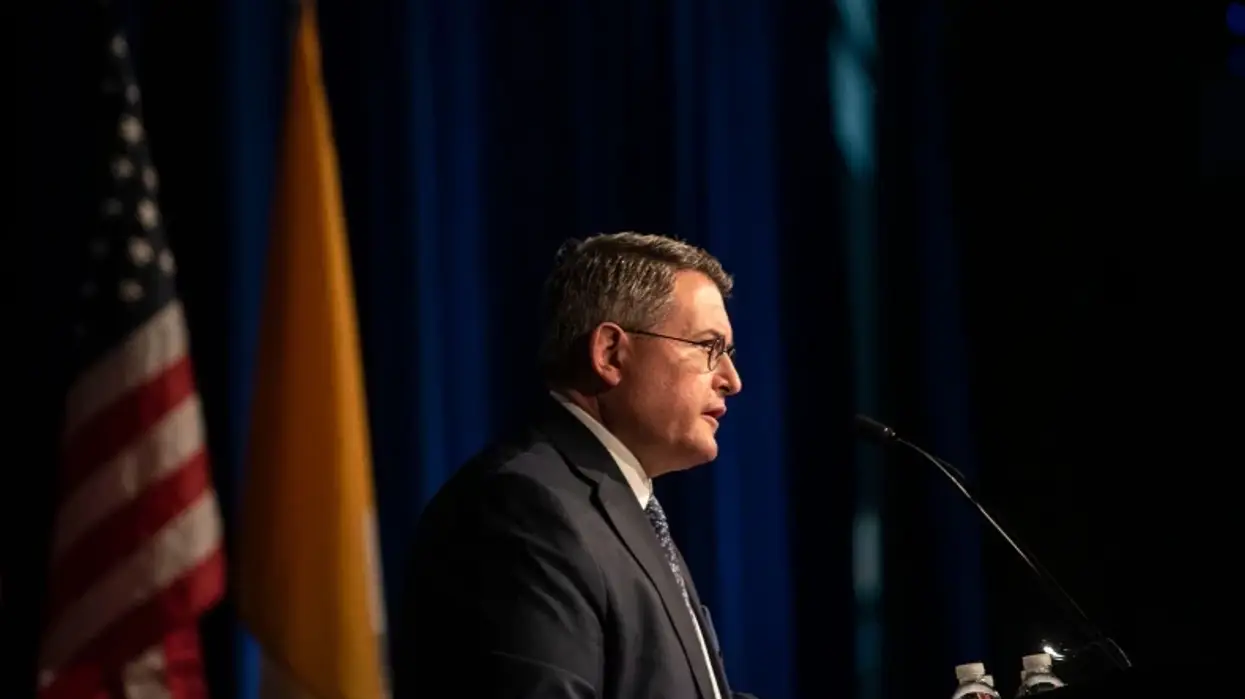
"This subpoena is a direct result of Mr. Leo's own actions and choices," said Judiciary Committee Chair Dick Durbin.
"Incredible," said one journalist on Friday of right-wing legal activist Leonard Leo's reasons for refusing to comply with a subpoena from the Senate Judiciary Committee as the panel investigates conservative Supreme Court justices' relationships with Leo and other Republican operatives and donors.
The Federalist Society co-chairman told The Washington Post that the subpoena was "politically motivated."
"I am not capitulating to [committee Chair Dick Durbin's (D-Ill.)] lawless support of Sen. Sheldon Whitehouse and the left's dark money effort to silence and cancel political opposition," said Leo, who has lobbied for the appointments of far-right judges to federal benches, in a statement.
The subpoena came over four months after the committee voted along party lines to subpoena Leo and billionaire GOP donor Harlan Crow following numerous reports about luxury travel and gifts they and others bestowed on Justices Clarence Thomas and Samuel Alito.
ProPublica revealed last June that Leo organized a luxury fishing trip to Alaska for Alito, with lodging and private jet travel paid for, in 2008. The trip was not included on Alito's federally required financial disclosure forms, continuing a pattern that ProPublica first reported on last April with several luxury vacations, real estate transactions, and other financial gifts to Thomas that were paid for by Crow.
Durbin said Thursday that the subpoena was issued because of the "blanket refusal to cooperate" with the investigation that Leo has displayed since last July.
"His outright defiance left the committee with no other choice but to move forward with compulsory process. For that reason, I have issued a subpoena to Mr. Leo," said Durbin. "Mr. Leo has played a central role in the ethics crisis plaguing the Supreme Court and, unlike the other recipients of information requests in this matter, he has done nothing but stonewall the committee. This subpoena is a direct result of Mr. Leo's own actions and choices."
The ethics violations revealed by ProPublica's reporting forced the Supreme Court last fall to adopt a code of conduct for the first time, modeled on the rules followed by judges on lower federal courts.
But ethics watchdogs labeled the code a "toothless PR stunt" and a "cover-up for Clarence Thomas," as it did not include an enforcement mechanism and provided the justices with discretion over recusal decisions.
Debt relief advocates called on Alito to recuse himself last year from two cases pertaining to Biden's student debt cancellation program, citing the reporting on Leo's gifts to the justice. The plane Alito took to Alaska was owned by billionaire investor Paul Singer, who has financially backed groups that lobbied the court to overturn Biden's plan.
The court struck down the debt relief program last June.
Like former President Donald Trump, said Alex Aronson, former chief counsel for Judiciary Committee senior member Sen. Sheldon Whitehouse (D-R.I.), "the other man most responsible for shaping our Supreme Court's runaway majority is a lawless con man and crook."
Caroline Ciccone, president of government watchdog Accountable.US, said Friday that "Supreme Court billionaire matchmaker Leonard Leo" is the force behind "a full-blown corruption crisis has plagued the high court for over a year, undermining its credibility and plummeting public trust in the court to record lows."
"Today's subpoena is a critical step toward accountability, and toward ensuring that our high court adheres to the highest possible ethics standards," said Ciccone. "As a result of the strong leadership of Chairman Durbin and the Judiciary Committee, we can now begin to get to the bottom of the corruption crisis pervading the Supreme Court."
With Leo refusing to comply with the subpoena, Democrats would need to hold a vote in the closely divided Senate to seek enforcement.
Former Trump aide Peter Navarro was found guilty of contempt of Congress for defying a subpoena from the committee that investigated the January 6, 2021 insurrection, and reported to a federal prison last month to serve his four-month sentence.
"Leonard Leo thinks he's above the law just like Navarro did," said one attorney. "We'll see if he's right."
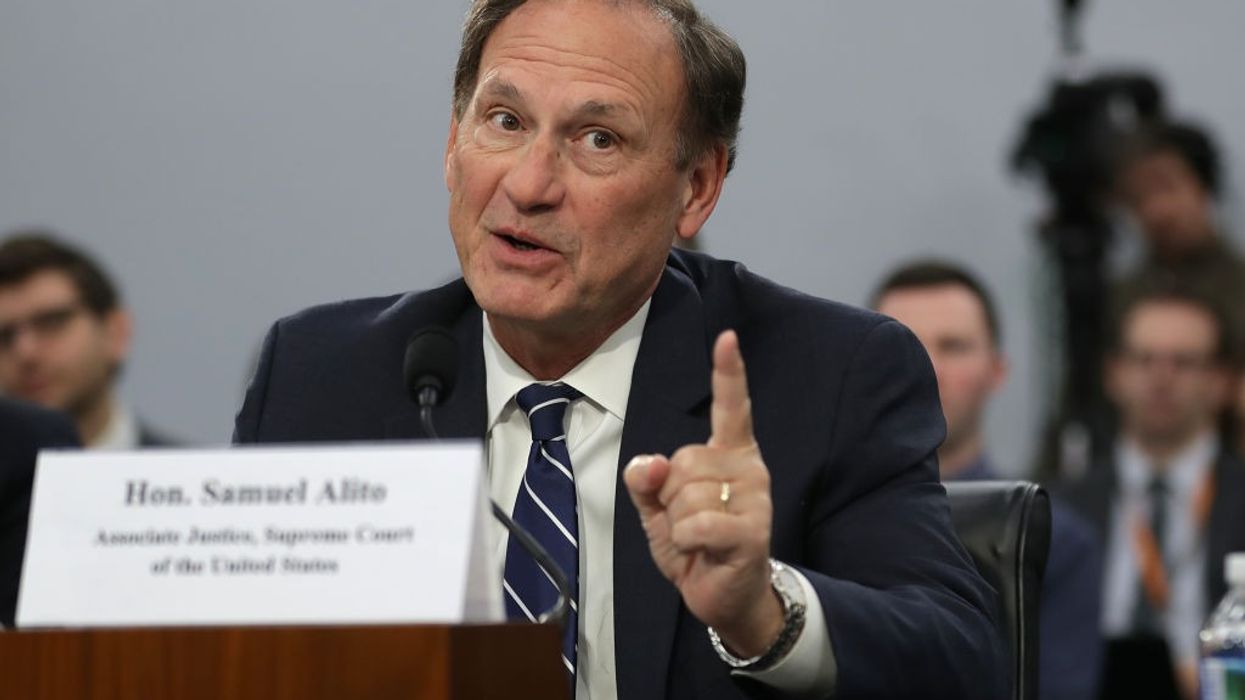
"Should Justice Alito preside over this case despite his clear conflicts of interest, it would add to the worsening Supreme Court corruption crisis and underscore the urgent need for ethics reform," said one critic.
Anti-corruption watchdog Accountable.US on Monday said there is a clear need for U.S. Supreme Court Justice Samuel Alito to recuse himself from an upcoming court case regarding the Consumer Financial Protection Bureau, as a new analysis revealed the extent of one of his key associate's financial interests in the case.
The group released new data showing that hedge fund manager Paul Singer holds at least $90 million in financial firms overseen by the CFPB, which was established in 2011 through the Dodd-Frank Wall Street Reform and Consumer Protection Act and has since provided $16 billion in financial relief to defrauded consumers and ordered companies to pay $3.7 billion in penalties.
The findings were released three months after ProPublica revealed Singer paid for a luxury fishing trip for the right-wing justice in 2008, costing him an estimated $100,000 each way. Alito has never recused himself from subsequent cases in which Elliott Management, Singer's firm, was directly involved, including one in which the court awarded $2.4 billion to the fund.
Now, said Accountable.US, "should Alito choose to preside over this case despite his billionaire benefactor's direct financial stake in the outcome, it would only fuel an already raging Supreme Court corruption crisis," referring to numerous reports of Justices Alito, Clarence Thomas, Neil Gorsuch, and others accepting gifts or money from groups or people with business before the court.
The case, which the court is set to hear on October 3, is CFPB v. the Community Financial Services Association of America (CFSA) and pertains to the CFPB's funding structure. Opponents—including Republican lawmakers whose own constituents have directly benefited from the agency's work—claim it is unconstitutional for the agency to be funded through the Federal Reserve and say Congress should approve appropriations for the CFPB regularly.
"In one fell swoop," said Accountable.US on Monday, "an anti-CFPB-led Congress could cut the purse strings and erase over a decade of consumer protections and rules that have made our markets fairer and more stable."
The group highlighted Singer's connections to the case, including:
"The sprawling web of financial dealings Mr. Singer has overseen by the CFPB explains why his firm has aggressively criticized the agency's independence," said Liz Zelnick, director of Accountable.US' Economic Security and Corporate Power program. "The cause for Alito's recusal in this matter is cut and dry. Should Justice Alito preside over this case despite his clear conflicts of interest, it would add to the worsening Supreme Court corruption crisis and underscore the urgent need for ethics reform."
The watchdog's report shows that Alito "enjoyed untold amounts of luxury and largesse from a billionaire hedge fund manager whose business interests would benefit if the Supreme Court allows for the worst rollback of consumer protections in U.S. history," Zelnick added.
Accountable.US warned that Alito's failure to recuse himself from the case could make it more likely that the court will side with "predatory lenders" like those tied to Singer's business.
"That will likely mean the agency's future funding will be beholden to the political whims of Congress," said the group. "There is little doubt a U.S. House of Representatives made up of lawmakers openly hostile to the CFPB—like the current MAGA Majority—would zero-fund the agency the first chance they get on behalf of their financial industry donors."
"It would be catastrophic," the watchdog added, "for consumers, honest businesses that simply want to compete fairly, and the stability of financial markets."
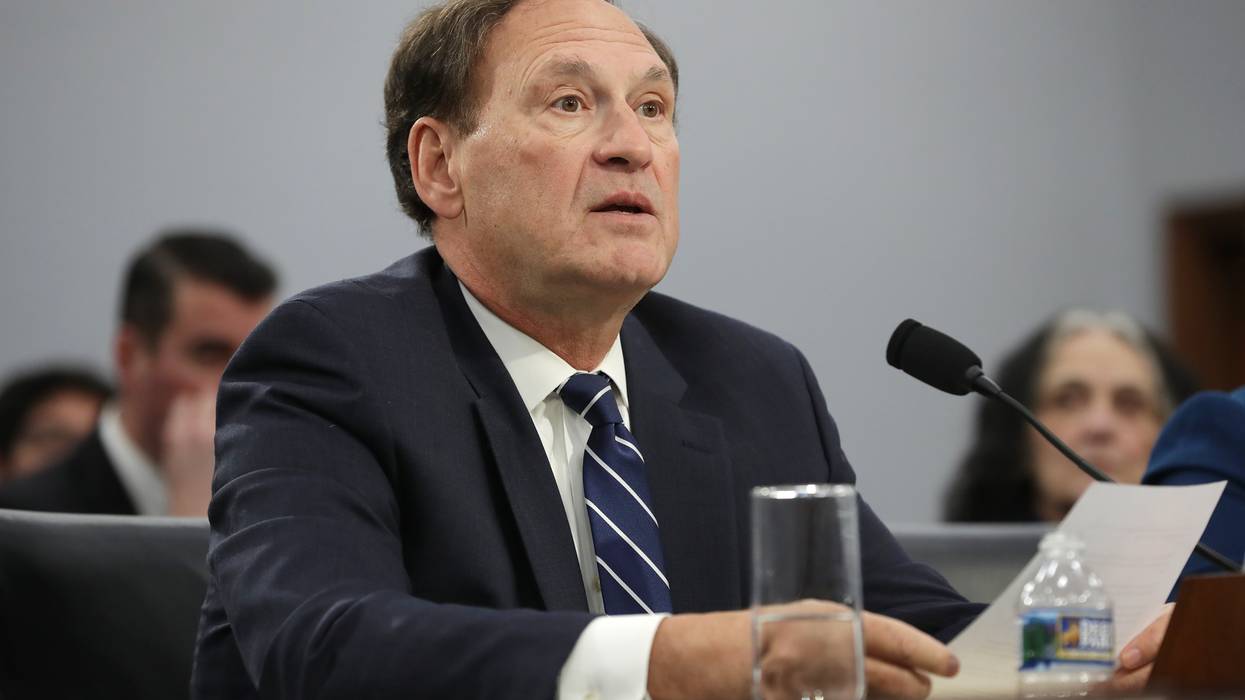
"First he accepted lavish gifts from billionaires and failed to disclose them. Then he gave a buddy-buddy interview to one of the case's anti-wealth tax lawyers. Enough."
U.S. Supreme Court Justice Samuel Alito is facing growing calls to recuse himself from a case that could hamstring Congress' ability to enact a federal wealth tax, a policy that progressive lawmakers and economists say is needed to rein in out-of-control inequality.
Late last week, Democrats on the Senate Judiciary Committee sent a letter urging Chief Justice John Roberts to "take appropriate steps to ensure that Justice Alito will recuse himself" from Moore v. United States, which the Supreme Court recently agreed to take up.
The lawmakers' demand was prompted by a friendly interview that Alito gave to The Wall Street Journal's opinion section, which in June allowed the right-wing justice to get out in front of a ProPublica story on his luxury trip with billionaire hedge fund titan Paul Singer.
The interview late last month was conducted in part by David Rivkin Jr., an attorney who is representing the plaintiffs in Moore v. United States. The case, which is mentioned in passing in the Journal's write-up of the Alito interview, concerns whether unrealized gains such as stock appreciation can be subject to federal taxation.
Unrealized gains are currently untaxed in the U.S., allowing billionaires such as Tesla CEO Elon Musk to accumulate massive fortunes while paying little to nothing in federal income taxes.
Supporters of the Moore plaintiffs, who are specifically challenging an obscure foreign earnings provision in the 2017 Republican tax law, have encouraged the Supreme Court to explicitly address the constitutionality of wealth taxes in its ruling.
"This case presents the court with an ideal opportunity to clarify that taxes on unrealized gains, such as wealth taxes, are direct taxes that are unconstitutional if not apportioned among the states," the right-wing Manhattan Institute argued in a May amicus brief. (Proponents of a tax on unrealized gains, such as Sen. Ron Wyden (D-Ore.), have expressed confidence that such a tax is constitutional.)
The Manhattan Institute is chaired by Singer, whose private jet flew Alito to an Alaska fishing trip that the justice did not disclose.
"Alito needs to recuse himself from the case deciding the constitutionality of a wealth tax," Americans for Tax Fairness, a progressive advocacy group, said Wednesday. "First he accepted lavish gifts from billionaires and failed to disclose them. Then he gave a buddy-buddy interview to one of the case's anti-wealth tax lawyers. Enough."
In their letter last week, Senate Democrats argued that Alito violated the Supreme Court's narrow ethical principles by agreeing to sit for an interview with an attorney with business before the court.
"Mr. Rivkin's access to Justice Alito and efforts to help Justice Alito air his personal grievances could cast doubt on Justice Alito's ability to fairly discharge his duties in a case in which Mr. Rivkin represents one of the parties," the senators wrote. "Recusal in these matters is the only reasonable way for Justice Alito to prevent further damage to public confidence in the court."
It is unlikely that Roberts or Alito will agree to the lawmakers' demands, given that both justices have cast doubt on Congress' power to oversee and regulate the Supreme Court.
"This episode again illustrates why legislation establishing stronger, enforceable ethics standards for the court is of paramount importance," the senators' letter concludes. "The court is mired in an ethical crisis of its own making, yet its only response has been a weak statement on ethics that Justice Alito has apparently ignored. It is unacceptable for the highest court in the land to have the lowest ethical standards, and because the court has abdicated its responsibility to establish its own standards, Congress must act."

Sens. Sheldon Whitehouse and Dick Durbin demanded details from "court fixer" Leonard Leo and two billionaires who were featured in recent reporting on Justice Samuel Alito.
A pair of Senate Democrats on Wednesday pressed Federalist Society co-chair Leonard Leo and two right-wing billionaires to provide a detailed accounting of all gifts and hospitality they've provided to U.S. Supreme Court justices over the years, a demand that came amid a steady stream of revelations indicating rampant corruption on the high court.
In separate letters to Leo, hedge fund tycoon Paul Singer, and real estate magnate Robin Arkley, Sens. Sheldon Whitehouse (D-R.I.) and Dick Durbin (D-Ill.) requested specific information on the roles the three played in organizing a 2008 Alaska fishing trip that Supreme Court Justice Samuel Alito attended.
Alito did not disclose the trip, which was first reported last month by the investigative outlet ProPublica.
"The reporting stated that you 'attended and helped organize' this event, invited Justice Alito and Paul Singer to attend, and asked Mr. Singer if you and Justice Alito could fly to Alaska on a private jet owned by Mr. Singer, or an entity he owns or controls," Whitehouse and Durbin, the chair of the Senate Judiciary Committee, wrote in their letter to Leo, who is notorious for orchestrating the right-wing takeover of the U.S. court system.
"Additionally, the free lodging for this trip was provided by Robin Arkley II, who has helped fund an advocacy group connected to you that has advocated for issues related to the federal judiciary. Justice Alito did not disclose these gifts of transportation and lodging on his annual financial disclosure form for 2008," the senators continued. "This follows earlier reporting indicating that you also joined at least one of Justice [Clarence] Thomas' undisclosed trips to Harlan Crow's Topridge Camp."
Crow, a billionaire and source of funding for right-wing dark money groups, has stonewalled the Senate Finance Committee's efforts to obtain further details about his many gifts to Thomas, which were also reported by ProPublica.
In their letters to Leo, Singer, and Arkley, Whitehouse and Durbin called on the three to turn over "an itemized list of all gifts, payments, and items of value exceeding $415 given by you, or by entities you own or control or for which you have served as a partner, director, or officer, to any justice of the Supreme Court or a member of the justice's family, including the name of the Justice, the approximate dollar amount of each item, and the date it was extended."
The senators also asked for "an itemized list of all transportation or lodging provided, whether by you; by entities you own or control or for which you have served as a partner, director, or officer; or by others, to a justice of the Supreme Court or a member of the justice's family, which you had a role in facilitating or arranging."
"Answers to these questions will help the committee's work to create reliable ethics guardrails at the court, under Congress' clearly established oversight and legislative authority."
Whitehouse and Durbin's sent the letters days after they announced that on July 20, the Senate Judiciary Committee will mark up and vote on the Rhode Island senator's Supreme Court Ethics, Recusal, and Transparency Act, a bill that would force the high court to adopt a binding code of conduct and strengthen disclosure requirements, among other reforms.
In a series of tweets on Wednesday, Whitehouse wrote that congressional action is necessary given that Chief Justice John Roberts "has barely acknowledged, much less investigated or sought to fix, the ethics crises swirling around our highest court," which has been busy gutting abortion rights, clean water protections, affirmative action, and more.
Earlier this year, Roberts declined Durbin's invitation to testify before the Senate Judiciary Committee in the wake of ProPublica's reporting on the luxury trips Thomas has taken on Crow's dime.
"Senator Durbin and I are demanding more information on gifts given to Supreme Court justices by right-wing court fixer Leonard Leo and two right-wing billionaires implicated in recent reporting on the court's ethics crisis," Whitehouse wrote Wednesday. "Answers to these questions will help the committee's work to create reliable ethics guardrails at the court, under Congress' clearly established oversight and legislative authority."

"Alito doesn't have to come across like a drunken Paul Thomas Anderson character gleefully confessing to drinking our collective milkshakes in order to be a real-life, run-of-the-mill political villain," quipped the founder of one ethics watchdog.
Advocates for ethical government on Monday sounded the alarm on a report revealing that the wife of U.S. Supreme Court Justice Samuel Alito leased property in Oklahoma to a fossil fuel company around the same time that the firm was involved in a case before the high court from which the judge did not recuse himself.
According to The Intercept, Martha Ann Bomgardner Alito last June leased a 160-acre plot of land in Grady County, Oklahoma, just southwest of Oklahoma City, to Citizen Energy III under an agreement that she would be paid 3/16ths of all the money the company made from oil and gas sales.
Last month, Justice Alito wrote the majority opinion in Sackett v. Environmental Protection Agency, which severely curtailed protections under the Waters of the United States rule, as Common Dreams reported at the time. The environmental legal advocacy group Earthjustice called the ruling "a catastrophic loss for water protections across the country and a win for big polluters, putting our communities, public health, and local ecosystems" in peril.
The high court's review was well underway at the time of the lease deal, with the justices agreeing to take the case in January 2022 and hearing arguments that October.
"There need not be a specific case involving the drilling rights associated with a specific plot of land for Alito to understand what outcomes in environmental cases would buttress his family's net wealth," Jeff Hauser, founder and director of the watchdog Revolving Door Project, told The Intercept.
"Alito does not have to come across like a drunken Paul Thomas Anderson character gleefully confessing to drinking our collective milkshakes in order to be a real-life, run-of-the-mill political villain," Hauser added.
As Daniel Boguslaw wrote for The Intercept:
In the past, Alito has often recused himself from cases that pose potential conflicts of interest with his vast investment portfolio. Many of these recusals were born from an inheritance of stocks after the death of Alito's father-in-law, Bobby Gene Bomgardner. Because Citizen Energy III isn't implicated in any cases before the Supreme Court, Alito's holding in Oklahoma doesn't appear to pose any direct conflicts of interest. But it does add context to a political outlook that has alarmed environmentalists since Alito's confirmation hearing in 2006—and cast recent decisions that embolden the oil and gas industry in a damning light.
During his 2006 Senate confirmation hearing, Alito appeared to set a high ethical bar for himself by stating justices should recuse themselves from cases in which "any possible question" might arise regarding "the appearance of impropriety."
The new revelation comes hot on the heels of a ProPublica report that exposed a previously undisclosed luxury fishing trip in Alaska that Alito was gifted by billionaire and GOP megadonor Paul Singer, whose hedge fund repeatedly had cases before the Supreme Court from which Alito declined to recuse himself.
A petition currently in circulation demands that Alito recuse himself from a pair of cases that will decide the fate of President Joe Biden's plan to relieve the college debt burdens of tens of millions of Americans.
Unlike other federal courts, there is no code of ethics governing Supreme Court justices. Although justices must file financial disclosures under the Ethics in Government Act, the choice of whether or not to recuse themselves from cases involving a conflict of interest is up to them.
"What makes political figures who violate ethics laws so exceptional is how much obviously unethical behavior is legal under our current overly permissive rules."
Another ProPublica report, this one published in April, showed how Justice Clarence Thomas and relatives apparently exploited this loophole by accepting lavish gifts including luxury vacations, domestic and international private jet travel, and even private school tuition for one of the judge's relatives.
"What makes political figures who violate ethics laws so exceptional is how much obviously unethical behavior is legal under our current overly permissive rules," Hauser told The Intercept. "Our current ethics regime assumes that a person's financial interests need to be extremely specific in order to influence their behavior, a worldview that ignores the foresight rich people and corporations regularly demonstrate."

"The appearance of corruption—your ties to Mr. Singer, and his ties to organizations with business before the court in Brown and Nebraska—clear the high ethical bar you established for yourself at your confirmation hearing in 2006."
A petition circulated Friday demands that U.S. Supreme Court Justice Samuel Alito recuse himself from a pair of cases that will decide the fate of President Joe Biden's student debt relief proposal, citing the judge's ties to a billionaire GOP megadonor who funds conservative groups fighting to kill the president's plan.
Earlier this week, ProPublica published a bombshell expośe revealing Alito took a previously undisclosed 2008 luxury fishing trip to Alaska on a private jet belonging to Paul Singer, whose hedge fund repeatedly had cases before the Supreme Court from which Alito declined to recuse himself.
Alito's Alaska getaway was organized by Leonard Leo, who heads the Federalist Society, a conservative legal organization promoting an 18th-century interpretation of the U.S. Constitution. The group has played a key role in the U.S. judiciary's rightward shift, and all six conservative Supreme Court justices are current or former members.
"In light of your now well-documented financial entanglement with billionaire investor Paul Singer, we write to demand your immediate recusal from two cases in which Mr. Singer appears to have direct or indirect ties to litigants or amici—Biden v. Nebraska and U.S. Department of Education v. Brown," begins the petition, which is being circulated by the Debt Collective.
The petition continues:
As you know, these cases will determine whether the Biden administration is able to deliver transformational student debt relief to more than 40 million working families...
Given your stated concerns over "the appearance of impropriety" related to potential conflicts of interest and the standard for recusal you set out in your own Senate confirmation hearing (recusal is needed when "any possible question might arise"), we expect that you agree that it is necessary to recuse yourself from both cases. We urge you to immediately and publicly communicate your intent to do so before decisions on these cases are released.
"The appearance of corruption—your ties to Mr. Singer, and his ties to organizations with business before the court in Brown and Nebraska—clear the high ethical bar you established for yourself at your confirmation hearing in 2006," the petition states. "There is only one path forward: You must recuse yourself in both Brown and Nebraska.
The petition cites Singer's "major" financial support for the Judicial Crisis Network, which has given at least $150,000 in direct financial support to the Job Creators Network, a right-wing dark money group bankrolling the plaintiffs in U.S. Department of Education v. Brown.
Singer also chairs the Manhattan Institute, a right-wing think tank known for members like Christopher Rufo, purveyor of baseless anti-critical race theory hysteria, and Diane Yap, who stands accused of promoting racist stereotypes under the guise of countering anti-Asian racism and championing educational merit. The organization filed a consolidated amicus brief in Biden v. Nebraska imploring the Supreme Court to strike down the student debt relief plan. In addition to the petition, the Debt Collective also noted that the Supreme Court on Friday "ruled that states do not have legal standing to sue the Biden administration on federal policies."
"In today's United States v. Texas decision, the court ruled that the states of Texas and Louisiana do not have standing to try to use the courts to force the Biden administration to enforce immigration laws more punitively," the group said. "Last week, in Haaland v. Brackeen, the Supreme Court ruled that the state of Texas also did not have standing to sue the federal government on behalf of its citizens—similar to the lawsuit brought on by Republican attorneys general in the sham student debt lawsuit."
Observing these rulings, Debt Collective spokesperson Braxton Brewington said in a statement Friday that "if the Supreme Court strikes down student debt relief, it will be a stark deviation from their rulings thus far and further expose the political corruption within this court."
"In Justice [Amy Coney] Barrett's own words, the ruling for student debt relief should be 'open and shut' in favor of mostly low-income families burdened with the crushing weight of student debt," Brewington added.

While it may be theoretically possible that a justice could receive such gifts and not have it impact their view of a specific case, it is unrealistic to believe that it won’t.
Workers should pay attention to news that Supreme Court Justice Clarence Thomas has been wined and dined by a billionaire businessman for years without disclosures, while Justice Neil Gorsuch sold property to a law firm executive who has been involved in numerous cases before the court. It will come as no surprise that justices receiving lavish gifts are going to side with the interests of their wealthy benefactors when a case comes before them involving business interests versus workers’ rights.
We can all hope the law will prevail, and that some of the moves to install new codes of ethics can restore some of the integrity of the court, but the Republican-appointed justices’ track record is dismal when it comes to empowering workers.
The Supreme Court has played an important role in the decades-long campaign to erode workers’ rights in this country. In particular, the Supreme Court has issued rulings that have undermined everything from workers’ rights to form unions, the ability to build strong unions, and health and safety on the job. This term, the Supreme Court once again sided with corporations in Glacier Northwest v. Teamsters to make it easier for employers to sue unions over their decision to strike.
It will come as no surprise that justices receiving lavish gifts are going to side with the interests of their wealthy benefactors when a case comes before them involving business interests versus workers’ rights.
Beyond Glacier, here’s a rundown of several key decisions that hurt workers just in the last few years:
Corporate America had been trying to push employees into arbitration to settle workplace disputes or labor violations, instead of allowing them to exercise their right to take legal action against the boss, either individually or as a class action suit.
This idea that employees and employers have equal power has been the leaning of the conservatives on the court. In a 5–4 decision, the court sided with the corporation in the 2018 Epic Systems Corp. v. Lewis case, claiming workers could get a fair shot at hammering out disputes in arbitration. Under the Supreme Court decision, contractual provisions for individualized arbitration proceedings must be enforced, despite workplace arbitration agreements often being a condition of employment. As Justice Ruth Bader Ginsburg noted in her dissent, the idea that employers can force workers to give up their rights in court in order to retain their jobs violates the basic premise of the National Labor Relations Act (NLRA) and ignores the unequal power between employers and employees.
Janus v. AFSCME was a notorious case that corporate-backed, right-wing legal foundations supported all the way to the Supreme Court, which ruled that public-sector employees would no longer be required to pay union dues if they decided not to become union members. In a 5–4 decision, the court overturned 41 years of labor law precedent that made clear that all workers represented by a union benefit from the union’s efforts to negotiate for better working conditions and, as a result, should be required to pay dues.
Our research found that the Janus decision was expected to have significant impacts on public-sector workers’ wages and job quality as well as on the critical public services these workers provide.
Cedar Point Nursery v. Hassid was a case involving an employer challenge to a California regulation that allows union representatives to visit the property of agricultural employers—in limited circumstances—to carry out efforts to organize the hundreds of thousands of California farmworkers who work in hazardous and low-paying jobs and who suffer high rates of wage and hour violations.
Supreme Court justices... should not be allowed to accept lavish tropical vacations or tuition payments or any other pricey swag that business moguls shower them with, or else we risk further weakening of worker protections in this country.
In a 6–3 decision, the court’s conservative justices ruled that the California regulation constitutes a per se physical taking of the employer’s property, which in practical terms means union organizers will no longer have the right to access the farms where farmworkers are employed. This will have devastating impacts because farmworkers are often difficult to reach since they work in remote locations and in many cases reside in housing that is owned and controlled by employers, so access to their workplaces is critical to organizing efforts. In addition, most farmworkers are immigrants, and a majority of them either lack an immigration status or have a precarious and temporary immigration status that their employers control, making it nearly impossible in practice for them to assert their workplace rights or to seek out unions and worker rights organizations.
The Supreme Court’s decision means that the already difficult task of organizing farmworkers will be even harder now for unions, and there could be additional impacts beyond labor organizing.
Looking ahead, there needs to be a movement to implement enforceable ethical standards for Supreme Court justices, who should not be allowed to accept lavish tropical vacations or tuition payments or any other pricey swag that business moguls shower them with, or else we risk further weakening of worker protections in this country.
While it may be theoretically possible that a justice could receive such gifts and not have it impact their view of a specific case, it is unrealistic to believe that it won’t, and it creates a blatant appearance of impropriety. Any reasonable person would have to assume that such gifts would influence the decision of a justice, who is supposed to be an impartial public servant. Establishing meaningful ethical standards is particularly important now, given that a host of cases will soon be coming before the court that could further gut worker protections that were put in place to empower workers.

The Student Borrower Protection Center said the right-wing justice "must immediately recuse" due to his ties to a billionaire with connections to opponents of student debt relief.
U.S. Supreme Court Justice Samuel Alito on Wednesday faced calls to recuse himself from two high-profile cases that will soon decide the fate of President Joe Biden's student debt cancellation plan after a ProPublica report revealed the judge's ties to Paul Singer, a billionaire with financial connections to right-wing groups backing efforts to block relief for tens of millions of borrowers.
In a letter to Alito on Wednesday, the Student Borrower Protection Center (SBPC) noted that Singer—a hedge fund tycoon whose private jet flew Alito to Alaska for a fishing trip in 2008—has "direct and indirect financial ties" to parties in Biden v. Nebraska and U.S. Department of Education v. Brown, cases brought by opponents of student debt cancellation.
"The U.S. Department of Education v. Brown litigants, student loan borrowers named Myra Brown and Alexander Taylor, were identified by a shadowy nonprofit organization known as the Job Creators Network," SBPC's letter states. "This entity, which advocates for extreme, right-wing positions on a range of issues, has been the recipient of an undisclosed amount of financial support from right-wing donors and has used these resources to publicly wage the legal fight to dismantle student debt relief."
SBPC's letter points out that the Judicial Crisis Network—a right-wing group that counts Singer as a major donor—"has provided at least $150,000 in direct financial support to the Job Creators Network since 2015, including $50,000 in 2020."
"Dark money moves in the shadows. Alito's SCOTUS gutted any guardrails around money in politics," said Mike Pierce, SBPC's executive director. "We don't know everywhere Singer's billions flow. But we do know that Singer has been linked to the Judicial Crisis Network."
Additionally, the group's letter highlights the fact that the Manhattan Institute—a conservative think tank whose board of trustees Singer chairs—"filed a consolidated amicus curiae brief urging the Supreme Court to strike down student debt relief."
"Taken together, these direct and indirect ties to parties and amici in these lawsuits raise significant questions about your ability to remain impartial, particularly given your documented history as a beneficiary of Mr. Singer's largesse," reads the new letter to Alito. "There is only one path forward: you must recuse yourself in both Brown and Nebraska."
The letter was sent hours after ProPublica published a bombshell story on Alito's previously undisclosed 2008 trip to Alaska on Singer's private jet—an excursion organized by Leonard Leo, the longtime head of the Federalist Society who has played a central role in the rightward shift of the U.S. judiciary.
Following the 2008 trip, Alito did not recuse from cases involving Singer's hedge fund.
ProPublica's reporting prompted fresh outcry over the Supreme Court's lack of a binding code of ethics, which has opened the door to what critics say is flagrant corruption. In April, ProPublica revealed that Justice Clarence Thomas has been secretly accepting luxury trips from conservative billionaire Harlan Crow, also a right-wing megadonor, for more than two decades.
"The Supreme Court is mired in an ethical catastrophe that threatens its fundamental credibility," Brett Edkins, managing director of policy and political affairs for the progressive advocacy group Stand Up America, said in a statement Wednesday. "Once again, a conservative Supreme Court justice has been discovered to have accepted luxury travel and gifts from an ultrarich GOP donor with business before the court."
The high court is expected to hand down its hugely consequential ruling on the Biden administration's student debt relief plan before the end of the month as advocates work to highlight the fundamental flaws in the plaintiffs' case for blocking relief.
During oral arguments in February, Alito joined his fellow right-wing justices in expressing skepticism over the administration's plan, rehashing the debt cancellation opponents' insistence that the program is unfair to those who wouldn't directly benefit from the relief.
SBPC argued Wednesday that by Alito's own professed ethical standards, he should not be participating in the debt relief cases.
In its letter to Alito on Wednesday, SBPC cites the judge's statement during his 2006 confirmation process that his "personal practice" is to recuse from cases in which "any possible question might arise" regarding his impartiality.
"The appearance of corruption—your ties to Mr. Singer, and his ties to organizations with business before the court in Brown and Nebraska—clear the high ethical bar you established for yourself," the letter states.

The investigative outlet ProPublica reported late Tuesday that U.S. Supreme Court Justice Samuel Alito took an undisclosed private jet flight to Alaska in 2008 with billionaire Paul Singer, whose hedge fund repeatedly had business before the high court in subsequent years.
Alito refused to answer questions for the ProPublica story, opting instead to pen a Wall Street Journal opinion piece attempting to prebut the outlet's contention that his private jet trip with Singer was likely a violation of a federal law requiring Supreme Court justices to disclose most gifts.
The conservative justice insisted there was nothing untoward about the private jet flight to Alaska; his stay at a commercial fishing lodge owned by Robin Arkley II, a donor to the right-wing legal movement; or his decision not to disclose them. Alito wrote that he was "invited shortly before" the fishing trip—without mentioning by whom—and "was asked whether I would like to fly there in a seat that, as far as I am aware, would have otherwise been vacant."
Notably, Alito also omitted the detail that Leonard Leo, co-chair of the conservative Federalist Society and a key figure in the decades-long effort to pull the U.S. judiciary to the right, helped organize the Alaska trip. A. Raymond Randolph, a conservative appellate judge, also attended.
According to ProPublica, Leo "invited Singer to join" and asked the hedge fund tycoon "if he and Alito could fly on the billionaire's jet."
"Leo had recently played an important role in the justice's confirmation to the court," ProPublica reported. "Singer and the lodge owner were both major donors to Leo's political groups."
Sen. Sheldon Whitehouse (D-R.I.), a longtime critic of the Supreme Court's complete lack of binding ethical standards, argued in a series of tweets late Tuesday that Alito's attempted prebuttal of ProPublica's reporting is riddled with holes.
"He just happened to be flying to Alaska and there just happened to be a private jet going to Alaska with an empty seat, and he just happened to find that out, like on some weird billionaire shared-ride Uber?" Whitehouse asked. "Oh, and would that 'empty seat' trick fly with legislative or executive ethics disclosures? (Hint: no.) And how about with the Financial Disclosure Committee? (Right, you didn't ask.)"
"This just keeps getting worse," the senator added.
ProPublica's reporting on Alito—who authored the 2022 ruling that overturned Roe v. Wade—comes weeks after the outlet revealed that another right-wing justice, Clarence Thomas, has been taking billionaire-funded trips for decades without disclosing them.
A common thread in the reporting about the two high court judges is Leo, who five years ago attended a vacation with Thomas at billionaire Harlan Crow's lakeside resort in upstate New York.
In a statement to ProPublica, Leo declared that he would "never presume to tell" the conservative judges "what to do, and no objective and well-informed observer of the judiciary honestly could believe that they decide cases in order to cull favor with friends, or in return for a free plane seat or fishing trip."
ProPublica reported Tuesday that Singer "has repeatedly asked the Supreme Court to rule in his favor in high-stakes business disputes."
The outlet detailed the most prominent example:
His hedge fund, Elliott Management, is best known for making investments that promise handsome returns but could require bruising legal battles...
Singer's most famous gamble eventually made its way to the Supreme Court. In 2001, Argentina was in a devastating economic depression... Unemployment skyrocketed and deadly riots broke out in the street. The day after Christmas, the government finally went into default. For Singer, the crisis was an opportunity. As other investors fled, his fund purchased Argentine government debt at a steep discount.
Within several years, as the Argentine economy recovered, most creditors settled with the government and accepted a fraction of what the debt was originally worth. But Singer's fund, an arm of Elliott called NML Capital, held out. Soon, they were at war: a midtown Manhattan-based hedge fund trying to impose its will on a sovereign nation thousands of miles away.
The fight played out on familiar turf for Singer: the U.S. courts. He launched an aggressive legal campaign to force Argentina to pay in full, and his personal involvement in the case attracted widespread media attention.
In 2007, for the first but not the last time, Singer's fund asked the Supreme Court to intervene. A lower court had stopped Singer and another fund from seizing Argentine central bank funds held in the U.S. The investors appealed, but that October, the Supreme Court declined to take up the case.
In 2014, years after the Alaska fishing trip, "the Supreme Court finally agreed to hear a case on the matter," specifically "how much protection Argentina could claim as a sovereign nation against the hedge fund's legal maneuvers in U.S. courts," ProPublica reported.
Judicial Crisis Network, a right-wing group with connections to Leo, filed a brief in support of Singer's fund.
"The court ruled in Singer's favor 7-1 with Alito joining the majority," ProPublica reported. "The justice did not recuse himself from the case or from any of the other petitions involving Singer."
In his Journal op-ed, Alito claimed he wasn't aware of Singer's connection to the case, even though his role was well publicized.
Singer also has connections to a high-profile Supreme Court fight involving the Biden administration's plan to cancel student debt for many borrowers.
The Manhattan Institute, a conservative think tank that Singer chairs, has filed a friend-of-the-court brief urging justices to block the debt relief plan, ProPublica reported.
"If the Supreme Court kills student debt cancellation nobody can pretend the court has an ounce of legitimacy," the Debt Collective tweeted Wednesday. "Singer became a billionaire buying debts for pennies on the dollar and then weaponizing the courts to collect the full amount from the poorest people. Alito must recuse."
MSNBC's Mehdi Hasan added that "in any just world, and in any world in which Dems could do politics, there would be calls tonight for both Alito and Thomas to resign from the Supreme Court—and calls for impeachment if they refused to do so."
"But in our real world," Hasan lamented, "they won't even be subpoenaed by the Senate."