SUBSCRIBE TO OUR FREE NEWSLETTER
Daily news & progressive opinion—funded by the people, not the corporations—delivered straight to your inbox.
5
#000000
#FFFFFF
To donate by check, phone, or other method, see our More Ways to Give page.
Daily news & progressive opinion—funded by the people, not the corporations—delivered straight to your inbox.
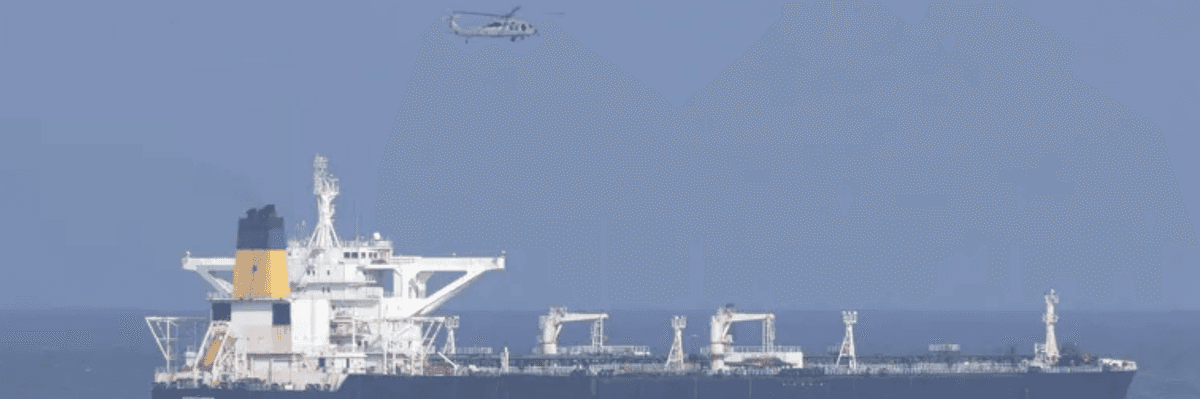
A US military helicopter flies over the oil tanker Centuries in the southern Caribbean Sea on December 20, 2025.
The Venezuelan government condemned the seizure as "a serious act of international piracy;" meanwhile, a US official said the Coast Guard was pursuing a third tanker in the Caribbean.
The Trump administration's "total and complete blockade" of "all sanctioned oil tankers" off the Venezuelan coast was already denounced by critics as "an act of war"—and the United States further escalated its aggression on Saturday by seizing a tanker that is not on a list vessels under US sanctions.
US Coast Guard troops led Saturday's seizure of the Centuries, a Panamanian-flagged, Chinese-owned oil tanker in the Caribbean Sea, after it left Venezuela.
"The United States will continue to pursue the illicit movement of sanctioned oil that is used to fund narco-terrorism in the region," US Homeland Security Secretary Kristi Noem said on X. "We will find you, and we will stop you."
On Sunday, an unnamed US official told Reuters that the Coast Guard "is in active pursuit" of a third tanker near Venezuela, "a sanctioned dark fleet vessel" that "is flying a false flag and under a judicial seizure order.”
The Venezuelan government condemned Saturday's seizure as "a serious act of international piracy."
Venezuela “denounces and rejects the theft and hijacking of a new private vessel transporting oil, as well as the forced disappearance of its crew, committed by military personnel of the United States of America in international waters," Venezuelan Vice President Delcy Rodríguez said in a statement.
“These acts will not go unpunished,” she vowed, adding that Venezuela will pursue "all corresponding actions, including filing a complaint before the United Nations Security Council, other multilateral organizations, and the governments of the world."
Earlier this week, President Donald Trump declared a blockade of all oil tankers under US sanctions that are traveling to or from Venezuela.
Saturday's action followed the US seizure of the Panamanian-flagged Skipper—which is under sanctions—off the Venezuelan coast on December 10.
The Centuries seizure also comes amid the Trump administration's bombing of at least 28 boats allegedly transporting drugs in the Caribbean Sea and Pacific Ocean, attacks that have killed more than 100 people and have been condemned as acts of extrajudicial murder.
In addition to the blockade and boat strikes, Trump has deployed an armada of warships and thousands of troops to the southern Caribbean, authorized covert CIA action against the socialist government of Venezuelan President Nicolás Maduro, and has threatened to invade the South American nation. This latest wave of aggression continues more than a century of US meddling in Venezuela's affairs and sovereignty.
Numerous world leaders have denounced the US aggression toward Venezuela. On Saturday, leftist Brazilian President Luiz Inácio Lula de Silva said during a summit of the South American Mercosur bloc in Foz do Iguaçu, Brazil that an "armed intervention in Venezuela would be a humanitarian catastrophe."
In the United States, multiple efforts by members of Congress—mostly Democrats, but also a handful of anti-war Republicans—to pass a war powers resolution blocking the Trump administration from bombing boats or attacking Venezuela have failed.
Echoing assertions by Venezuelan officials and others, one of those Republicans, Rep. Thomas Massie of Kentucky, said earlier this week that Trump's aggressive escalation "is all about oil and regime change."
Some critics have called Trump's actions a renewal of the "gunboat diplomacy" practiced by the US in the 19th and 20th centuries. The US has conducted scores of military interventions in Latin America, including dozens of regime change operations.
Dear Common Dreams reader, It’s been nearly 30 years since I co-founded Common Dreams with my late wife, Lina Newhouser. We had the radical notion that journalism should serve the public good, not corporate profits. It was clear to us from the outset what it would take to build such a project. No paid advertisements. No corporate sponsors. No millionaire publisher telling us what to think or do. Many people said we wouldn't last a year, but we proved those doubters wrong. Together with a tremendous team of journalists and dedicated staff, we built an independent media outlet free from the constraints of profits and corporate control. Our mission has always been simple: To inform. To inspire. To ignite change for the common good. Building Common Dreams was not easy. Our survival was never guaranteed. When you take on the most powerful forces—Wall Street greed, fossil fuel industry destruction, Big Tech lobbyists, and uber-rich oligarchs who have spent billions upon billions rigging the economy and democracy in their favor—the only bulwark you have is supporters who believe in your work. But here’s the urgent message from me today. It's never been this bad out there. And it's never been this hard to keep us going. At the very moment Common Dreams is most needed, the threats we face are intensifying. We need your support now more than ever. We don't accept corporate advertising and never will. We don't have a paywall because we don't think people should be blocked from critical news based on their ability to pay. Everything we do is funded by the donations of readers like you. When everyone does the little they can afford, we are strong. But if that support retreats or dries up, so do we. Will you donate now to make sure Common Dreams not only survives but thrives? —Craig Brown, Co-founder |
The Trump administration's "total and complete blockade" of "all sanctioned oil tankers" off the Venezuelan coast was already denounced by critics as "an act of war"—and the United States further escalated its aggression on Saturday by seizing a tanker that is not on a list vessels under US sanctions.
US Coast Guard troops led Saturday's seizure of the Centuries, a Panamanian-flagged, Chinese-owned oil tanker in the Caribbean Sea, after it left Venezuela.
"The United States will continue to pursue the illicit movement of sanctioned oil that is used to fund narco-terrorism in the region," US Homeland Security Secretary Kristi Noem said on X. "We will find you, and we will stop you."
On Sunday, an unnamed US official told Reuters that the Coast Guard "is in active pursuit" of a third tanker near Venezuela, "a sanctioned dark fleet vessel" that "is flying a false flag and under a judicial seizure order.”
The Venezuelan government condemned Saturday's seizure as "a serious act of international piracy."
Venezuela “denounces and rejects the theft and hijacking of a new private vessel transporting oil, as well as the forced disappearance of its crew, committed by military personnel of the United States of America in international waters," Venezuelan Vice President Delcy Rodríguez said in a statement.
“These acts will not go unpunished,” she vowed, adding that Venezuela will pursue "all corresponding actions, including filing a complaint before the United Nations Security Council, other multilateral organizations, and the governments of the world."
Earlier this week, President Donald Trump declared a blockade of all oil tankers under US sanctions that are traveling to or from Venezuela.
Saturday's action followed the US seizure of the Panamanian-flagged Skipper—which is under sanctions—off the Venezuelan coast on December 10.
The Centuries seizure also comes amid the Trump administration's bombing of at least 28 boats allegedly transporting drugs in the Caribbean Sea and Pacific Ocean, attacks that have killed more than 100 people and have been condemned as acts of extrajudicial murder.
In addition to the blockade and boat strikes, Trump has deployed an armada of warships and thousands of troops to the southern Caribbean, authorized covert CIA action against the socialist government of Venezuelan President Nicolás Maduro, and has threatened to invade the South American nation. This latest wave of aggression continues more than a century of US meddling in Venezuela's affairs and sovereignty.
Numerous world leaders have denounced the US aggression toward Venezuela. On Saturday, leftist Brazilian President Luiz Inácio Lula de Silva said during a summit of the South American Mercosur bloc in Foz do Iguaçu, Brazil that an "armed intervention in Venezuela would be a humanitarian catastrophe."
In the United States, multiple efforts by members of Congress—mostly Democrats, but also a handful of anti-war Republicans—to pass a war powers resolution blocking the Trump administration from bombing boats or attacking Venezuela have failed.
Echoing assertions by Venezuelan officials and others, one of those Republicans, Rep. Thomas Massie of Kentucky, said earlier this week that Trump's aggressive escalation "is all about oil and regime change."
Some critics have called Trump's actions a renewal of the "gunboat diplomacy" practiced by the US in the 19th and 20th centuries. The US has conducted scores of military interventions in Latin America, including dozens of regime change operations.
The Trump administration's "total and complete blockade" of "all sanctioned oil tankers" off the Venezuelan coast was already denounced by critics as "an act of war"—and the United States further escalated its aggression on Saturday by seizing a tanker that is not on a list vessels under US sanctions.
US Coast Guard troops led Saturday's seizure of the Centuries, a Panamanian-flagged, Chinese-owned oil tanker in the Caribbean Sea, after it left Venezuela.
"The United States will continue to pursue the illicit movement of sanctioned oil that is used to fund narco-terrorism in the region," US Homeland Security Secretary Kristi Noem said on X. "We will find you, and we will stop you."
On Sunday, an unnamed US official told Reuters that the Coast Guard "is in active pursuit" of a third tanker near Venezuela, "a sanctioned dark fleet vessel" that "is flying a false flag and under a judicial seizure order.”
The Venezuelan government condemned Saturday's seizure as "a serious act of international piracy."
Venezuela “denounces and rejects the theft and hijacking of a new private vessel transporting oil, as well as the forced disappearance of its crew, committed by military personnel of the United States of America in international waters," Venezuelan Vice President Delcy Rodríguez said in a statement.
“These acts will not go unpunished,” she vowed, adding that Venezuela will pursue "all corresponding actions, including filing a complaint before the United Nations Security Council, other multilateral organizations, and the governments of the world."
Earlier this week, President Donald Trump declared a blockade of all oil tankers under US sanctions that are traveling to or from Venezuela.
Saturday's action followed the US seizure of the Panamanian-flagged Skipper—which is under sanctions—off the Venezuelan coast on December 10.
The Centuries seizure also comes amid the Trump administration's bombing of at least 28 boats allegedly transporting drugs in the Caribbean Sea and Pacific Ocean, attacks that have killed more than 100 people and have been condemned as acts of extrajudicial murder.
In addition to the blockade and boat strikes, Trump has deployed an armada of warships and thousands of troops to the southern Caribbean, authorized covert CIA action against the socialist government of Venezuelan President Nicolás Maduro, and has threatened to invade the South American nation. This latest wave of aggression continues more than a century of US meddling in Venezuela's affairs and sovereignty.
Numerous world leaders have denounced the US aggression toward Venezuela. On Saturday, leftist Brazilian President Luiz Inácio Lula de Silva said during a summit of the South American Mercosur bloc in Foz do Iguaçu, Brazil that an "armed intervention in Venezuela would be a humanitarian catastrophe."
In the United States, multiple efforts by members of Congress—mostly Democrats, but also a handful of anti-war Republicans—to pass a war powers resolution blocking the Trump administration from bombing boats or attacking Venezuela have failed.
Echoing assertions by Venezuelan officials and others, one of those Republicans, Rep. Thomas Massie of Kentucky, said earlier this week that Trump's aggressive escalation "is all about oil and regime change."
Some critics have called Trump's actions a renewal of the "gunboat diplomacy" practiced by the US in the 19th and 20th centuries. The US has conducted scores of military interventions in Latin America, including dozens of regime change operations.