
SUBSCRIBE TO OUR FREE NEWSLETTER
Daily news & progressive opinion—funded by the people, not the corporations—delivered straight to your inbox.
5
#000000
#FFFFFF
To donate by check, phone, or other method, see our More Ways to Give page.


Daily news & progressive opinion—funded by the people, not the corporations—delivered straight to your inbox.
"Does anyone really care if the Strait of Hormuz is open?" asked one banking executive.
Even as President Donald Trump's illegal war with Iran and tariffs on foreign goods are hammering working-class Americans, a new report shows that members of the US elite have never had it better.
As The Financial Times reported on Thursday, attendees at the annual Milken Institute conference in Beverly Hills this week were living in "blissful ignorance" of the economic pain hitting workers in the US and around the world.
“People are glossing over the war with Iran,” an anonymous private credit firm executive told The Financial Times. “They've become desensitized to it. For some reason, people are saying, ‘Yeah, so what?'"
The Financial Times also quoted one person described as a "high-powered banker" who asked, "Does anyone really care if the Strait of Hormuz is open?"
Ted Koenig, chief executive of Monroe Capital, told The Financial Times that, while people at the conference were vaguely aware of the suffering of middle-class and working-class Americans, "at the end of the day, everyone’s focused on their own investment portfolios, especially here."
While the mood at the Milken conference may have been buoyant thanks to the record-setting stock market, fresh data released Friday showed Main Street America is feeling the exact opposite.
The University of Michigan's latest Surveys of Consumers found that consumer sentiment has hit another all-time low, driven in large part by anxiety over price increases caused by the Iran war.
"Taken together, consumers continue to feel buffeted by cost pressures, led by soaring prices at the pump," explained Joanne Hsu, director of the Surveys of Consumers. "Middle East developments are unlikely to meaningfully boost sentiment until supply disruptions have been fully resolved and energy prices fall."
Tahra Hoops, director of economic analysis at Chamber of Progress, noted 30% of respondents in the latest Surveys of Consumers said that Trump's tariffs were driving up their expenses.
"It would do well for Dems to continue to shout that gas prices are high and tariffs are raising your costs!" Hoops wrote.
While consumer spending has for months held up in the wake of low confidence, McDonald's CEO Chris Kempczinski said this week that signs of real strain are starting to appear.
As CNBC reported Thursday, Kempczinski described the current economic environment as "challenging," and warned that "it’s certainly not improving, and it may be getting a little bit worse."
The fast food CEO pointed to high gas prices as a particular strain on working-class consumers, who are the most regular customers at McDonald's.
“Clearly, when you have elevated gas prices, which is the core issue that I think we’re all seeing about in the press right now, gas prices, inflation on that, that is going to disproportionately impact low-income consumers,” Kempczinski said. “And so we expect the pressures there are going to continue.”
Kempczinski wasn't the only CEO to sound alarms about US consumer spending this week.
According to a Thursday report from Market Watch, Whirlpool CEO Marc Bitzer said during a quarterly earnings call that the appliance industry had seen a 7.4% drop in demand in the first quarter of 2026.
"This level of industry decline is similar to what we have observed during the global financial crisis," said Bitzer, "and even higher than during other recessionary periods."
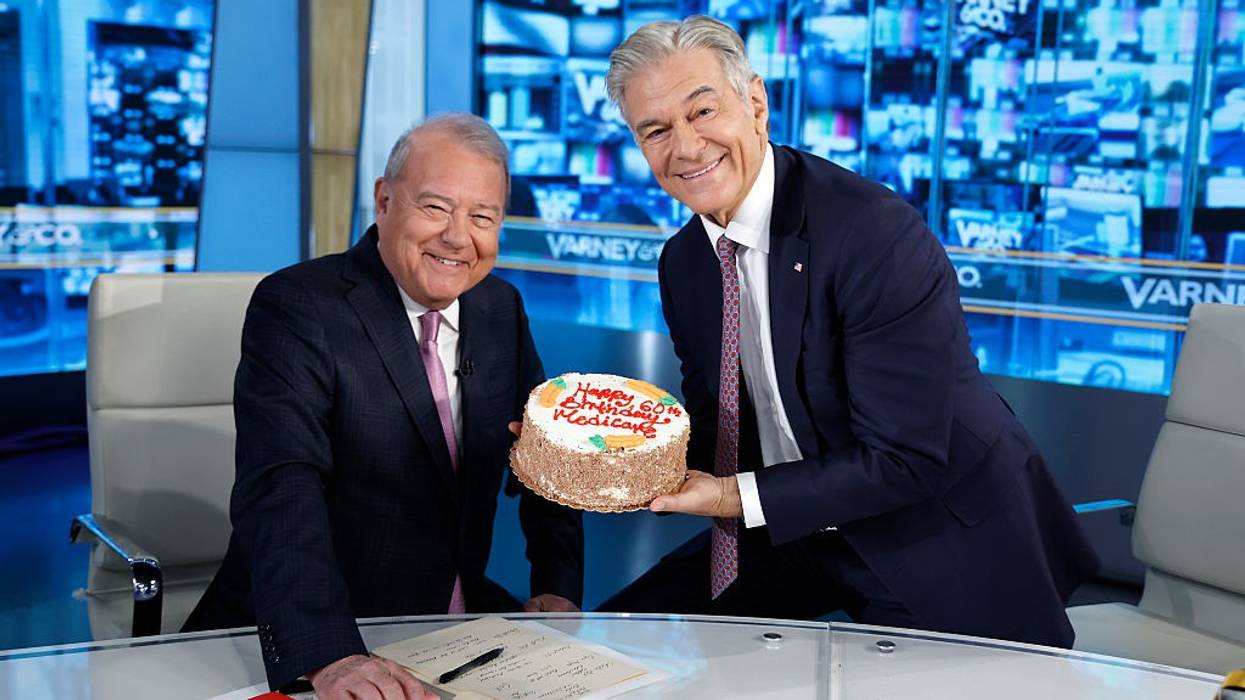
"Why don't you pry carrot cake out of my cold, dead hands and give us back Medicaid coverage for millions instead," replied Democratic Sen. Mark Warner.
U.S. Centers for Medicare and Medicaid Services Administrator Dr. Mehmet Oz appeared on Fox Business on Monday, where he presented a carrot cake to celebrate Medicaid's 60th birthday and brushed aside concerns about the millions of Americans likely to lose their healthcare coverage under recently passed Republican legislation—by telling people to not eat carrot cake.
Oz—the multimillionaire erstwhile celebrity surgeon, purveyor of "miracle" cures, and failed U.S. Senate candidate—gave Fox Business host Stuart Varney what he called a "MAHA Medi-cake" before proceeding to extol the virtues of Medicaid, the program launched during then-President Lyndon B. Johnson's "Great Society" agenda that provides health insurance to more than 70 million lower-income Americans.
Medicaid "was a promise to the American people to take care of you if you are having problems financially or if you were having an issue because you're older and needed healthcare," Oz said. "And it changed the country in a good way for many reasons."
"But we're all in it together, Stuart," he added, "which means we'll be there for you, the American people, when you need help with Medicaid and Medicare, but you've got to stay healthy as well. Be healthy, do the most you can do to really live up to the potential, your God-given potential to live a full and healthy life, you know, don't eat carrot cake, eat real food."
17 million people are going to lose their health insurance because of the Trump administration.Dr. Oz's advice is “don’t eat carrot cake.”
[image or embed]
— Elizabeth Warren (@warren.senate.gov) July 14, 2025 at 10:17 AM
Social media users roundly ridiculed Oz's remarks, with criticism centered around the estimated 17 million people who will be left uninsured under the so-called One Big Beautiful Bill Act signed by President Donald Trump earlier this month. The legislation contains the largest Medicaid cuts in history.
"Why don't you pry carrot cake out of my cold, dead hands and give us back Medicaid coverage for millions instead," Sen. Mark Warner (D-Va.) wrote on Bluesky.
Another Bluesky user wrote, "Carrot cake didn't give me cancer, dumbass."
Yet another said, "Um... your boss eats McDonald's every chance he gets and you are judging people eating carrot cake," a reference to Trump's legendary fondness for Big Macs, Filet-O-Fish sandwiches, and vanilla shakes.
Still another quipped, "First he came for my crudites, now my carrot cake."
"Carrot cake didn't give me cancer, dumbass."
Over on X, one account with over 130,000 followers said: "What an insensitive prick as he brings a piece of carrot cake to Stu Varney during the interview. Republicans seem so gleeful to be hurting Americans. This is why millionaires and billionaires should never be in Congress or the [White House]."
The Occupy Democrats X account also weighed in, posting, "It's not enough for them to take away our healthcare, Republicans want to blame us for getting sick."
"The idea that avoiding carrot cake in favor of healthier foods will somehow render Americans immune to health problems is insulting in the extreme," Occupy Democrats continued. "Rather than 'let them eat cake,' he's telling us 'do not eat cake,' but the sentiment is every bit as out of touch as Marie Antoinette's apocryphal quote."
"MAHA stands for 'Make America Healthy Again,' an Orwellian phrase deployed by an administration that is actively making Americans sicker by stripping away their healthcare," the account added. "This is what Republicans really think of the American people. They ram through policies making our lives worse in countless ways, then they laugh at us and spit in our faces. There has never been a more gleefully spiteful political movement."
The Republican nominee "acting like he is a worker is beyond gross, and slap in the face to all working-class people," said the Durham Workers Assembly.
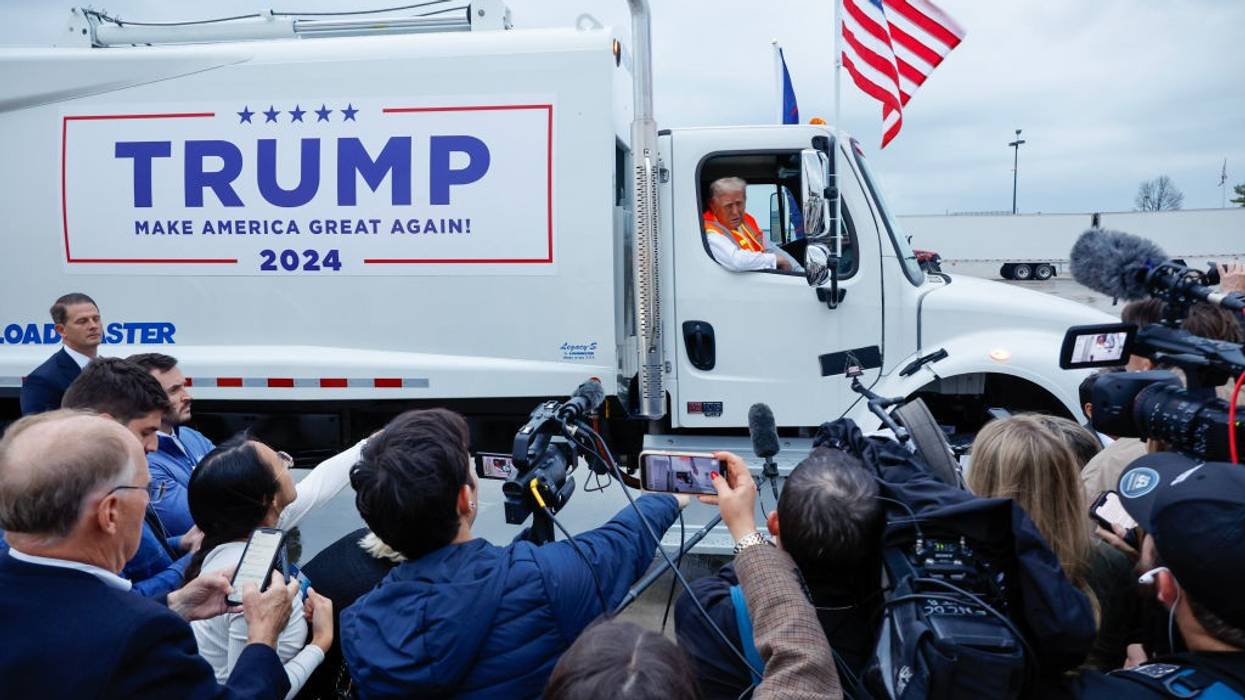
A worker group in North Carolina on Wednesday criticized former U.S. President Donald Trump and one of the Republican nominee's allies for campaign stunts involving garbage trucks.
After struggling to open the truck's door—which led to a viral video clip and concerns about Trump's physical condition—the ex-president climbed into the passenger seat of a white truck adorned with American flags and a banner that said, "Trump, Make America Great Again! 2024."
Wearing an orange high-visibility vest that he also wore during a later rally in Green Bay, Wisconsin, Trump took aim at President Joe Biden and Vice President Kamala Harris, the Democratic nominee, saying to reporters: "How do you like my garbage truck? This truck is in honor of Kamala and Joe Biden."
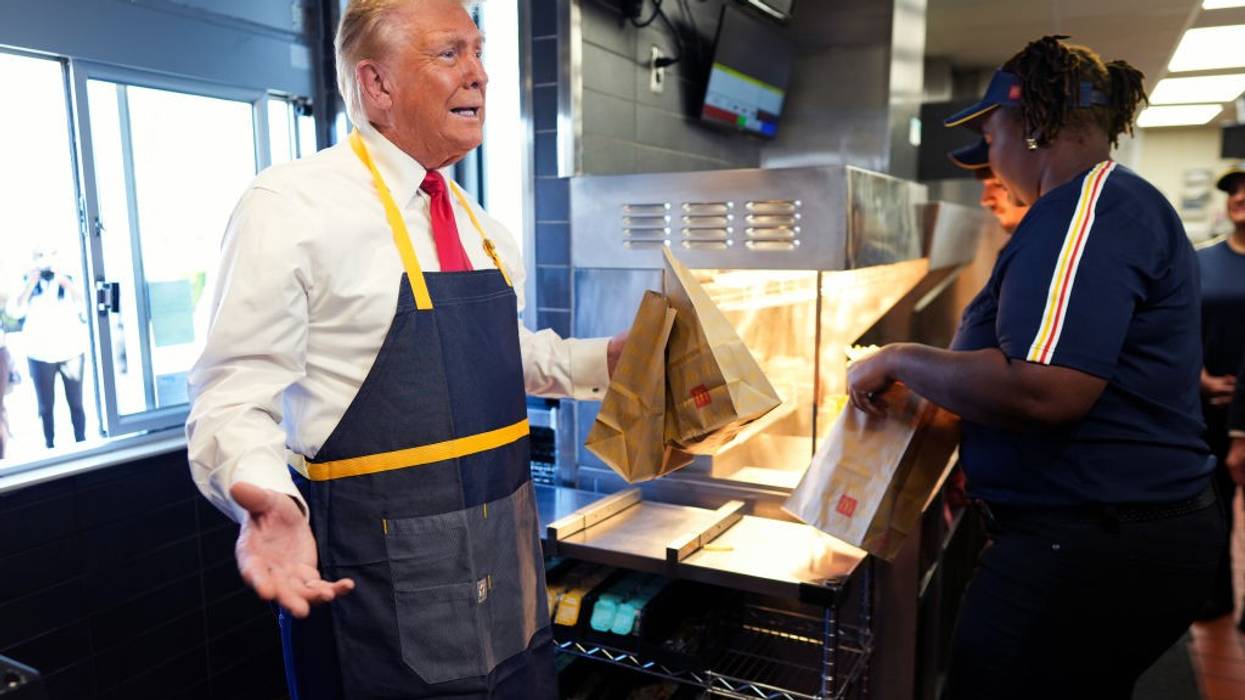
In a pair of social media posts, the Durham Workers Assembly highlighted that the dump truck gimmick followed Trump donning an apron last week at a McDonald's in another swing state—Pennsylvania—where he worked a french fry fryer and dodged questions about raising the minimum wage.
"First slinging fries at McD's now this!" said the Durham, North Carolina branch of the Southern Workers Assembly, which aims to organize the unorganized working class in the U.S. South and coordinate actions across the region.
"A billionaire sleazeball acting like he is a worker is beyond gross, and slap in the face to all working-class people," the group declared on social media. "Workers must organize and raise up to smash MAGA fascism!"
The Durham Workers Assembly noted that "pro-Trump fellow billionaire" Vivek Ramaswamy participated in a similar stunt, arriving at a Wednesday campaign event in Charlotte, North Carolina on the back of a sanitation truck.
The garbage truck events, as Politico explained, came in response to "Biden responding to a comedian at the former president's Sunday rally at Madison Square Garden calling Puerto Rico a 'floating island of garbage.' Biden, addressing the racist joke on Tuesday, appeared to call Trump's supporters 'garbage' in return, which Republicans seized on even as the White House said he was referring to Trump's 'supporter's'— note the apostrophe placement—'demonization of Latinos.'"
Winning over working-class voters has been a priority for both campaigns. Many national unions have endorsed Harris—though, notably, not the International Brotherhood of Teamsters, whose leader spoke at this year's Republican National Convention and faced criticism for not backing a presidential candidate for the first time in decades.
The United Auto Workers is among the unions that have endorsed Harris. In a Tuesday speech, UAW president Shawn Fain advocated for working-class unity against Trump, whom he's called a "scab," and emphasized that "we engage in politics as a union because it is core to our fight for economic and social justice."
Unions and worker advocates cheered Harris' selection of Minnesota Gov. Tim Walz as her running mate. A former public school teacher, Walz has slammed Trump and his vice presidential candidate, Sen. JD Vance (R-Ohio), as enemies of the working class, saying that "the only thing those two guys know about working people is how to work to take advantage of them."
Vance is a former venture capitalist known for his memoir Hillbilly Elegy, which was made into a movie. As Rolling Stone's Tim Dickinson wrote in September: "In the pages of his book, Vance presents a dim view of the actual poor, whom he refers to as 'welfare queens' and accuses of 'gaming' America's too-generous social services. And as he campaigns in 2024, Vance is wielding his book as both a shield and a cudgel, using the tale of his hardscrabble youth to distract from the fact that he's now a multimillionaire member of the Senate, while simultaneously lashing out at the 'elites' for looking on his kind with contempt."
During a Thursday campaign event, Walz acknowledged the garbage truck stunt while lambasting Trump's tariff plans.
"This dude's nearly 80 years old. He damn near killed himself getting in a garbage truck. You would think over 80 years you would understand how a tariff works," Walz said. "Smarter people than Donald Trump—which is a good chunk of folks—CEOs of companies like Black & Decker, AutoZone, and Columbia, have gone on the record to say, if Donald Trump goes forward with this plan, they will simply have to raise prices and pass it on to you."
"McDonald's workers don't need photo-ops; they need living wages," said Nina Turner.
Standing in the drive-through window of a McDonald's in the battleground state of Pennsylvania on Sunday, Republican presidential nominee Donald Trump dodged a direct question about whether he supports raising the nation's paltry minimum wage after employees at the low-paying restaurant briefly walked him through the process of making french fries.
"I think these people work hard, they're great," Trump said in response to the minimum wage question. "I just saw something, a process, that's beautiful. It's a beautiful thing to see, these are great franchises."
When reporters attempted for a second time to get an answer on the minimum wage, the former president moved on to a different question.
After working the fryer at McDonald’s, I asked Trump if he thinks the minimum wage should be raised: “Well I think this. These people work hard. They’re great. And I just saw something… a process that’s beautiful,” Trump said. pic.twitter.com/pg2synNA59
— Olivia Rinaldi (@olivialarinaldi) October 20, 2024
Trump's visit to the Pennsylvania McDonald's during the final stretch of the 2024 race was widely characterized as a political stunt aimed at bolstering the former president's claim to be a champion of the U.S. working class, despite his record of assailing labor protections and weakening an overtime pay rule put forth by his predecessor, leaving millions of workers behind.
After winning the 2016 election, Trump selected fast food executive Andrew Puzder—an opponent of raising the minimum wage and subminimum wage for tipped workers—as his pick to lead the U.S. Department of Labor. Puzder withdrew after it became clear he didn't have enough Senate support to be confirmed.
"Ending the subminimum wage and raising the minimum wage would be the real happy meal for American workers," Saru Jayaraman, the president of One Fair Wage, said Sunday. "While Trump panders to the wealthy, workers across Pennsylvania and the nation are still earning poverty wages."
The New York Times reported that the McDonald's was closed to the public during Trump's visit and that the GOP nominee "handed bags of food to preselected drive-through customers." McDonald's is viciously anti-union and, until 2019, lobbied against minimum wage increases.
Trump used the visit to attack his Democratic opponent, Vice President Kamala Harris, whose campaign said she worked at a California McDonald's in 1983 after her freshman year of college.
"McDonald’s representatives have ignored media requests for information," the Times reported. Trump claimed, without evidence, that Harris is lying about having worked at McDonald's.
Minnesota Gov. Tim Walz, Harris' running mate, hit back at Trump on social media, writing, "This guy spent decades stiffing workers pay, cut overtime benefits for millions of people, and opposed any effort to raise the minimum wage."
Nina Turner, founder of the advocacy organization We Are Somebody, said Sunday in response to Trump's stunt that "workers don't need gimmicks—they need the power to organize and demand the wages and dignity they deserve."
"McDonald's workers don't need photo-ops; they need living wages," said Turner. "We all need to come together and push back against a system that keeps them in poverty while corporate executives make billions. Real change is possible when workers unite and demand it."
"Fast food companies can afford to pay $20/hour without raising prices or cutting hours," said the California Fast Food Workers Union. "Doing either is a choice. Don't let them tell you otherwise."
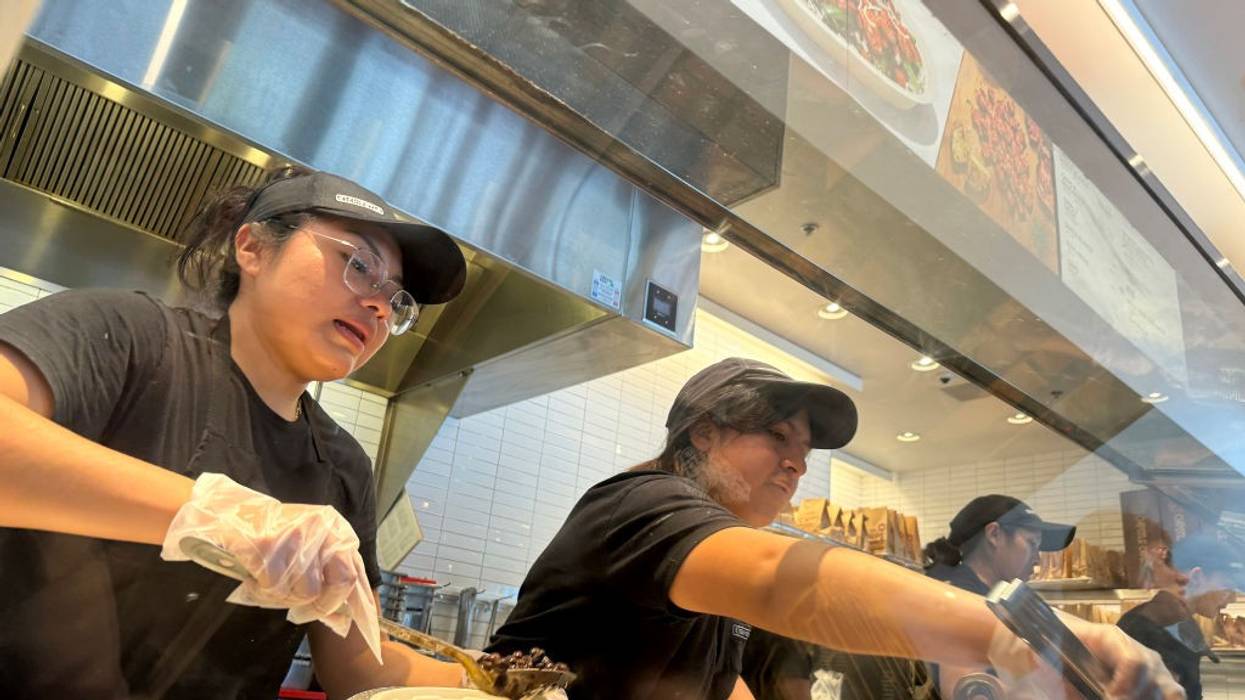
A new California law raising the minimum wage for most fast food workers from $16 to $20 an hour took effect Monday, a move cheered by labor advocates who dismissed—and debunked—claims by an industry reaping record profits that the pay hike would force restaurant chains to raise prices and cut jobs.
The law applies to restaurants at national fast food chains with at least 60 locations and that have limited or no table service. Restaurants inside supermarkets and establishments that bake and sell bread are exempt. Twenty dollars is just a starting point, as a state law also established a Fast Food Council that can raise wages by up to 3.5% annually through 2029.
"The vast majority of fast food locations in California operate under the most profitable brands in the world," Joseph Bryant, executive vice president of the Service Employees International Union, said in a statement. "Those corporations need to pay their fair share and provide their operators with the resources they need to pay their workers a living wage without cutting jobs or passing the cost to consumers."
As the California Fast Food Workers Union noted:
BREAKING: Today hundreds of fast food workers from across California are in LA to officially launch the California Fast Food Workers Union
We've won a Fast Food Council
We've won $20/hr
Now we're doing whatever it takes to win annual raises, just cause, and more#UnionsForAll pic.twitter.com/pykRKZF0PV
— California Fast Food Workers Union (@CAFastFoodUnion) February 9, 2024
The union highlighted various studies, including one in 2024 that found no fast food jobs were lost when California and New York increased their minimum wage to $15; another in 2018 that showed a slight increase in restaurant and food service employment in six cities that raised their minimum wage; and yet another in 2021 revealing hikes in state and local minimum wages had no effect on McDonald's opening or closing restaurants.
"According to the data, there's no reason why the new fast food minimum wage of $20 per hour in California should mean layoffs or increased prices," Alí Bustamante, deputy director for the Worker Power and Economic Security program at the Roosevelt Institute, said last week. "Profits in the fast food industry are sufficiently high to absorb the greater operating costs and ensure industry workers are paid fairly."
As More Perfect Union noted, McDonald's made $8.5 billion in profit last year, while Burger King's parent company raked in $1.2 billion, and Starbucks enjoyed $4.1 billion in profits.
Additionally, a new Roosevelt Institute analysis co-authored by Bustamante found that the 10 largest publicly traded fast food companies spent $6.1 billion on stock buybacks last year alone. This, while fast food prices soared by 46.8% over the past decade compared with 28.7% for the average of all prices. In 2023, fast food companies charged their customers 27% above their production costs. Critics have accused these and other corporations of "greedflation."
"In 2022, fast food industry employment in California had increased to approximately 553,000 workers—a 20.1% increase since 2014," the analysis notes. "Trends in the California fast food labor market have mirrored the national averages. Yet between 2014 and 2023, the federal minimum wage remained stagnant at $7.25 per hour, while California's minimum wage increased from $9 to $15.50 an hour—further evidence that California fast food firms can readily adjust to minimum wage increases."
The U.S. federal minimum wage of $7.25 an hour has not been raised since 2009, and that amount is worth far less now than it was then due to inflation.
"This is an insult to American workers and bad for our economy," former U.S. Labor Secretary Robert Reich said in a video published Monday by the Gravel Institute.
"It's simply a myth that raising the wage automatically means lost jobs," Reich asserted. "Here's the bottom line: If your business depends on paying your workers starvation wages, you should not be in business."
"Less than $1,000 per child," said one critic. "For one of the biggest franchises on Earth."
McDonald's, one of the largest employers in the world, was fined just $26,000—a tiny fraction of its profits—on Monday for violating child labor laws in Pennsylvania, with two franchisees found to be violating numerous rules in five stores.
The U.S. Department of Labor's (DOL) Wage and Hour Division found that Paul and Meghan Sweeney, owners of a company called Endor, which runs five McDonald's locations, employed 34 children who were 14 and 15 years old.
The employers scheduled the teenagers to work outside the times that 14- and 15-year-olds are legally permitted to work, including during school hours, earlier than 7:00 am and 7:00 pm during the school year, and more than three hours on a school day.
Writer and organizer Joshua P. Hill said the $26,000 fine—amounting to less than $1,000 per child who was affected by the Sweeneys' employment practices—was "not even a slap on the wrist," especially considering that the $200 billion multinational fast food company is one of the world's largest companies.
John DuMont, district director for the Wage and Hour Division in Western Pennsylvania, said in a statement that the Sweeneys employed young teenagers "at the expense of their education or well-being."
"Fast food restaurants offer young workers an opportunity to gain valuable work experience," said DuMont. "The Fair Labor Standards Act allows for developmental experiences but restricts the work hours of 14- and 15-year-olds and provides for penalties when employers do not follow the law."
Earlier this year, the DOL found that three McDonald's stores in Kentucky were illegally employing more than 300 children—some as young as 10. A coalition of McDonald's shareholders demanded a third-party human rights assessment in June, citing the Kentucky case and that of a 15-year-old employee in Tennessee who was injured at work.
The AFL-CIO pointed out that the violations at stores in Brookville, Clarion, Punxsutawney, and St. Mary's, Pennsylvania, took place amid a right-wing push to roll back child labor laws.
With the backing of powerful conservative donors like Richard Uihlein, lawmakers in Florida, Iowa, Arkansas have pushed legislation to weaken child labor protections in recent months. Iowa Gov. Kim Reynolds, a Republican, signed a bill in May removing so-called "unnecessary restrictions" that keep minors from working in hazardous workplaces, and GOP Arkansas Gov. Sarah Huckabee Sanders signed a bill in March allowing companies to hire children under the age of 16 without verifying their age.
The finding at the Pennsylvania McDonald's locations serves as a reminder that "any lawmaker who votes to roll back child labor laws is a disgrace," said the AFL-CIO.
The fine announced on Monday only represents "two ten-thousandths of a single percent" of McDonald's gross profits in 2022, said the labor group.
The new rule "will help restore fairness to an economy rigged against workers," said Sen. Bernie Sanders.
Workers' rights advocates celebrated Thursday as the National Labor Relations Board finalized a rule establishing how companies can qualify as "joint employers"—a classification that makes firms responsible for workers' wages.
The board announced that, effective in 60 days, two or more entities can be considered joint employers of a group of employees if they both have employment relationship with the workers and help to determine their terms and condition of employment.
Under former Republican President Donald Trump, the NLRB narrowed the joint-employer standard, requiring joint employers to "possess and exercise substantial direct and immediate control" over at least one aspect of the workers' employment.
That standard, said the National Employment Law Project (NELP) at the time, would allow employers to "use temp agencies and subcontractors to try to duck responsibility for workplace violations and to squelch worker organizing and collective action for mutual aid and protection."
The new rule, said People's Parity Project co-founder Sejal Singh, would help anyone in the U.S. who has "ever technically 'worked' for a weird staffing agency or sketchy subcontractor instead of the company" that determined their pay and work responsibilities.
For those employees, said Singh, "it just got easier to organize a union."
Veteran union organizer Kraig Peck added that companies that rely on franchisees to operate their business, such as McDonald's, and corporations that hire certain workers through contracting companies, like Amazon, could now be required to negotiate with a union formed at a franchise or contractor if the NLRB determines they jointly employ the unionized workers.
"Giants like Amazon and McDonald's can't hide behind loopholes anymore," said labor rights media organization More Perfect Union.
U.S. Sen. Bernie Sanders (I-Vt.), an outspoken defender of labor rights, said the new standard will "help ensure corporations cannot avoid their responsibility to collectively bargain with their workers."
The final rule, said the senator, who chairs the Senate Health, Education, Labor, and Pensions Committee, "will help restore fairness to an economy rigged against workers."
This is the most opportune time for millions of workers in Big Box retail stores and fast-food outlets to form unions. McDonald's, Walmart, Amazon, Starbucks, Dunkin Donuts, Burger King, and other giant chains are having trouble finding enough workers. Some of these companies are even paying signing bonuses and upping low pay.
Chalk it up to the pandemic's dislocations when millions of workers left their jobs, and many have not yet returned. The International Brotherhood of Teamsters (IBT), the United Food & Commercial Workers International Union (UFCW), and the Service Employees International Union (SEIU) see the opportunity of a lifetime, but are they putting enough organizing resources into this effort?
For over four decades, unions of all kinds in the corporate economy have been in decline. Only six percent of private sector workers are now in unions. However, polls are showing a high favorability level for unions, following worker heroics on behalf of Covid-19 victims.
The House of Representatives has passed the Protecting the Right to Organize Act - opposed by the Republican corporatists - but Senate prospects are dim due to the same GOP corporatists. Why the Senate Democrats are not regularly holding hearings on the plights of non-union working families can only be answered by Majority Leader, Democrat Chuck Schumer of New York.
Since Reagan took office in January 1981, organized labor has been battered by numerous forces. These include (1) the eight years of Ronald Reagan, Union-buster-in-chief, owning the White House, (2) ever greater exportation of jobs propelled by large companies abandoning the U.S. for communist and fascist dictatorships abroad with their legions of serf labor, and (3) growing automations of the workplace. Mediocre leadership of many unions has not helped either.
Younger people in these giant retail outlets have little knowledge of how unions saved the working classes in the 20th century from many of the cruelest treatments by corporate capitalism. Current union educational efforts are filling some of this gap of why, how, and where to form a union - though not with the intensity of the late union leaders Tony Mazzocchi and Harry Kelber. Mr. Kelber was the greatest writer of popular "how to" pamphlets for workers seeking unions. (See: laboreducator.org).
While the big retailers may sporadically fill worker gaps with one-time economic incentives, they are still run by the same old union busting bosses with their union busting, pricey law firms and consultants.
Their mantra - crush any tiny unionizing effort at any store, no matter its costs. A few weeks ago, Dollar General, with over 7,000 stores nationwide, crushed such an effort in a Dollar General store in Winsted, Connecticut. They sent in five "consultants" to stay in the store at a stunning $2700 each a day, according to a long page-one article in the Washington Post. These and other corporate intimidators sometimes outnumbered the six employees during the unionizing drive, until the unionists narrowly lost the vote to the other frightened employees. One employee was dismissed for being pro-union but reinstated for the vote.
There are major strikes by workers at John Deere, Kellogg, and some other large manufacturing firms. Right now, however, the big battle that should be joined is with Big Retail, where the jobs making burgers or coffee cannot be exported.
The takeaway from all this is threefold.
First, the Democratic Party should scale up its enthusiasm and backing of these valiant workers, right down to the local Democratic Party committees.
Second, same is true for the AFL-CIO which can provide stronger backup of the federation's member unions and press the Biden Administration to strongly enforce labor laws that are routinely, says the AFL-CIO website, violated by companies with impunity.
Third, consumers and their organizations should elevate their support for paid sick leave, adequate healthcare, safe working conditions, and fair wages; if not for solidarity, then for safely served food. Consumers should not want to see hard-pressed, sick workers having to serve them, to pay bills.
For labor, this is a briefly open window in history. Robotics and surplus labor will soon be closing it. Unions need to move at unaccustomed and rapid speeds now!
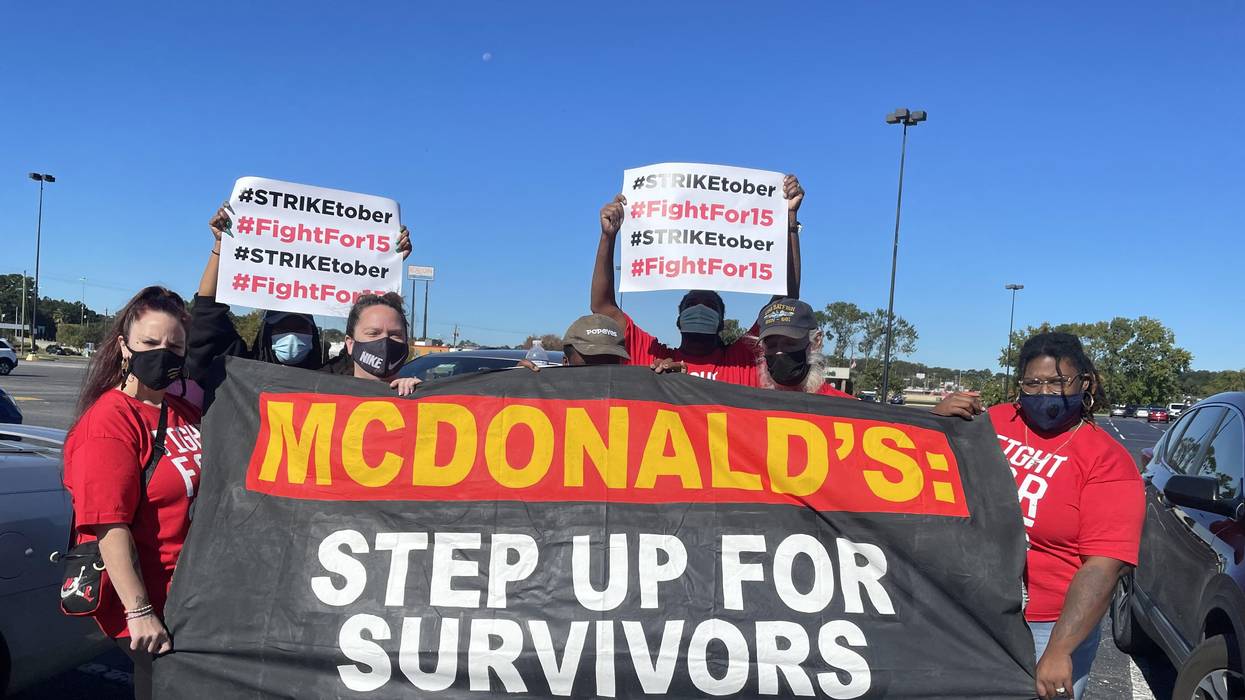
Amid of wave of worker walkouts that supporters are collectively calling "Striketober," McDonald's employees in at least 12 U.S. cities took to the streets Tuesday to raise concerns about how the fast food giant has handled sexual harassment and to demand a union.
"No matter what McDonald's says, not much has changed for workers like me."
Though McDonald's in April announced new sexual harassment training standards that all of its restaurants worldwide will be required to meet by January 2022, workers still joined the one-day walkout from Chicago and Detroit to Houston and Miami, charging that the company has not done enough to keep employees safe on the job.
"I'm going on strike because despite years of protests, McDonald's still refuses to take responsibility for the countless women and teenagers who face harassment on the job at its stores across the globe," Jamelia Fairley, a McDonald's employee in Florida said in a statement ahead of the walkout. "No matter what McDonald's says, not much has changed for workers like me."
"I do believe that we're in a moment where workers are standing up more for their rights," said Fairley, a plaintiff in a class-action lawsuit accusing McDonald's of systemic sexual harassment. "I have met others who have experienced sexual harassment... We want a union to prevent it from happening."
The strike comes after a civil lawsuit filed against McDonald's in September alleged that Walter A. Garner, a 42-year-old manager previously convicted of sexual assault, raped a 14-year-old employee in the bathroom of a franchise restaurant operated by Rice Enterprises in Pennsylvania.
Michele Rice of Rice Enterprises said last month that the manager was fired "as soon as we learned about a complaint against him." Garner was charged with rape but his attorneys negotiated a plea of indecent sexual assault and corruption of a minor, according to KDKA in Pittsburgh. He was sentenced last week to four to 10 years in prison and five years probation.
McDonald's--which has over 39,000 locations across 119 countries--said in a statement to the Associated Press that it expects all of its restaurants including franchises to meet its harassment training requirement and investigate all allegations.
The company's statement added that every employee "deserves to feel safe and respected when they come to work, and sexual harassment and assault have no place in any McDonald's restaurant."
Tuesday's action also comes after the U.S. Equal Employment Opportunity Commission, at the end of September, sued another McDonald's franchisee, AMTCR, for subjecting young employees at 22 locations in Arizona, California, and Nevada to "egregious sexual harassment" that included "unwanted groping and touching, offensive comments and gestures regarding male genitalia, unwelcome sexual advances, sexual ridicule, intimidation, and insults."
AMTCR declined to comment to the Chicago Tribune, which reported on the Tuesday walkout in the Windy City, home to the fast food company's headquarters.
"It's time for McDonald's to address the pattern of sexual harassment in its stores," Adriana Alvarez, a 29-year-old who said she has worked at a restaurant in the Chicago suburb of Cicero for a decade, told the Tribune.
Alvarez said she hasn't experienced sexual harassment while working at McDonald's but has seen it happen to co-workers. She added that the new standards can't hurt, as long as the company doesn't "keep trying to brush it under the rug."
According to the newspaper, Alvarez and other activists at the Chicago protest also called for a union "to ensure our voices can be heard."
"If McDonald's changed its menu immediately it would make a big difference but waiting until 2050 is insufficient to avoid climate catastrophe."