SUBSCRIBE TO OUR FREE NEWSLETTER
Daily news & progressive opinion—funded by the people, not the corporations—delivered straight to your inbox.
5
#000000
#FFFFFF
To donate by check, phone, or other method, see our More Ways to Give page.
A detailed new analysis of the tax proposals Republican nominee Donald Trump has floated during the 2024 presidential campaign show they would result in annual tax increases for the bottom 95% of the U.S. income distribution—and a substantial giveaway to the richest 5%.
The Institute on Taxation and Economic Policy (ITEP) described its study, published Monday, as the "most comprehensive analysis that anyone has done" thus far of Trump's tax plan, which includes an extension of his deeply regressive and unpopular 2017 tax law, an exemption of tips from taxes, a further reduction of the statutory corporate tax rate, and a 20% tariff on imported goods from everywhere except China, whose imports would face a 60% tariff.
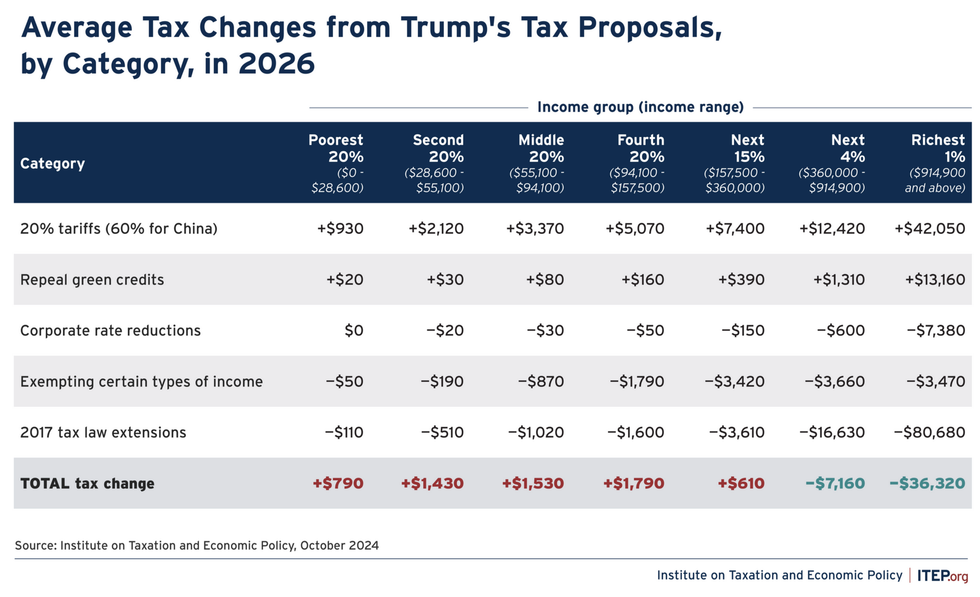
"If these proposals were in effect in 2026, the richest 1% would receive an average tax cut of about $36,300 and the next richest 4% would receive an average tax cut of about $7,200," ITEP found. "All other groups would see a tax increase with the hike on the middle 20% at about $1,500 and the increase on the lowest-income 20% of Americans at about $800."
ITEP argues that Trump's proposed tariffs "would largely be passed onto consumers as increased prices." For most Americans, that would "more than offset" any tax benefits from extending provisions of the former president's 2017 law, much of which is set to expire at the end of next year.
As a share of income, ITEP found, working-class families would face the largest tax hikes under Trump's economic agenda, with the poorest 20% of Americans seeing an "increase equal to 4.8% of their income—all while the top 5% get a tax cut."
ITEP noted that Trump's proposed cuts to the corporate tax rate would "mainly benefit owners of U.S. corporate stocks, which are held disproportionately by high-income households and by white households, which means they contribute to inequality in the U.S., even as many of the benefits flow out of the country to foreign investors."
Amy Hanauer, ITEP's executive director, said in a statement that the findings "are crystal clear" in detailing how "Trump's tax proposals would substantially raise taxes on regular Americans while delivering more tax cuts to corporations and the wealthy."
Trump has placed fresh tax cuts and tariffs at the center of his campaign for the White House, telling his rich donors and supporters that he intends to deliver another massive tax giveaway if he's elected in November.
Democratic nominee Kamala Harris, by contrast, has called for an increase in the corporate tax rate, a change that economists say would slightly boost economic growth and reduce inequality.
Analysis after analysis, including ITEP's, has concluded that the plans Trump has outlined so far would in their totality be hugely regressive and costly.
A recent review by The American Prospect estimated that the former president's "bid for votes by giving away a host of tax benefits and exemptions would bring the total cost of his tax plan to between $8.5 trillion and $9.75 trillion over a decade"—a significantly higher price tag than the 2017 law.
"Trump has boasted that you could not only pay for all tax cuts with the tariffs but still have enough left over to fund investments in things like childcare," wrote the Prospect's David Dayen last month. "But the most aggressive tariff he's ever proposed, with 20% across the board on all imports and up to 60% tariffs on Chinese goods, wouldn't even cover the increase in debt from the extension of the 2017 tax cut, let alone all of the new handouts he's making in a play for votes."
A detailed new analysis of the tax proposals Republican nominee Donald Trump has floated during the 2024 presidential campaign show they would result in annual tax increases for the bottom 95% of the U.S. income distribution—and a substantial giveaway to the richest 5%.
The Institute on Taxation and Economic Policy (ITEP) described its study, published Monday, as the "most comprehensive analysis that anyone has done" thus far of Trump's tax plan, which includes an extension of his deeply regressive and unpopular 2017 tax law, an exemption of tips from taxes, a further reduction of the statutory corporate tax rate, and a 20% tariff on imported goods from everywhere except China, whose imports would face a 60% tariff.
"If these proposals were in effect in 2026, the richest 1% would receive an average tax cut of about $36,300 and the next richest 4% would receive an average tax cut of about $7,200," ITEP found. "All other groups would see a tax increase with the hike on the middle 20% at about $1,500 and the increase on the lowest-income 20% of Americans at about $800."
ITEP argues that Trump's proposed tariffs "would largely be passed onto consumers as increased prices." For most Americans, that would "more than offset" any tax benefits from extending provisions of the former president's 2017 law, much of which is set to expire at the end of next year.
As a share of income, ITEP found, working-class families would face the largest tax hikes under Trump's economic agenda, with the poorest 20% of Americans seeing an "increase equal to 4.8% of their income—all while the top 5% get a tax cut."
ITEP noted that Trump's proposed cuts to the corporate tax rate would "mainly benefit owners of U.S. corporate stocks, which are held disproportionately by high-income households and by white households, which means they contribute to inequality in the U.S., even as many of the benefits flow out of the country to foreign investors."
Amy Hanauer, ITEP's executive director, said in a statement that the findings "are crystal clear" in detailing how "Trump's tax proposals would substantially raise taxes on regular Americans while delivering more tax cuts to corporations and the wealthy."
Trump has placed fresh tax cuts and tariffs at the center of his campaign for the White House, telling his rich donors and supporters that he intends to deliver another massive tax giveaway if he's elected in November.
Democratic nominee Kamala Harris, by contrast, has called for an increase in the corporate tax rate, a change that economists say would slightly boost economic growth and reduce inequality.
Analysis after analysis, including ITEP's, has concluded that the plans Trump has outlined so far would in their totality be hugely regressive and costly.
A recent review by The American Prospect estimated that the former president's "bid for votes by giving away a host of tax benefits and exemptions would bring the total cost of his tax plan to between $8.5 trillion and $9.75 trillion over a decade"—a significantly higher price tag than the 2017 law.
"Trump has boasted that you could not only pay for all tax cuts with the tariffs but still have enough left over to fund investments in things like childcare," wrote the Prospect's David Dayen last month. "But the most aggressive tariff he's ever proposed, with 20% across the board on all imports and up to 60% tariffs on Chinese goods, wouldn't even cover the increase in debt from the extension of the 2017 tax cut, let alone all of the new handouts he's making in a play for votes."
A detailed new analysis of the tax proposals Republican nominee Donald Trump has floated during the 2024 presidential campaign show they would result in annual tax increases for the bottom 95% of the U.S. income distribution—and a substantial giveaway to the richest 5%.
The Institute on Taxation and Economic Policy (ITEP) described its study, published Monday, as the "most comprehensive analysis that anyone has done" thus far of Trump's tax plan, which includes an extension of his deeply regressive and unpopular 2017 tax law, an exemption of tips from taxes, a further reduction of the statutory corporate tax rate, and a 20% tariff on imported goods from everywhere except China, whose imports would face a 60% tariff.
"If these proposals were in effect in 2026, the richest 1% would receive an average tax cut of about $36,300 and the next richest 4% would receive an average tax cut of about $7,200," ITEP found. "All other groups would see a tax increase with the hike on the middle 20% at about $1,500 and the increase on the lowest-income 20% of Americans at about $800."
ITEP argues that Trump's proposed tariffs "would largely be passed onto consumers as increased prices." For most Americans, that would "more than offset" any tax benefits from extending provisions of the former president's 2017 law, much of which is set to expire at the end of next year.
As a share of income, ITEP found, working-class families would face the largest tax hikes under Trump's economic agenda, with the poorest 20% of Americans seeing an "increase equal to 4.8% of their income—all while the top 5% get a tax cut."
ITEP noted that Trump's proposed cuts to the corporate tax rate would "mainly benefit owners of U.S. corporate stocks, which are held disproportionately by high-income households and by white households, which means they contribute to inequality in the U.S., even as many of the benefits flow out of the country to foreign investors."
Amy Hanauer, ITEP's executive director, said in a statement that the findings "are crystal clear" in detailing how "Trump's tax proposals would substantially raise taxes on regular Americans while delivering more tax cuts to corporations and the wealthy."
Trump has placed fresh tax cuts and tariffs at the center of his campaign for the White House, telling his rich donors and supporters that he intends to deliver another massive tax giveaway if he's elected in November.
Democratic nominee Kamala Harris, by contrast, has called for an increase in the corporate tax rate, a change that economists say would slightly boost economic growth and reduce inequality.
Analysis after analysis, including ITEP's, has concluded that the plans Trump has outlined so far would in their totality be hugely regressive and costly.
A recent review by The American Prospect estimated that the former president's "bid for votes by giving away a host of tax benefits and exemptions would bring the total cost of his tax plan to between $8.5 trillion and $9.75 trillion over a decade"—a significantly higher price tag than the 2017 law.
"Trump has boasted that you could not only pay for all tax cuts with the tariffs but still have enough left over to fund investments in things like childcare," wrote the Prospect's David Dayen last month. "But the most aggressive tariff he's ever proposed, with 20% across the board on all imports and up to 60% tariffs on Chinese goods, wouldn't even cover the increase in debt from the extension of the 2017 tax cut, let alone all of the new handouts he's making in a play for votes."