SUBSCRIBE TO OUR FREE NEWSLETTER
Daily news & progressive opinion—funded by the people, not the corporations—delivered straight to your inbox.
5
#000000
#FFFFFF
To donate by check, phone, or other method, see our More Ways to Give page.
Daily news & progressive opinion—funded by the people, not the corporations—delivered straight to your inbox.
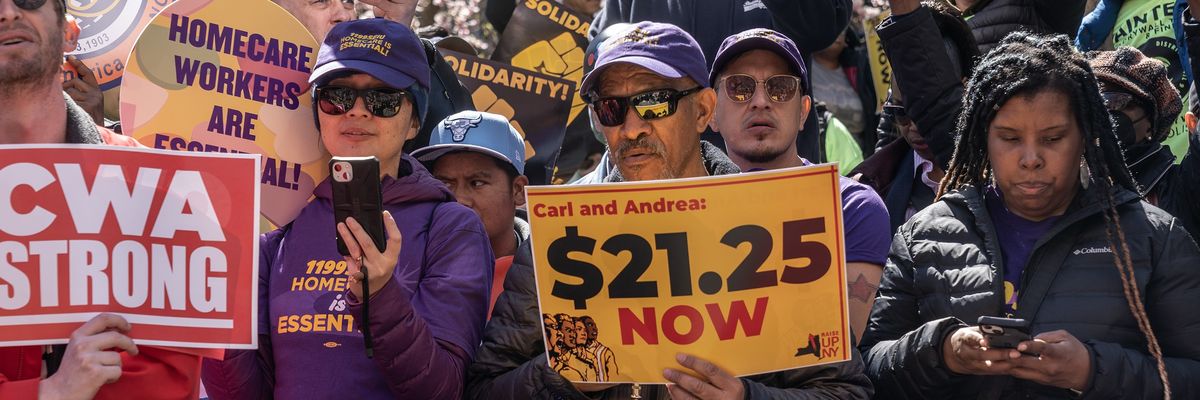
Labor unions join forces to rally for a higher minimum wage in New York City on April 10, 2023.
"Voters understand that raising the minimum wage is the right thing to do, even if their elected officials in state legislatures and Washington, D.C. remain inactive."
Former U.S. President Barack Obama had been in office for just over six months when the federal minimum wage was raised to a paltry $7.25 an hour—where it remains today, 15 years later.
Wednesday marked exactly a decade and a half since the federal wage floor was last lifted, an occasion that advocates used to tout state-level pay hikes and make the case for a long-overdue national increase, particularly as the nation's billionaires and corporations do better than ever.
"Workers can't afford to wait for Congress to act; they need to feed their families, pay their bills, and take care of their loved ones," said Kelly Hall, executive director of the Fairness Project, a group that has backed ballot measures across the U.S. that have resulted in over $22 billion in additional earnings for workers.
"This year, we see a clear path to victory in Alaska and Missouri because when voters have the chance, they choose higher wages," Hall continued, referring to minimum wage ballot initiatives in the two states. "Voters understand that raising the minimum wage is the right thing to do, even if their elected officials in state legislatures and Washington, D.C. remain inactive."
"It's been 15 years since the federal minimum wage was increased," Hall added, "and while this is both an economic and moral failing, we believe the solution lies in direct democracy through the ballot box."
A lot's changed since July 24, 2009. Barack Obama was president. Netflix was still mailing out DVDs in red envelopes.
What hasn't changed? The federal minimum wage of $7.25/hr. It is long past time to raise it. pic.twitter.com/gCY6FTWs9t
— Robert Reich (@RBReich) July 24, 2024
Years of inaction and obstruction by corporate-backed lawmakers in the U.S. Congress have spurred states and localities to raise their minimum wages well above the federal floor.
This year alone, according to the National Employment Law Project (NELP), 25 states and 65 localities across the U.S. will raise their minimum wages, providing pay boosts for millions of workers.
"November 2024's election will provide even more opportunities for progress, as Arizona, Alaska, and Oklahoma will all likely have questions on the ballot on whether or not their state minimum wages should increase," Kyle Ross of the Center for American Progress noted Wednesday. "Voters in these states should take advantage of this chance to give workers a much-needed raise."
Twenty U.S. states still have minimum wages pegged to the federal floor, which is worth less today than "at any time since 1949," Axios' Emily Peck observed Wednesday.
Some lawmakers at the federal level have pushed, without success, for legislation that would raise the federal minimum wage. Last year, Sen. Bernie Sanders (I-Vt.) and Rep. Bobby Scott (D-Va.) introduced a bill that would incrementally hike the national wage floor to $17 an hour by 2028 and index it to median wages in subsequent years.
The measure did not receive a vote in the House or Senate. According to the Economic Policy Institute, 31 million U.S. workers are paid less than $17 an hour.
"The minimum wage has fallen so far behind the cost of living that millions of workers are earning wages too low to live on at the minimum wage and above it," Holly Sklar, CEO of Business for a Fair Minimum Wage, said in a statement. "That's bad for workers and businesses."
"Local businesses depend on customers who make enough to buy their products and services," Sklar added. "Raising the minimum wage boosts consumer spending and helps businesses hire and retain employees. Businesses that are more invested in their employees benefit from lower turnover and increased productivity, and the kind of customer service that keeps customers coming back."
Dear Common Dreams reader, It’s been nearly 30 years since I co-founded Common Dreams with my late wife, Lina Newhouser. We had the radical notion that journalism should serve the public good, not corporate profits. It was clear to us from the outset what it would take to build such a project. No paid advertisements. No corporate sponsors. No millionaire publisher telling us what to think or do. Many people said we wouldn't last a year, but we proved those doubters wrong. Together with a tremendous team of journalists and dedicated staff, we built an independent media outlet free from the constraints of profits and corporate control. Our mission has always been simple: To inform. To inspire. To ignite change for the common good. Building Common Dreams was not easy. Our survival was never guaranteed. When you take on the most powerful forces—Wall Street greed, fossil fuel industry destruction, Big Tech lobbyists, and uber-rich oligarchs who have spent billions upon billions rigging the economy and democracy in their favor—the only bulwark you have is supporters who believe in your work. But here’s the urgent message from me today. It's never been this bad out there. And it's never been this hard to keep us going. At the very moment Common Dreams is most needed, the threats we face are intensifying. We need your support now more than ever. We don't accept corporate advertising and never will. We don't have a paywall because we don't think people should be blocked from critical news based on their ability to pay. Everything we do is funded by the donations of readers like you. When everyone does the little they can afford, we are strong. But if that support retreats or dries up, so do we. Will you donate now to make sure Common Dreams not only survives but thrives? —Craig Brown, Co-founder |
Former U.S. President Barack Obama had been in office for just over six months when the federal minimum wage was raised to a paltry $7.25 an hour—where it remains today, 15 years later.
Wednesday marked exactly a decade and a half since the federal wage floor was last lifted, an occasion that advocates used to tout state-level pay hikes and make the case for a long-overdue national increase, particularly as the nation's billionaires and corporations do better than ever.
"Workers can't afford to wait for Congress to act; they need to feed their families, pay their bills, and take care of their loved ones," said Kelly Hall, executive director of the Fairness Project, a group that has backed ballot measures across the U.S. that have resulted in over $22 billion in additional earnings for workers.
"This year, we see a clear path to victory in Alaska and Missouri because when voters have the chance, they choose higher wages," Hall continued, referring to minimum wage ballot initiatives in the two states. "Voters understand that raising the minimum wage is the right thing to do, even if their elected officials in state legislatures and Washington, D.C. remain inactive."
"It's been 15 years since the federal minimum wage was increased," Hall added, "and while this is both an economic and moral failing, we believe the solution lies in direct democracy through the ballot box."
A lot's changed since July 24, 2009. Barack Obama was president. Netflix was still mailing out DVDs in red envelopes.
What hasn't changed? The federal minimum wage of $7.25/hr. It is long past time to raise it. pic.twitter.com/gCY6FTWs9t
— Robert Reich (@RBReich) July 24, 2024
Years of inaction and obstruction by corporate-backed lawmakers in the U.S. Congress have spurred states and localities to raise their minimum wages well above the federal floor.
This year alone, according to the National Employment Law Project (NELP), 25 states and 65 localities across the U.S. will raise their minimum wages, providing pay boosts for millions of workers.
"November 2024's election will provide even more opportunities for progress, as Arizona, Alaska, and Oklahoma will all likely have questions on the ballot on whether or not their state minimum wages should increase," Kyle Ross of the Center for American Progress noted Wednesday. "Voters in these states should take advantage of this chance to give workers a much-needed raise."
Twenty U.S. states still have minimum wages pegged to the federal floor, which is worth less today than "at any time since 1949," Axios' Emily Peck observed Wednesday.
Some lawmakers at the federal level have pushed, without success, for legislation that would raise the federal minimum wage. Last year, Sen. Bernie Sanders (I-Vt.) and Rep. Bobby Scott (D-Va.) introduced a bill that would incrementally hike the national wage floor to $17 an hour by 2028 and index it to median wages in subsequent years.
The measure did not receive a vote in the House or Senate. According to the Economic Policy Institute, 31 million U.S. workers are paid less than $17 an hour.
"The minimum wage has fallen so far behind the cost of living that millions of workers are earning wages too low to live on at the minimum wage and above it," Holly Sklar, CEO of Business for a Fair Minimum Wage, said in a statement. "That's bad for workers and businesses."
"Local businesses depend on customers who make enough to buy their products and services," Sklar added. "Raising the minimum wage boosts consumer spending and helps businesses hire and retain employees. Businesses that are more invested in their employees benefit from lower turnover and increased productivity, and the kind of customer service that keeps customers coming back."
Former U.S. President Barack Obama had been in office for just over six months when the federal minimum wage was raised to a paltry $7.25 an hour—where it remains today, 15 years later.
Wednesday marked exactly a decade and a half since the federal wage floor was last lifted, an occasion that advocates used to tout state-level pay hikes and make the case for a long-overdue national increase, particularly as the nation's billionaires and corporations do better than ever.
"Workers can't afford to wait for Congress to act; they need to feed their families, pay their bills, and take care of their loved ones," said Kelly Hall, executive director of the Fairness Project, a group that has backed ballot measures across the U.S. that have resulted in over $22 billion in additional earnings for workers.
"This year, we see a clear path to victory in Alaska and Missouri because when voters have the chance, they choose higher wages," Hall continued, referring to minimum wage ballot initiatives in the two states. "Voters understand that raising the minimum wage is the right thing to do, even if their elected officials in state legislatures and Washington, D.C. remain inactive."
"It's been 15 years since the federal minimum wage was increased," Hall added, "and while this is both an economic and moral failing, we believe the solution lies in direct democracy through the ballot box."
A lot's changed since July 24, 2009. Barack Obama was president. Netflix was still mailing out DVDs in red envelopes.
What hasn't changed? The federal minimum wage of $7.25/hr. It is long past time to raise it. pic.twitter.com/gCY6FTWs9t
— Robert Reich (@RBReich) July 24, 2024
Years of inaction and obstruction by corporate-backed lawmakers in the U.S. Congress have spurred states and localities to raise their minimum wages well above the federal floor.
This year alone, according to the National Employment Law Project (NELP), 25 states and 65 localities across the U.S. will raise their minimum wages, providing pay boosts for millions of workers.
"November 2024's election will provide even more opportunities for progress, as Arizona, Alaska, and Oklahoma will all likely have questions on the ballot on whether or not their state minimum wages should increase," Kyle Ross of the Center for American Progress noted Wednesday. "Voters in these states should take advantage of this chance to give workers a much-needed raise."
Twenty U.S. states still have minimum wages pegged to the federal floor, which is worth less today than "at any time since 1949," Axios' Emily Peck observed Wednesday.
Some lawmakers at the federal level have pushed, without success, for legislation that would raise the federal minimum wage. Last year, Sen. Bernie Sanders (I-Vt.) and Rep. Bobby Scott (D-Va.) introduced a bill that would incrementally hike the national wage floor to $17 an hour by 2028 and index it to median wages in subsequent years.
The measure did not receive a vote in the House or Senate. According to the Economic Policy Institute, 31 million U.S. workers are paid less than $17 an hour.
"The minimum wage has fallen so far behind the cost of living that millions of workers are earning wages too low to live on at the minimum wage and above it," Holly Sklar, CEO of Business for a Fair Minimum Wage, said in a statement. "That's bad for workers and businesses."
"Local businesses depend on customers who make enough to buy their products and services," Sklar added. "Raising the minimum wage boosts consumer spending and helps businesses hire and retain employees. Businesses that are more invested in their employees benefit from lower turnover and increased productivity, and the kind of customer service that keeps customers coming back."