SUBSCRIBE TO OUR FREE NEWSLETTER
Daily news & progressive opinion—funded by the people, not the corporations—delivered straight to your inbox.
5
#000000
#FFFFFF
To donate by check, phone, or other method, see our More Ways to Give page.
Daily news & progressive opinion—funded by the people, not the corporations—delivered straight to your inbox.
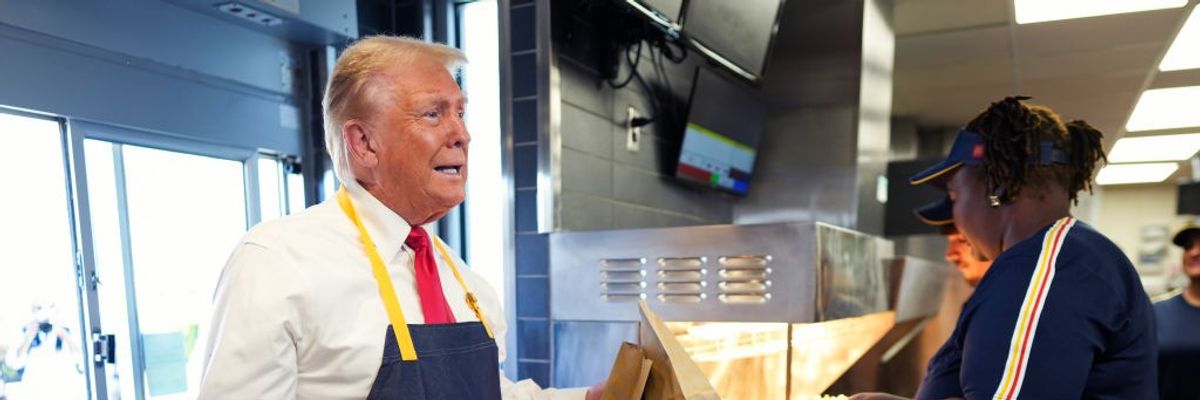
Republican presidential nominee Donald Trump is pictured at McDonald's on October 20, 2024 in Feasterville-Trevose, Pennsylvania.
"McDonald's workers don't need photo-ops; they need living wages," said Nina Turner.
Standing in the drive-through window of a McDonald's in the battleground state of Pennsylvania on Sunday, Republican presidential nominee Donald Trump dodged a direct question about whether he supports raising the nation's paltry minimum wage after employees at the low-paying restaurant briefly walked him through the process of making french fries.
"I think these people work hard, they're great," Trump said in response to the minimum wage question. "I just saw something, a process, that's beautiful. It's a beautiful thing to see, these are great franchises."
When reporters attempted for a second time to get an answer on the minimum wage, the former president moved on to a different question.
After working the fryer at McDonald’s, I asked Trump if he thinks the minimum wage should be raised: “Well I think this. These people work hard. They’re great. And I just saw something… a process that’s beautiful,” Trump said. pic.twitter.com/pg2synNA59
— Olivia Rinaldi (@olivialarinaldi) October 20, 2024
Trump's visit to the Pennsylvania McDonald's during the final stretch of the 2024 race was widely characterized as a political stunt aimed at bolstering the former president's claim to be a champion of the U.S. working class, despite his record of assailing labor protections and weakening an overtime pay rule put forth by his predecessor, leaving millions of workers behind.
After winning the 2016 election, Trump selected fast food executive Andrew Puzder—an opponent of raising the minimum wage and subminimum wage for tipped workers—as his pick to lead the U.S. Department of Labor. Puzder withdrew after it became clear he didn't have enough Senate support to be confirmed.
"Ending the subminimum wage and raising the minimum wage would be the real happy meal for American workers," Saru Jayaraman, the president of One Fair Wage, said Sunday. "While Trump panders to the wealthy, workers across Pennsylvania and the nation are still earning poverty wages."
The New York Times reported that the McDonald's was closed to the public during Trump's visit and that the GOP nominee "handed bags of food to preselected drive-through customers." McDonald's is viciously anti-union and, until 2019, lobbied against minimum wage increases.
Trump used the visit to attack his Democratic opponent, Vice President Kamala Harris, whose campaign said she worked at a California McDonald's in 1983 after her freshman year of college.
"McDonald’s representatives have ignored media requests for information," the Times reported. Trump claimed, without evidence, that Harris is lying about having worked at McDonald's.
Minnesota Gov. Tim Walz, Harris' running mate, hit back at Trump on social media, writing, "This guy spent decades stiffing workers pay, cut overtime benefits for millions of people, and opposed any effort to raise the minimum wage."
Nina Turner, founder of the advocacy organization We Are Somebody, said Sunday in response to Trump's stunt that "workers don't need gimmicks—they need the power to organize and demand the wages and dignity they deserve."
"McDonald's workers don't need photo-ops; they need living wages," said Turner. "We all need to come together and push back against a system that keeps them in poverty while corporate executives make billions. Real change is possible when workers unite and demand it."
Dear Common Dreams reader, It’s been nearly 30 years since I co-founded Common Dreams with my late wife, Lina Newhouser. We had the radical notion that journalism should serve the public good, not corporate profits. It was clear to us from the outset what it would take to build such a project. No paid advertisements. No corporate sponsors. No millionaire publisher telling us what to think or do. Many people said we wouldn't last a year, but we proved those doubters wrong. Together with a tremendous team of journalists and dedicated staff, we built an independent media outlet free from the constraints of profits and corporate control. Our mission has always been simple: To inform. To inspire. To ignite change for the common good. Building Common Dreams was not easy. Our survival was never guaranteed. When you take on the most powerful forces—Wall Street greed, fossil fuel industry destruction, Big Tech lobbyists, and uber-rich oligarchs who have spent billions upon billions rigging the economy and democracy in their favor—the only bulwark you have is supporters who believe in your work. But here’s the urgent message from me today. It's never been this bad out there. And it's never been this hard to keep us going. At the very moment Common Dreams is most needed, the threats we face are intensifying. We need your support now more than ever. We don't accept corporate advertising and never will. We don't have a paywall because we don't think people should be blocked from critical news based on their ability to pay. Everything we do is funded by the donations of readers like you. When everyone does the little they can afford, we are strong. But if that support retreats or dries up, so do we. Will you donate now to make sure Common Dreams not only survives but thrives? —Craig Brown, Co-founder |
Standing in the drive-through window of a McDonald's in the battleground state of Pennsylvania on Sunday, Republican presidential nominee Donald Trump dodged a direct question about whether he supports raising the nation's paltry minimum wage after employees at the low-paying restaurant briefly walked him through the process of making french fries.
"I think these people work hard, they're great," Trump said in response to the minimum wage question. "I just saw something, a process, that's beautiful. It's a beautiful thing to see, these are great franchises."
When reporters attempted for a second time to get an answer on the minimum wage, the former president moved on to a different question.
After working the fryer at McDonald’s, I asked Trump if he thinks the minimum wage should be raised: “Well I think this. These people work hard. They’re great. And I just saw something… a process that’s beautiful,” Trump said. pic.twitter.com/pg2synNA59
— Olivia Rinaldi (@olivialarinaldi) October 20, 2024
Trump's visit to the Pennsylvania McDonald's during the final stretch of the 2024 race was widely characterized as a political stunt aimed at bolstering the former president's claim to be a champion of the U.S. working class, despite his record of assailing labor protections and weakening an overtime pay rule put forth by his predecessor, leaving millions of workers behind.
After winning the 2016 election, Trump selected fast food executive Andrew Puzder—an opponent of raising the minimum wage and subminimum wage for tipped workers—as his pick to lead the U.S. Department of Labor. Puzder withdrew after it became clear he didn't have enough Senate support to be confirmed.
"Ending the subminimum wage and raising the minimum wage would be the real happy meal for American workers," Saru Jayaraman, the president of One Fair Wage, said Sunday. "While Trump panders to the wealthy, workers across Pennsylvania and the nation are still earning poverty wages."
The New York Times reported that the McDonald's was closed to the public during Trump's visit and that the GOP nominee "handed bags of food to preselected drive-through customers." McDonald's is viciously anti-union and, until 2019, lobbied against minimum wage increases.
Trump used the visit to attack his Democratic opponent, Vice President Kamala Harris, whose campaign said she worked at a California McDonald's in 1983 after her freshman year of college.
"McDonald’s representatives have ignored media requests for information," the Times reported. Trump claimed, without evidence, that Harris is lying about having worked at McDonald's.
Minnesota Gov. Tim Walz, Harris' running mate, hit back at Trump on social media, writing, "This guy spent decades stiffing workers pay, cut overtime benefits for millions of people, and opposed any effort to raise the minimum wage."
Nina Turner, founder of the advocacy organization We Are Somebody, said Sunday in response to Trump's stunt that "workers don't need gimmicks—they need the power to organize and demand the wages and dignity they deserve."
"McDonald's workers don't need photo-ops; they need living wages," said Turner. "We all need to come together and push back against a system that keeps them in poverty while corporate executives make billions. Real change is possible when workers unite and demand it."
Standing in the drive-through window of a McDonald's in the battleground state of Pennsylvania on Sunday, Republican presidential nominee Donald Trump dodged a direct question about whether he supports raising the nation's paltry minimum wage after employees at the low-paying restaurant briefly walked him through the process of making french fries.
"I think these people work hard, they're great," Trump said in response to the minimum wage question. "I just saw something, a process, that's beautiful. It's a beautiful thing to see, these are great franchises."
When reporters attempted for a second time to get an answer on the minimum wage, the former president moved on to a different question.
After working the fryer at McDonald’s, I asked Trump if he thinks the minimum wage should be raised: “Well I think this. These people work hard. They’re great. And I just saw something… a process that’s beautiful,” Trump said. pic.twitter.com/pg2synNA59
— Olivia Rinaldi (@olivialarinaldi) October 20, 2024
Trump's visit to the Pennsylvania McDonald's during the final stretch of the 2024 race was widely characterized as a political stunt aimed at bolstering the former president's claim to be a champion of the U.S. working class, despite his record of assailing labor protections and weakening an overtime pay rule put forth by his predecessor, leaving millions of workers behind.
After winning the 2016 election, Trump selected fast food executive Andrew Puzder—an opponent of raising the minimum wage and subminimum wage for tipped workers—as his pick to lead the U.S. Department of Labor. Puzder withdrew after it became clear he didn't have enough Senate support to be confirmed.
"Ending the subminimum wage and raising the minimum wage would be the real happy meal for American workers," Saru Jayaraman, the president of One Fair Wage, said Sunday. "While Trump panders to the wealthy, workers across Pennsylvania and the nation are still earning poverty wages."
The New York Times reported that the McDonald's was closed to the public during Trump's visit and that the GOP nominee "handed bags of food to preselected drive-through customers." McDonald's is viciously anti-union and, until 2019, lobbied against minimum wage increases.
Trump used the visit to attack his Democratic opponent, Vice President Kamala Harris, whose campaign said she worked at a California McDonald's in 1983 after her freshman year of college.
"McDonald’s representatives have ignored media requests for information," the Times reported. Trump claimed, without evidence, that Harris is lying about having worked at McDonald's.
Minnesota Gov. Tim Walz, Harris' running mate, hit back at Trump on social media, writing, "This guy spent decades stiffing workers pay, cut overtime benefits for millions of people, and opposed any effort to raise the minimum wage."
Nina Turner, founder of the advocacy organization We Are Somebody, said Sunday in response to Trump's stunt that "workers don't need gimmicks—they need the power to organize and demand the wages and dignity they deserve."
"McDonald's workers don't need photo-ops; they need living wages," said Turner. "We all need to come together and push back against a system that keeps them in poverty while corporate executives make billions. Real change is possible when workers unite and demand it."