

SUBSCRIBE TO OUR FREE NEWSLETTER
Daily news & progressive opinion—funded by the people, not the corporations—delivered straight to your inbox.
5
#000000
#FFFFFF
To donate by check, phone, or other method, see our More Ways to Give page.
Daily news & progressive opinion—funded by the people, not the corporations—delivered straight to your inbox.

"Just as the difficulty in accessing fertility treatment is overlooked, so too is the heartbreak of loss," said US Senate candidate Graham Platner and his wife, Amy Gertner.
An outpouring of support met US Senate candidate Graham Platner's announcement on social media Monday evening that his wife Amy Gertner suffered a miscarriage following the couple's decision to pursue in vitro fertilization treatment in Norway earlier this year.
In announcing this past January that they were traveling to Norway in an effort to have a child, Platner and Gertner said Monday that the couple had aimed "to shine a light on a hardship that millions of people face but is too often disregarded in our society and our politics." IVF treatment in Norway, the couple had shared as they embarked on their trip, would cost less than a quarter of what it would have cost in the US.
"Just as the difficulty in accessing fertility treatment is overlooked, so too is the heartbreak of loss," said the couple on Monday. "We suffered that heartbreak recently, when we experienced a miscarriage."
They emphasized that they "felt it was important to be open, because so many families have experienced the same. One in five known pregnancies end in miscarriage."
"To anyone who has experienced a loss like this: You are not alone," said Platner and Gertner. "We're with you—just as so many of you have been there for us."
US Rep. Ro Khanna (D-Calif.), who endorsed Platner's Democratic Senate primary run weeks after the combat veteran and oyster farmer launched his campaign last summer, said the couple's decision to share their experience would "light the way for countless others."
Karthik Soora, a former Democratic Texas state Senate candidate and clean energy advocate, also expressed sympathy.
"Sending his family positive energy as someone who lost a child-to-be at 22 weeks," said Soora. "We are all with you and you are not alone."
Platner and Gertner concluded their statement by asking for "grace as we grieve, and space as we figure out what comes next."
Platner is facing Maine Gov. Janet Mills in the US Senate primary, scheduled for June 9. Platner is running on a platform focused on passing Medicare for All and a billionaires' minimum tax, and has spoken out forcefully against President Donald Trump's mass deportation agenda and the US-Israeli war on Iran. In recent surveys he has polled ahead of Mills by up to 38 points.

"Not to get political, but it's a real indication of how flawed our healthcare system is," says the candidate for US Senate in Maine who supports Medicare for All.
Graham Platner and his wife, Amy Gertner, announced on Saturday that they are "leaving for a little while" in order to receive in vitro fertilization (IVF) treatments in the social democratic country of Norway, the necessity of which the Democratic Mainer running to unseat Republican Senator Susan Collins this year is a direct indictment of a "flawed" US healthcare system.
Platner, running against Maine Gov. Janet Mills and other candidates in a primary race to win the chance to challenge Collins, explains in a video how his and Amy's effort to get pregnant with their first child has corresponded with—but also predates—his Senate bid.
"Amy and I's life has taken an incredible turn," says Platner, filmed sitting with his wife in their home in Maine, as the video begins.
"We have been all over the state of Maine, from Ogunquit to Madawasca, from Rumford to Callis, holding well over 30 town halls" over recent months, he explains. "But in the background, we've also been trying to do something else, something we've been trying to do for a couple of years, and that has been to start a family."
"One round here in the States is $25,000. One round in Norway is $5,500 bucks. Even when you add on plane tickets, it's incomparable." —Graham Platner, candidate for US Senate
Watch:
Due to 'Astronomical' Cost in US, @grahamformaine and Wife, Amy Platner, Heading to Norway for Affordable IVF Treatment | "Not to get political, but it's a real indication of how flawed our healthcare system is," says US Senate candidate who supports Medicare for All. pic.twitter.com/036d4dig3I
— Common Dreams (@commondreams) January 10, 2026
Throughout his campaign for Senate, Platner, a military veteran who has benefited from the VA health system, has consistently called out the social injustice and economic backwardness of the nation's dominant for-profit healthcare system. Backing Medicare for All, Platner has said a single-payer system—with no co-pays, profit motives from giant insurers, and free medical care at point of service—is "the answer," a profoundly better way to manage the health needs of Americans, especially working people.
"I don't think we should live in a system where only the wealthy can afford healthcare," Platner said at a campaign event last year.
In December, just before the New Year, he said, "I will fight for Medicare for All in the Senate. Until we win it, I’ll back every bill that expands Medicare and Medicaid, cuts prescription drug costs, and puts the healthcare needs of the working class first."
In Saturday's announcement about their infertility journey and where it's headed next, the couple explain that they first looked at the VA to see if that would be a viable pathway to make the IVF process—which can cost $25,000 per round of treatment—more affordable.
Unfortunately, they found out, as Amy explains, that because "the infertility was something that was part of my body" and less so of Graham's, the VA system would not cover the treatments.
"We're going to have to have a conversation in the Senate, by the way," Graham said of that dynamic. "It takes two people. If you wanna have a kid, it's not a one-person job."

But while the VA's denial may have been the "end of the road," feared Amy, her doctor told her about other patients who have sought treatment abroad, where IVF treatments can be a fraction of the cost—a familiar pattern when it comes to what people in other countries pay for care, treatments, and prescription drugs compared to the United States.
Given Amy's assertion that she wanted to have a baby of her own "ever since I knew that it was something the female body was capable of doing," the idea of going to Norway arrived as a lifeline.
"To watch the woman that I love, who I want to start a family with, go through this experience of infertility," says Graham in the video. "I can see how it impacts her. I have so much respect and so much ... I'm so impressed at how you've been able to handle it."
Ultimately, it was the affordability dynamic, they explain, that led them to take the idea of going abroad seriously.
"One round here in the States is $25,000. One round in Norway is 5,500 bucks," Graham explains. "Even when you add on plane tickets, it's incomparable."
"Not to get political," he continues, "but it's a real indication of how flawed our healthcare system is. For us, the Senate campaign is a way of making sure that other people do not have to go through the exact same things that we've been through, where we can help build power in order to go get things that working people in this country need, like a universal healthcare system that provides fertility support."
Graham and Amy first spoke about their trip with local journalist Jesse Ellison with the Midcoast Villager for a story published on Thursday. In their conversation with the local paper, they both spoke of how the deeply personal struggle of trying to get pregnant is not at all divorced from the very real reasons that they both decided to back Graham's run for Senate.
From Ellison's reporting:
“It’s less about the VA and more about the fact that IVF is unaffordable for regular working-class people in this country,” Platner told me. “The concept of insurance companies not covering infertility treatment is why we need universal health care. Our story of infertility is just another example among many stories, we know we aren’t the only people struggling with this.” And so the two of them decided to talk about this choice publicly, too. Because if flying to Norway, spending two weeks in an Airbnb, and paying out-of-pocket for health care makes more financial sense than getting care here in America, well, that says something in and of itself.
For her part, Amys says, "I really wanted to share the story with any of you who have experienced infertility. I don't know if I have all of the answers or if sharing this story makes you feel like you're part of a community of infertility, but I hope that this can offer you some hope."

"Instead of fighting the rising cost of healthcare, gas, or groceries, this Congress prioritized rewarding the wealthy and well-connected military-industrial complex," said Defense Spending Reduction Caucus co-chairs.
Despite the Pentagon's repeated failures to pass audits and various alarming policies, 81 Democrats in the U.S. House of Representativesvoted with 200 Republicans on Wednesday to advance a $883.7 billion annual defense package.
The Servicemember Quality of Life Improvement and National Defense Authorization Act (NDAA) for Fiscal Year 2025, unveiled by congressional negotiators this past Saturday, still needs approval from the Senate, which is expected to vote next week. U.S. Sen. Bernie Sanders (I-Vt.) said Wednesday that he plans to vote no and spoke out against the military-industrial complex.
The push to pass the NDAA comes as this congressional session winds down and after the U.S. Department of Defense (DOD) announced last month that it had failed yet another audit—which several lawmakers highlighted after the Wednesday vote.
Reps. Mark Pocan (D-Wis.) and Barbara Lee (D-Calif.), co-chairs and co-founders of the Defense Spending Reduction Caucus, said in a joint statement, "Time and time again, Congress seems to be able to find the funds necessary to line the pockets of defense contractors while neglecting the problems everyday Americans face here at home."
"Instead of fighting the rising cost of healthcare, gas, or groceries, this Congress prioritized rewarding the wealthy and well-connected military-industrial complex with even more unaccountable funds," they continued. "After a seventh failed audit in a row, it's disappointing that our amendment to hold the Pentagon accountable by penalizing the DOD's budget by 0.5% for each failed audit was stripped out of the final bill. It's time Congress demanded accountability from the Pentagon."
"While we're glad many of the poison pill riders that were included in the House-passed version were ultimately removed from the final bill, the bill does include a ban on access to medically necessary healthcare for transgender children of service members, which will force service members to choose between serving their country and getting their children the care they need," the pair noted. "The final bill also failed to expand coverage for fertility treatments, including in vitro fertilization (IVF), for service members regardless of whether their infertility is service-connected."
Several of the 124 House Democrats who voted against the NDAA cited those "culture war" policies, in addition to concerns about how the Pentagon spends massive amounts of money that could go toward improving lives across the country.
"Once again, Congress has passed a massive military authorization bill that prioritizes endless military spending over the critical needs of American families. This year's NDAA designates $900 billion for military spending," said Rep. Ilhan Omar (D-Minn.), noting the audit failures. "While I recognize the long-overdue 14.5% raise for our lowest-ranking enlisted personnel is important, this bill remains flawed. The bloated military budget continues to take away crucial funding from programs that could help millions of Americans struggling to make ends meet."
Taking aim at the GOP's push to deny gender-affirming care through TRICARE, the congresswoman said that "I cannot support a bill that continues unnecessary military spending while also attacking the rights and healthcare of transgender youth, and for that reason, I voted NO."
As Omar, a leading critic of the U.S.-backed Israeli assault on the Gaza Strip, also pointed out: "The NDAA includes a provision that blocks the Pentagon from using data on casualties and deaths from the Gaza Ministry of Health or any sources relying on those statistics. This is an alarming erasure of the suffering of the Palestinian people, ignoring the human toll of ongoing violence."
Israel—which receives billions of dollars in annual armed aid from the United States—faces a genocide case at the International Court of Justice and the International Criminal Court last month issued arrest warrants for Israeli Prime Minister Benjamin Netanyahu and former Israeli Defense Minister Yoav Gallant. The NDAA includes over $627 million in provisions for Israel.
Congresswoman Delia Ramirez (D-Ill.), who voted against the NDAA, directed attention to U.S. President-elect Donald Trump's proposed Department of Government Efficiency (DOGE), set to be run by billionaires Elon Musk and Vivek Ramaswamy.
"How do we know that DOGE is not a good-faith effort to address wasted funding and unaccountable government? The NDAA passed today," Ramirez said. "Republicans overwhelmingly supported the $883.7 billion authorization bill even though the Pentagon just failed its seventh audit in a row."
"Billions of dollars go to make defense corporations and their investors, including Members of Congress, rich while Americans go hungry, families are crushed by debt, and bombs we fund kill children in Gaza," she added. "No one who voted for this bill can credibly suggest that they care about government waste."
Rep. Ro Khanna (D-Calif.), who also opposed the NDAA, wrote in a Tuesday opinion piece for MSNBC that he looks forward to working with DOGE "to reduce waste and fraud at the Pentagon, while strongly opposing any cuts to programs like Social Security, Medicare, the Department of Veterans Affairs, or the Consumer Financial Protection Bureau."
"We should make defense contracting more competitive, helping small and medium-sized businesses to compete for Defense Department projects," Khanna argued. "The Defense Department also needs better acquisition oversight. Defense contractors have gotten away with overcharging the Pentagon and ripping off taxpayers for too long."
"Another area where we can work with DOGE is reducing the billions being spent to maintain excess military property and facilities domestically and abroad," he suggested. "Finally, DOGE can also cut the Nuclear-Armed Sea-Launched Cruise Missile program."
The congressman, who is expected to run for president in 2028, concluded that "American taxpayers want and deserve the best return on their investment. Let's put politics aside and work with DOGE to reduce wasteful defense spending. And let's invest instead in domestic manufacturing, good-paying jobs, and a modern national security strategy."

"Thank you Gwen Walz for powerfully sharing your fertility journey and committing to protecting fertility treatments for all Americans."
Minnesota First Lady Gwen Walz—whose husband, Democratic Gov. Tim Walz, is U.S. Vice President Kamala Harris' running mate—shared her full fertility journey in an essay published by Women's Health on Monday, just weeks away from the November 5 election.
The Democrats are set to face Republican former President Donald Trump—who is voting to uphold Florida's six-week abortion ban and brags about having appointed three of the U.S. Supreme Court justices who reversed Roe v. Wade—and Sen. JD Vance (R-Ohio), whose selection was seen as further proof that their administration would "stop at nothing to ban all abortion" at the federal level.
Since Harris took the torch from President Joe Biden this past summer, she has had widespread support from reproductive freedom advocates. They celebrated her choosing the Minnesota governor, who signed bills strengthening abortion protections and shielding people who seek or provide abortions or gender-affirming care from legal action by conservative states.
"Donald Trump is the one who took down Roe. I don't trust him. And frankly, I'm not willing to put my daughter's reproductive health in his hands."
Throughout the campaign, Tim and Gwen Walz have shared their difficult journey to conceiving their two children: 23-year-old Hope, and Gus, who turned 18 on Sunday. As the Minnesota first lady detailed in Women's Health, she had "felt pangs of frustration and anger since Roe was overturned" but was ultimately pushed to speak out by an Alabama Supreme Court ruling.
In February, Alabama's high court recognized frozen embryos as children who must be protected by the Wrongful Death of a Minor Act, halting in vitro fertilization (IVF) in the state and elevating fears of what Republican control of Congress and the White House would mean for the future of fertility treatments and reproductive freedom more broadly.
"I don't think anyone should be telling us when, if, or how to start families. But when the Alabama Supreme Court ruling came down, that was a moment when it was just like, okay, now we're here," Gwen Walz wrote. "We went through this difficult time for a purpose—to have our children—but there's another purpose now. We have an opportunity, in leadership roles as governor and first lady, and now on the campaign trail for Kamala Harris, to tell our story. So, we told it all across the country."
She recalled taking Clomid, "a medication that increases the hormones that stimulate egg production in your ovaries and can help you get pregnant," and coordinating her schedule with their "wonderful neighbor Mary," a nurse and mother of three who helped administer shots to boost her chances of pregnancy and successful fertilization.
"When we finally conceived Hope using intrauterine insemination (IUI), it was right before Easter. We'd been struggling with infertility for years by that point," Walz wrote. "You never imagine that your daughter is going to have fewer rights than you do. And in 21 states that have abortion bans or gestational limits right now, that is the case."
"Donald Trump is the one who took down Roe. I don't trust him. And frankly, I'm not willing to put my daughter's reproductive health in his hands. If he's elected, I think there will be a nationwide abortion ban," she continued. "But I plan on making my voice heard at the ballot box. There's a clear choice between Kamala Harris and my husband, Tim—who trust women—and Trump and JD Vance, who do not. Everyone has to understand that you have the power to make this choice, and the power to respect reproductive freedom for every single woman in every single family—so that if, when, or how you want to have a family is up to you."
Welcoming the essay on social media, Reproductive Freedom for All said, "Thank you Gwen Walz for powerfully sharing your fertility journey and committing to protecting fertility treatments for all Americans."
Reproductive Freedom for All has endorsed the Harris-Walz ticket and has been working to reach voters in key states. The group's president and CEO, Mini Timmaraju, said earlier this month that "one of the most powerful ways we can mobilize voters is by speaking to the people we know in our own communities."
"Voters have never been so fired up about abortion," she added. "Our reproductive freedom is at stake and we can't afford to do anything less than leave it all on the field."

"By blocking access to IVF and trying to control how families grow, MAGA Republicans in the Senate are proving just how far they're willing to go to impose Trump's out-of-touch, authoritarian vision."
In another effort to call out Republicans in Congress for pushing deadly policies that restrict reproductive freedom, Senate Democrats on Tuesday held a vote to open debate on legislation that is intended "to protect and expand nationwide access to fertility treatment, including in vitro fertilization."
The tally was 51-44, short of the 60 votes needed to start debate on the Right to IVF Act (S. 4555). Sens. Susan Collins (R-Maine) and Lisa Murkowski (R-Alaska) voted with every Democrat and Independent present to advance the bill, while Sens. Cory Booker (D-N.J.), Joe Manchin (I-W.Va.), Mike Rounds (R-S.D.), Thom Tillis (R-N.C.), and JD Vance (R-Ohio) did not participate.
Senate Majority Leader Chuck Schumer (D-N.Y.) previously held a vote on the legislation in July—part of a broader strategy in the lead-up to the November election that has also featured votes on the Right to Contraception Act and the Reproductive Freedom for Women Act. In all cases, Republican senators have blocked the bills from advancing to final votes.
In addition to deciding the makeup of Congress, U.S. voters are set to choose whether former Republican President Donald Trump or Democratic Vice President Kamala Harris returns to the White House. Throughout the contest, Harris has campaigned on expanding reproductive freedom at the federal level and her running mate, Minnesota Gov. Tim Walz, has shared how his family was made possible through fertility treatments.
Harris said on social media after Tuesday's vote that Senate Republicans "made clear—again—that they will not protect access to the fertility treatments many couples need to fulfill their dream of having a child."
Meanwhile, Trump has both bragged about his role in reversing Roe v. Wade, which enabled a fresh wave of state-level abortion bans, but also attempted to distance himself from the most extreme laws and proposals. He also chose Vance as his running mate, heightening fears of what their election would mean for reproductive rights nationwide.
"By all accounts, a vote to protect something as basic and popular as IVF shouldn't be necessary. But sadly it is very necessary, thanks to attacks against reproductive care by Donald Trump and his Project 2025," Schumer said Tuesday, referring to the Heritage Foundation-led initiative designed for the next Republican president that Trump has tried to disavow.
"From the moment Donald Trump's MAGA Supreme Court reversed Roe, the hard-right made clear they would keep going. As we saw earlier this year in Alabama, IVF has become one of the hard-right's next targets," Schumer continued, recalling the state Supreme Court's February decision recognizing frozen embryos as children.
After the vote, the Democratic leader declared that "Senate Republicans just blocked the bill to protect IVF—AGAIN. They keep trying to tell everyone who will listen that they support IVF. But their actions speak louder."
Like Schumer and other critics, Christina Harvey, executive director of Stand Up America, pointed to Project 2025 on Thursday.
"Donald Trump can try to walk away from Project 2025, but his fingerprints are all over it. At least 140 former Trump administration and campaign officials helped craft this far-right agenda," she said in a statement. "Trump's public disavowal is nothing more than an attempt to deceive voters while his allies in Congress push the very policies he's pretending to distance himself from."
"Project 2025 isn't a distant, abstract threat—it's a real, extremist agenda that MAGA Republicans are eager to implement. By blocking access to IVF and trying to control how families grow, MAGA Republicans in the Senate are proving just how far they're willing to go to impose Trump's out-of-touch, authoritarian vision," Harvey added. "As more Americans learn about the policies in Project 2025, the stakes at the ballot box this November will become even clearer."
Democratic National Committee spokesperson Aida Ross targeted the Republican vice presidential candidate, saying that "JD Vance celebrated when Donald Trump 'proudly' overturned Roe v. Wade and paved the way for threats to IVF access for Americans who want to start or grow their family. Today, Vance couldn't be bothered to show up to vote on protecting IVF access, after voting against the same protections in June."
"Vance is showing us who he is and we should believe him," Ross added. "The American people will remember that Vance didn't show up for them, and they'll make that clear when they reject the Trump-Vance ticket's anti-choice Project 2025 agenda in November."
American Bridge 21st Century, a Democratic super political action committee, said the vote shows Republicans "are full of sh*t on protecting IVF," specifically calling out Sens. Ted Cruz (R-Texas), Deb Fischer (R-Neb.), Josh Hawley (R-Mo.), and Rick Scott (R-Fla.), who are seeking reelection this November and have previously claimed to support access to fertility treatments.
"Sens. Rick Scott, Ted Cruz, Josh Hawley, and Deb Fischer's hypocrisy on IVF underscores the Republican Party's refusal to support and protect reproductive rights," said American Bridge Senate communications director Nico Delgado. "Voters already know the GOP's damaging stance on abortion—and each vote against protecting IVF only deepens their credibility crisis."
Indivisible's co-founder and co-executive Director Leah Greenberg similarly said in a statement that "Trump and the GOP have been scrambling to hide their unpopular, outdated views on reproductive rights, but they're not fooling anybody."
Greenberg continued:
When Republicans send mixed messages on TV and online, look at their voting records. They've consistently voted against protecting personal freedoms—from access to abortion and contraceptives to IVF. For decades, they've chipped away at reproductive rights, and it's only gotten worse since Trump entered politics.
"As attacks on reproductive rights intensify, including MAGA efforts against contraception, we can't let our guard down. Indivisible proudly supports Sen. Schumer and Democrats for not only standing up for these fundamental rights, but continuously calling out their Republican colleagues' blatant lies.
Millions rely on contraception and IVF to build their families and lives, including Gov. Walz who has shared his family's struggles with fertility. These rights are fundamental and widely supported, and Republicans are straight-up trying to take them away. It is not only weird—it's dangerous.
"We commend Senate Democrats for taking decisive and strategic action by bringing this bill for a vote," she added. "Between now and November, we'll make sure every single voter sees through Republican bullshit and knows they voted against IVF protections today."
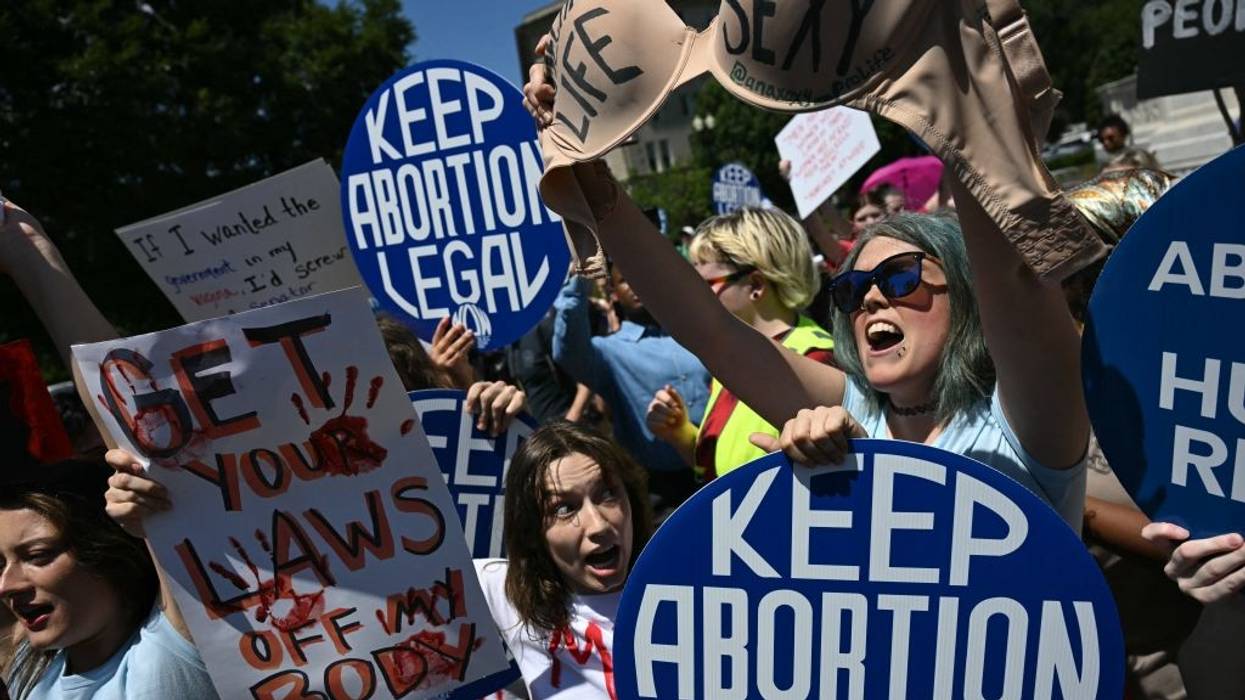
"The American people want to know where their senators stand on freedom of choice," said Democratic Senate Majority Leader Chuck Schumer.
In another display of GOP lawmakers' opposition to reproductive rights, U.S. Senate Republicans on Wednesday blocked the Reproductive Freedom for Women Act.
Introduced last month by Sen. Patty Murray (D-Wash.), the bill states that "the protections enshrined in Roe v. Wade... should be restored and built upon, moving towards a future where there is reproductive freedom for all."
The bill also acknowledges Dobbs v. Jackson Women's Health Organization, the right-wing U.S. Supreme Court's June 2022 ruling that reversed Roe, the decision that had affirmed the right to abortion until viability since 1973. Dobbs set off a fresh wave of efforts to impose devastating new restrictions on reproductive healthcare.
"If Republicans are going to force women to stay pregnant, we are going to force them to be honest with the American people about their extreme position. And, by the way, Democrats are going to keep fighting to restore the rights the American people have been so clear that they want back," Murray said on the Senate floor before Wednesday's vote.
The vote was 49-44, mostly along party lines. Seven senators were not present, and Sens. Susan Collins (R-Maine) and Lisa Murkowski (R-Alaska) were the only Republicans who supported holding a final vote on the legislation. Senate Majority Leader Chuck Schumer (D-N.Y.) changed his vote to "no" so he can bring the bill back up at a later date.
Wednesday's vote followed Republicans blocking bills on in vitro fertilization (IVF) and contraception last month. It also came after the GOP blocked three bills on Tuesday, which aimed to affirm the freedom to cross state lines for abortion care, protect doctors providing legal abortions from being punished for treating patients from other states, and support training for more providers.
"We know where the American people stand on the freedom of choice: Over 80% of Americans—including two-thirds of Republicans—agree that healthcare decisions including abortion should be between a woman and her doctor," Schumer said on the Senate floor Wednesday.
"But Americans are rightfully worried that reproductive rights are becoming extinct in this country. They see what's happening at the Supreme Court. They see the attacks on women's rights in states like Texas and Florida and Alabama and Idaho and beyond," he continued. "The American people want to know where their senators stand on freedom of choice."
The Senate majority leader also called out former President Donald Trump, the presumptive Republican nominee to face embattled Democratic President Joe Biden in November.
While Trump's recognition that rolling back reproductive freedom is unpopular is reportedly what led to changes in the Republican Party's 2024 policy platform, campaigners and legal experts have warned this week that the final language is still incredibly threatening and the GOP can't be trusted on this issue.
The White House said Tuesday that "the administration strongly supports Senate passage" of the bill and "will continue to work with Congress to defend reproductive freedom once and for all."
The statement also called out the GOP, saying that "Republican elected officials' extreme agenda is putting women's health and lives at risk and unleashing chaos and cruelty across America."
After the vote Wednesday, Reproductive Freedom for All president and CEO Mini Timmaraju said in a statement that "we're grateful to Sen. Murray, Leader Schumer, and our champions in the Senate for continuing to hold Republicans' feet to the fire for the damage they've done to reproductive freedom."
She added that "the GOP must be held accountable for the abortion bans they've helped orchestrate and refuse to back down from—and this November, they will be voted out of office."

"Voters don't want abortion bans," said one advocate. "Republicans know it and this plan shows just how desperate Trump and the MAGA GOP are to strip away our reproductive freedom."
Reproductive freedom advocates on Monday warned against trusting the Republican Party, whose 2024 policy platform now "reads like the transcript" from one of former U.S. President Donald Trump's rallies—including its section on abortion.
" Republicans want to criminalize abortion care and impose a nationwide ban," declared U.S. House Minority Leader Hakeem Jeffries (D-N.Y.). "The far-right extremists lied to the American people about respecting the precedent of Roe v. Wade. They are lying once again."
Trump, a frequent liar, attacked reproductive freedom as president and has bragged about appointing half of the U.S. Supreme Court justices who reversed Roe with a Dobbs v. Jackson Women's Health Organization ruling that paved the way for strict bans in over a dozen states.
However, Trump has also tried to distance himself from some extreme and devastating policies, recognizing them as politically risky as he runs for the White House against embattled President Joe Biden, a Democrat campaigning on his support for reproductive rights.
The GOP abortion policy appears on the second-to-last page of the 2024 platform, released just a week before the Republican National Convention is set to kick off in Milwaukee, Wisconsin. It states:
Republicans Will Protect and Defend a Vote of the People, from within the States, on the Issue of Life
We proudly stand for families and Life. We believe that the 14th Amendment to the Constitution of the United States guarantees that no person can be denied Life or Liberty without Due Process, and that the States are, therefore, free to pass Laws protecting those Rights. After 51 years, because of us, that power has been given to the States and to a vote of the People. We will oppose Late Term Abortion, while supporting mothers and policies that advance Prenatal Care, access to Birth Control, and IVF (fertility treatments).
Trump says he supports states making abortion policies. The Associated Press reported that the platform reflects his position, "omitting the explicit basis for a national ban for the first time in 40 years."
According to Politico, "Trump didn't just edit the platform language, but wrote some parts of the 15-page draft himself."
The Republican National Committee's (RNC) platform panel approved the document in an 84-18 vote, noted The New York Times, which added that Trump "was especially focused on softening the language on abortion."
In response to the Times reporting, journalist Paul Blest asserted on social media that "this is such a ridiculous framing on this story about the Republican platform."
"The platform didn't soften the abortion [stance], it just didn't mention it, and the people whose job is to advocate for abortion bans are totally fine with it," Blest continued. "Why do you think that would be?"
"If there's a landslide thanks to Biden's hubris you can bet the GOP will try to jam through a 15-week ban, then a 12-week ban, then a six-week ban, then a full ban with exceptions, then a full ban with no exceptions," he warned. "Whether the platform says it or not."
University of Texas law professor Liz Sepper explained what is included in the platform, saying: "Y'all, the RNC draft platform does not 'moderate' on abortion. It commits to constitutional personhood for fetuses. It takes the view that it is not a mere statute but rather the Constitution that bans abortion nationwide."
"Allow me to anti-abortion translate: The 14th Amendment to the U.S. Constitution protects life of fetuses," Sepper said. "With Roe, states could not so legislate. After Dobbs, they can legislate this view. And the 14th Amendment prohibits denial of fetal life IN ALL STATES."
"This is commitment to full constitutional personhood for blastocysts/embryos/fetuses," she continued. "That is, the RNC is committing to ensure embryos have rights equal to a full human person. There is no universe where embryos have constitutional rights and IVF can still happen on any scale."
Addressing the platform in an email, Biden's campaign said that "in a desperate attempt to conceal his extreme stance on abortion, Donald Trump directed the RNC to hide the ball on their unpopular plans to ban abortion nationwide—with or without Congress."
"Trump has endorsed every extreme abortion ban, including those with no exceptions for rape or incest, and has even said states should have the right to punish and prosecute women who have an abortion and monitor their pregnancies," the campaign added. "No one is buying Trump's sudden backtracking, including his fellow abortion banners."
The Biden campaign and other critics highlighted praise for the platform from leaders of anti-choice groups including Americans United for Life, Students for Life of America, and Susan B. Anthony Pro-Life America.
Meanwhile, Mini Timmaraju, who leads Reproductive Freedom for All, said that "the GOP wants to ban abortion nationwide—and their platform shows that they'll try to use the 14th Amendment to do it."
"Voters don't want abortion bans," she emphasized. "Republicans know it and this plan shows just how desperate Trump and the MAGA GOP are to strip away our reproductive freedom."
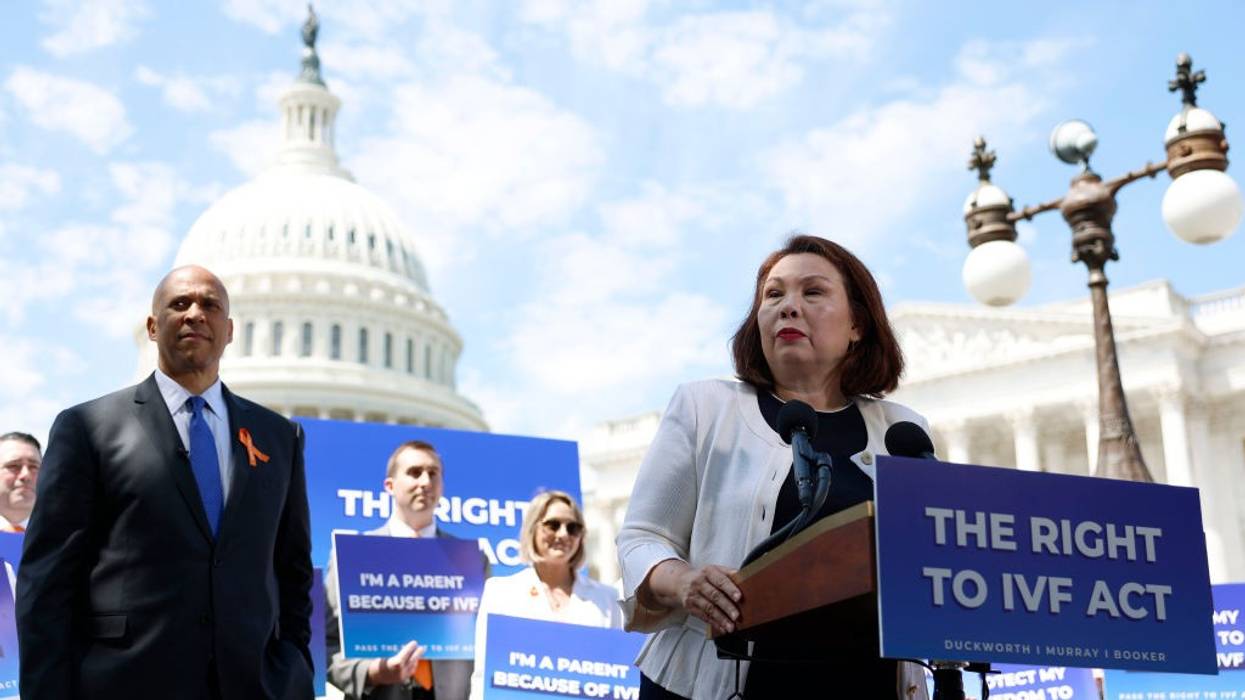
"This is the third time they've blocked legislation to protect IVF nationwide," said the sponsor, Sen. Tammy Duckworth. "This is who Republicans are."
After blocking a vote on the Right to Contraception Act last week, U.S. Senate Republicans on Thursday similarly prevented the chamber from weighing in on "a bill to protect and expand nationwide access to fertility treatment, including in vitro fertilization."
Only Republican Sens. Susan Collins of Maine and Lisa Murkowski of Alaska joined with Democrats for the 48-47 procedural vote on Sen. Tammy Duckworth's (D-Ill.) Right to IVF Act, which needed three-fifths majority support to hold a final vote in the chamber.
"IVF access has helped countless American families to form and grow. This bill would have protected their access to this healthcare and all the hope it represents amidst active MAGA threats to ban IVF," Indivisible said on social media Thursday. "Following this vote on the Right to IVF Act, all those people now know exactly where their senators stand."
"This is the kind of thing Democrats need to do more of. Go on offense. Force Republicans on the record. Don't let them say one thing and do another," the group asserted just months away from the November general election. "Republicans have waffled on this for months. When finally forced to take action, the GOP was too chicken."
Indivisible emphasized that "this legislation contains basic, popular things that actually enjoy wide support among Democratic and Republican voters alike. It would have been safe and frankly smart for most of the GOP to vote for it. But this shows how loyal to anti-choice extremists the whole party is."
"This amounts to a total refusal to protect our access to reproductive healthcare. It is truly indefensible."
Senate Majority Chuck Schumer (D-N.Y.)—who changed his vote to "no" so he can bring the bill up again—said on the chamber's floor Thursday that "it is a contradiction to claim you are pro-family but then turn around and block protections for IVF."
"In a perfect world a bill like this would not be necessary," Schumer argued, "but after the fiasco of the Alabama Supreme Court decision, and the generally MAGA views of some on the [U.S.] Supreme Court, Americans are genuinely worried that IVF is the next target of anti-choice extremists."
The Alabama Supreme Court in February delivered what critics called a "radically theocratic" decision, recognizing frozen embryos as children. IVF clinics swiftly stopped operating in the state and fears about the future of fertility treatments mounted nationwide.
Alabama state legislators swiftly worked to pass new IVF protections, but the Mobile Infirmary Health and the Center for Reproductive Medicine said in March that "the law falls short of addressing the fertilized eggs currently stored across the state and leaves challenges for physicians and fertility clinics trying to help deserving families have children of their own."
Since then, many GOP political figures across the country have claimed to support such in vitro fertilization—including the 49 Senate Republicans who signed a Wednesday statement led by Sen. Katie Britt (R-Ala.), who also pushed a competing IVF bill. However, Democratic leaders and reproductive rights advocates warn that like abortion and birth control, fertility care remains at risk of being restricted by right-wingers unless Congress passes legislation to protect it.
"Republicans talk a big game. But they will vote to block protections for IVF, just like they did for contraception," Sen. Elizabeth Warren (D-Mass.) said before the vote. "Talk is cheap. Only Democrats are fighting to protect abortion, contraception, and IVF."
Duckworth—who led the bill alongside Sens. Patty Murray (D-Wash.) and Cory Booker (D-N.J.)—declared: "This is the third time they've blocked legislation to protect IVF nationwide. This is who Republicans are."
Campaigners were similarly critical on Thursday. Kristin Rowe-Finkbeiner, executive director and CEO of MomsRising, said in a statement that "it is shameful, and it is harmful that U.S. Senate Republicans today refused to take the simple, necessary step of passing a wildly popular bill to protect access to in vitro fertilization."
"Together with Republicans' refusal to enshrine our right to contraception into federal law and to codify Roe v. Wade, this amounts to a total refusal to protect our access to reproductive healthcare. It is truly indefensible," Rowe-Finkbeiner continued. "The need for a federal law is indisputable in the wake of the appalling actions by Alabama legislators who have still not clarified that embryos are not people with the same rights as children, and legislative proposals that threaten IVF access in other states."
After listing the Right to IVF Act's provisions and noting the thousands of babies born thanks to such care, she concluded that "no family should ever have to fear that access to IVF will be denied or that they will be prosecuted for using it. But Republicans in the U.S. Senate today refused to offer that simple protection. Moms will not forget this vote."
In addition to deciding which party will control each chamber of Congress, U.S. voters in November are set to choose between Democratic President Joe Biden and former Republican President Donald Trump, who has bragged about appointing half of the U.S. Supreme Court justices who overturned Roe v. Wade.
"I have long said that overturning Roe v. Wade was just the beginning of a full-on attack on fundamental freedoms, and this is the latest indication that extremists plan to go much further," Vice President Kamala Harris said in a campaign statement about the Senate vote on Thursday.
"Unlike Donald Trump, President Biden and I believe a politician should never come between a woman and her doctor—whether that be for abortion care, contraception, or treatment like IVF," she added. "In November, Americans have a chance to stand up for reproductive freedom of all forms by rejecting Donald Trump and his extremist allies."
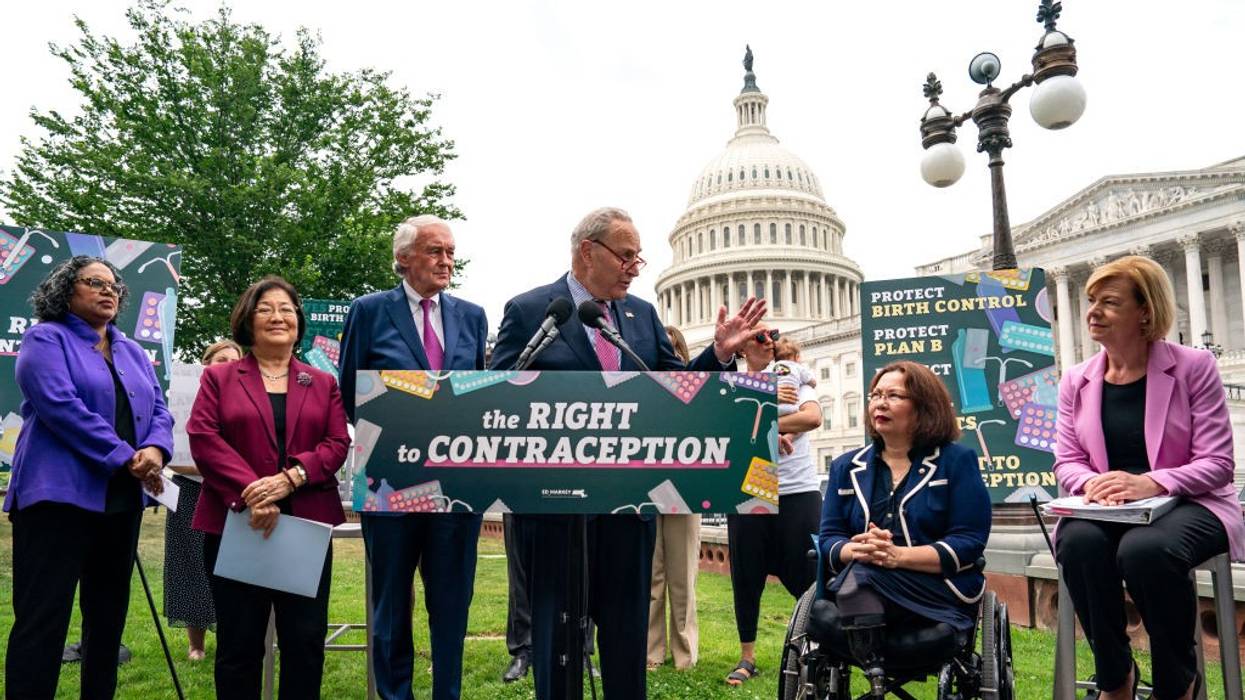
"Today was not a 'show vote'—this was a show-us-who-you-are vote," said Senate Majority Leader Chuck Schumer. "And Senate Republicans showed the American people exactly who they are."
U.S. Senate Republicans on Wednesday blocked consideration of the Right to Contraception Act, a move that Democratic leaders and rights advocates pointed to as further evidence that the GOP is hellbent on further degrading reproductive freedom.
"It's appalling. Shameful. Inexcusable. Grossly out of touch. Today Republicans in the U.S. Senate refused to take the simple step of enshrining our right to contraception into federal law when they voted down the Right to Contraception Act," declared Kristin Rowe-Finkbeiner, executive director and CEO of MomsRising. "When Senate Republicans turned their backs on it today, they turned their backs on America's moms."
Reproductive Freedom for All president and CEO Mini Timmaraju said that "if you still need more proof that Republicans are coming for birth control, here it is. Their refusal to protect this popular and fundamental right tells us everything we need to know—and voters won't forget it this November."
Reproductive freedom has been a key issue at all levels of U.S. politics leading up to the general election, when voters will determine who controls Congress and the White House. Democratic President Joe Biden, who supports reproductive rights, is running for reelection and is set to face former Republican President Donald Trump.
The Right to Contraception Act was spearheaded by Sens. Ed Markey (D-Mass.), Mazie Hirono (D-Hawaii), and Tammy Duckworth (D-Ill.). The bill would "protect an individual's ability to access contraceptives and to engage in contraception and... protect a healthcare provider's ability to provide contraceptives, contraception, and information related to contraception."
Timmaraju thanked the Democratic sponsors and Senate Majority Leader Chuck Schumer (D-N.Y.) for trying to advance to a final vote a bill that members of Congress have been fighting for since 2022. She also stressed that "as Republican lawmakers and Donald Trump continue to threaten access to contraception, protecting it is more important than ever."
After the procedural vote on Wednesday, Biden's reelection campaign released a video in which Vice President Kamala Harris notes that Trump—who has bragged about appointing three of the six U.S. Supreme Court justices who overturned Roe v. Wade—signaled on camera last month that his election would threaten access to not only abortion care but also contraceptives.
"If given an opportunity, Donald Trump would sign a national abortion ban," Harris warns in the clip. "A second Trump term would really mean more harm, more pain, and less freedoms. But we're not going to let that happen."
While Republican senators on Wednesday tried to dismiss Democrats' push for a vote on the contraception bill as a political stunt, rights advocates and reporters have highlighted right-wing Supreme Court Justice Clarence Thomas' concurring opinion two years ago in Dobbs v. Jackson Women's Health Organization, the case that reversed Roe.
"In future cases, we should reconsider all of this court's substantive due process precedents," Thomas wrote, setting his sights on the 1965 Griswold v. Connecticut ruling in favor of the liberty to use contraceptives, the 2003 Lawrence v. Texas decision overturning a state law that criminalized consensual sexual activity between adults of the same sex, and the 2015 Obergefell v. Hodges opinion that affirmed same-sex couples can legally marry nationwide.
As Schumer emphasized during a press conference after the vote, since Dobbs, Republican policymakers have created what critics in the chamber call "a healthcare nightmare across America" by ramping legislative attacks on reproductive rights—as was detailed during a Senate Health, Education, Labor, and Pensions Committee hearing on Tuesday.
"Today was not a 'show vote'—this was a show-us-who-you-are vote. And Senate Republicans showed the American people exactly who they are. They showed that they're not willing to stand up and protect something that 92% of Americans support," Schumer said Wednesday. "To Senate Republicans who argue federal protections for birth control are unnecessary, go ask the people of Virginia what they think after their Republican governor vetoed a bill that would have protected contraceptives at the state level."
"Go ask the people of Nevada what they think after their Republican governor also vetoed a bill to protect access to birth control," he continued. "And to those who say birth control will never fall at risk, go ask the people of Arizona, or Florida, or Idaho, or Iowa, or Missouri. In each of these states, Republican governors or Republican state legislators are on record blocking protections for birth control access in some form or another."
The majority leader—who changed his vote on the Right to Contraception Act to "no" so he has the option to bring it up for a vote again—is planning a similar push for a bill to protect access to in vitro fertilization (IVF) next week. Several rights leaders have connected the fight for abortion and contraception rights to fertility care, including Fatima Goss Graves, president and CEO of the National Women's Law Center.
"We are outraged that some senators blocked passage of the Right to Contraception Act, especially at a time when extremists are threatening access to birth control, blocking access to IVF, and criminalizing abortion," she said. "Their refusal to vote to protect our right to birth control goes against the will of the people and it demonstrates that our right to contraception is not safe."
Reproductive Equity Now similarly warned on social media that "it's obvious from today's vote that anti-abortion extremists will not stop at banning abortion. They will attempt to block our access to birth control, attack IVF, eliminate LGBTQ+ healthcare, and decimate our reproductive autonomy. This is what's at stake in November."

Democrats see the win in Alabama as a sign that supporting reproductive rights will make a difference in November.
Marilyn Lands, a Democratic candidate for a state House seat in Alabama, won a special election on Tuesday, defeating Republican Teddy Powell.
Lands focused her campaign on reproductive rights, including support for access to in vitro fertilization and abortion. The election was for a seat in Madison City, and it was previously held by a Republican.
"Today, Alabama women and families sent a clear message that will be heard in Montgomery and across the nation. Our legislature must repeal Alabama's no-exceptions abortion ban, fully restore access to IVF, and protect the right to contraception," Lands said in a statement.
Congrats to my friend Marilyn Lands on her resounding victory in the Alabama House District 10 special election. She campaigned on women’s reproductive freedom and pushing back on the culture wars being waged by AL Republicans. This is a big win for a better, stronger Alabama.…
— Doug Jones (@DougJones) March 27, 2024
Alabama has a strict abortion ban, and a February Alabama Supreme Court ruling declared that frozen embryos are people, imperiling access to in vitro fertilization in the state following the U.S. Supreme Court’s overturning of Roe v. Wade in 2022. Lands' opponent supported the state's abortion ban.
"This special election is a harbinger of things to come—Republicans across the country have been put on notice that there are consequences to attacks on IVF—from the bluest blue state to the reddest red, voters are choosing to fight for their fundamental freedoms by electing Democrats across the country," Heather Williams, president of the Democratic Legislative Campaign Committee, told Politico.
Democrats see Lands' win as a sign that supporting reproductive rights could continue to be a winner in November, even in deeply red states like Alabama. President Joe Biden voiced his support for access to IVF and abortion in his State of the Union address earlier this month.
"Marilyn Lands' victory demonstrates that voters aren't going to sit idly by while MAGA Republicans lay the groundwork for a national abortion ban," Democratic National Committee Chair Jaime Harrison said in a statement.