SUBSCRIBE TO OUR FREE NEWSLETTER
Daily news & progressive opinion—funded by the people, not the corporations—delivered straight to your inbox.
5
#000000
#FFFFFF
To donate by check, phone, or other method, see our More Ways to Give page.
Daily news & progressive opinion—funded by the people, not the corporations—delivered straight to your inbox.
How do we stop this war? How do we redirect the money being wasted into the schools and health centers, bike lanes and sustainable-energy infrastructures that we all so desperately need?
Guns or butter. Butter or guns. Can we have both? If not, which should come first? Consider it one of those chicken-and-egg conundrums of modern society.
“Guns” is the stand-in for a well-funded military and “butter” for all the human goods, comforts, and needs of a society.
Economists, politicians, and generals have long considered the balance of guns and butter. Wage too many wars, produce too many arms, and there won’t be enough money to keep a nation decently fed and comfortable. Produce too many consumer goods, meet everyone’s needs, and a nation might find itself ill-prepared and vulnerable in the face of a possible attack or even invasion. Everyone from Nazi propagandist Joseph Goebbels to British Prime Minister Margaret Thatcher has had something to say about the balance of guns and butter (or, more likely, the lack of it).
No surprise, but I like butter and don’t like guns. I have long been attracted to the graphics produced by groups like the National Priorities Project (NPP) and Brown University’s Costs of War Project that dramatize the opportunity costs of war investment in the United States. At some point, one of those groups created a pen that had a long scroll on a pull-out flap inside it. At parties, as you were discussing the military budget, you could take out that pen and unfurl a long bar graph comparing US military spending to the budgets for education, healthcare, and infrastructure. Neat trick, right?
Every war is bad, stupid, and represents a colossal failure of the imagination, but this one, with the Trump trademark on it, should be considered the ur-war to oppose, resist, and refuse to pay for.
These days, NPP has a new factsheet that offers a breakdown of how the cost (so far) of President Donald Trump’s Iran “escapade” could have been so much better spent:
Those numbers are based on the Pentagon’s request for $200 billion in supplemental funding for the Iran war effort. Defense Secretary Pete Hegseth was on Capitol Hill on April 30, supporting a lowball estimate of the war costs as a mere $25 billion (and worth every dollar!) and asking for support for an inconceivable $1.5 trillion for Trump’s war machine in fiscal year 2027. Guns vs. Butter? More like guns force-fed foie gras and caviar and sautéed in the world’s most expensive butter.
If I ever got a tattoo, it would probably be of this line from President Dwight D. Eisenhower’s 1953 “Chance for Peace” speech: “Every gun that is made, every warship launched, every rocket fired signifies, in the final sense, a theft from those who hunger and are not fed, those who are cold and are not clothed.”
Eisenhower gave that speech 73 years ago (even as military budgets increased significantly while he was president) and yet the words ring truer than ever today. In reality, I’m unlikely to get a first tattoo at the age of 52, but I did see all of this up close and personal a couple of weeks ago at my Connecticut town’s school board meeting.
For months, school board members had been ringing an alarm bell about their budget. After years of scrimping and shaving, layoffs and early retirement packages, they were no longer able to economize their way to a balanced budget, and so were considering a “nuclear option”: closing one of our local schools.
Community members rallied, testified, and harangued. Busloads of kids joined our superintendent at the state capitol to ask for more support for our schools. For the last two months, everyone in my neighborhood has been talking about this, and on a Monday night a few weeks ago, the school board held a public meeting to make an ultimate decision about what to do.
I drove there over streets riddled with potholes, past new luxury apartments built as “workforce housing” for the engineers at General Dynamics Electric Boat, where a new class of nuclear submarines (12 boats for $132 billion) is now being designed. Those $2,200-a-month studio apartments overlook a gas station, train tracks, and a low block of struggling businesses in a flood zone.
The school budget gap (more than $7 million) is there for all the usual reasons, made more extreme because we’re living through what, in the age of President Donald J. Trump, can only be considered the cratering of imperial America globally and the volume is up to 11 on everything. In these years, the line items for staff health insurance, building utilities, and a host of other costs have skyrocketed. The contributions from the state of Connecticut aren’t even close to keeping pace. The whole enterprise is built on the backs of local property owners, and our taxes are already far too high.
The place most likely to be shuttered was CB Jennings School, right up the road from my house, which has (for the rest of this school year, anyway) 338 students. All but 30 of those students qualify for free or reduced-fare lunches, meaning they come from low-income households. The school population includes 149 “multi-language learners” and 66 special-education students.
The 338 kids there would be divided between the other two elementary schools in our neighborhood. The fifth graders would all go to the local middle school (which itself was to be consolidated from two buildings into one) and the eighth graders to the local high school.
Teachers and custodians, principals and paraprofessional educators, social workers and secretaries will all be moved around, too. Routines will be broken, friendships and collegial collaborations disrupted, teaching teams split up. There will be a great jostling for parking spaces, offices with windows, and classrooms that face out of (or into) the sun. September will be stressful indeed and no one is happy.
Who bears the brunt of all this disorder? The answer: the kids who pay no taxes and make no policies. The little ones who are already deemed behind when they show up for kindergarten and need all the help the professionals there can give them. The tween ones who just want to see their friends, show off their new braids, learn to play the trumpet, and get first place in the spelling bee. The older ones who need the breakfast, lunch, and snacks that are served at school. The ones who bring the light and the joy of learning with them every day.
The lives of those little ones and their slightly bigger siblings are all soon going to be subjected to massive disruptions.
Of course, those “massive disruptions” are only so in relative terms. They’re but a minor hiccup compared to what’s happening in the lives of children throughout Iran during President Trump’s war on their country.
I cry about the war against Iran every day. (Truly!) The terror and the horror buzz through my head at the weirdest times: as I run errands, work in my garden, perform my school-crossing guard duties, and greet my young walkers. All this daily predictability and precious stability, the gorgeous ho-hum of the daily grind that has been stolen from the people of Iran by our war.
I look at pictures of Iranians cleaning up around buildings reduced to rubble and trying to go about their lives amid the catastrophe and I’m filled with awe. How would I ever begin again after surviving a rocket attack? Would I be able to extract the broom from the wreckage or ever brew tea again?
I tried to put such images aside when I went into the school board meeting that fateful night. When it was my turn to speak, I had three points to make—one minor, one secondhand, and one massive. I was nervous. My first point was easy. I argued that the school at the edge of the city should close instead of Jennings, which is more centrally located. My second point was awkward. My 12-year-old had written a speech, but then refused to read it and was whispering contradictory instructions to me as I got up for my turn to speak.
Finally, I got to my third point. Facing a semicircle of board members, I tried to channel the gravitas of President Eisenhower by pointing out that the Trump White House began its war against Iran by hitting a primary school with a Tomahawk cruise missile and killing 165 civilians, most of them schoolgirls. And I pointed out that decisions like the one to start a war with Iran ripple all the way to our coastline—destabilizing our local world and stealing from our kids, too. Closing an elementary school or having a massive budget hole are not our only two options, I said. We could instead be living in a society that prioritizes keeping elementary schools open and fully funded instead of bombing schools 6,700 miles away.
I tried not to think about the room full of parents and teachers behind me, but I still felt uncomfortably out on a limb making my geopolitical points during our local school board meeting. Despite my doubts, however, I continued, noting that between February 28—when my country started that terrible, illegal war—and March 27, the United States had fired 850 Tomahawk missiles at targets in Iran. And mind you, each one of those missiles comes at a cost to taxpayers of more than $3 million.
My three minutes of time were running out, so I rushed through the next part, mentioning that our senator, Richard Blumenthal (D-Conn.), estimated at the beginning of April that Trump’s war is now costing US taxpayers $1 billion dollars a day! And that’s before we factor in the long-term economic consequences of oil and gas price rises, disruptions to the global supply chain, and the cratering of my country’s already teetering standing globally.
I finished up by saying that we all have to work so much harder to stop this war as well as fund our schools and that the two were connected. This budget gap would be a difficult dilemma under the best of circumstances, but against the backdrop of war and calamity, it feels indicative of a much deeper problem than a few-million-dollar local budget holes. As I concluded. I made eye contact with the school board members and thanked them for their time.
Making my way back to my seat, I noticed that I was a little sweaty and that my hands were trembling. Why was I so nervous? Why was that so hard?
Eisenhower’s speech is a rhetorical master class, well worth revisiting in this age of imperial fiat by tweet. Ike went on to intone:
This world in arms is not spending money alone. It is spending the sweat of its laborers, the genius of its scientists, the hopes of its children. The cost of one modern heavy bomber is this: a modern brick school in more than 30 cities…. We pay for a single destroyer with new homes that could have housed more than 8,000 people… This is not a way of life at all, in any true sense. Under the cloud of threatening war, it is humanity hanging from a cross of iron.
After some formalities and hearing from a handful more people, the school board voted to shutter the CB Jennings Elementary School, a remarkably modern school in the heart of our city with a new playground and a beautiful library. The vote was unanimous. The board members were sad but resigned. It was treated as an inevitable but unfortunate outcome or even as a forward-looking, resolute action. They were “doing something” in the face of a huge budget gap.
And indeed, the school budget will be back in the black—for now—once a $1.4 million shortfall is settled by cutting more positions, shaving costs, and looking for grants. Meanwhile, the local schools that remain are indeed closer to a balanced budget (at least until utility costs spike even higher and yet more global war-making costs hit home in this country).
The cost of the war against Iran is just one reason to be against it. The wanton violence, the indiscriminate death dealing, the gold-plated hubris, and the gargantuan stupidity of Trump and crew, as well as the massive long-term impacts of the closing of the Strait of Hormuz, are something to try to take in.
Every war is bad, stupid, and represents a colossal failure of the imagination, but this one, with the Trump trademark on it, should be considered the ur-war to oppose, resist, and refuse to pay for. And sitting in that makeshift meeting room of the New London Board of Education, I felt like a tightly wound, somewhat muted Cassandra, requesting that people who are probably against the war, too, somehow consider it part of the reason we are being called upon to close a school and reduce the quality of our kids’ education.
We have a well-worn poster in the back hallway of our house. It’s an image of kids playing on a metal jungle gym alongside the words: “It will be a great day, when our schools get all the money they need, and the Air Force has to hold a bake sale to buy a bomber.”
A bake sale to buy a bomber? A car wash to get a Tomahawk? A dime drive for the next generation of nuclear submarines? This administration’s officials aren’t even pretending to enlist the public in support of their latest war, nor did they even try to get Congress to rubber-stamp it. They care that little for democracy, the rule of law, or even our hearts and minds. This White House grows fat on our outrage, our protest gestures, and our well-mannered critiques. They are printing money and telling lies in a frenzy of impunity that will (hopefully) finally be checked by the November elections. But there is so much violence and scapegoating and scaremongering coming out of Donald Trump’s White House and his Florida compound that many people are checking out on all of it just to carry on with their lives. But nothing now is NORMAL and we can’t allow ourselves to normalize any of it.
How do we stop this war? How do we redirect the money being wasted into the schools and health centers, bike lanes and sustainable-energy infrastructures that we all so desperately need? How do we take care of those victimized, maimed, and orphaned by our military? How do we take care of those rendered homeless, stateless, limbless by our wars?
The answer: We do something to protest, undermine, and challenge militarism every day. We work to connect those faraway wars, framed as invisible or normal or too complicated for us to grasp, to our everyday lives. We make all the awkward speeches we can. We hold up homemade antiwar signs. We refuse to pay for the wars we oppose. We continue to demand that butter, not guns, schools, not heavy bombers, homes, not destroyers be the focus of our lives.
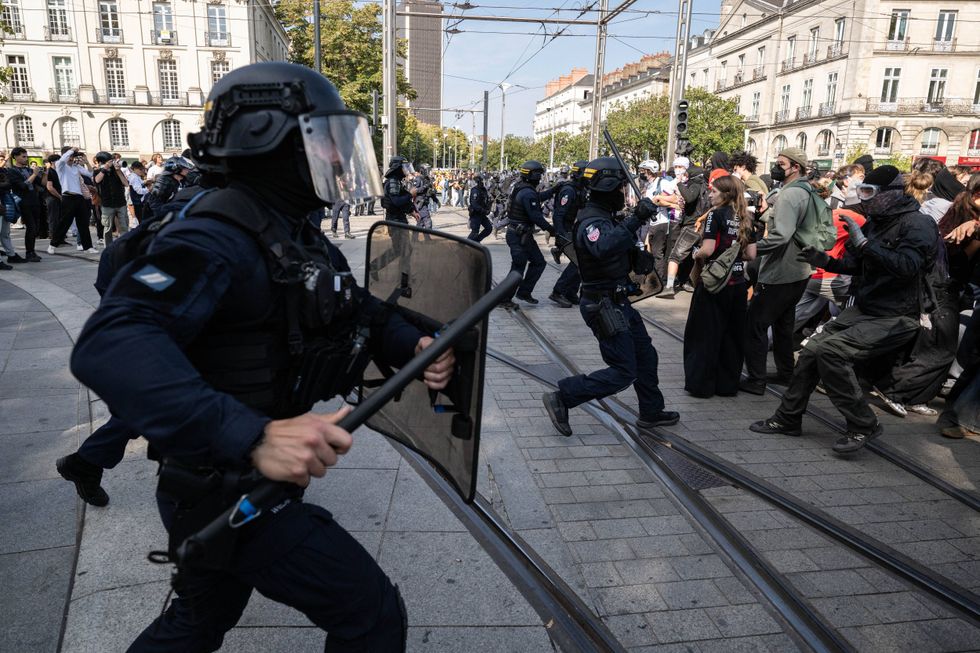
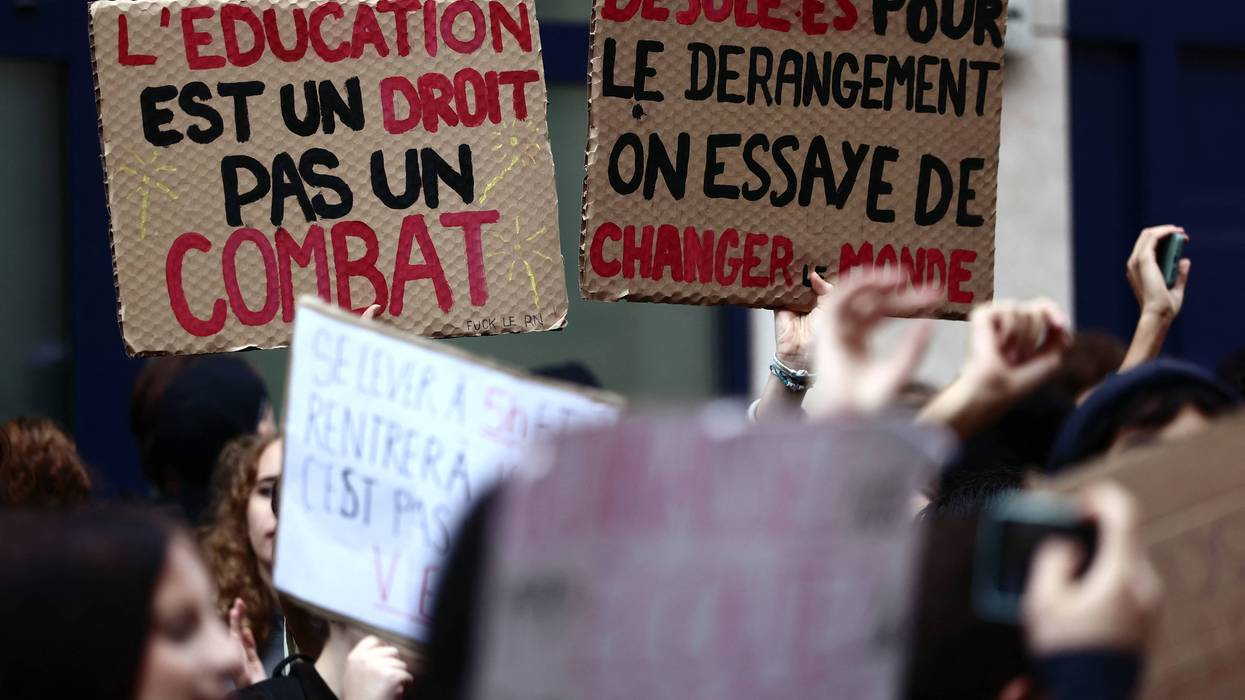
“This government is determined to defund public education,” said one protester.
Tens of thousands of Argentines took to the streets on Tuesday to protest against cuts to public universities championed by right-wing President Javier Milei.
As reported by The Associated Press, demonstrators in Buenos Aires marched on the Plaza de Mayo toward the Casa Rosada to demand the government implement funding for public universities that was passed by Congress last year but that Milei's administration is challenging in court.
The AP reported that university professors' salaries have declined by roughly one-third since Milei came to power in 2023 due to the rising cost of living in the country, and education unions have rejected the government's proposals for marginal funding increases as woefully insufficient.
A report from DW noted that "public university budgets been slashed by 40% since 2023 when Milei took power."
Sol Muñíz, a law student at the University of Buenos Aires, told the AP that Milei's cuts to the education system aren't about saving the government money, but are part of a broader ideological project.
“It’s very clear this government is determined to defund public education,” said Muñíz. “University is a source of pride for us. It is the best thing we have.”
Student Renata Lopez said in an interview with Agence France-Presse that Milei's attacks on education reminded her of the society depicted in Ray Bradbury's classic book Fahrenheit 451, in which government agents systematically burned their citizens' books.
"Defunding education isn't something alien, it isn't dystopian," said Lopez. "It's something that's happening."
A demonstrator identified only as Marcelo, a student at the University of Quilmes, told El País that he was demonstrating to "defend our public university, which isn’t a privilege but a right of all Argentinians."
According to a report from Bloomberg earlier this month, Milei's popularity in Argentina has been sinking in recent months, as his government has been beset by corruption scandals and economic setbacks that have harmed the image he has tried to cultivate as an anti-establishment reformer.
One expert warned that removing works on activism and social movements erodes the ability of marginalized communities "to take action amid rising authoritarian tactics by our government and attacks on free speech."
As President Donald Trump returned to the White House in the middle of the 2024-25 academic year and swiftly pursued increasingly authoritarian policies, there was "an embrace of anti-intellectualism" within the book-banning movement targeting US public schools and classrooms.
That embrace is detailed in "Facts & Fiction: Stories Stripped Away By Book Bans," an annual report released Thursday by PEN America, a nonprofit that promotes the protection of free expression through the advancement of human rights and literature.
The group found that from July 2024 to last June, 3,743 unique titles were removed from school libraries and classrooms nationwide—and 1,102 of them were "educational or informational books for young people—textbooks or reference texts on a wide range of subjects, history books, biographies, and autobiographies."
Although the majority of banned titles were still fiction, such as Fahrenheit 451 by Ray Bradbury and The Hunger Games by Suzanne Collins, the share of "fiction titles dropped from 85% to 69% of all banned titles, while nonfiction rose from 14% to a startling 29% of all banned titles," according to the analysis.
"This marked impact on books anchored in scientific and historic facts, real events, and real people represents something new and distinctive about the trajectory of book bans in public schools," the report states. "As nonfiction titles are not always the targets of efforts to remove books, that books on ancient Egypt, the digestive system, and self-help for teens, to name a few examples, are impacted by censorship signals an alarming spread of book bans that ignore the educational value of texts and books."
Targeted "nonfiction titles are wide-ranging," the report notes, "from memoirs such as Night by Elie Wiesel to biographies such as RuPaul by Maria Isabel Sánchez Vegara, alongside historical and educational or informational books such as Aztec, Inca & Maya by Elizabeth Baquedano and Challenges for LGBTQ Teens by Martha Lundin."
Flagging this "embrace of anti-intellectualism" in a statement about the new report, Kasey Meehan, director of PEN America's Freedom to Read program, said that "it is another example of how censorship sweeps broadly, leading to removals of all kinds of books, in its efforts to sow fear and distrust in our public education system."
Like the previous academic year, "realistic/contemporary and dystopia/sci-fi/fantasy remain the dominant genres banned," the publication highlights. "But of note, educational/informational titles grew from 5% of all titles in 2023-24 to 13% of total titles banned in 2024-25, or nearly 500 unique titles."
Among the nonfiction titles banned, "52% contained themes of activism and social movements, the most commonly banned topic within nonfiction titles," the report says. "Whether #WomensMarch: Insisting on Equality by Rebecca Felix or IntersectionAllies: We Make Room for All by Chelsea Johnson, LaToya Council, and Carolyn Choi, and illustrated by Ashley Seil Smith, this literature is crucial in the education of young people. These books can encourage readers to challenge the status quo and resist injustice."
Freedom to Read program assistant and report co-author Yuliana Tamayo Latorre said that removing books on these topics "silences the voices of marginalized communities and erode[s] their ability to take action amid rising authoritarian tactics by our government and attacks on free speech."
The most common theme across all banned books was nonsexual violence. This was a theme in 57% of the targeted titles, and they addressed topics including "war, gun violence, natural disasters, domestic violence, human trafficking, slavery and genocide, physical fighting, and more."
Other key themes included death and grief (48%), empowerment and self-esteem (39%), LGBTQ+ topics and metaphors (36%), consensual sexual experiences (34%), mental health disorders (29%), verbal or emotional abuse (28%), and substance use and/or abuse (27%).
There was an increase in banned titles with themes of empowerment and self-esteem, up from 31% in 2023-24.
"Fictional titles with themes of empowerment include Flor Fights Back: A Stonewall Riots Survival Story by Joy Michael Ellison and illustrated by Francesca Ficorilli, and The Moon Within by Aida Salazar," the report says. "To remove these books from classroom and library shelves means revoking access to books that students may rely on for personal and emotional development."
There is an entire section of the report about "erasing people" that examines trends in the identities of characters in banned books. Of all the targeted titles, 44% featured people of color, 39% had LGBTQ+ characters, 19% included transgender or genderqueer individuals, and 10% involved those who are neurodivergent or disabled.
Trump and other leading Republicans have embraced and advanced campaigns against diversity, equity, and inclusion (DEI). PEN America acknowledged that such efforts "have contributed to restrictions and removals on books with people of color and mirror efforts to suppress curriculum on Indigenous history, Black history, Asian American and Pacific Islander stories, and Latine and Hispanic contributions."
Another section of the report addresses a major "discrepancy between the titles impacted by book bans and the justifications made to ban books. Book banners have long cited 'pornography' and 'sexually explicit' material in literature to justify book challenges. Claims that these books contain 'explicit' or 'obscene' content grossly misrepresent the materials."
That section points out that 19% of last year's banned titles contained sexual violence—and "according to RAINN, 1 in 9 girls and 1 in 20 boys under 18 experience sexual abuse or assault. With so many of these titles banned since 2021, it is possible that some young people who have experienced sexual violence no longer have access to books that could help them."
"Books containing experiences of sexual violence include The Nickel Boys by Colson Whitehead, winner of the 2020 Pulitzer Prize for Fiction, set in a 1960s Southern juvenile reform school, and Laurie Halse Anderson's memoir Shout, a call to action for sexual abuse and trauma survivors in the wake of the #MeToo movement," according to PEN America.
The group's report came just a few weeks after a similar annual publication from the American Library Association, which details challenges to at least 4,235 unique titles in 2025, resulting in bans on at least 5,668 books and restrictions on another 920 works.
"In 2025, book bans were not sparked by concerned parents, and they were not the result of local grassroots efforts," noted Sarah Lamdan, executive director of the association's Office for Intellectual Freedom. “They were part of a well-funded, politically driven campaign to suppress the stories and lived experiences of LGBTQIA+ and BIPOC individuals and communities."