SUBSCRIBE TO OUR FREE NEWSLETTER
Daily news & progressive opinion—funded by the people, not the corporations—delivered straight to your inbox.
5
#000000
#FFFFFF
To donate by check, phone, or other method, see our More Ways to Give page.
Daily news & progressive opinion—funded by the people, not the corporations—delivered straight to your inbox.
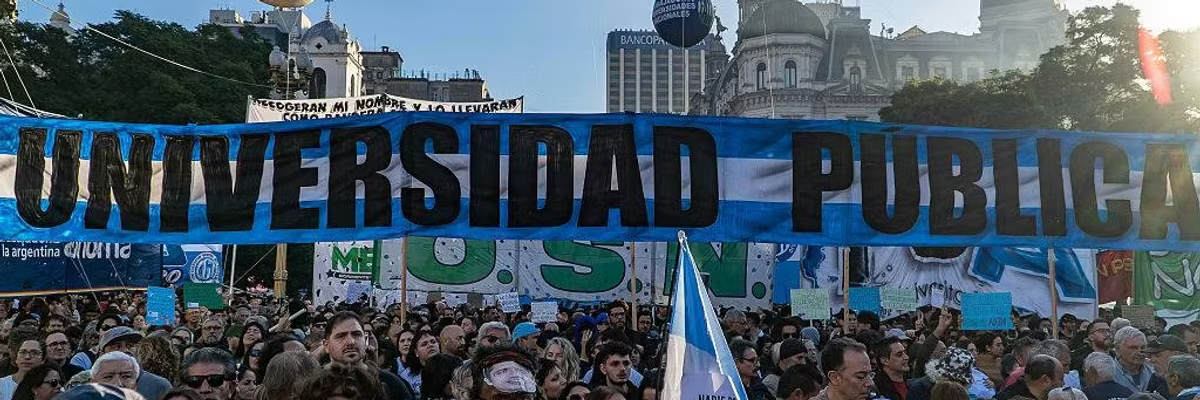
A crowd protests during the National University March in Plaza de Mayo on May 12 in Buenos Aires, Argentina.
“This government is determined to defund public education,” said one protester.
Tens of thousands of Argentines took to the streets on Tuesday to protest against cuts to public universities championed by right-wing President Javier Milei.
As reported by The Associated Press, demonstrators in Buenos Aires marched on the Plaza de Mayo toward the Casa Rosada to demand the government implement funding for public universities that was passed by Congress last year but that Milei's administration is challenging in court.
The AP reported that university professors' salaries have declined by roughly one-third since Milei came to power in 2023 due to the rising cost of living in the country, and education unions have rejected the government's proposals for marginal funding increases as woefully insufficient.
A report from DW noted that "public university budgets been slashed by 40% since 2023 when Milei took power."
Sol Muñíz, a law student at the University of Buenos Aires, told the AP that Milei's cuts to the education system aren't about saving the government money, but are part of a broader ideological project.
“It’s very clear this government is determined to defund public education,” said Muñíz. “University is a source of pride for us. It is the best thing we have.”
Student Renata Lopez said in an interview with Agence France-Presse that Milei's attacks on education reminded her of the society depicted in Ray Bradbury's classic book Fahrenheit 451, in which government agents systematically burned their citizens' books.
"Defunding education isn't something alien, it isn't dystopian," said Lopez. "It's something that's happening."
A demonstrator identified only as Marcelo, a student at the University of Quilmes, told El País that he was demonstrating to "defend our public university, which isn’t a privilege but a right of all Argentinians."
According to a report from Bloomberg earlier this month, Milei's popularity in Argentina has been sinking in recent months, as his government has been beset by corruption scandals and economic setbacks that have harmed the image he has tried to cultivate as an anti-establishment reformer.
This country and this world are at a monumental crossroads. US voters have an opportunity to beat back the forces of fascism and confront the billionaires who are rigging the economy, our media system, and our democracy, making it increasingly impossible for ordinary people to get by. We’re not just talking about the election. We’re talking about what must be done once these fascist elements are vanquished from power. We need a bolder set of solutions than what either major party has so far been willing to offer and a working-class movement ready to fight like hell for it. Trump didn't emerge from nowhere. The conditions that fueled MAGA authoritarianism were created by decades of radical neoliberal economic policies and a corrupt political system dominated by corporate interests. They slashed taxes on the super-rich, promising that the benefits would trickle down. They said giveaways to the corporate titans would make life more affordable for the rest of us. It was all bullshit. And when a bitter, betrayed populace searches for someone to blame, right-wing demagogues have little trouble finding scapegoats. People know when they're being lied to, but you won't hear any of this from the corporate media. Only independent journalism—powered and funded by people who believe in building a better world—can deliver truly trustworthy daily news. If you share our vision, please contribute whatever you can to sustain our work. |
Tens of thousands of Argentines took to the streets on Tuesday to protest against cuts to public universities championed by right-wing President Javier Milei.
As reported by The Associated Press, demonstrators in Buenos Aires marched on the Plaza de Mayo toward the Casa Rosada to demand the government implement funding for public universities that was passed by Congress last year but that Milei's administration is challenging in court.
The AP reported that university professors' salaries have declined by roughly one-third since Milei came to power in 2023 due to the rising cost of living in the country, and education unions have rejected the government's proposals for marginal funding increases as woefully insufficient.
A report from DW noted that "public university budgets been slashed by 40% since 2023 when Milei took power."
Sol Muñíz, a law student at the University of Buenos Aires, told the AP that Milei's cuts to the education system aren't about saving the government money, but are part of a broader ideological project.
“It’s very clear this government is determined to defund public education,” said Muñíz. “University is a source of pride for us. It is the best thing we have.”
Student Renata Lopez said in an interview with Agence France-Presse that Milei's attacks on education reminded her of the society depicted in Ray Bradbury's classic book Fahrenheit 451, in which government agents systematically burned their citizens' books.
"Defunding education isn't something alien, it isn't dystopian," said Lopez. "It's something that's happening."
A demonstrator identified only as Marcelo, a student at the University of Quilmes, told El País that he was demonstrating to "defend our public university, which isn’t a privilege but a right of all Argentinians."
According to a report from Bloomberg earlier this month, Milei's popularity in Argentina has been sinking in recent months, as his government has been beset by corruption scandals and economic setbacks that have harmed the image he has tried to cultivate as an anti-establishment reformer.