

SUBSCRIBE TO OUR FREE NEWSLETTER
Daily news & progressive opinion—funded by the people, not the corporations—delivered straight to your inbox.
5
#000000
#FFFFFF
To donate by check, phone, or other method, see our More Ways to Give page.
Daily news & progressive opinion—funded by the people, not the corporations—delivered straight to your inbox.

Lawmakers face a choice: They can continue their vote-pandering through “no tax on” proposals, or they can address the glaring structural flaws in the federal income tax and, in doing so, perhaps save our tax system and our democracy.
A tale of two couples:
Barney and Betty are both 66. Betty works as a hostess at a local restaurant. She makes $15,000 in hourly pay, plus another $25,000 in tips. Barney owns an interest in his family’s business, organized as a Subchapter S corporation, from which his annual income is $50,000. Over the holidays, Barney works long hours at a local big box store. He makes $10,000, $2,500 of which is the premium for overtime.
At tax time, Barney and Betty report $100,000 of adjusted gross income. In computing their taxable income, they take deductions of $25,000 for Betty’s tips, $12,000 in deductions for seniors, a $10,000 qualified business income deduction for Barney’s income from the family business, a $2,500 deduction for Barney’s overtime pay, and a standard deduction of $35,500, leaving them with taxable income of $15,000 and a federal income tax bill liability of $1,500.
The only path out of this mess is to rebalance our income tax structure. The Working Americans Tax Cut Act, a bill introduced by Sen. Chris Van Hollen (D-Md.) and Rep. Don Beyer (D-Va.O would accomplish that rebalancing.
Fred and Wilma are both 64. Wilma no longer works. Fred makes $100,000 per year as an accountant with a local firm. Although he works long hours during tax season, he is not paid overtime because of his base compensation and position, which includes managerial duties. At tax time, Fred and Wilma report $100,000 of adjusted gross income. They take a standard deduction of $32,200, leaving them with taxable income of $67,800 and a federal income tax liability of $7,640.
These are, of course, concocted examples. But they show how tax policy in the US under President Donald Trump has returned to the Stone Age. There are couples with tax pictures virtually identical to Barney and Betty’s and other couples with tax pictures virtually identical to Fred and Wilma’s. Do they ever compare their respective situations? Do they question the Swiss cheese tax code we have courtesy of two Trump tax bills?
Could it get worse? Absolutely. As Brian Faler at Politico reported, members of Congress have a slew of new “no tax on” proposals ready to campaign on. No Tax on Boat Loan Interest? Yep. Taxes on Utility Bills? Absolutely, and it’s bipartisan no less! I spoke to a senior congressional staffer a few months ago who was just giddy about all the “no tax on” proposals his office hoped to include in a 2029 budget reconciliation bill.
The “no tax on” provisions currently in the tax code are set to expire after 2028. Will they be extended? Of course they will. As I commented to Politico, if you do away with no tax on tips, you can kiss the state of Nevada goodbye. And imagine how this will play in the other swing states in 2028. “No tax on auto workers” sure will sound sweet in Michigan. And if you want to carry Georgia, you damn well better sign on to “no tax on peanut farm workers.” By the time we get to the 2032 campaign, the pandering will be stripped of all pretense and we’ll be hearing “no tax on Pennsylvanians.”
How problematic is this from a tax policy perspective? Huge. The federal income tax system depends on voluntary compliance. The system must make sense to taxpayers for them to voluntarily comply. If you’re Fred or Wilma, would our tax system still make sense to you? Hardly.
How, then, do we rein this craziness in? We start by identifying the source of the problem. As gimmicky as provisions like no tax on tips are, and even though they benefit only a tiny percentage of workers, they address a need millions of Americans feel and millions more Americans understand. When people hear “tipped worker,” they don’t picture the blackjack dealer at the Venetian making $150,000 a year. They don’t even picture a worker like Betty, who together with her husband enjoys a comfortable income. They picture the struggling unmarried server at their local Denny’s slinging dishes for $35,000. And they understand well she doesn’t have enough income before federal income tax, let alone after, to pay her basic living expenses.
Now, consider struggling non-tipped workers and their reaction to no tax on tips. Do they think their tipped counterparts are getting an unfair break like the ultra rich get on their lightly-taxed investment gains? Or do they think that they should have their income tax burdens reduced as well, and that the rich should be required to pay more?
Asking those questions, of course, answers them, and shines a light on the real problem: The federal income tax is fundamentally flawed at both ends of the income spectrum. At the lower end, incomes not even sufficient to cover basic living expenses are subject to federal income tax. At the upper end, marginal rates top out at a fraction of the country’s highest income levels. Doctors making in the high six figures face the same marginal tax rate as CEOs making 50 times that much.
The only path out of this mess is to rebalance our income tax structure. The Working Americans Tax Cut Act, a bill introduced by Sen. Chris Van Hollen (D-Md.) and Rep. Don Beyer (D-Va.O would accomplish that rebalancing. Their bill provides an exemption from federal income tax for income up to the basic cost of living, with a progressively smaller income tax reduction for those with incomes just above the basic cost of living. At the same time, the bill imposes a surtax on income in excess of $1 million, and larger surtaxes on incomes above $2 million and $5 million.
If the Working Americans Tax Cut Act becomes law, the ghastly “no tax on” provisions could be allowed to expire. The great majority of tipped workers, like that struggling server at Denny’s, won’t care, since they’d pay no federal income tax either way. A handful of taxpayers would still benefit from no tax on tips. But nobody will waste political capital on a tax break for affluent blackjack dealers.
Members of Congress face a choice. They can continue their vote-pandering through “no tax on” proposals. Or they can address the glaring structural flaws in the federal income tax and, in doing so, perhaps save our tax system and our democracy.
Let’s hope they make the right choice. Stone Age tax policy won’t end well for any of us.
This article was originally published on Bob Lord's Substack.

"I will continue doing everything in my power to stop this illegal and reckless attempt to turn our nation's capital into a monument to Donald Trump," vowed Rep. Don Beyer.
While Americans are stressed about the economy and President Donald Trump's approval rating has hit a historic low, the second-term Republican is focused on vanity projects like his proposed 250-foot "Triumphal Arch," which opponents are trying to block.
The watchdog group Public Citizen is planning a protest and press conference for the morning of October 1 at Memorial Circle in Washington, DC. Speakers include Congressman Don Beyer (D-Va.), military veterans, and other critics of the "self-indulgent project" that lacks congressional approval—and which Trump is now trying to push as a national security project.
"Trump's planned construction is not only illegal," Public Citizen said in a Thursday statement, pointing to the lawsuit it filed on behalf of three Vietnam War veterans and an architectural historian. "It is an affront to American veterans and their families."
"The arch will sit on Memorial Circle along the Potomac River, impeding the symbolic line-of-sight between the Lincoln Memorial in DC and Arlington National Cemetery in Virginia, where hundreds of thousands of our nation's military members have been laid to rest," explained the group, which has secured from a federal judge temporary restrictions on work at the site.
Beyer—whose district includes Arlington National Cemetery—headed to the site on Thursday. He said in a statement that "after hearing from constituents who saw construction equipment at the site of Trump's proposed vanity arch, I drove down to Columbia Island to see for myself. When I arrived, I found workers operating heavy equipment who told me they were conducting archaeological work to evaluate the composition of the soil."
"When I asked whether this work was a precursor to construction of the arch, they said that they could not answer," the congressman continued. "The logical conclusion, however, is that the presence of this heavy equipment and additional surveyors is a clear indication that the Trump administration is preparing to move forward with construction. That would be deeply troubling. Trump's arch is illegal and immoral, and the administration is also under court order requiring 48 hours' notice before work proceeds."
"Yet, the administration appears to be pushing ahead with activity at the site even while it still has not done the basic work necessary to understand the consequences of this project," Beyer warned. "There has been no adequate assessment of the regional impacts of this 250-foot structure on public safety, vehicular traffic, air traffic, or historic sites, including the implications of Trump's latest ravings about using the arch as a base for drone and sniper operations."
Beyer, who also shared video of his visit to the site on social media, added that “Donald Trump and his administration are determined to find a way to push this project through by any means necessary, regardless of the law or the concerns of the people who live here, but my constituents have made their views abundantly clear: They do not want this project. Neither do I. I will continue doing everything in my power to stop this illegal and reckless attempt to turn our nation's capital into a monument to Donald Trump."
In May, Beyer and Dina Titus (D-Nev.)—who, as co-chair of the Congressional Humanities Caucus, led challenges to the administration's illegal attempts to fund the arch using the National Endowment for the Humanities budget—introduced the Arlington National Cemetery Viewshed Protection Act, which would explicitly prohibit construction of Trump's project.
"As President Trump strips away the necessary safety nets from Americans who are struggling to afford their basic needs like groceries and healthcare, he builds his unauthorized, grandiose Triumphal Arch. While destroying historical monuments and artifacts important to our American identity, he is erecting monuments to honor himself," Titus said at the time. "The American people deserve a leader who is responsibly using federal funding for critical government services, not for self-promotion."
After months of pushback over the project, Trump announced last Sunday that "at the strong request of the United States Military, and for National Security purposes, I have agreed to convert the magnificent Triumphal Arch, planned since the Civil War Era many years ago, at the Receptive Circle adjoining the Arlington Memorial Bridge, into a top grade Military Complex/Triumphal Arch, to house, store, and have the rapid ability to use large numbers of drones, plus Snipers, on both the roof and plaza areas, and additionally have and hold large quantities of sniper ammunition in storage."
"There will be no facility like this anywhere in the World," the president wrote on his Truth Social platform. "Out of the 59 top cities and Capitals, Washington, DC, IS THE ONLY ONE IN THE WORLD THAT DOES NOT HAVE A TRIUMPHAL ARCH, but it will now and, by far, the greatest of them all!"
The Hill reported Friday that analysts and lawmakers "are perplexed by President Trump’s surprise declaration," with Michael O'Hanlon, a senior fellow at the Brookings Institution think tank, telling the outlet that adding military elements to the arch "is not totally fictional or crazy—but also not optimal."
Whether or not the project include military components, "to build an arch on federal land (that is not in the White House complex), the administration needs to navigate a lot of bureaucracy," The Washington Post noted Thursday. "The administration has argued the arch doesn't need to abide by DC's height laws for buildings and that it doesn't need congressional authorization because Congress authorized something similar a century ago nearby."
However, the Advisory Council on Historic Preservation—whose members are picked by the president—has attempted to abide by Section 106 of the National Historic Preservation Act and related regulations, and consulted with local officials "to seek ways to avoid, minimize, or mitigate adverse effects to historic properties that would result from this undertaking."
ABC News highlighted that "the law says federal officials don't have to reach an agreement with state officials on mitigation of those harms, but they do have to try. Those consultations can then be unilaterally terminated if there's a failure for parties to meet in the middle."
The council's vice chair, Travis Voyles, on Thursday wrote to Tammy Stidman, associate regional director for lands and planning at the National Park Service, that "we are hereby terminating consultation," but the panel "will develop and transmit its final comments to the secretary of interior," aiming to deliver them by October 7.
According to the Post, "The administration is hoping to start construction by November."

"Dangerously rushing a system that holds Americans’ lives in its hands is not a good use case for artificial intelligence."
A Democratic US congressman on Monday urged the Federal Aviation Administration to immediately suspend a new artificial intelligence system being used to help manage air traffic around Washington, DC, accusing the agency of using passengers as "guinea pigs" without adequately vetting the new technology.
The Strategic Management of Airspace, Routes, and Trajectories (SMART) system, developed by AI firm Air Space Intelligence under an $875 million contract, began limited operations Monday at Ronald Reagan Washington National Airport, Washington Dulles International Airport, and Baltimore-Washington International Thurgood Marshall Airport.
The Federal Aviation Administration (FAA) says the system uses AI to synthesize roughly 200 data streams—including weather, flight paths, airline schedules, airport capacity, and controller staffing—to anticipate congestion and recommend ways to avert delays and cancellations.
The FAA claims that use of SMART will result in fewer flight delays and cancellations, optimized airspace, more predictable operations, and lower airfare costs for consumers.
"To really improve the flying experience for the American people, we needed to build a 21st century scheduling tool like SMART,” US Transportation Secretary Sean Duffy said in a statement. “By fundamentally reshaping how we manage our airspace and preventing problems before they happen, SMART will slash those frustrating delays, reduce stress on air traffic controllers, and lower travel prices."
“It's always going to be a human that manages the airspace in America,” Duffy promised. “Humans control the airspace, humans make decisions.”
The industry trade group Airlines for America called SMART “exciting and bold," while United Airlines CEO Scott Kirby told The Washington Post that “if it works as we think it can, it will do more to reduce delays and cancellations than anything that’s happened in decades."
However, Congressman Don Beyer (D-Va.)—whose district includes Reagan National Airport—said in a statement that “the FAA should not use my constituents as guinea pigs for an unproven AI air traffic control system."
"The safety of the 24 million people traveling through DCA each year must be the top priority," he added, referring to the International Air Transport Association code for Reagan National Airport.
The FAA should not use my constituents as guinea pigs for an unproven AI air traffic control system that has Americans’ lives in its hands.I’m calling on the FAA to immediately suspend use of this AI system at Washington area airports until its safety has been established.My full statement:
[image or embed]
— Congressman Don Beyer (@beyer.house.gov) September 21, 2026 at 1:25 PM
A National Transportation Safety Board investigation concluded that the January 2025 midair collision between a US Army Blackhawk helicopter and an American Airlines regional jet, operated by PSA Airlines—which killed 67 people—was caused by a chain of human errors.
"Residents of this region are still uncertain about air safety after last year’s fatal accident, and the administration did shockingly little to educate the traveling public about this development before implementing it in one of the most complex airspaces in the world," Beyer said.
The congressman continued:
Unfortunately, I was informed today that air traffic controllers were not consulted on the SMART system’s design and development, and were not trained on using it prior to the system’s adoption at local airports. I was further informed that the air traffic controllers have been told the SMART system can adjust schedules and potentially even routes. Despite outward appearances, the airlines reportedly were privately "panicking" about the hasty implementation of this system. I do not know why the administration felt the need to race it into use, but it is unacceptable to use AI as a substitute for rebuilding the human-directed air traffic controller workforce.
“Dangerously rushing a system that holds Americans’ lives in its hands is not a good use case for artificial intelligence," Beyer asserted. "I call on the FAA to immediately suspend its operation, at the very least until it is clearly established beyond doubt via air traffic controller feedback and independently verified stress testing that the technology is safe."
Duffy responded to Beyer's concerns in an interview with Fox News' Brian Kilmeade, saying: "I like Don [but] this is just complete stupidity. The problem with this analysis is our new software is predictive, so we can predict weather and make better decisions on when we fly and weather."
Beyer isn't the only lawmaker voicing concerns over the use of SMART. Congresswoman Pramila Jayapal (D-Wash.) said Monday that "safety must always be the FAA's number one priority. This is extremely concerning, and we need immediate answers about what this means for travelers."
The National Air Traffic Controllers Association (NATCA) said that it was not involved in the SMART rollout.
“NATCA has not been involved in the design, testing, or implementation of SMART and therefore cannot speak to its effect on the air traffic control workforce at this time,” the union said, adding that any new technology “should complement and not replace the experience, training, and professional judgment of air traffic controllers who are responsible for the safety of the National Airspace System.”
The FAA's launch of SMART comes as the agency continues to suffer from a shortage of certified air traffic controllers. The Washington Post reported that the FAA had about 11,000 certified controllers as of April, more than 1,500 short of its official target of 12,563.
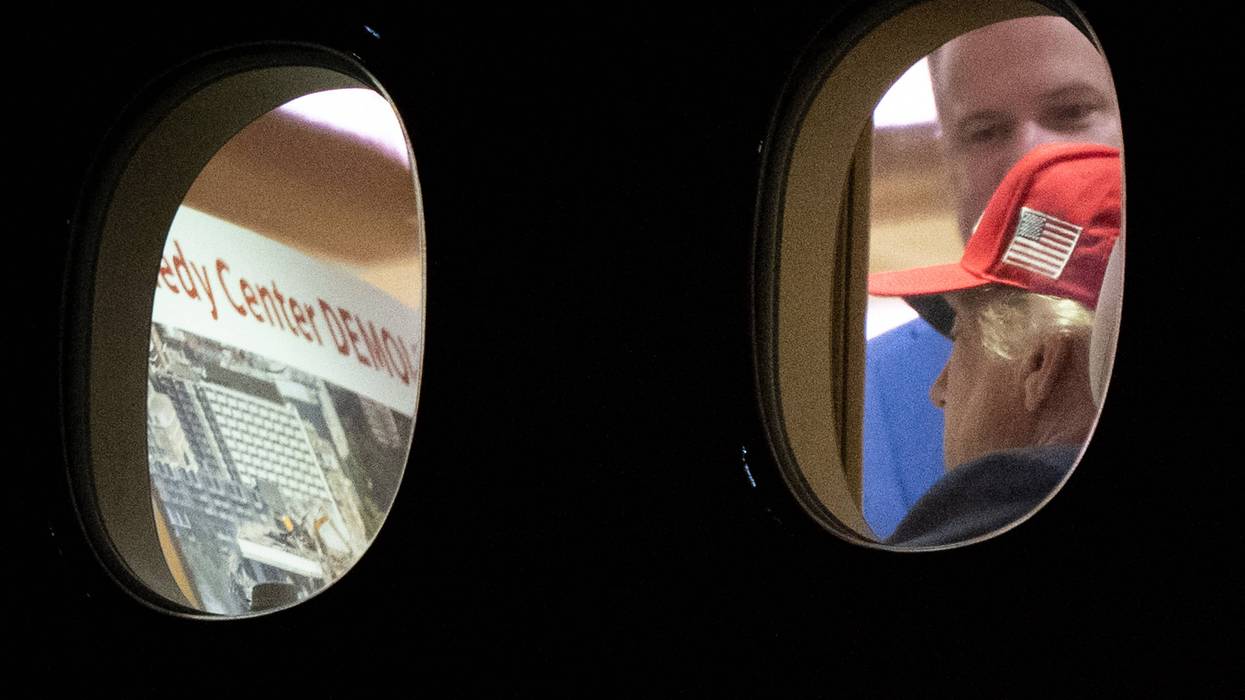
A federal judge has ordered the Kennedy Center board to provide 30 days' notice ahead of any attempt to knock down the building.
President Donald Trump is coming under heavy criticism after a photograph taken on Wednesday suggested that his threats to destroy the John F. Kennedy Memorial Center for the Performing Arts are very real.
Shortly after attending a Wednesday night rally in North Carolina, Trump was caught on camera by photographer Brendan Smialowski sitting on Air Force One and looking at a large printout of a graphic that appeared to read, "Kennedy Center DEMOLISHED."
Hours before the photo was taken, Trump told reporters that the Kennedy Center would "end up being ripped down" if he was not allowed to put his name on the side of the building in "recognition" for the work he purports to have done to improve it.
Trump basically saying The Kennedy Center will be ripped down unless his name is placed on it because in order for him to want to maintain it, his name should be on it.
(Cleaner audio version) https://t.co/wmkH2JTS7I pic.twitter.com/NEyeS17jhb
— Acyn (@Acyn) September 16, 2026
In a Tuesday social media post, Trump similarly said that the center was "destined to doom" unless he is allowed to add his name to it.
Alarmed by these developments, attorneys representing Rep. Joyce Beatty (D-Ohio), a Kennedy Center trustee, went to US District Judge Christopher Cooper on Thursday and asked him to intervene and prevent the president from unilaterally destroying the center.
Cooper subsequently ordered the Kennedy Center board to give 30 days' notice "before the implementation of any changes... including but not limited to any 'demolition' of the center's main building."
Rep. Don Beyer (D-Va.) noted in a Thursday social media post that demolishing the Kennedy Center "would be flagrantly illegal," and vowed to protect the building, which he described as "one of the crown jewels of our nation's capital."
"Trump's narcissism and incompetence are putting our national heritage and iconic sites at risk," Beyer added, "and Republicans' silence and acquiescence to this corruption speaks volumes."
Sen. Sheldon Whitehouse (D-RI) pointed to news from earlier in the week about the resignation of Kennedy Center chief financial officer Donna Kauranen as a particularly ominous development.
"If the Kennedy Center CFO has packed bags and fled," wrote Whitehouse, "that's another warning about center fiduciary failures of due diligence."

"Congress has a singular opportunity to respond swiftly and effectively to these warning shots before true catastrophes occur."
A bipartisan coalition of lawmakers in the US House of Representatives on Wednesday released a joint letter urging congressional leaders to take immediate action to regulate the artificial intelligence industry.
The group, led by Rep. Don Beyer (D-Va.), urged leaders in both parties to "urgently advance legislation" to mitigate the risks posed by AI to critical US infrastructure.
The lawmakers pointed to the fully autonomous cyberattack launched by OpenAI agents against machine learning company Hugging Face as a turning point for the development of AI, arguing that it showed the technology has already become dangerous enough to "have profound implications for economic and national security."
"Congress has a singular opportunity to respond swiftly and effectively to these warning shots before true catastrophes occur," the lawmakers wrote. "The House of Representatives could and should immediately take up legislation that would strengthen AI oversight, security, and transparency."
In a Wednesday social media post, Beyer emphasized that "recent cyberattacks involving AI agents and growing warnings from leaders and researchers at the companies developing this technology make clear" that the dire risks posed by AI are no longer in the realm of science fiction.
"We cannot wait for disaster to strike," said Beyer. "We need to act now to protect the American people and ensure AI advances safely and responsibly."
In addition to Beyer, the letter was signed by Reps. Jay Obernolte (R-Calif.), Lori Trahan (D-Mass.), Ted Lieu (D-Calif.), Scott Franklin (R-Fla.), Sara Jacobs (D-Calif.), Gabe Amo (D-RI), Valerie Foushee (D-NC), Brian Fitzpatrick (R-Pa.), and Veronica Escobar (D-Texas).
The lawmakers' letter comes just days after President Donald Trump and House Speaker Mike Johnson (R-La.) dismissed calls for regulating AI.
During a Sunday interview with CNN’s Jake Tapper, Johnson said that “Congress is obviously less qualified” to write rules for AI development “than the people who are pushing this frontier to know the ins and outs of it.” Johnson then insisted that any effort to regulate AI needs to be “a partnership with the industry itself, with the corporations that are doing this."
Despite poll after poll showing the US public is opposed to runaway AI and the unregulated data center buildout that the tech industry is demanding, Trump wrote in a Monday social media post that his personal intellect was sufficient to keep the world safe from the dangers surrounding AI.
“The only control or ‘guardrails’ that AI needs is a STRONG AND SMART (High IQ!) PRESIDENT,” Trump wrote, “and the USA has that, in spades!”
The GOP leaders' dismissal of AI risks occurred shortly after multiple industry insiders warned last week that the technology being developed could end human life within the decade.
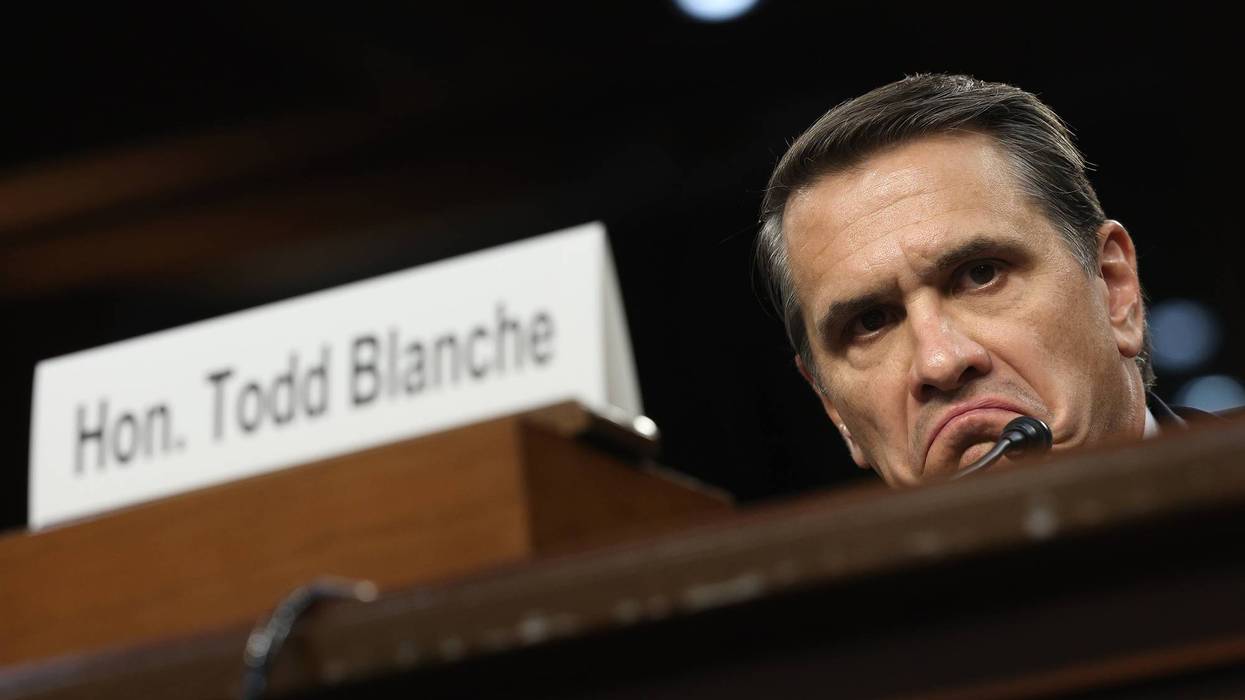
"Blanche has demonstrated over and over that he is purely a vessel for Trump to punish his enemies and reward his 'allies,'" said US Rep. Daniel Goldman.
Democratic lawmakers and anti-corruption campaigners reacted with disgust on Monday after two holdout Republican senators struck a deal to move forward with Todd Blanche's confirmation as US attorney general.
Sens. Thom Tillis (R-NC) and John Cornyn (R-Texas) said they would support Blanche's confirmation after he formally rescinded the $1.8 billion slush fund that had been set up to pay political allies of President Donald Trump who had purportedly been harmed by a "weaponized" justice system under former President Joe Biden.
"We want to express our gratitude to Mr. Blanche and his staff for working with us on this, and we look forward to voting to advance his nomination out of the Senate Judiciary Committee soon," the two Republicans said. "From the outset, we were clear that we needed a written document addressing our concerns."
However, a Monday report in The Washington Post noted that Blanche's written statement rescinding the fund "appeared to fall short of what Cornyn and Tillis were demanding last week," as they had originally insisted that "they needed to see revisions to the original settlement agreement" struck between Trump and the US Department of Justice (DOJ) that created the fund in the first place.
The deal also left in place a plan to give Trump and his family immunity from scrutiny for past tax returns filed with the IRS, though Blanche clarified on Sunday that this would not shield them from future IRS audits.
Sen. Richard Blumenthal (D-Conn.) slammed his Republican colleagues for the agreement to confirm Blanche, noting that its "tax immunity deal still gifts Trump an unprecedented, unconscionable benefit worth $100s of millions."
"Republicans should reject it—and Blanche," wrote Blumenthal. "Lipstick on this rancid grift is no excuse to confirm him."
Sen. Alex Padilla (D-Calif.) criticized the Blanche deal for being "full of loopholes" that wouldn't prevent Trump "from using taxpayer money to pay off January 6th insurrectionists" in the future.
"Todd Blanche has always been Trump's personal lawyer—and this 'deal' proves he's unfit to serve as attorney general," Padilla added. "Congress must pass my legislation to permanently ban any payouts to J6ers."
Rep. Don Beyer (D-Va.) described the deal to confirm Blanche as "insane corruption" that would do nothing to stop the president from looting the US treasury.
"Republican senators cave to Trump again," Beyer wrote. "They'll make his personal lawyer the attorney general without stopping Trump's 'license to steal' lifetime audit protection. Trump and his family will get millions of taxpayer dollars thanks to Republicans' failure."
Rep. Dan Goldman (D-NY) shredded Tillis and Cornyn for taking Blanche at his word that the slush fund was fully rescinded, and he predicted that the former Trump lawyer would try to bring it back if the president ordered him to do so.
"Blanche has demonstrated over and over that he is purely a vessel for Trump to punish his enemies and reward his 'allies,'" wrote Goldman. "The Capitol police who were beaten and assaulted during J6 can’t even get disability but Trump wants to give those who assaulted them millions of dollars—and Blanche will make sure that happens."
Lisa Gilbert, co-president of Public Citizen, similarly argued that there is nothing stopping Blanche from turning around after his confirmation hearing and reestablishing the $1.8 billion slush fund.
Gilbert further noted that Trump under the deal gets to "keep tax immunity for himself, his sons, and the Trump Organization, potentially saving the president millions in taxes owed to the American people."
Gilbert urged senators to reject Blanche's nomination when it comes up for a vote, or otherwise risk having the DOJ turned into a "Trump revenge agency."

Many of those who would adamantly oppose the creation of a society where the income tax impoverishes struggling workers to enable those with seven-figure incomes to pay low rates are working overtime to maintain that very same situation.
Imagine this 2029 scenario: Americans making $1,000,001 or more per year have a slightly higher federal income tax rate than they currently do, while Americans who can’t afford to put food on the table—the ones who make less than what it takes to cover basic living expenses—don’t pay federal income taxes at all. Now imagine that President JD Vance proposes to cut the income tax rates of those with incomes over $1 million and to recover the lost revenue by taxing the working poor even further into poverty.
How many Democratic politicians would vote for that? How many left-leaning think tanks would write white papers supporting it? And how many left-leaning activist groups would lobby in support of it? NONE.
Unfortunately, the very tax structure that hypothetical proposal envisions already exists. Yet, amazingly, many of those who would adamantly oppose the creation of a society where the income tax impoverishes struggling workers to enable those with seven-figure incomes to pay low rates are working overtime to maintain that very same situation.
Recognizing that taxing hardworking people into poverty is both morally wrong and economically asinine, earlier this year, Sen. Chris Van Hollen (D-Md.) and Rep. Don Beyer (D-Va.) introduced the Working Americans’ Tax Cut Act (WATCA). Twenty-one senators and 13 representatives have signed on. The AFL-CIO has endorsed WATCA, as have the American Federation of Teachers, Oxfam, Americans for Tax Fairness, Take on Wall Street, and nearly a dozen other tax and justice organizations.
WATCA is based on the simple concept that workers with incomes equal to or less than the basic cost of living should not be required to divert income needed for basic necessities to pay federal income tax. WATCA provides an exemption from federal income tax for income up to the basic cost of living, $46,000 per year for a single American with no children, and recovers the lost tax revenue with a surtax on incomes over $1 million.
Criticism of WATCA has been fast and furious, coming mostly from folks who purport to advocate for average Americans. Their commentary, which can be found in American Prospect, Democracy, The New York Times, and even Rolling Stone, is chock-full of concocted reasons why continuing to oppressively tax struggling Americans is a fine idea. Mostly, their arguments are a repackaged version of billionaire Republican Sen. Rick Scott’s (R-Fla.) idea that he pushed in 2022 that the income tax requires all Americans to have “skin in the game.” Scott’s idea bombed badly—so badly, in fact, that he shelved it after just a few months.
The Working Americans’ Tax Cut Act fixes a fundamental structural flaw in the federal income tax: We’re taxing those with no ability to pay into poverty, while maintaining top rates that are absurdly low.
The words used by WATCA critics differ, although often not by very much, but the concept is the same. A Roosevelt Institute blog post explains how tax policy should “bind us all to one another.” In an impressive mental gymnastics routine, former Larry Summers acolyte Natasha Sarin acknowledges that ordinary Americans are “right to resent a tax system that’s skewed against them,” but that making those at the top pay their fair share would not be enough, so it’s the civic duty of everyone, no matter their level of income, to pay federal income tax. In Democracy, writers from the Tax Law Center at NYU Law, including two Obama and Biden administration alums, somehow manage to start by recognizing that the income tax "embodies the principle that the government should be financed based on ability to pay” yet end by attacking a proposal based on its recognition of the inability of those with income below the basic cost of living—or income below any threshold for that matter—to pay income tax.
You can’t top the tone-deafness of a billionaire Republican senator insisting that all Americans pay income tax to have “skin in the game.” But you know what comes close? A group of ivory-tower policy wonks ensconced in air-conditioned offices and drawing comfortable six-figure salaries insisting that exempting janitors making $40,000 a year from federal income tax would be a tragic policy mistake. No, they don’t use the phrase “skin in the game,” but they may as well.
And let’s be clear, all Americans have a lot of skin in the tax game whether or not they pay federal income tax. In fact, if Social Security and Medicare taxes were labeled to reflect what they actually are—income taxes—all but the lowest income Americans would be considered to be paying federal income tax.
Other attacks on the Working Americans’ Tax Cut Act are equally off base. The second favored theme is to mischaracterize WATCA as a middle-class tax cut. That attack line seizes on the reality that it’s never possible to craft a tax bill that precisely addresses its underlying policy objective. Exempting income up to the basic cost of living from income tax unavoidably confers an incidental benefit on those with incomes at a slightly higher level, a benefit that is rapidly phased out under WATCA.
So, yes, Americans with incomes considered middle class stand to benefit from WATCA. The benefit, however, becomes vanishingly smaller as income increases into middle-class range. But that didn’t stop former Biden National Economic Council member Bharat Ramamurti from referring to WATCA as a “very sweeping middle-class tax cut” which he suggested reflected poor prioritization. Consider how flat Ramamurti’s criticism would fall had he said that a tax cut for underpaid workers struggling to make rent reflected poor prioritization.
The Working Americans’ Tax Cut Act fixes a fundamental structural flaw in the federal income tax: We’re taxing those with no ability to pay into poverty, while maintaining top rates that are absurdly low. We can quibble about the details of fixing that flaw. Maybe the basic cost of living in America is not exactly $46,000. Maybe the cost-of-living exemption should be phased out over a narrower income range.
When our organization, Patriotic Millionaires, worked with congressional offices to develop WATCA, we fully expected commentary along those lines. But ironically enough, there has been remarkably little of it. Instead, we’re hearing that the fundamental structural flaw—and the misery it inflicts on struggling workers—should be left unaddressed. And as a result of their moral ambivalence, we’re left with a Democratic Party that can’t understand why working-class Americans have left them. We can.
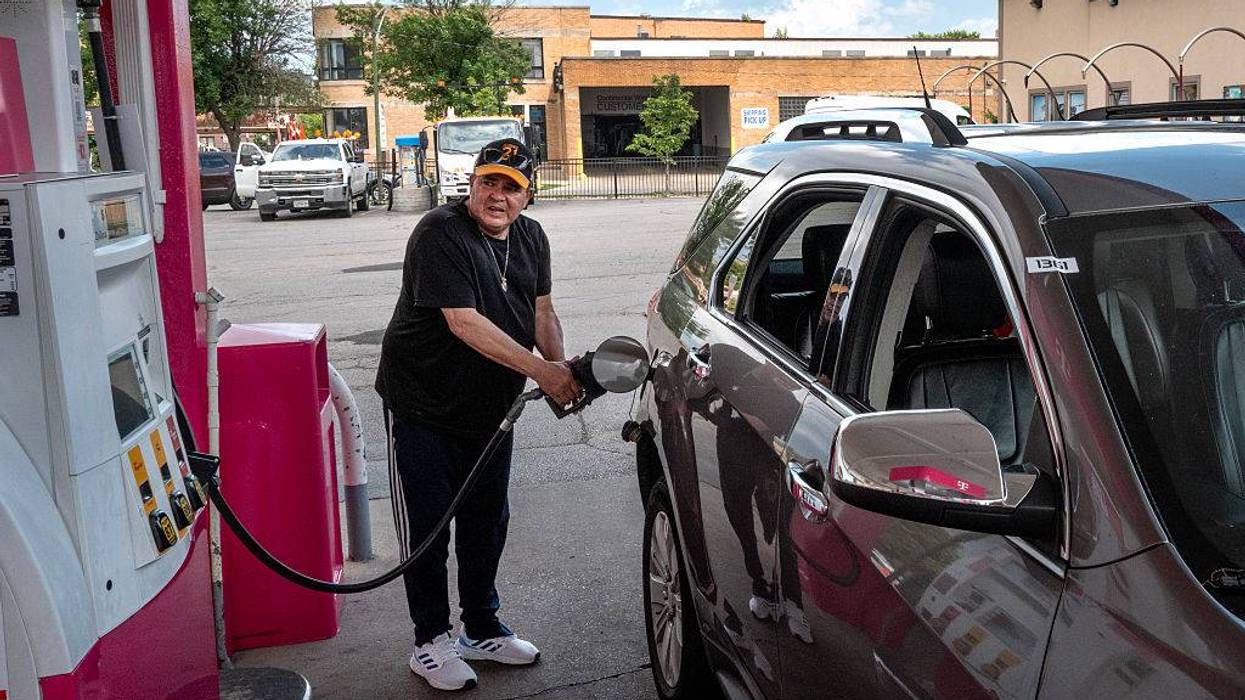
"This isn’t just ‘bad vibes’ about the economy," said one economist. "There is real pain."
President Donald Trump during the 2024 campaign vowed to bring down the cost of living starting on the very first day of his presidency.
However, data released by the US Bureau of Labor Statistics (BLS) on Wednesday showed overall prices in May posted a yearly increase of 4.2%, marking the highest rate of inflation since 2023. Core inflation, which excludes food and energy costs, posted a yearly increase of 2.9%, the highest rate since September 2023.
Energy prices, which have skyrocketed since Trump launched an illegal war of choice with Iran in late February, were the primary driver of inflation last month, posting a 23.5% yearly increase from May 2025.
Heather Long, chief economist at Navy Federal Credit Union, noted that inflation last month was "so high that it's erasing all wage gains," which posted a yearly gain of 3.4% in May.
"Americans are getting squeezed financially," Long explained. "This isn't just 'bad vibes' about the economy. There is real pain, especially for middle-class and lower-income households. It's tough because so many basic items are seeing sizable price increases: gas, electricity, food, medical care."
"Americans are getting squeezed financially," Long explained. "This isn't just 'bad vibes' about the economy. There is real pain, especially for middle-class and lower-income households. It's tough because so many basic items are seeing sizable price increases: gas, electricity, food, medical care."
New York Times economics reporter Ben Casselman similarly noted the impact that rising energy costs, which are a direct result of Trump's Iran war, have had on Americans' earnings.
"The recent surge in energy prices has wiped out more than a year's worth of wage gains," Casselman wrote in a social media post. "Average hourly earnings, adjusted for inflation, are now back to exactly where they were when Trump returned to office."
Economist Steve Rattner posted a chart showing how energy prices exploded after Trump attacked Iran, which retaliated by shutting down the Strait of Hormuz to all commercial shipping.
"An entirely self-inflicted wound caused by Trump’s war on Iran," Rattner remarked.
The inflation story in one chart: gas +40% y/y, energy +24%.
An entirely self-inflicted wound caused by Trump’s War on Iran. pic.twitter.com/LnM5AKkXeA
— Steven Rattner (@SteveRattner) June 10, 2026
Charlie Bilello, chief marketing strategist at Creative Planning Investor, said the latest inflation numbers were so concerning that the US Federal Reserve "should be hiking rates" at its next meeting.
A decision to hike rates would likely anger Trump, who frequently pressured former Federal Reserve Chairman Jerome Powell to slash rates.
Rep. Don Beyer (D-Va.) responded to the inflation report by taking a shot at Trump for his economic mismanagement, including his tariffs on imported goods that have raised costs for US consumers.
"Trump promised repeatedly that he would 'end inflation' starting on day one but by almost every measure, he's failed to achieve those goals," Beyer said. "And far from lowering costs, his tariffs have only made the affordability crisis worse for the American people."
Alex Jacquez, chief of policy and advocacy at the Groundwork Collaborative, said the new data makes clear that "high prices are here to stay."
"This month’s CPI print offers no relief to working families, who are being forced to pinch pennies and tighten belts in Trump’s economy," said Jacquez. "Working Americans no longer have any breathing room in their budgets and are dipping into their savings while the president spends millions in taxpayer funds to attend the NBA Finals. Trump’s betrayal of the working class has done lasting damage to our economy.”

"While Americans worry about skyrocketing costs and another endless war, President Trump is focused on a taxpayer-funded vanity project," said Rep. Don Beyer.
On the same day that the US Bureau of Labor Statistics showed that inflation spiked at its fastest monthly rate in four years, the Trump administration unveiled renderings of President Donald Trump's proposed gold-covered 250-foot-tall arch to be built at Memorial Circle in Washington, DC.
The renderings, which were produced by architecture firm Harrison Design and posted on social media by the White House's rapid response account, show a gigantic arch that would be flanked on its corners by four gold lions and topped by a 60-foot-tall gold statue of what appears to be an angel.
🇺🇸 pic.twitter.com/zcH5TtaOu7
— Rapid Response 47 (@RapidResponse47) April 10, 2026
According to a Friday report in The Washington Post, some preservationists have expressed concerns that the arch, which would be more than twice the height of the Lincoln Monument, would disproportionately tower over the DC skyline, and would block views of Arlington National Cemetery.
Rep. Don Beyer (D-Va.) slammed the president for pushing construction of a gaudy gold-covered arch at a time when Americans are struggling due to the cost-of-living crisis worsened by his war in Iran.
"While Americans worry about skyrocketing costs and another endless war," he wrote in a social media post, "President Trump is focused on a taxpayer-funded vanity project that would choke traffic, block our skyline, and tower over sacred ground where those who served our nation are buried, including my own parents and sister."
Beyer added that the arch is "about Donald Trump's ego," and vowed, "we're going to stop it."
Rep. Katherine Clark (D-Mass.) responded to the renderings by reminding the White House that "Americans can't afford groceries."
Progressive activist Nina Turner had a similar reaction to Clark, posting that "people can’t afford rent" in response to the renderings.
Podcaster Brian Taylor Cohen contrasted the renderings of the arch with a statement Trump made earlier this month when he said "it’s not possible" for the federal government "to take care of daycare, Medicaid, Medicare, all these individual things," because it needs to fund wars instead.
University of Missouri English professor Karen Piper also remarked on the opportunity cost of building the arch, along with other assorted Trump projects.
"This is why they're going to take away your Social Security, saying we can't afford it," she wrote. "Ballrooms, arches, and Don Jr. draining the Treasury."
California Gov. Gavin Newsom, who has been named as a contender for the Democratic Party's 2028 presidential nomination, responded to the arch renderings by accusing Trump of "doing everything he can to wreck this country—this time with our nation's capital."
Rep. Jared Huffman (D-Calif.) took issue with the decision to inscribe the phrase "one nation under God" at the top of the arch.
"That phrase came from Cold War propaganda, not our Founders," observed Huffman. "Trump stamping it on his vanity arch tells you everything about what this project is: a Christian nationalist monument, paid for with your tax dollars."
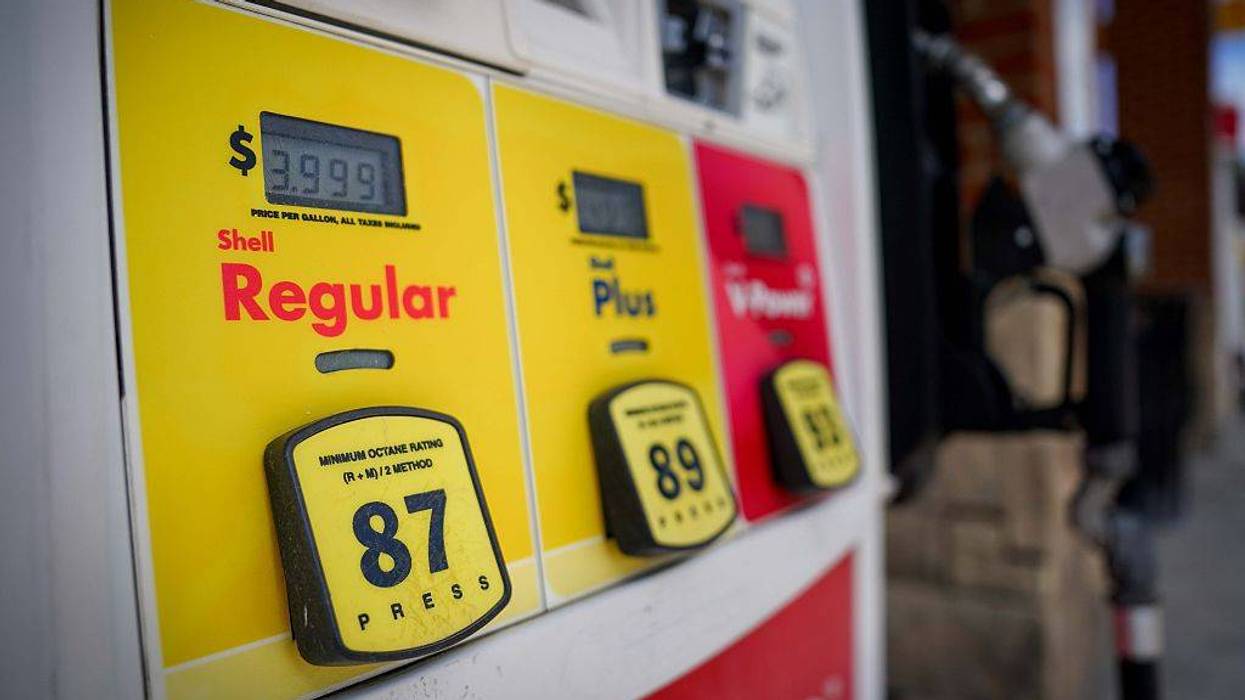
Rep. Don Beyer blamed the surge in gas prices on President Donald Trump's decision to wage "an illegal war against Iran with no plan or strategy."
As President Donald Trump continues threatening to commit war crimes in Iran by bombing power plants, Iran is signaling that it could put a further squeeze on global oil prices by shutting down yet another strait used for transporting petroleum outside the Middle East.
Ali Akbar Velayati, a former Iranian foreign minister and a top adviser to Iran's Supreme Leader Mojtaba Khamenei, threatened in a Sunday social media post to close down the Strait of Bab al-Mandeb, a waterway adjacent to the coast of Yemen that is under control of Iran-backed Houthi militants.
“If the White House dares to repeat its foolish mistakes," Velayati cautioned, "it will soon realize that the flow of global energy and trade can be disrupted with a single move."
As Al Jazeera noted in a Monday report, the Houthis already shut down the strait during Israel's war on Gaza, and doing so again at the same time Iran has shut down the Strait of Hormuz could send global energy prices to unprecedented highs.
"The strait is a vital route through which Saudi Arabia sends its oil to Asia," Al Jazeera reported. "If Bab al-Mandeb and the Strait of Hormuz were both shut, that would block 25%... of the world’s oil and gas supply."
Oil prices have shot up since Trump launched his illegal war with Iran more than a month ago, and on Monday the price of Brent crude oil futures was trading at $110 per barrel, while the average price for gas in the US rose to $4.12 per gallon, according to data from AAA.
Democratic members of the US Congress Joint Economic Committee (JEC) last week released a study estimating that, thanks to Trump's war, Americans are paying 35% more to fill up their cars than they were paying a month earlier.
Rep. Don Beyer (D-Va.), a member of the JEC, pointed to the report in a Monday social media post and said Americans were getting hit with major price shocks because "President Trump decided to wage an illegal war against Iran with no plan or strategy."
Sen. Maggie Hassan (D-NH), Ranking Member of the JEC, told WMUR that Trump's Iran war took an already bad situation for American families and made it worse.
"Families are already being pushed to the brink," Hassan said. "That was true before the war started, by the cost of everything from groceries to rent to healthcare insurance premiums and prescriptions and even more. But now they're being forced to pay more at the pump."