SUBSCRIBE TO OUR FREE NEWSLETTER
Daily news & progressive opinion—funded by the people, not the corporations—delivered straight to your inbox.
5
#000000
#FFFFFF
To donate by check, phone, or other method, see our More Ways to Give page.
Daily news & progressive opinion—funded by the people, not the corporations—delivered straight to your inbox.
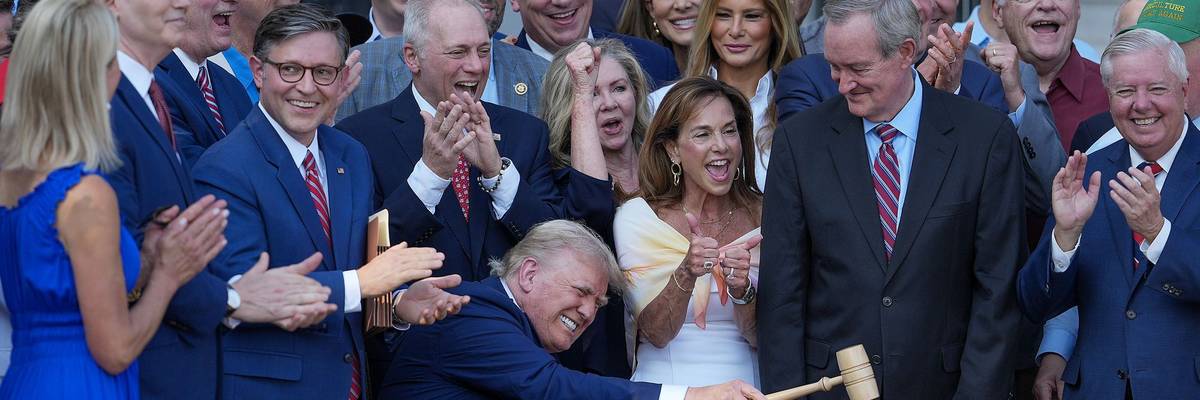
US President Donald Trump, joined by Republican lawmakers and others including First Lady Melania Trump, wields a gavel after signing the One Big Beautiful Bill Act into law on the South Lawn of the White House on July 4, 2025 in Washington, DC.
“You cannot change what a company did in the past, so that half-year of retroactive effect of the provision is just a windfall to companies," said one critic.
Corporations are likely to claim $16 billion in fresh tax breaks on expenditures made before the passage of the budget legislation signed earlier this year by US President Donald Trump, according to an analysis by a nonpartisan congressional committee released Tuesday.
The analysis by the Joint Committee on Taxation (JCT)—a panel composed of five members each from the Senate Finance Committee and House Ways and Means Committee—came in response to a September query from Sen. Elizabeth Warren (D-Mass.) regarding the One Big Beautiful Bill Act's (OBBBA) extension of full bonus depreciation, a tax-savings tool allowing businesses to automatically deduct costs of qualifying assets.
As Warren explained in her letter, full bonus depreciation enables corporations "to immediately deduct some or all of the cost of new business investments, such as the purchase of manufacturing equipment, software, and furniture, rather than deducting those costs over the estimated lifetime of those assets."
"This policy was first implemented in 2010 as an intended temporary economic stimulus in the aftermath of the Great Recession, and Congress allowed it to expire the following year," Warren noted.
"However, President Trump’s 2017 tax law reinstated 100% bonus depreciation from 2018 through 2022 in what amounted to a massive corporate giveaway," the senator continued, highlighting nearly $67 billion in tax savings for more than two dozen corporations including Google, Facebook, UPS, and Target.
"And after extensive lobbying from billionaire-funded right-wing lobbying groups, the OBBBA reinstated 100% bonus depreciation permanently to the tune of hundreds of billions of more dollars over the next decade," Warren added.
Applying retroactively to capital expenditures since January 19, corporate tax deductions under the OBBBA's reinstatement of the full bonus depreciation will cost $16 billion in lost federal revenue, according to the JCT's analysis. The tool has been hailed as game-changer for Bitcoin miners, who can write off 100% of hardware costs in the year of purchase.
The OBBBA provision allows firms to use the deduction to write off certain qualifying business-related properties, such as corporate jets. Meanwhile, millions of lower-income US households are suffering from the law's unprecedented cuts to vital social programs including Medicaid and the Supplemental Nutrition Assistance Program.
While proponents of the full bonus depreciation argue that large corporations benefit most from the tool because they make up the lion's share of investments, critics point out that such breaks are generally poor investment incentives because they are applied after companies have already made their spending decisions.
“Thanks to Donald Trump and Republicans’ Big Beautiful Bill, giant corporations will win big while American families see their costs skyrocket," Warren said Tuesday in response to the JCT analysis. "Next year, the federal government will spend over five times more on these tax handouts for billionaire corporations than it spends each year on childcare."
"Time and time again, Donald Trump and Republicans have made clear that they stand with billionaires and billionaire corporations—not American families," she added.
Numerous corporations taking advantage of the full bonus depreciation have paid effective federal corporate tax rates far below the statutory 21%, according to a 2023 analysis by the Institute on Taxation and Economic Policy (ITEP).
One tax expert called the deduction "a cheat code to saving millions in taxes," as thousands of companies have dodged paying their fair share by effectively reducing their income to zero, or even making it negative.
As Warren noted Tuesday, "over 80% of the 100% bonus depreciation claimed by corporations from 2018-22 went to companies with over $1 billion in yearly income," while "99% of bonus depreciation benefits went to corporations making over $1 million annually."
ITEP federal policy director Steve Wamhoff told the Washington Post Tuesday that “it is quite obvious that if an incentive is retroactive, it is not actually an effective incentive."
“You cannot change what a company did in the past, so that half-year of retroactive effect of the provision is just a windfall to companies," Wamhoff added. "That part is just ridiculous.”
Dear Common Dreams reader, It’s been nearly 30 years since I co-founded Common Dreams with my late wife, Lina Newhouser. We had the radical notion that journalism should serve the public good, not corporate profits. It was clear to us from the outset what it would take to build such a project. No paid advertisements. No corporate sponsors. No millionaire publisher telling us what to think or do. Many people said we wouldn't last a year, but we proved those doubters wrong. Together with a tremendous team of journalists and dedicated staff, we built an independent media outlet free from the constraints of profits and corporate control. Our mission has always been simple: To inform. To inspire. To ignite change for the common good. Building Common Dreams was not easy. Our survival was never guaranteed. When you take on the most powerful forces—Wall Street greed, fossil fuel industry destruction, Big Tech lobbyists, and uber-rich oligarchs who have spent billions upon billions rigging the economy and democracy in their favor—the only bulwark you have is supporters who believe in your work. But here’s the urgent message from me today. It's never been this bad out there. And it's never been this hard to keep us going. At the very moment Common Dreams is most needed, the threats we face are intensifying. We need your support now more than ever. We don't accept corporate advertising and never will. We don't have a paywall because we don't think people should be blocked from critical news based on their ability to pay. Everything we do is funded by the donations of readers like you. When everyone does the little they can afford, we are strong. But if that support retreats or dries up, so do we. Will you donate now to make sure Common Dreams not only survives but thrives? —Craig Brown, Co-founder |
Corporations are likely to claim $16 billion in fresh tax breaks on expenditures made before the passage of the budget legislation signed earlier this year by US President Donald Trump, according to an analysis by a nonpartisan congressional committee released Tuesday.
The analysis by the Joint Committee on Taxation (JCT)—a panel composed of five members each from the Senate Finance Committee and House Ways and Means Committee—came in response to a September query from Sen. Elizabeth Warren (D-Mass.) regarding the One Big Beautiful Bill Act's (OBBBA) extension of full bonus depreciation, a tax-savings tool allowing businesses to automatically deduct costs of qualifying assets.
As Warren explained in her letter, full bonus depreciation enables corporations "to immediately deduct some or all of the cost of new business investments, such as the purchase of manufacturing equipment, software, and furniture, rather than deducting those costs over the estimated lifetime of those assets."
"This policy was first implemented in 2010 as an intended temporary economic stimulus in the aftermath of the Great Recession, and Congress allowed it to expire the following year," Warren noted.
"However, President Trump’s 2017 tax law reinstated 100% bonus depreciation from 2018 through 2022 in what amounted to a massive corporate giveaway," the senator continued, highlighting nearly $67 billion in tax savings for more than two dozen corporations including Google, Facebook, UPS, and Target.
"And after extensive lobbying from billionaire-funded right-wing lobbying groups, the OBBBA reinstated 100% bonus depreciation permanently to the tune of hundreds of billions of more dollars over the next decade," Warren added.
Applying retroactively to capital expenditures since January 19, corporate tax deductions under the OBBBA's reinstatement of the full bonus depreciation will cost $16 billion in lost federal revenue, according to the JCT's analysis. The tool has been hailed as game-changer for Bitcoin miners, who can write off 100% of hardware costs in the year of purchase.
The OBBBA provision allows firms to use the deduction to write off certain qualifying business-related properties, such as corporate jets. Meanwhile, millions of lower-income US households are suffering from the law's unprecedented cuts to vital social programs including Medicaid and the Supplemental Nutrition Assistance Program.
While proponents of the full bonus depreciation argue that large corporations benefit most from the tool because they make up the lion's share of investments, critics point out that such breaks are generally poor investment incentives because they are applied after companies have already made their spending decisions.
“Thanks to Donald Trump and Republicans’ Big Beautiful Bill, giant corporations will win big while American families see their costs skyrocket," Warren said Tuesday in response to the JCT analysis. "Next year, the federal government will spend over five times more on these tax handouts for billionaire corporations than it spends each year on childcare."
"Time and time again, Donald Trump and Republicans have made clear that they stand with billionaires and billionaire corporations—not American families," she added.
Numerous corporations taking advantage of the full bonus depreciation have paid effective federal corporate tax rates far below the statutory 21%, according to a 2023 analysis by the Institute on Taxation and Economic Policy (ITEP).
One tax expert called the deduction "a cheat code to saving millions in taxes," as thousands of companies have dodged paying their fair share by effectively reducing their income to zero, or even making it negative.
As Warren noted Tuesday, "over 80% of the 100% bonus depreciation claimed by corporations from 2018-22 went to companies with over $1 billion in yearly income," while "99% of bonus depreciation benefits went to corporations making over $1 million annually."
ITEP federal policy director Steve Wamhoff told the Washington Post Tuesday that “it is quite obvious that if an incentive is retroactive, it is not actually an effective incentive."
“You cannot change what a company did in the past, so that half-year of retroactive effect of the provision is just a windfall to companies," Wamhoff added. "That part is just ridiculous.”
Corporations are likely to claim $16 billion in fresh tax breaks on expenditures made before the passage of the budget legislation signed earlier this year by US President Donald Trump, according to an analysis by a nonpartisan congressional committee released Tuesday.
The analysis by the Joint Committee on Taxation (JCT)—a panel composed of five members each from the Senate Finance Committee and House Ways and Means Committee—came in response to a September query from Sen. Elizabeth Warren (D-Mass.) regarding the One Big Beautiful Bill Act's (OBBBA) extension of full bonus depreciation, a tax-savings tool allowing businesses to automatically deduct costs of qualifying assets.
As Warren explained in her letter, full bonus depreciation enables corporations "to immediately deduct some or all of the cost of new business investments, such as the purchase of manufacturing equipment, software, and furniture, rather than deducting those costs over the estimated lifetime of those assets."
"This policy was first implemented in 2010 as an intended temporary economic stimulus in the aftermath of the Great Recession, and Congress allowed it to expire the following year," Warren noted.
"However, President Trump’s 2017 tax law reinstated 100% bonus depreciation from 2018 through 2022 in what amounted to a massive corporate giveaway," the senator continued, highlighting nearly $67 billion in tax savings for more than two dozen corporations including Google, Facebook, UPS, and Target.
"And after extensive lobbying from billionaire-funded right-wing lobbying groups, the OBBBA reinstated 100% bonus depreciation permanently to the tune of hundreds of billions of more dollars over the next decade," Warren added.
Applying retroactively to capital expenditures since January 19, corporate tax deductions under the OBBBA's reinstatement of the full bonus depreciation will cost $16 billion in lost federal revenue, according to the JCT's analysis. The tool has been hailed as game-changer for Bitcoin miners, who can write off 100% of hardware costs in the year of purchase.
The OBBBA provision allows firms to use the deduction to write off certain qualifying business-related properties, such as corporate jets. Meanwhile, millions of lower-income US households are suffering from the law's unprecedented cuts to vital social programs including Medicaid and the Supplemental Nutrition Assistance Program.
While proponents of the full bonus depreciation argue that large corporations benefit most from the tool because they make up the lion's share of investments, critics point out that such breaks are generally poor investment incentives because they are applied after companies have already made their spending decisions.
“Thanks to Donald Trump and Republicans’ Big Beautiful Bill, giant corporations will win big while American families see their costs skyrocket," Warren said Tuesday in response to the JCT analysis. "Next year, the federal government will spend over five times more on these tax handouts for billionaire corporations than it spends each year on childcare."
"Time and time again, Donald Trump and Republicans have made clear that they stand with billionaires and billionaire corporations—not American families," she added.
Numerous corporations taking advantage of the full bonus depreciation have paid effective federal corporate tax rates far below the statutory 21%, according to a 2023 analysis by the Institute on Taxation and Economic Policy (ITEP).
One tax expert called the deduction "a cheat code to saving millions in taxes," as thousands of companies have dodged paying their fair share by effectively reducing their income to zero, or even making it negative.
As Warren noted Tuesday, "over 80% of the 100% bonus depreciation claimed by corporations from 2018-22 went to companies with over $1 billion in yearly income," while "99% of bonus depreciation benefits went to corporations making over $1 million annually."
ITEP federal policy director Steve Wamhoff told the Washington Post Tuesday that “it is quite obvious that if an incentive is retroactive, it is not actually an effective incentive."
“You cannot change what a company did in the past, so that half-year of retroactive effect of the provision is just a windfall to companies," Wamhoff added. "That part is just ridiculous.”