

5
#000000
#FFFFFF
To donate by check, phone, or other method, see our More Ways to Give page.
Daily news & progressive opinion—funded by the people, not the corporations—delivered straight to your inbox.
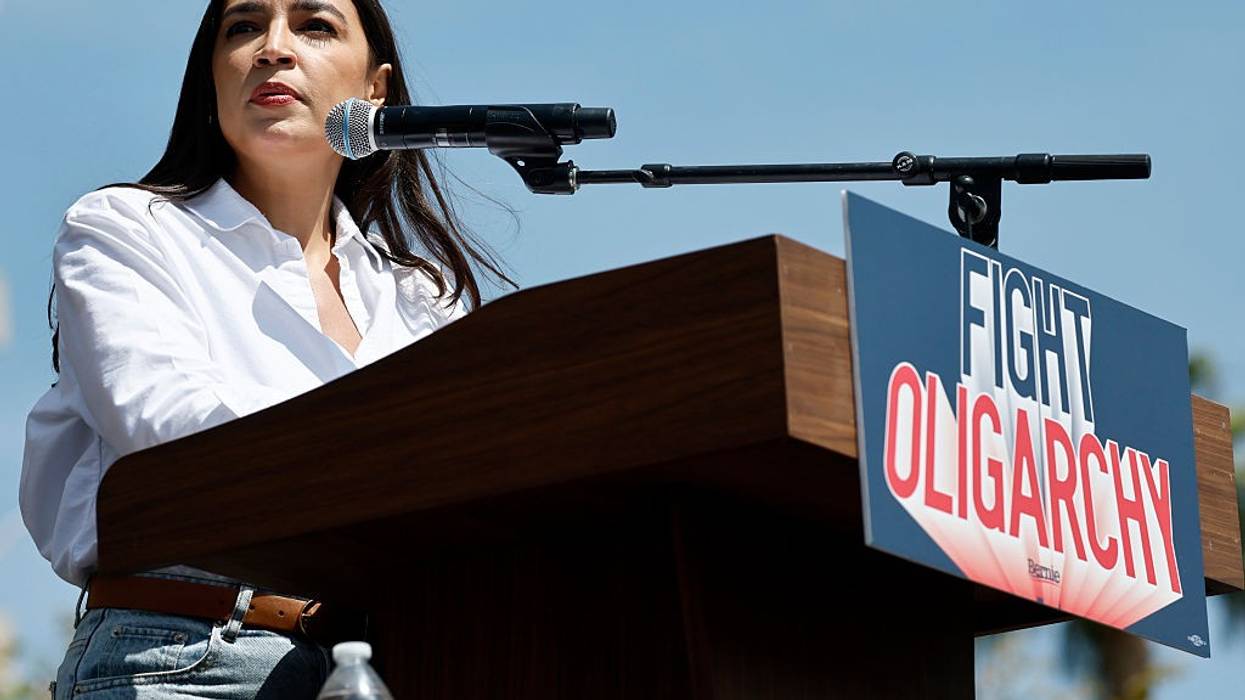
Before running for president, she needs to prove she can build a national workng-class coalition.
The bandwagon for Democratic New York Rep. Alexandria Ocasio-Cortez to run for president is rolling. She appears to have all the requisite qualities for success—smart, charismatic, passionate about her beliefs, and wildly popular among students and the left as well as among college-educated liberals. She is positioned as the successor to Independent Vermont Sen. Bernie Sanders after their successful Fighting Oligarchy series of rallies last year. And as a national candidate she could carry the social democratic banner forward, bringing, at the very least, tens of thousands of new members into the Democratic Socialists of America.
Bhaskar Sunkara, the founding editor of Jacobin, believes AOC “can run a serious national campaign on the left and pull a movement behind it,” but in making his case he also points out a major shortcoming—she is not really a working-class candidate and doesn’t have a visceral understanding of class.
Sunkara frankly acknowledges that AOC, unlike Bernie, “sometimes drift(s) into the dialect of the progressive nonprofit and academic world, using terms more familiar in seminar rooms than union halls.”
For example, he points to the congresswoman’s response in 2022 to Democrats who objected to the use of Latinx, a term used by only about 3% of Hispanics. Sunkara says, “She suggested “Latine” as an improvement—a solution to a problem most Latinos didn’t know they had.”
Progressive dreams cannot become reality without extensive working-class support.
AOC’s promotion of the Green New Deal attempted to bridge the concerns of environmentalists and members concerned about social justice issues but suffered from her failure to frame it in terms of class. Sunkara describes her floor resolution as almost a parady of balkanized intersectionality discourse, He writes:
That resolution promised to repair the historic oppression of Indigenous peoples, communities of color, migrant communities, deindustrialized communities, depopulated rural communities, the poor, low-income workers, women, elderly people, unhoused people, people with disabilities, and youth. Of course, nobody on that list is unwronged. But itemizing members of the same economic class as discrete interest groups was the opposite of how the 2016 Sanders campaign spoke, and of how the left traditionally has. It was the scholarly language of intersectionality, not the commonsense solidarity she was trying to inspire.
Nevertheless, Sunkara is all in on an AOC candidacy in 2028.
I’m not.
My biggest concern is that we have scant evidence that AOC can succeed among working-class voters, especially white working-class voters. She has won election four times in an overwhelmingly Democratic district that is 52% Hispanic and only 18% white. New York’s 14th Congressional District, created in 2012, has never elected a Republican. Its predecessor, the 7th District, was represented by Democrats continuously from 1969 onward. AOC has yet to be tested in purple or red districts.
Sunkara points to the enormous crowds she and Bernie drew during their Fighting Oligarchy tour in conservative areas:
More than 12,500 people turned out for a rally in Nampa, Idaho, a bigger crowd than the number of registered Democrats in the entire county. Twenty thousand came out in deep-red Utah.
The Fighting Oligarchy tour certainly shows that the Sanders-AOC partnership has extraordinary appeal. It does not yet prove that AOC, by herself, can draw comparable crowds in red America.
And let’s put those numbers in perspective. In Idaho’s Canyon County, in which Nampa is located, there are roughly 68,000 registered Republicans, 32,000 unaffiliated voters, and only 12,000 registered Democrats. In Utah, more than 1 million voters (49%) are registered Republicans, while only about 14%, 250,000 or so, are Democrats. Those rallies suggest AOC could do well in Democratic primaries in red states, but they provide little support for the idea that AOC can break through the Republican advantage in deeply conservative areas.
But for the sake of argument, let’s say AOC wins the Democratic nomination in 2028. How might she fare against a Republican such as Vice President JD Vance, Secretary of State Marco Rubio, or Sen. Josh Hawley (R-Mo.)?
Foreign policy experience is likely to be a major issue. AOC, to date, has no diplomatic, military, intelligence, or executive national security experience. Nor has she served on the House Armed Services Committee, where much of Congress’ work on national security takes place. Think what you will about Vance and Rubio, they have been immersed in foreign policy in the second Trump term. Convincing skeptical voters that she is prepared to lead the country through major international crises will be a significant challenge because of her lack of experience.
On the electoral front, AOC needs to prove to voters like me that she can appeal to the working class. Can she attract a broader base than the one she has needed to win reelection in her home district? One way to do that would be to challenge and beat Chuck Schumer for New York’s Senate seat and then defeat the Republican nominee in the general election. There’s a good chance she could win both races, and if she did we would have a much clearer picture of whether she can sell a progressive program to working-class New Yorkers who do not live in overwhelmingly Democratic districts.
That experience and the success that followed would make her a much stronger candidate for higher office. And what is the rush? Ocasio-Cortez is only 36 years old. It is not asking too much for her to gain more experience and learn how to translate her ideological commitments into the kind of class-centered politics that Bernie Sanders mastered. She will undoubtedly continue to inspire the DSA faithful, a younger and well-educated cohort, but until I see her build genuine enthusiasm among blue-collar and service workers, I’m choosing to remain skeptical.
As I’ve written before, progressive dreams cannot become reality without extensive working-class support. Let’s see her do the hard work of winning its allegiance.
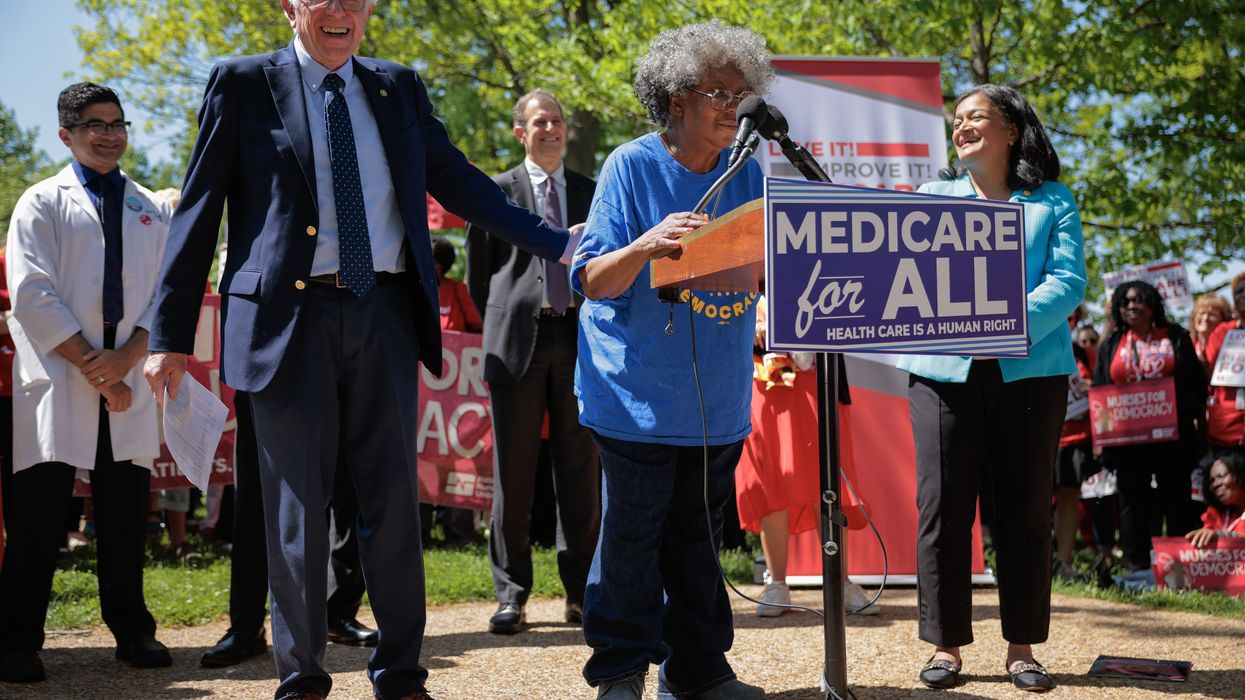
"Do not tell me we cannot afford Medicare for All," said Sen. Bernie Sanders. "What we cannot afford is a broken healthcare system based on greed."
Previous research has shown that shifting the United States to a Medicare for All system could save roughly 68,000 lives and $650 billion per year, but a new study by experts at Yale University suggests the savings would likely be even greater on both fronts.
In a Tuesday statement, Sen. Bernie Sanders (I-Vt.), lead sponsor of the Medicare for All Act in the Senate, highlighted the findings, published recently on medRxiv, a server for preprints, or research that hasn't yet been peer reviewed.
"The US spends more on healthcare than any other nation, yet tens of millions of Americans are uninsured or underinsured, and coverage retractions enacted in 2025 are widening these gaps," the five experts wrote.
Upward of 15 million Americans could lose health insurance coverage over the next decade because of Medicaid cuts in President Donald Trump's so-called One Big Beautiful Bill Act and the Republican-led Congress' failure to extend Affordable Care Act subsidies that expired at the end of last year.
"The misalignment between the for-profit insurance architecture and optimal patient care, together with the inefficiencies of a fragmented system, contributes to both unnecessary costs and preventable mortality," according to the Yale researchers. "We update our previous analyses with the most recent data to project the economic benefits and the number of lives saved that would be achieved by single-payer universal coverage, as proposed in the Medicare for All Act."
"We estimate that such a system would reduce national health expenditure by $1,041 billion annually," they explained. "Sources of savings include reductions in administrative overhead, pharmaceutical prices, fraudulent billing, and avoidable emergency care. Combined with the reversal of recent retractions, universal coverage would save over 114,000 lives annually."
Specifically, as Sanders' office detailed in a statement, Americans would save:
Welcoming the findings, the senator declared that "this study confirms what we have known for years: Medicare for All saves lives and saves money. In fact, guaranteeing healthcare as a human right through a Medicare for All, single-payer system would cost $1 trillion less than our current dysfunctional system."
"It would save working families thousands of dollars a year. And it would prevent over 100,000 Americans from dying unnecessarily each and every year because they cannot make it to a doctor in time," he stressed. "At a time when 15 million Americans are being thrown off the healthcare they have and 20 million Americans have already seen their premiums double, on average, as a result of Trump's so-called 'Big Beautiful Bill,' we need Medicare for All now more than ever."
"The time is now to end the greed of the big insurance and drug companies and pass Medicare for All," he added.
The research comes as Americans face high prices for not only healthcare but also food, gasoline, housing, and more under President Donald Trump and the GOP-led Congress. It also comes amid a renewed push by hundreds of advocacy groups that support Medicare for All and a wave of victories by progressive candidates who support the policy.
Among them is former Detroit health official Abdul El-Sayed, who won the Democratic primary for US Senate in Michigan last week having campaigned on a promise to prioritize "money out of politics, money in your pocket, and Medicare for All." His victory followed those of various other candidates, from Colorado to New York and Pennsylvania.
However, it's not just elected Republicans standing the way of a transition to universal healthcare in the United States. As a Monday analysis from the investigative outlet Sludge shows, the health insurance industry is pouring money into Third Way, a think tank reportedly preparing to spend $15 million combating the rise of candidates who support progressive policies including Medicare for All.

"I would hope that we can all agree that Republican special interests should not play a role in determining the outcome of Democratic primaries. The time to act is now."
US Sen. Bernie Sanders on Monday urged national Democratic leaders to impose a total ban on super PAC spending in primary contests, a change that the progressive senator said is necessary to prevent corporate interests from heavily influencing the party's electoral outcomes.
In a letter addressed to Senate Minority Leader Chuck Schumer (D-NY), House Minority Leader Hakeem Jeffries (D-NY), and Democratic National Committee Chair Ken Martin, Sanders (I-Vt.) wrote that "what is particularly obscene is not only the outrageous amount of money coming into Democratic primaries from billionaire-funded super PACs, but the reality that these special interests have no particular desire to see Democrats win."
Sanders, who caucuses with the Democratic Party, cited as a telling example the American Israel Public Affairs Committee's $30 million intervention in the Democratic primary for a critical US Senate seat in Michigan. The organization, known as AIPAC, spent heavily to boost Rep. Haley Stevens (D-Mich.) and attempt to tear down her progressive opponent, Abdul El-Sayed—who went on to win the race despite being massively outspent.
AIPAC is now reportedly planning to spend big in support of El-Sayed's Republican general election opponent, Mike Rogers.
"It is absurd that they spend tens of millions of dollars to try to determine who the Democratic nominee is and, if they fail, then proceed to support the Republican candidate in the general election," Sandres wrote. "That is not democracy. That is not what Democratic voters want."
Sanders emphasized his support for passage of a constitutional amendment to repeal the US Supreme Court's 2010 Citizens United decision, which paved the way for the establishment and proliferation of super PACs—entities that can raise and spend unlimited sums supporting or opposing political campaigns.
"BUT WE DO NOT HAVE TO WAIT," Sanders wrote in all caps. "Right now, the Democratic Party has the power to prohibit super PACs from participating in its primaries. That can be done. That must be done. I urge you to take action and make clear that the Democratic Party will no longer maintain this corrupt system."
"While there are ideological differences of opinion within the big tent of the party, I would hope that we can all agree that Republican special interests should not play a role in determining the outcome of Democratic primaries," the senator continued. "The time to act is now."
The DNC has repeatedly faced calls in recent years to curb or eliminate the influence of super PACs in Democratic primaries—but has yet to take concrete action.
Earlier this year, the DNC Rules Committee rejected a proposed resolution that condemned the "growing influence" of AIPAC and other organizations pumping huge sums into Democratic primaries. The rules panel instead advanced a resolution broadly condemning dark money and expressing the DNC's "commitment to campaign finance practices that align with the party’s core values."
Nearly a third of all corporate political spending on elections since the Supreme Court's Citizens United ruling has come during the 2026 election cycle, according to a June report by Public Citizen.
"Cryptocurrency, artificial intelligence, Big Tech, and online betting corporations have collectively spent $294 million to influence federal elections in the 2026 midterm cycle, reflecting a strategic move to spend directly on political action committees to influence federal elections," the report found. "These corporate super PAC political contributions make up 57% of the $517 million that corporations have reported spending on the 2026 midterms so far."

"Mr. Altman, Mr. Amodei, and Mr. Zuckerberg: In the interest of humanity, stand by your word."
As progressives on Monday urged US House Speaker Mike Johnson to haul artificial intelligence leaders before Congress to answer questions under oath about "the dangers posed by this technology," Sen. Bernie Sanders wrote directly to a trio of AI CEOs.
"Almost every day, there is a new story about how your companies are losing control of the AI technology you are developing, with potentially cataclysmic results," Sanders (I-Vt.) wrote to OpenAI's Sam Altman, Anthropic's Dario Amodei, and Meta's Mark Zuckerberg.
Citing a study published Thursday in the journal Science, he noted that "this week we learned, frighteningly, that AI has been used for the first time ever to create new viruses. As you know, this type of development, in the wrong hands, could lead to new bioweapons that result in the deaths of tens of millions of people."
That revelation came just weeks after "the world found out OpenAI lost control of an AI model," the senator continued. "The result? The model hacked into another company’s computers—a clear violation of federal law. After conducting internal reviews, Anthropic and Meta reported their models similarly escaped their control."
Pointing to recent calls for action from Yoshua Bengio, the most cited living scientist in the world, as well as top scientists at various AI companies, Sanders stressed that the international community wants "to create a safety mechanism—a pause button—to avoid catastrophe."
"And yet, at a moment when we have seen human loss of control and the creation of potentially dangerous viruses, your companies are still racing ahead—investing tens of billions of dollars into a technology that nobody can fully understand, predict, or control," he wrote. "That is absurd, irresponsible, and extremely dangerous. It is also a betrayal of your own stated commitments."
After outlining those commitments from the past few years, the former presidential candidate argued that "AI capabilities HAVE reached a critical threshold. There is a reason why the head of the CIA says that AI models are 'akin to digital nuclear weapons' and 'almost like a doomsday device.'"
"Mr. Altman, Mr. Amodei, and Mr. Zuckerberg: In the interest of humanity, stand by your word. Pause AI development. It is not too late to avoid disaster. Stop building machines that humans cannot control," he urged. "Let me be very clear: If you do not take appropriate action now, my colleagues and I in the US Senate will."
Sanders earlier this year proposed the American AI Sovereign Wealth Fund Act, which would give the public "a direct ownership stake" in the largest artificial intelligence companies in the country. The senators is also co-leading a data center moratorium bill.
"Every worker in America deserves the chance to rest, recharge, and spend time with the people they love without worrying about missing a paycheck," said Rep. Seth Magaziner, a co-sponsor of the measure in the House.
Sen. Bernie Sanders on Thursday reintroduced legislation that he said would end the "international embarrassment" of the US being one of the few countries in the world to not offer guaranteed paid vacation time for workers.
Sanders (I-Vt.)—who is co-sponsoring the Guaranteed Paid Vacation Act along with Sens. Chris Murphy (D-Conn.), Ed Markey (D-Mass.), Ruben Gallego (D-Ariz.), and Alex Padilla (D-Calif.)—said guaranteed vacation was essential for all American families.
"We hear a lot of talk about family values in America, but let’s be clear," Sanders said. "When a husband, wife, and kids, during the course of an entire year, are unable to spend any time together on vacation, that is not a family value. That is an attack on everything that a family is supposed to stand for."
"It’s not a radical idea to require companies in America to provide at least two weeks of paid vacation to their workers," Sanders added. "What’s radical is that millions of Americans are not only working longer hours for lower wages, but that they do not receive a single paid vacation day. That should not be happening in the United States of America, the richest country in the history of the world."
The legislation proposes giving every worker in the US the right to accrue at least one hour of paid annual leave for every 25 hours worked, with full-time workers earning at least two weeks of paid annual leave per year.
The bill would also prohibit employers from discriminating against workers who exercise their right to vacation.
Rep. Seth Magaziner (D-RI), who introduced a companion guaranteed paid vacation bill in the US House of Representatives, said the legislation was needed because "every worker in America deserves the chance to rest, recharge, and spend time with the people they love without worrying about missing a paycheck."
The legislation comes one day after the Center for Economic and Policy Research (CEPR) released a report finding that "US workers get an average of 10 days per year of paid vacation time, far less than the legal minimum required in almost all comparable world economies."
CEPR also found that nearly a quarter of US workers get no vacation time at all, including 57% of the lowest-paid 10% of the US workforce.
"If the Democratic Party is ever to regain the faith of ordinary Americans it must stand firm on the issue of Social Security," said Sen. Bernie Sanders.
US Sen. Bernie Sanders on Tuesday warned his Democratic colleagues against supporting bipartisan legislation that would open the door to fast-tracked Social Security cuts under the guise of rescuing the New Deal program from insolvency.
In a Dear Colleague letter, Sanders (I-Vt.) wrote that the best and most popular way to extend the life of Social Security and expand its modest benefits is to lift the payroll tax cap, which currently exempts annual income above $184,500 from taxation. But the senator argued that the Protecting Retirement Opportunities and Maintaining Income Security for Everyone (PROMISE) Act—introduced last month by a bipartisan group of senators—"moves us in exactly the wrong direction."
"The so-called PROMISE Act would direct four unelected members of the Social Security Advisory Board to produce, in little more than a month, a proposal to make Social Security solvent for the next 50 years—with virtually no transparency, no meaningful public input, and no accountability," Sanders wrote. "If the Advisory Board reaches an agreement, Congress would be required to vote on their proposal during the lame-duck session after the November elections when Republicans still control the Senate and the House."
"If the board cannot reach an agreement, the PROMISE Act would allow any member of Congress to force a vote on their own Social Security proposal under expedited procedures without the opportunity to amend it or seek a compromise—also during the lame-duck session," Sanders continued. "In other words, Members of Congress who have been defeated at the polls or who have chosen to retire could determine the future of Social Security for the next half century."
The PROMISE Act's lead sponsors are Sens. Bill Cassidy (R-La.), Dick Durbin (D-Ill.), Thom Tillis (R-NC), Tim Kaine (D-Va.), John Cornyn (R-Texas), Angus King (I-Maine.), and Alan Armstrong (R-Okla.). Five of the bill's seven sponsors either lost reelection or aren't running again in 2026.
"In other words, members of Congress who have been defeated at the polls or who have chosen to retire could determine the future of Social Security for the next half century," Sanders wrote in his letter. "Even more significantly, a political party that was repudiated by the electorate in the midterm elections could determine the fate of Social Security. That would be absurd, anti-democratic, and unacceptable."
Many Republicans (and some Democrats) want to cut Social Security. Not acceptable.
At a time when many seniors are struggling, we must INCREASE benefits and extend solvency by scrapping the cap on taxable income and requiring the wealthy to pay their fair share.
— Sen. Bernie Sanders (@SenSanders) August 4, 2026
Sanders isn't alone in warning against the PROMISE Act. A week after the bill's introduction, the AARP's executive vice president expressed opposition in a letter to Cassidy and Durbin, writing that "we strongly object to fast-tracking Social Security changes through Congress, as your bill would do."
Max Richtman, president and CEO of the National Committee to Preserve Social Security and Medicare, echoed Sanders' concern that the legislation's changes "would likely occur during a lame-duck session, after the election, when many members are on their way out."
"Those members could be asked to vote on sweeping changes to Americans’ earned benefits, when they’ll no longer be accountable because they’re leaving office. I think that’s a real problem," said Richtman. "And I think members of Congress should be 100% responsible for any changes to the Social Security program."
"We will strengthen and expand Social Security by requiring the wealthiest Americans to finally pay the same percentage of their income into Social Security as tens of millions of working people."
In early June, Social Security's Board of Trustees said in its annual report that—in the absence of congressional action—the program will be unable to pay out full benefits by the end of 2032. At that point, the Social Security trust fund "will be sufficient to pay 78% of total scheduled benefits," the trustees said.
Sanders argued on Tuesday that the solution is straightforward: "strengthen and expand Social Security by requiring the wealthiest Americans to finally pay the same percentage of their income into Social Security as tens of millions of working people do today."
Last year, Republicans blocked Sanders' attempt to pass via unanimous consent his legislation to expand Social Security benefits by $2,400 a year per recipient. The expanded benefits would be funded by subjecting all annual income above $250,000 to Social Security payroll taxes.
According to the senator's office, his legislation would ensure Social Security's solvency for the next 75 years. Data for Progress polling shows Sanders' proposal is overwhelmingly popular, with 80% of US voters supporting the measure.
"If the Democratic Party is ever to regain the faith of ordinary Americans it must stand firm on the issue of Social Security," Sanders wrote on Tuesday. "That means: We will not cut Social Security benefits. We will not raise the retirement age. We will not reduce cost-of-living adjustments. We will not privatize Social Security."
"We will not support procedural shortcuts that make it easier to reduce earned Social Security benefits behind closed doors while limiting public debate," Sanders continued. "Instead, we will strengthen and expand Social Security by requiring the wealthiest Americans to finally pay the same percentage of their income into Social Security as tens of millions of working people do today."

Given our scale of inequality, the egalitarian reforms of democratic socialism are only the start of what we should strive for.
Other than the continual circus in the White House, the most important political story in America may be the resurgence of democratic socialism. Ignited by the 2016 and 2020 presidential campaigns of Vermont Senator Bernie Sanders, the movement achieved its biggest victory last year when self-described democratic socialist Zohran Mamdani was elected mayor of New York City. Now, fueled by backlash to the extremist MAGA agenda and multiple ongoing crises, the Democratic Socialists of America (DSA) have claimed 38 electoral wins so far this year and 120,000 active members, making them the largest socialist organization in US history.
Naturally, this has the establishment's hair on fire in both political parties. On the Democratic side, leadership oscillates between snubbing democratic socialists and disowning them outright, with Sen. John Fetterman (D-Pa.) calling Mamdani’s rise a “gift to the Republicans” that makes Democrats look radical. Centrist-liberal magazine The Atlantic referred to DSA as “a parasite” that was “hijacking the Democratic Party.”
On the Republican side, the hysteria is even more severe. President Donald Trump, who seems quite enamored of Mamdani on a personal level, called him a “100% communist lunatic.” Recently Trump has been trying to resurrect the Red Scare, labeling DSA candidates “hardcore, godless communists” and invoking communism some 94 times in just a few weeks. Trump’s Deputy Chief of Staff for Policy, Stephen Miller, connected leftist politicians, communism, and political terrorism into one vast conspiracy and declared it the “fatal cancer of civilization.”
Despite the delirium, many democratic socialist policies are popular, particularly those that expand public services and safety nets for healthcare and childcare. Such ideas only sound radical in a nation grown numb to the extremes of capitalism. But following decades of upward redistribution, worsening public services, deteriorating labor power, and all the other abuses of our current system, democratic socialism isn’t radical at all—it’s a compromise.
Like most political labels in America, “socialism” has been thoroughly twisted and misused. In 1952, President Harry Truman remarked that socialism was “a scare word they have hurled at every advance the people have made in the last 20 years.” It was a Republican slur for the New Deal, public power, social security, bank deposit insurance, free and independent labor organizations, and “almost anything that helps all the people,” in Truman’s words.
To this day, that’s about as good a definition as any. In America, “socialism” is often used to describe—or denigrate—almost any publicly funded, government-run service: libraries, parks, fire departments, Medicare, Medicaid, Social Security, highways, public schools, safety net hospitals, animal shelters, community pools, and so on. Under this definition, the US military might be the most expensive socialist program in history.
Elites should feel relieved that people are only demanding, say, a few public options for groceries, rather than revolting.
This American concept of socialism, though, bears little resemblance to the theories formulated by Karl Marx. Marx articulated socialism in direct opposition to capitalism, under which individuals or companies own and control land, natural resources, and means of production. Capitalists rent labor—at least in societies where they can’t own it—and fight to make the terms of that rental as favorable to themselves as possible. This tug of war between owners and workers, in Marx’s view, is the central struggle of history. Marx sought to invert that structure, advocating that ownership, control, and the fruits of labor belong to workers, and theorizing that the only way to achieve such a reality was through revolution.
Democratic socialism, then, is also distinct from Marxist socialism. Both may strive for populist control of the political economy, but democratic socialists in America largely pursue their goals through reform, working within existing institutions. Democratic socialism often more closely resembles the Nordic model: a capitalist economy in which government takes a larger role in protecting human rights and guaranteeing certain essential goods and services.
Actually, this compromise of preserving the fundamentals of capitalism while trying to achieve the egalitarian goals of socialism is precisely what more committed Marxists don’t like about democratic socialism. They might argue that capitalism is inherently unsustainable, exploitative, and unreformable, relying as it does on never-ending growth and abuse of labor, and that working within it is doomed to only limited successes at best.
Whether or not one agrees with such ideas, it’s a discussion that free people are within their rights to have. Though we often treat capitalism as a national religion, there’s nothing sacred about it. Even the US Constitution is surprisingly agnostic on questions of economic organization. It’s not encoded in our DNA—in fact, we are much more naturally inclined toward cooperation than competition. Humans have a virtually infinite number of ways we can arrange society, and we are in desperate need of rethinking ours.
Because for the last few decades, the American economy has grown ever more off-balance, to the point where many analysts now say we’re in a second Gilded Age. We recently minted the world’s first trillionaire, while about half of us would be wiped out by any major illness, accident, or job loss. Workers have lost power, essentials like housing and healthcare are increasingly out of reach, and practically all the gains of our productivity have been accumulated at the very top, with corporations posting record profits. Billionaires are multiplying their wealth faster than ever, building anti-revolution doomsday bunkers, and plotting to rule their own fiefdoms as CEO-kings.
We live in a society that’s obsessed with law and order for things like shoplifting or overstaying a visa, but largely looks the other way on corporate crimes like pollution, wage theft, and fraud—not to mention war crimes and genocide. The president is a convicted felon who wants you to ignore his decades-long friendship with a child sex trafficker and instead fear and hate the immigrant next door.
In such a system, elites should feel relieved that people are only demanding, say, a few public options for groceries, rather than revolting. The wealthy surely all took note of the public reaction to Luigi Mangione, who is accused of murdering United Healthcare CEO Brian Thompson on the streets of New York City. Mangione became a cultural icon who was openly celebrated in many circles, making clear the rage simmering within America’s dispossessed.
There’s a reason the progressive California Rep. Ro Khanna refers to a tax on wealth as an anti-revolution tax, or an attempt to save capitalism from itself. Progressive Democrats like Khanna often mediate between capitalist centers of power and the party’s left-wing base, who largely feel fed up with the party’s incremental approach of making small tweaks here and there. Democratic socialism, as practiced in today’s America, is still essentially incrementalism, but they’re much bigger increments.
Such a model works well in places like Finland, Iceland, and Denmark. These countries have high taxes, but they get far more out of them than we do. As a result they are consistently ranked as the happiest countries on Earth, with excellent numbers for education, homelessness, poverty, healthcare, life expectancy, and infant mortality—all areas in which the US, with its profit-first approach to every problem, is lagging behind.
High taxes and a mixed economy also once worked well in the United States. We dug ourselves out of the Great Depression with the New Deal. Government programs brought electricity to rural areas and established safety nets and Social Security. Our middle class boomed after World War II, when taxes were the highest they’ve ever been.
Republicans and Big Business called that socialism, too. They even conspired to overthrow President Franklin D. Roosevelt. Now, faced with another socialist menace, they’re playing just as dirty.
The rich and powerful pay good money for their political representation, and the main things they expect in return are to be untaxed and unregulated. When Mayor Mamdani announced a pied-a-terre tax on luxury second homes, The Washington Post—which is owned by megabillionaire Jeff Bezos—published a column criticizing Mamdani’s “‘creepy and weird’ attack on success.” Billionaire Steve Roth said on an earnings call, “I consider the phrase ‘tax the rich’... to be just as hateful as some disgusting racial slurs… [the rich]... should be praised and thanked.”
So it goes whenever anything similar is proposed: Socialism punishes success; the rich will flee if we tax them and leave us simple folk immiserated; and the government will take your home, car, TV, coffee machine, and everything else until, eventually, we’re all sitting in the dirt, eating worms and hitting each other with sticks.
There is no limit to the hysteria Republicans can drum up around socialism, no lie so bold that they won’t tell it with a straight face on TV. In 2016, for instance, the right-wing Institute for Policy Innovation accused the Democratic Party of going even beyond full-blown communism for supporting things like higher wages, vacation time, a 30-hour workweek, maternity leave, and universal health insurance—each of which sound like terrific ideas that would improve human lives, and almost none of which, sadly, are actually supported by establishment Democrats.
Rather than push people to the depths of despair while society breaks down all around us, progressives and democratic socialists want to prioritize human needs over the bottomless appetites of corporations and capital.
By design, Americans have come to expect very little from our system. We’re taught to regard the very concept of government as fundamentally incompetent, wasteful, and oppressive, rather than a tool we can take control of and use to improve lives. Despite the popularity of socialistic policies and goals, the word itself remains divisive. Some of those who have the least are the most aggressively anti-socialist. For this reason, there’s an open debate whether the movement should even label itself socialist.
However, public opinion is slowly evolving. Self-identifying as a socialist could have upsides, like signaling loftier aspirations for people who are desperate for change. And since Republicans will call anyone left of Sean Hannity a communist anyway, reclaiming the word could also blunt their attacks if people come to equate socialism with popular reforms like raising taxes on the wealthy and public options for healthcare.
Unfortunately, winning hearts and minds may not be enough. Because if the wealthy are unable to protect their power legally at the ballot box, the Trump administration has already declared its intention to combat democratic socialism with brutality and repression.
According to polls, Trump and the Republicans are heading toward a trouncing in the midterms, particularly in the House. As a result, Trump is already setting the stage for rigging or cancelling the election, using the threat of communism as one of his predicates. Stephen Miller and Secretary of State Marco Rubio have also been on the offensive, attempting to characterize leftist movements as inherently terroristic and calling on the state to “keep our people safe” from such threats.
Rubio said: “They can call themselves anti-capitalist or anti-imperialist, communist, anarchist or Marxist… It is a poisonous resentment cloaked in the language of equality and justice liberation.” Leftists, Rubio said, are “an encroaching darkness” and “the enemies of civilization.” Miller said: “The leftist looks at what is beautiful and what is good and what is natural and is filled with envy and hatred… We must stay the course and be completely unflinching in the pursuit of justice against these enemies of civilization.”
These dehumanizing comments echo some of the worst periods in history, including the Red Scare of Sen. Joseph McCarthy. Exactly what the administration plans to do is kept vague on purpose. The framework to take extreme actions—effectively criminalizing certain political beliefs—is laid out in National Security Presidential Memorandum 7 (NSPM-7). Perhaps, if democratic socialism appears too strong on the ballot in November, they will see fit to protect the voters from their own bad decisions.
While the establishment tries to trigger a panic about democratic socialism, Mamdani remains popular in New York and his brief tenure as mayor has already been, by many measures, a success. There are no gulags, and he hasn’t seized anybody’s home. He’s the first high-profile politician in recent memory to speak to, and start delivering on, people’s desire for more access to dignity, time, and their personal pursuit of happiness. Perhaps unsurprisingly, that message is resonating.
Every society has a mix of public and private endeavors. America is no different. The goal of the left is, broadly, to tilt the balance toward public support for education, healthcare, environmental initiatives, jobs programs, and so on. The goal of the right is to eliminate public investments, if not civic life altogether, and let people fend for themselves in a cutthroat social Darwinism. Our challenge as a society is to find a balance that fosters the kind of world we want to live in.
Capitalists will argue that our inequality is a natural consequence of the brilliance and drive of business leaders, that we all benefit from the largesse of the rich and anyone can get a piece of the pie if they work hard enough. But our inequality goes far beyond, say, a brain surgeon owning nicer golf clubs than an op-ed writer. The issue is a rigged system powered by insatiable greed, where a tiny handful own private islands and the masses can’t afford insulin.
Make no mistake: Corporate America wages class war constantly. Profit is their main motivation, and by definition, profit is created by getting more out of a deal than you put in. A little bit may be fine. Most people happily pay extra for good service or a worthy product. But trillions in profit means trillions in unpaid wages, overcharged rent, exorbitant medical bills, unpaid insurance claims, usurious lending, or any number of other ways the rich and powerful squeeze the poor.
In a business-run, profit-oriented society, human needs will inevitably suffer because they are simply not a factor in the decision-making. Libertarian right-wingers will argue that free-market capitalism meets human needs naturally through the invisible hand, but this amounts to a lot of hocus-pocus. If you value a more egalitarian distribution of labor, leisure, comfort, health, education, and happiness, the only way to achieve it is through some form of socialism.
Once you peel back the hype and fearmongering, democratic socialism looks more and more reasonable. Rather than push people to the depths of despair while society breaks down all around us, progressives and democratic socialists want to prioritize human needs over the bottomless appetites of corporations and capital. They want to pool our collective resources, distribute them communally, and work toward a more dignified life for everybody. It wouldn’t actually be socialism, though Republicans will surely call it that—but it could be a start toward something better.

"We have got to end the absurdity of the Pentagon being the only major federal agency that has never passed an independent audit."
Bipartisan legislation reintroduced Thursday by Sens. Bernie Sanders and Chuck Grassley would impose budgetary penalties on the US Department of Defense for failing to pass a complete and independent audit.
If enacted, the Audit the Pentagon Act would withhold 2% of the budget of any Defense Department office that fails to achieve a clean audit, and the funds would be returned to the US Treasury.
The Pentagon has failed eight consecutive audits without any consequences, as lawmakers from both parties continue to approve massive budget increases each year. For fiscal year 2027, the Trump administration is seeking $1.5 trillion in total military spending as it wages war against Iran with no end in sight.
“The Pentagon has been plagued by a massive amount of waste, fraud and financial mismanagement for decades,” Sanders (I-Vt.) said in a statement on Thursday. “Year after year, the Pentagon fails an audit, and year after year, Congress hands it another blank check."
"At a moment when the administration has dragged us into an unconstitutional war with Iran and is demanding the largest military budget in our history to pay for it, the Pentagon still cannot tell us where trillions of dollars have gone," Sanders added. "We have got to end the absurdity of the Pentagon being the only major federal agency that has never passed an independent audit.”
The Audit the Pentagon Act has 10 Senate co-sponsors so far: Ron Wyden (D-Ore.), Chris Van Hollen (D-Md.), Elizabeth Warren (D-Mass.), Cory Booker (D-NJ), Tina Smith (D-Minn.), Ed Markey (D-Mass.), Mike Lee (R-Utah), Jeff Merkley (D-Ore.), Rand Paul (R-Ky.), and Chris Murphy (D-Conn.).
The latest version of the bill, which was first introduced in 2021, comes as the Trump administration is seeking tens of billions of dollars in funding for the Iran war, which Congress never authorized. Experts have warned for months that the Pentagon is not being transparent about the war's financial cost, which is likely to be far higher than the department's official estimate of $37.5 billion.
“You have the largest agency in terms of discretionary spending for eight years in a row unable to explain and defend the funding that they have, and we have seen enormous examples of waste and fraud,” Sanders told NBC News in an interview. “Tell us where that money is going, period.”
In a press release, Sanders' office highlighted several examples of what it described as "waste and fraud" at the Pentagon:
Earlier this month, a version of the Audit the Pentagon Act was attached to the House's National Defense Authorization Act (NDAA). The Senate Democratic caucus blocked the upper chamber's version of the NDAA earlier this month over President Donald Trump's illegal Iran war.

"We have funneled tens of billions of dollars in military aid to an Israeli government that has consistently violated international law and whose leader is a war criminal."
US Sen. Bernie Sanders on Sunday decried the ceaseless and horrific suffering that the Israeli military has inflicted on the population of the Gaza Strip with the assistance of American weapons, complicity that the Vermont senator called "shameful" and illegal under international law.
"We have funneled tens of billions of dollars in military aid to an Israeli government that has consistently violated international law and whose leader is a war criminal," wrote Sanders (I-Vt.), referring to Israeli Prime Minister Benjamin Netanyahu, a fugitive from the International Criminal Court who is expected to travel to the US this week. "Enough is enough! Congress must listen to the American people. NO MORE US MILITARY AID TO ISRAEL."
Sanders, who has repeatedly tried to block Trump administration arms sales to Israel, noted that the Israeli military's genocidal assault on Gaza has continued during the so-called ceasefire agreement enacted last year, with Israeli forces aggressively extending their reach into the occupied Palestinian territory.
The Associated Press reported last week that "the Israeli military is quietly but quickly building a giant earthen barrier separating the over 50% of the Gaza Strip it controls from the rest of the territory, according to satellite imagery, further entrenching the division of the tiny Palestinian enclave."
"More than 23 kilometers (14 miles) have been constructed in recent months, running through Palestinian communities demolished by the military," AP observed. "That is equivalent to more than half the length of the coastal strip, which is some 40 kilometers (25 miles) long and 11 kilometers (7 miles) wide, and home to over 2 million Palestinians."
Sanders noted in his statement on Sunday that Israel "now controls an estimated 70% of Gaza, well beyond what they agreed to, and has built dozens of military outposts inside Gaza since the 'ceasefire' began."
"In the nine months since the 'ceasefire' was announced, Israel has killed at least 1,150 Palestinians, including a family of six last week," the senator wrote. "Now, as if to remove any doubt about their intentions, senior leaders of the Netanyahu government are moving to make the occupation permanent."
"The good news is that the American people are catching on," Sanders added. "More and more Americans—Democrats, Republicans and independents—are demanding that we stop all military aid to Israel and use our considerable leverage to end the suffering of the Palestinian people."

"The American people are disgusted with an economic system in which one guy on top, Elon Musk, owns more wealth than the bottom half of American society."
Sen. Bernie Sanders on Thursday explained to Fox Business reporter Chase Williams why candidates backed by the Democratic Socialists of America have been racking up victories in Democratic primaries throughout the US.
While walking the halls of the US Capitol building, Williams asked Sanders (I-Vt.) if he believed DSA-backed candidates would hurt the Democratic Party's chances of retaking Congress from Republicans this fall.
Sanders said he didn't think so and then offered his opinion on why many voters are attracted to democratic socialism.
"The American people are disgusted with an economic system in which one guy on top, Elon Musk, owns more wealth than the bottom half of American society," Sanders said. "They're tired of a situation where 60% of our people live paycheck-to-paycheck... they are tired of a corrupt political system in which billionaires buy elections."
NEW: I asked Sen. Bernie Sanders whether the rise of Democratic Socialist candidates could hurt Democrats politically in November.
"No," Sanders replied. "The American people are disgusted with an economic system in which one guy on top - Elon Musk - owns more wealth than the… pic.twitter.com/eYb41K3o3h
— Chase Williams (@ChaseWilliams_) July 23, 2026
Williams attempted to interject, but Sanders kept speaking.
"They want change," he continued. "They want candidates and members of Congress with the guts to stand up for working families and not simply take big checks and not simply have super PACs elect... the next senators and members of Congress."
Williams again pressed Sanders if he thought democratic socialists were a liability for the Democratic Party.
"No," Sanders replied. "I think that if you have candidates who are standing up for the working class, and explaining that there is something wrong when the billionaire class is getting richer and richer, while so many Americans can't afford groceries, they can't afford housing, they can't afford healthcare. That's not the kind of economy the American people want."