The Climate Crisis and Its Solutions, by the Numbers
So, to begin:
#76.9°Fahrenheit
That was the average temperature for the lower 48 states in July, according to just-released federal stats, making it the hottest month in American history, 3.3°F hotter than the 20th-century average. As the Wall Street Journal pointed out, Wyoming was the furthest above average for the month. Among other things, this development robs climate deniers of a cherished talking point. July 1936 had been the co-record holder. We understood why—in the words of climatologist Andrew Dessler:
During the early 20th century, aggressive plowing and the replacement of native grasses left Great Plains soils exposed. When drought conditions developed, those degraded soils dried out quickly, reducing evaporation and soil moisture and reinforcing the heat.
But try telling that to Fox News. Dessler, by the way, has had a fascinating three-part series on those century-old Midwestern extremes. But now it’s mostly academic; we’re living in a hotter country than any American has ever seen. And indeed a hotter world. As Jeff Masters reports, July 2026 tied for the warmest month in the planet’s history, with July 2024.
#3.6°F
That’s how much temperatures have risen on average in Europe since the 1960s, according to the new State of the Climate 2025 report, which veteran analyst Bob Berwyn broke down this week. Just think about that for a moment, because it helps you to understand the scale of what we’ve done. When you walk outside your home, in Europe or America, it’s 3°F hotter than it would have been a just few decades ago. Think of that amount of extra heat (and remember that ninety percent more is stored away in the oceans, waiting to be released).
Writing from Berlin, Jim Tankersley and Tatiana Firsova offer a vivid account of what that feels like in every day European life:
It’s changing the way children see summer.
“Some days it’s too hot, and the heat is just so oppressive. I’m more of a winter person,” said Sophia Nachtsheim, 15, who visited Krumme Lanke on Thursday with her mother and three younger siblings.
#$65 billion
That’s the windfall profit so far for the oil industry thanks to the Iran War, according to a new analysis from the folks at Oil Change International.
The five major international oil companies (IOCs) recorded massive jumps in profits in Q2 2026 compared to the same quarter of 2025. Their total adjusted net income amounted to $51 billion for the 3 months—that’s nearly $400,000 per minute. Meanwhile, people around the world are paying around 30% more for gasoline and diesel, with some countries, particularly in Southeast Asia, seeing increases of 80% or more.
It would of course make great sense to tax these windfall profits, earned entirely on the back of dead Iranians and Americans, and everyone who’s paying $4.50 a gallon at the pump. Portugal actually is, at a 33% rate. Exxon’s Darren Woods has responded to wider EU efforts with threats:
We canceled investments that we had planned for Europe based on the last time they passed a windfall profits tax. In fact, we’re suing the EU because we don’t think that’s a legal taking for the industry.
#4.8% of Global Energy-Related Carbon Emissions
So far the energy debate around AI has focused on how much electricity it takes to run data centers. But the number above comes from a different heretofore uncounted part of the problem: It’s what a new study says artificial intelligence could add to the atmosphere simply by making it easier for the fossil fuel industry to find and exploit oil and gas wells. Emily Atkin has a top-notch account of the new study, which makes it clear that a data center might as well have an oil derrick sitting on top. She includes these additional numbers:
Specifically, they found that Big Oil’s use of AI to produce more oil and gas could create 3.3 to 13.3 times more climate pollution than powering AI’s data centers.
On the low end, these tools could enable additional yearly carbon emissions equal to Mexico’s, according to the research. On the high end, they could enable yearly climate pollution equal to Russia’s—the world’s fourth-largest emitting country.
Meanwhile, I mentioned this parenthetically last week, but it deserves more attention: Climate researcher Zeke Hausfather took the time to calculate how much energy is used when you really use AI “agents” for carrying out tasks. And the answer is: a lot. Asking Claude a question is not so energy-intensive, but as he explained to Robinson Meyer this week:
Increasingly AI is being used in an agentic form. And that more means that you give AI a set of instructions or a goal to achieve. And then AI goes off and does many, many, many, things to try to achieve that goal. AI agents are, at least in the corporate world and the software engineering and scientific world, the vast majority of AI use today. And those agents make both much more complicated calls than the prompts would suggest and many, many more calls. And so when you look at the actual energy use of these AI agents, it’s something on the order of 600 times larger per prompt than the traditional, like, type something in a chat box and got to get an immediate response. And so that does end up adding up. I actually looked at two months of my own AI use because I had local logs of all of the numbers there… I found that on average I was using about three kilowatt hours a day for my agentic energy use which is the equivalent of running two refrigerators.
#70%
That’s been the average growth in US battery installations over the last three years, according to the US Energy Information Administration, and it’s continuing to accelerate. Here’s the chart:
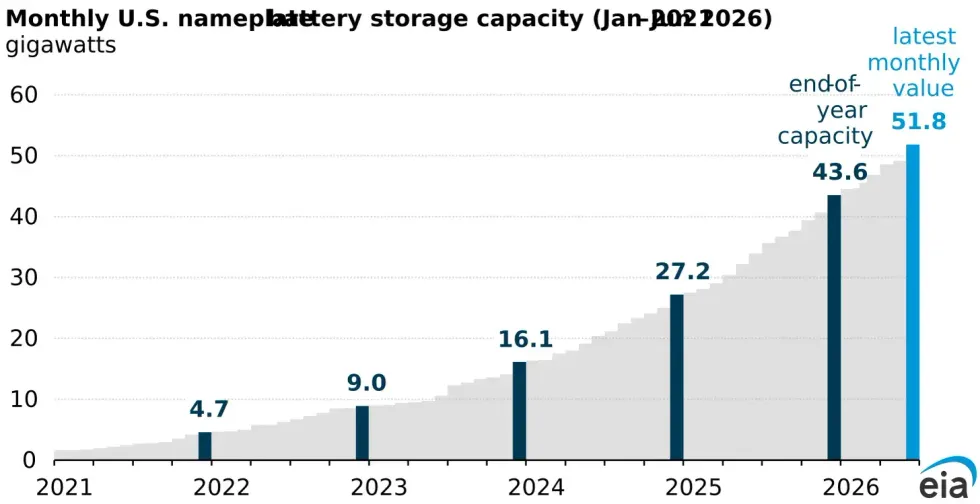
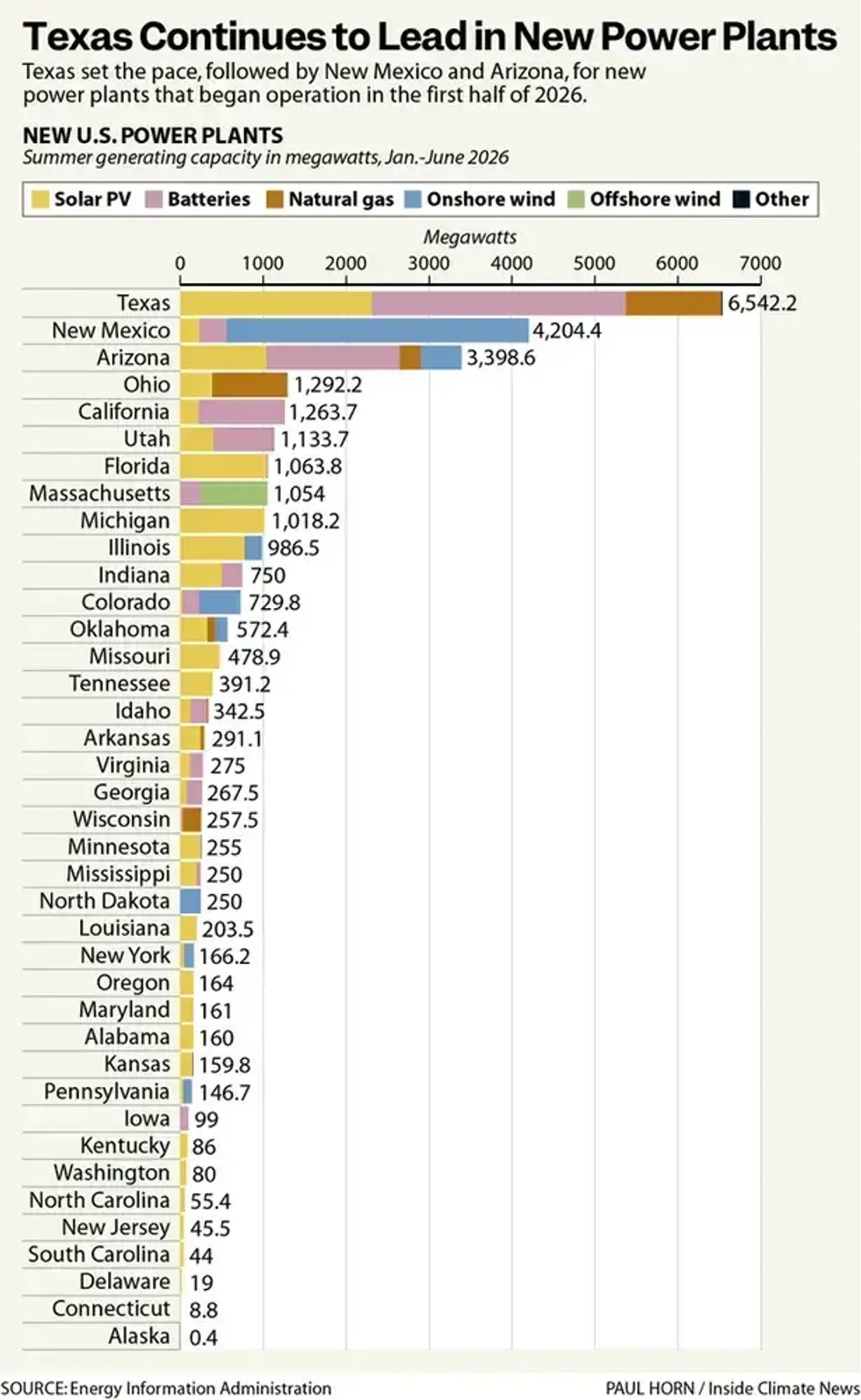
Notice that it’s continuing to rise this year. And as long as we’re doing charts, here it is broken down by state, with batteries in lavender. You’ll note that only four or five states are really participating in the battery revolution so far, which leaves enormous room for rapid growth elsewhere. Batteries are the transformative technology for the second half of this decade, as sun and wind were for the first half. Note also the incredible damage the Trump administration has done to the wind industry.
#44%
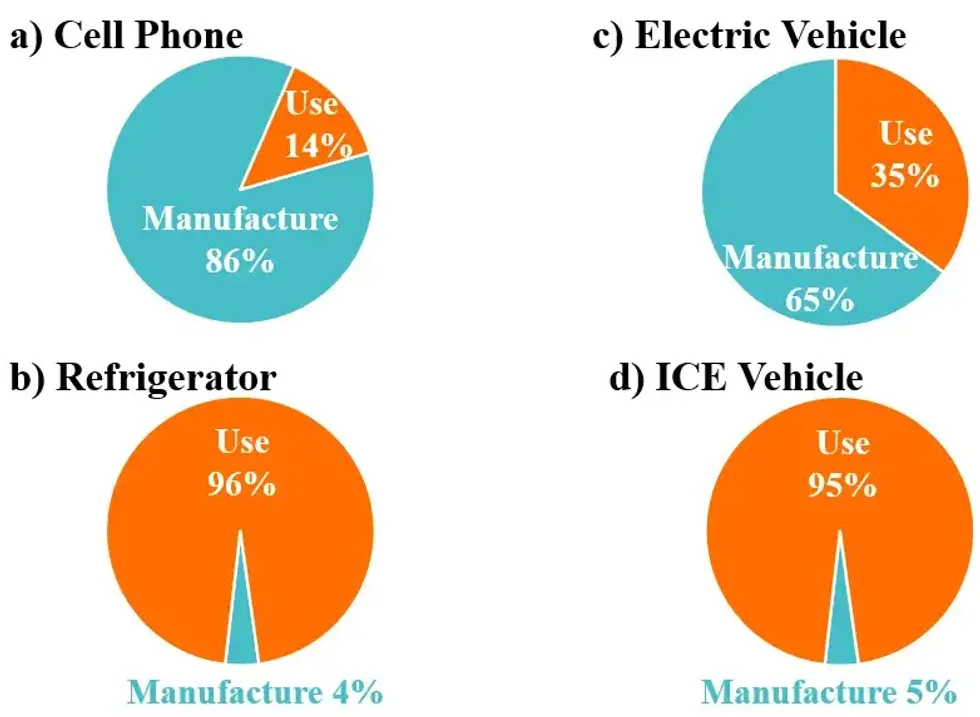
That’s how much you’d save in carbon emissions by retiring your internal combustion engine vehicle (ICEV) and replacing it with an EV—even if it was only two years old, and taking into account the amount of energy used to build both vehicles. A new study in Science from G. Elliott Campbell attempts to answer a question that’s puzzled many good-faith people: Does it really make sense to get rid of my ICEV if I’m worried about the climate. It does, beginning the day you drive it off the lot. It’s somewhat more complicated if you sell your used gas-guzzler to someone else, but as Science editor Jesse Smith notes:
The energy impact benefits from swapping an EV for an ICEV begin to accrue as early as the first day of the life of the ICEV, and that replacement early in the life cycle consistently provides reductions in greenhouse gas emissions. Financial considerations will also affect when people choose to make the replacement, of course, but from the perspective of emissions, it is almost never too soon to switch.
As Campbell explained to Tik Root:
“We’re trying to show that there’s not an environmental motivation for extending the lifetime of a gas vehicle,” he said. “Electric vehicles are a very clear winner.”
This isn’t true of everything you own, by the way. It basically depends on whether the carbon emissions of the thing mostly come from building it, or from powering it. Hence this chart that Professor Campbell sent me. Hold on to your cell phone another year!
#20 percent
That’s how much of French nuclear capacity is offline due to low river levels with the summer’s heat and fierce drought. (Oh, and a jellyfish invasion at a coastal plant, itself caused by warming seas). As Le Monde reports:
According to Agence France-Presse (AFP) calculations based on data published by energy group EDF since 2015, 20.4% of generating capacity was unavailable. Between 9:45 am and 10:00 am, EDF's nuclear fleet recorded a new peak in outages due to "environmental constraints" or "external environmental causes," both in terms of the number of reactors shut down or operating at reduced output and in terms of lost generating capacity.
The point is not to say "shut down nuclear power plants." It’s merely to point out that charge long leveled at sun and wind—that they provide “intermittent power”—is probably truer now of other energy sources (including the natural gas that can get shut down if, say, a war breaks out in the Strait of Hormuz). See the numbers on batteries above—I think it’s pretty clear that once you connect them to a solar or a wind farm you’ve got some of the world’s firmest power. By the way, that’s how BMW has kept its Hungarian plant churning out EVs even as the country’s lone nuke shut down, causing a cascading energy shortage across the country.
#22%
That’s how much domestic airline emissions have fallen in Austria over the last three years, since the government banned short haul flights to domestic destinations that were served by trains; something similar happened in France, which passed a more limited version of the same law. As Logan Varsano writes:
These initial successes in Austria and France are promising.
They also prompt a number of follow-on questions: What might be the climate benefit if such policies were more broadly adopted across Europe? What if they were implemented beyond Europe’s borders? What if they were applied to short-haul international flights, and not merely domestic routes?
Research published in 2021 found that, in Finland, replacing all short-haul flights with non-high-speed rail could cut emissions by 95%. One year later in 2022, different researchers took a broader look at commercial passenger flights across 31 countries. A 2023 study took a closer look at Spain's two busiest domestic corridors: Madrid-Barcelona and Madrid-Valencia. In 2024, data from IATA focused a lens back on France. And more recently, a September 2025 study on commercial intra-European aviation concluded that substituting short-haul flights with rail alternatives could reduce a trip's emissions by up to 97%, depending on the length of the trip.
I’d just add: City center to city center trains are infinitely nicer than dealing with airports, at least for me. Until we get the blimps up and running, more rail please!
#5.5°C vs 2°C
This last one is a little complicated, but it underscores the most important point I keep trying to make in this newsletter: We must act fast!
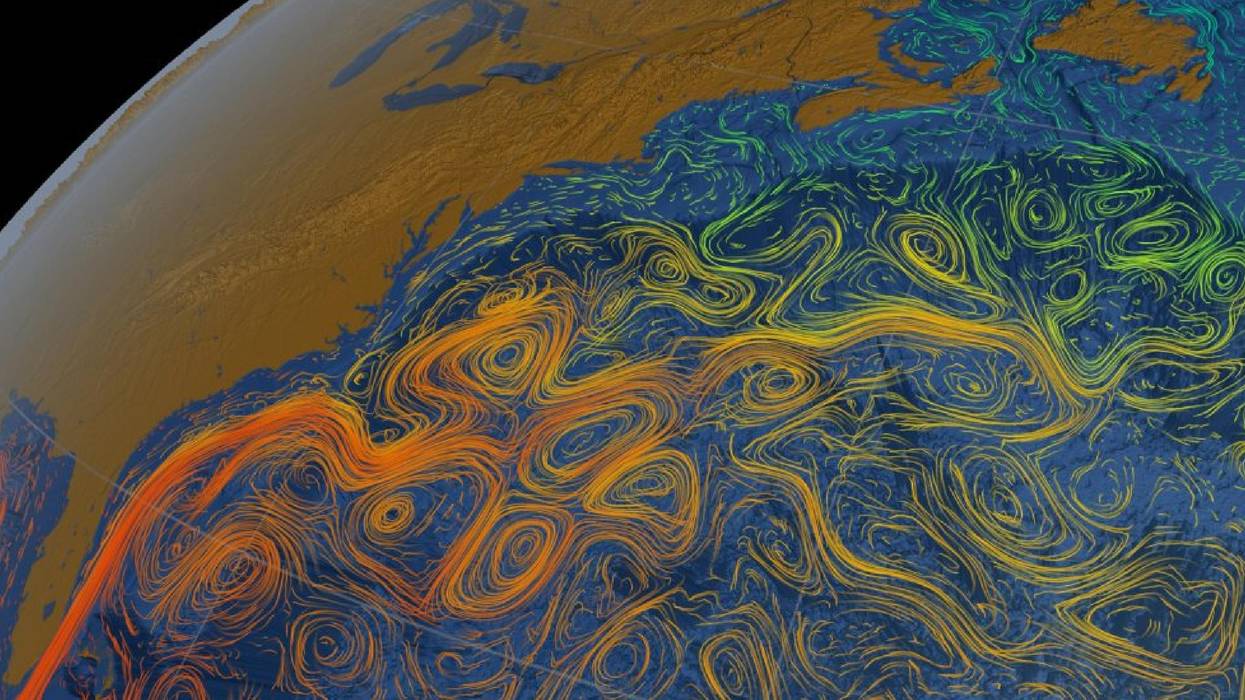
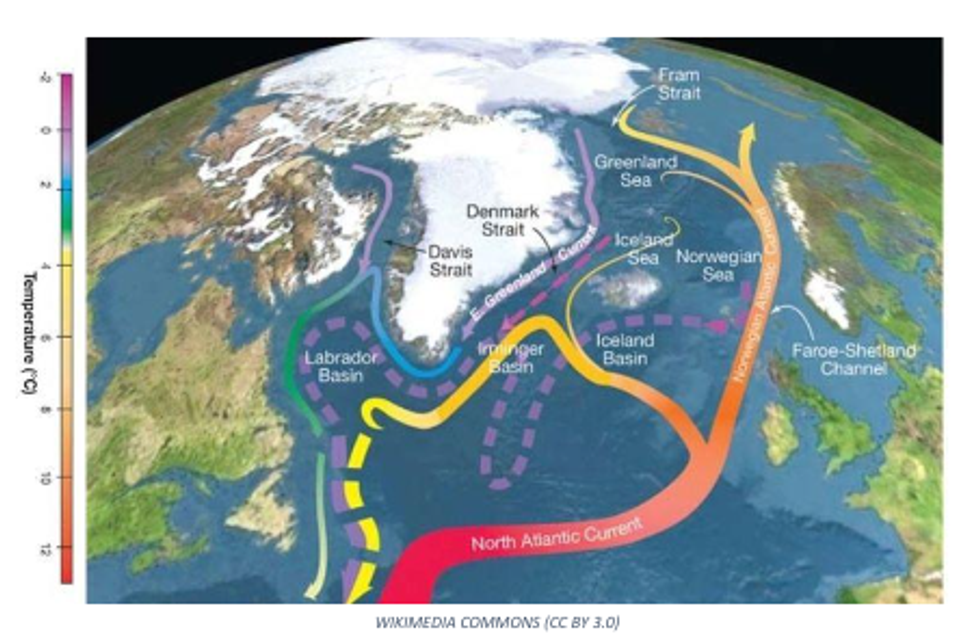
It comes from a new study about the collapse of the Atlantic Meridional Overturning Currents, or AMOC, the most important heat distribution on planet Earth, and one we’re threatening to wreck by raising temperatures. What the study—out Thursday in Nature—calculates is the risk of raising the temperature fast, which is what we’re doing now. On a “slow ramp,” this computer model shows that the currents stay stable until temperatures are raised 5.5°C—which is a lot of breathing room. But if you ramp up the temperature quickly, going past 2°C can shut them down. Rosa van den Dool interviewed one of the study’s authors:
The explanation lies in how the ocean is able to adjust to change. “Under slow warming, the entire ocean, from the surface down to its deepest layers, has time to gradually reorganize and adapt to the changing conditions,” says co-author Henk Dijkstra, professor of dynamical oceanography. “Under faster warming, the ocean simply can’t keep up.”
According to the researchers, the critical warming rate lies around 0.3°C per decade, a pace the world is already approaching. Van Westen compares it to driving a car: “If you’re driving toward a wall, it makes sense to steer around it. To do that, you need to brake, otherwise you fly off the road. When it comes to global warming, the world is still pressing extra hard on the accelerator right now.”
Math can’t tell us everything we need to know about the climate crisis. At some level, the crucial calculation is about the size of the human heart, and whether we’re ready to really press for the change that’s required. But math illuminates the parameters that humans must live within, and it shines a light on our possibilities. Above all it explains why these are the crucial years: Temperatures and solutions are rising at the exact same moment. Our job is to see if we can nudge the odds in this race.
And we can, so we must. Thank you for being part of the fight!