
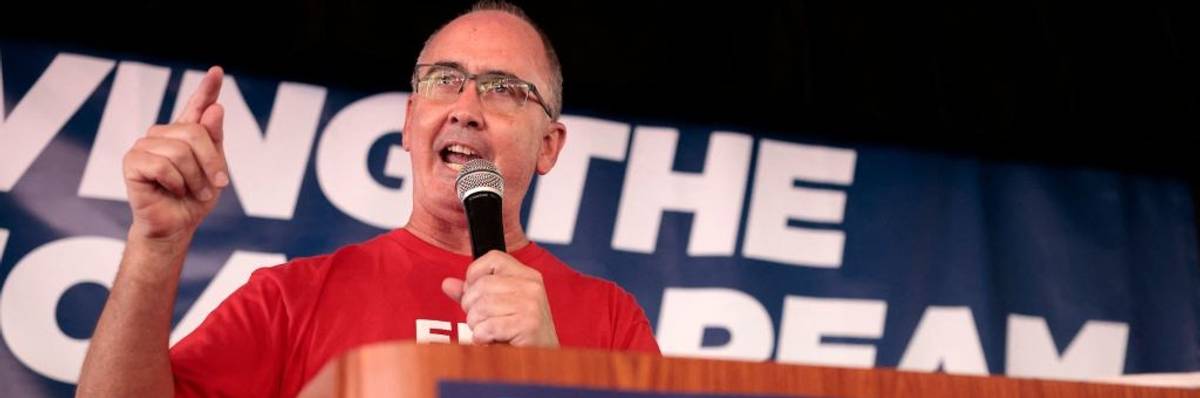
United Automobile Workers (UAW) President Shawn Fain speaks as UAW members and their supporters gather for Solidarity Sunday at the UAW Region 1 office in Warren, Michigan, on August 20, 2023.
Get Ready. Working Class Will Reclaim May Day in 2028
To reshape the economy into one that works for the benefit of everyone — not just the wealthy — we need to reclaim our country’s history of militant trade unions.
Members of the United Auto Workers courageously fought corporate greed at Ford, General Motors and Stellantis last fall during the historic six-week Stand-Up Strike. Because of their determination and commitment, we won record contracts with the Big Three automakers.
After decades of falling behind, UAW autoworkers are finally moving forward again.
We made a lot of ambitious demands at the bargaining table. One in particular may not have gotten the same attention as the reinstatement of cost-of-living adjustments or the reopening of the Stellantis assembly plant in Belvidere, Ill. — but it could also prove transformational: We aligned our contracts to expire at midnight on April 30, 2028.
We are fully preparing to strike on May Day 2028, which is critically important for several reasons.
We are fully preparing to strike on May Day 2028.
The first is that, to reshape the economy into one that works for the benefit of everyone — not just the wealthy — we need to reclaim our country’s history of militant trade unions that united workers across race, gender, and nationality.
May Day has its roots right here in the United States — in 1886, in the streets of Chicago, where workers were organizing and fighting for the 8-hour workday. This demand was met with brutal resistance by employers, who used both vicious mercenaries and the police to violently suppress mass protests led by unions. A bomb exploded in Chicago’s Haymarket Square during a clash between workers and police on May 4, 1886, killing several police officers and others.
The result was a sham trial, and seven labor leaders were sentenced to death.
The cause of those Haymarket Martyrs became the cause of the working class around the world, and May 1 became an international holiday commemorating the fight of workers everywhere to reclaim their time and the value of their labor.
Now, about 138 years later, May Day is celebrated as an official holiday in countries from Argentina to South Africa to Sweden to Hong Kong, just about everywhere — except its country of origin.
That’s not a coincidence. The billionaire class and their political lackeys have done everything they can to white out the true history of the working class in our country.
The billionaire class and their political lackeys have done everything they can to white out the true history of the working class in our country.
They want us to believe that corporate bosses gave workers decent wages, benefits and safer working conditions out of the goodness of their hearts. That justice and equality for people of color, for immigrants, for women and for queer communities were gifts benevolently handed down from above.
But we know the truth. Every law passed, every union formed and contract won — every improvement made at the workplace — has been won through the tireless sacrifice of the working class.
But if we are to truly reclaim the power and importance of May Day, then it can’t be through empty symbolism. It must be through action.
We wanted to ensure our contracts expired at midnight on April 30, 2028, not as a symbolic gesture, but as a rallying cry. We’ve asked other unions to join us in setting their contract expiration dates to May Day 2028 in hopes the labor movement can collectively aspire to building the power needed to change the world.
We form unions in our workplaces because we know we have far more power together than we do as individuals. What is true for workers in one workplace is true for workers across all workplaces. When unions organize together across industries and countries, our power is exponentially amplified. The fact is: without workers, the world stops running.
If working people are truly going to win on a massive scale — truly win healthcare as a human right, win pensions so everyone can retire with dignity, win an improved standard of living and more time off the clock so we can spend more of our time with our family and friends — then unions have to start thinking bigger.
I’ll give you an example.
We form unions in our workplaces because we know we have far more power together than we do as individuals. What is true for workers in one workplace is true for workers across all workplaces.
Last summer, during the lead-up to the contract expiration at the Big Three, I had the opportunity to meet with Teamsters General President Sean O’Brien at their headquarters in Washington, D.C. During our conversation, he pledged that no trucks driven by Teamsters would deliver parts to struck Big Three facilities.
The power of UAW autoworkers withholding our labor during the Stand-Up Strike was massive. But with the Teamsters supporting our fight, refusing to deliver parts to Big Three facilities, we had even more power. It created another headache for the Detroit automakers. It created more pressure on the Big Three to settle.
Now, imagine that type of worker solidarity on a much bigger scale.
And because corporate greed doesn’t recognize borders, neither should our solidarity. In the UAW, we’ve seen firsthand how companies pit workers against one another. Workers in Michigan are pitted against workers in Alabama, workers in the United States are pitted against workers in Mexico, workers in North America are pitted against workers in South America.
It’s a simple game. Companies shift production — or threaten to shift production — to locations where the labor is cheaper, the environmental regulations more lax, and the tax cuts and subsidies are greater.
A united working class is the only effective wall against the billionaire class’ race to the bottom. For the U.S. labor movement, that means grappling with some hard truths. Like the undeniable fact that it is impossible to protect American jobs while ignoring the plight of everyone else.
Sign up for our weekend newsletter A weekly digest of our best coverage Email Address
There’s been talk about a “general strike” for as long as I’ve been alive. But that’s all it has been: talk.
If we are serious about building enough collective power to win universal healthcare and the right to retire with dignity, then we need to spend the next four years getting prepared.
A general strike isn’t going to happen on a whim. It’s not going to happen over social media. A successful general strike is going to take time, mass coordination, and a whole lot of work by the labor movement.
As working people, we must come together. We can no longer allow corporations, politicians and borders to divide us.
It’s time we reclaimed May Day for the working class.
That’s what our May Day contract expiration is all about.
We are at a crossroads
This country and this world are at a monumental crossroads. In a few short weeks, US voters will have an opportunity to beat back the forces of fascism and confront the billionaires who are rigging the economy, our media system, and our democracy, making it increasingly impossible for ordinary people to get by. We’re not just talking about the election. We’re talking about what must be done once these fascist elements are vanquished from power. We need a bolder set of solutions than what either major party has so far been willing to offer and a working-class movement ready to fight like hell for it. Trump didn't emerge from nowhere. The conditions that fueled MAGA authoritarianism were created by decades of radical neoliberal economic policies and a corrupt political system dominated by corporate interests. They slashed taxes on the super-rich, promising that the benefits would trickle down. They said giveaways to the corporate titans would make life more affordable for the rest of us. It was all bullshit. And when a bitter, betrayed populace searches for someone to blame, right-wing demagogues have little trouble finding scapegoats. People know when they're being lied to, but you won't hear any of this from the corporate media. Only independent journalism—powered and funded by people who believe in building a better world—can deliver truly trustworthy daily news. Our Fall Campaign is underway, and we need your help. To power our newsroom through the rest of the year, we need to raise $125,000 by midnight on October 31. So if you share our vision, please contribute whatever you can to sustain our work. |
Members of the United Auto Workers courageously fought corporate greed at Ford, General Motors and Stellantis last fall during the historic six-week Stand-Up Strike. Because of their determination and commitment, we won record contracts with the Big Three automakers.
After decades of falling behind, UAW autoworkers are finally moving forward again.
We made a lot of ambitious demands at the bargaining table. One in particular may not have gotten the same attention as the reinstatement of cost-of-living adjustments or the reopening of the Stellantis assembly plant in Belvidere, Ill. — but it could also prove transformational: We aligned our contracts to expire at midnight on April 30, 2028.
We are fully preparing to strike on May Day 2028, which is critically important for several reasons.
We are fully preparing to strike on May Day 2028.
The first is that, to reshape the economy into one that works for the benefit of everyone — not just the wealthy — we need to reclaim our country’s history of militant trade unions that united workers across race, gender, and nationality.
May Day has its roots right here in the United States — in 1886, in the streets of Chicago, where workers were organizing and fighting for the 8-hour workday. This demand was met with brutal resistance by employers, who used both vicious mercenaries and the police to violently suppress mass protests led by unions. A bomb exploded in Chicago’s Haymarket Square during a clash between workers and police on May 4, 1886, killing several police officers and others.
The result was a sham trial, and seven labor leaders were sentenced to death.
The cause of those Haymarket Martyrs became the cause of the working class around the world, and May 1 became an international holiday commemorating the fight of workers everywhere to reclaim their time and the value of their labor.
Now, about 138 years later, May Day is celebrated as an official holiday in countries from Argentina to South Africa to Sweden to Hong Kong, just about everywhere — except its country of origin.
That’s not a coincidence. The billionaire class and their political lackeys have done everything they can to white out the true history of the working class in our country.
The billionaire class and their political lackeys have done everything they can to white out the true history of the working class in our country.
They want us to believe that corporate bosses gave workers decent wages, benefits and safer working conditions out of the goodness of their hearts. That justice and equality for people of color, for immigrants, for women and for queer communities were gifts benevolently handed down from above.
But we know the truth. Every law passed, every union formed and contract won — every improvement made at the workplace — has been won through the tireless sacrifice of the working class.
But if we are to truly reclaim the power and importance of May Day, then it can’t be through empty symbolism. It must be through action.
We wanted to ensure our contracts expired at midnight on April 30, 2028, not as a symbolic gesture, but as a rallying cry. We’ve asked other unions to join us in setting their contract expiration dates to May Day 2028 in hopes the labor movement can collectively aspire to building the power needed to change the world.
We form unions in our workplaces because we know we have far more power together than we do as individuals. What is true for workers in one workplace is true for workers across all workplaces. When unions organize together across industries and countries, our power is exponentially amplified. The fact is: without workers, the world stops running.
If working people are truly going to win on a massive scale — truly win healthcare as a human right, win pensions so everyone can retire with dignity, win an improved standard of living and more time off the clock so we can spend more of our time with our family and friends — then unions have to start thinking bigger.
I’ll give you an example.
We form unions in our workplaces because we know we have far more power together than we do as individuals. What is true for workers in one workplace is true for workers across all workplaces.
Last summer, during the lead-up to the contract expiration at the Big Three, I had the opportunity to meet with Teamsters General President Sean O’Brien at their headquarters in Washington, D.C. During our conversation, he pledged that no trucks driven by Teamsters would deliver parts to struck Big Three facilities.
The power of UAW autoworkers withholding our labor during the Stand-Up Strike was massive. But with the Teamsters supporting our fight, refusing to deliver parts to Big Three facilities, we had even more power. It created another headache for the Detroit automakers. It created more pressure on the Big Three to settle.
Now, imagine that type of worker solidarity on a much bigger scale.
And because corporate greed doesn’t recognize borders, neither should our solidarity. In the UAW, we’ve seen firsthand how companies pit workers against one another. Workers in Michigan are pitted against workers in Alabama, workers in the United States are pitted against workers in Mexico, workers in North America are pitted against workers in South America.
It’s a simple game. Companies shift production — or threaten to shift production — to locations where the labor is cheaper, the environmental regulations more lax, and the tax cuts and subsidies are greater.
A united working class is the only effective wall against the billionaire class’ race to the bottom. For the U.S. labor movement, that means grappling with some hard truths. Like the undeniable fact that it is impossible to protect American jobs while ignoring the plight of everyone else.
Sign up for our weekend newsletter A weekly digest of our best coverage Email Address
There’s been talk about a “general strike” for as long as I’ve been alive. But that’s all it has been: talk.
If we are serious about building enough collective power to win universal healthcare and the right to retire with dignity, then we need to spend the next four years getting prepared.
A general strike isn’t going to happen on a whim. It’s not going to happen over social media. A successful general strike is going to take time, mass coordination, and a whole lot of work by the labor movement.
As working people, we must come together. We can no longer allow corporations, politicians and borders to divide us.
It’s time we reclaimed May Day for the working class.
That’s what our May Day contract expiration is all about.
Members of the United Auto Workers courageously fought corporate greed at Ford, General Motors and Stellantis last fall during the historic six-week Stand-Up Strike. Because of their determination and commitment, we won record contracts with the Big Three automakers.
After decades of falling behind, UAW autoworkers are finally moving forward again.
We made a lot of ambitious demands at the bargaining table. One in particular may not have gotten the same attention as the reinstatement of cost-of-living adjustments or the reopening of the Stellantis assembly plant in Belvidere, Ill. — but it could also prove transformational: We aligned our contracts to expire at midnight on April 30, 2028.
We are fully preparing to strike on May Day 2028, which is critically important for several reasons.
We are fully preparing to strike on May Day 2028.
The first is that, to reshape the economy into one that works for the benefit of everyone — not just the wealthy — we need to reclaim our country’s history of militant trade unions that united workers across race, gender, and nationality.
May Day has its roots right here in the United States — in 1886, in the streets of Chicago, where workers were organizing and fighting for the 8-hour workday. This demand was met with brutal resistance by employers, who used both vicious mercenaries and the police to violently suppress mass protests led by unions. A bomb exploded in Chicago’s Haymarket Square during a clash between workers and police on May 4, 1886, killing several police officers and others.
The result was a sham trial, and seven labor leaders were sentenced to death.
The cause of those Haymarket Martyrs became the cause of the working class around the world, and May 1 became an international holiday commemorating the fight of workers everywhere to reclaim their time and the value of their labor.
Now, about 138 years later, May Day is celebrated as an official holiday in countries from Argentina to South Africa to Sweden to Hong Kong, just about everywhere — except its country of origin.
That’s not a coincidence. The billionaire class and their political lackeys have done everything they can to white out the true history of the working class in our country.
The billionaire class and their political lackeys have done everything they can to white out the true history of the working class in our country.
They want us to believe that corporate bosses gave workers decent wages, benefits and safer working conditions out of the goodness of their hearts. That justice and equality for people of color, for immigrants, for women and for queer communities were gifts benevolently handed down from above.
But we know the truth. Every law passed, every union formed and contract won — every improvement made at the workplace — has been won through the tireless sacrifice of the working class.
But if we are to truly reclaim the power and importance of May Day, then it can’t be through empty symbolism. It must be through action.
We wanted to ensure our contracts expired at midnight on April 30, 2028, not as a symbolic gesture, but as a rallying cry. We’ve asked other unions to join us in setting their contract expiration dates to May Day 2028 in hopes the labor movement can collectively aspire to building the power needed to change the world.
We form unions in our workplaces because we know we have far more power together than we do as individuals. What is true for workers in one workplace is true for workers across all workplaces. When unions organize together across industries and countries, our power is exponentially amplified. The fact is: without workers, the world stops running.
If working people are truly going to win on a massive scale — truly win healthcare as a human right, win pensions so everyone can retire with dignity, win an improved standard of living and more time off the clock so we can spend more of our time with our family and friends — then unions have to start thinking bigger.
I’ll give you an example.
We form unions in our workplaces because we know we have far more power together than we do as individuals. What is true for workers in one workplace is true for workers across all workplaces.
Last summer, during the lead-up to the contract expiration at the Big Three, I had the opportunity to meet with Teamsters General President Sean O’Brien at their headquarters in Washington, D.C. During our conversation, he pledged that no trucks driven by Teamsters would deliver parts to struck Big Three facilities.
The power of UAW autoworkers withholding our labor during the Stand-Up Strike was massive. But with the Teamsters supporting our fight, refusing to deliver parts to Big Three facilities, we had even more power. It created another headache for the Detroit automakers. It created more pressure on the Big Three to settle.
Now, imagine that type of worker solidarity on a much bigger scale.
And because corporate greed doesn’t recognize borders, neither should our solidarity. In the UAW, we’ve seen firsthand how companies pit workers against one another. Workers in Michigan are pitted against workers in Alabama, workers in the United States are pitted against workers in Mexico, workers in North America are pitted against workers in South America.
It’s a simple game. Companies shift production — or threaten to shift production — to locations where the labor is cheaper, the environmental regulations more lax, and the tax cuts and subsidies are greater.
A united working class is the only effective wall against the billionaire class’ race to the bottom. For the U.S. labor movement, that means grappling with some hard truths. Like the undeniable fact that it is impossible to protect American jobs while ignoring the plight of everyone else.
Sign up for our weekend newsletter A weekly digest of our best coverage Email Address
There’s been talk about a “general strike” for as long as I’ve been alive. But that’s all it has been: talk.
If we are serious about building enough collective power to win universal healthcare and the right to retire with dignity, then we need to spend the next four years getting prepared.
A general strike isn’t going to happen on a whim. It’s not going to happen over social media. A successful general strike is going to take time, mass coordination, and a whole lot of work by the labor movement.
As working people, we must come together. We can no longer allow corporations, politicians and borders to divide us.
It’s time we reclaimed May Day for the working class.
That’s what our May Day contract expiration is all about.