SUBSCRIBE TO OUR FREE NEWSLETTER
Daily news & progressive opinion—funded by the people, not the corporations—delivered straight to your inbox.
5
#000000
#FFFFFF
To donate by check, phone, or other method, see our More Ways to Give page.
Daily news & progressive opinion—funded by the people, not the corporations—delivered straight to your inbox.
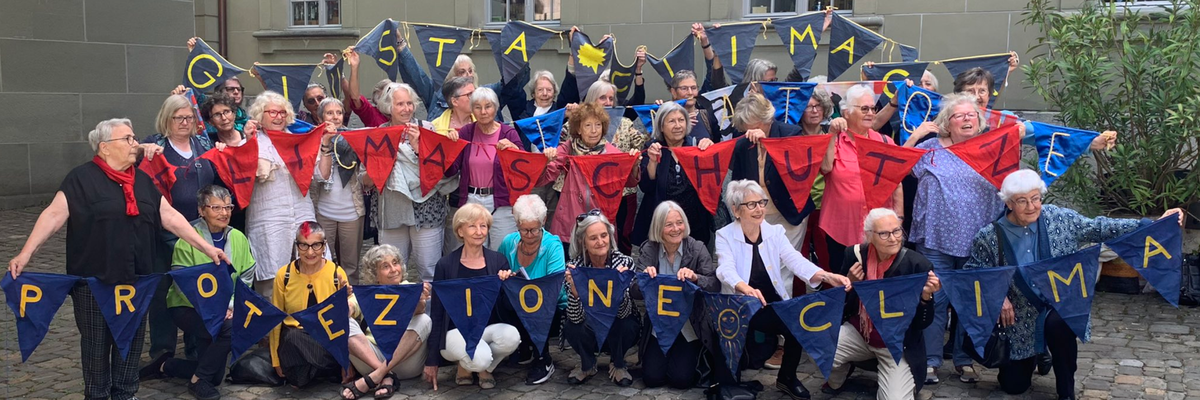
Members of the Swiss group KlimaSeniorinnen pose for a photo on May 30, 2022.
"The declaration is an attempt to continue to prevent human rights climate protection for political reasons, rather than recognizing that climate change is a scientific reality that affects everyone," said Greenpeace Switzerland.
Swiss women elders who recently won a landmark climate case said that they feel betrayed by their federal lawmakers, who voted Wednesday to disregard the court ruling.
The European Court of Human Rights (ECtHR) ruled in April that the Swiss government violated senior citizens' human rights by refusing to heed scientists' climate warnings and swiftly phase out fossil fuel production.
However, on Wednesday the National Council—Switzerland's lower legislative chamber—voted 111-72 to essentially ignore the court's decision, which some lawmakers condemned as judicial overreach. This followed a 31-11 vote by the Council of States, the upper legislative chamber, on a similar measure earlier this month.
"Climate and health are intrinsically linked; good health and a safe climate go hand in hand."
"We are appalled by this decision which feels like both a betrayal of older women but is also out of step with humankind's collective responsibility to tackle climate change for the benefits of vulnerable groups and the future of all humankind," said Pia Hollenstein, a retired nurse and member of KlimaSeniorinnen, the group of women ages 64 and older who sued their government for failing to take adequate action to stop the planet from heating 1.5°C, the more ambitious target of the Paris agreement.
"As a nurse, I have seen how climate and health are intrinsically linked; good health and a safe climate go hand in hand," she added.
Responding to Wednesday's vote, Greenpeace Switzerland said that "the declaration is an attempt to continue to prevent human rights climate protection for political reasons, rather than recognizing that climate change is a scientific reality that affects everyone."
Switzerland's Alpine climate is particularly vulnerable the effects of global heating, which is mainly caused by burning fossil fuels. Studies have shown that the country's glaciers—a key water source for millions of Europeans—could disappear by the end of the century if warming isn't curbed.
At least one lawmaker who voted to flout the ECtHR ruling attacked KlimaSeniorinnen members. Jean-Luc Addor of the right-wing Swiss People's Party dismissed the activists as "just a bunch of... 'boomeuses',"—or female Baby Boomers—"who are trying to deny our children the living conditions they have enjoyed all their lives."
However, Véronique Boillet, a member of the Swiss Human Rights Institute and a law professor at the University of Lausanne, said in a statement: "The binding nature of the rulings of the European Court of Human Rights is the heart of the European human rights system. It is the element that makes this system unique and a model worldwide."
"It is not for the Swiss Parliament to decide when a judgment has been implemented and when further measures are necessary," she continued. "It is normal that courts set certain objectives, as the ECtHR did for Swiss politics. It is also a sign of a functioning system of checks and balances."
Dear Common Dreams reader, It’s been nearly 30 years since I co-founded Common Dreams with my late wife, Lina Newhouser. We had the radical notion that journalism should serve the public good, not corporate profits. It was clear to us from the outset what it would take to build such a project. No paid advertisements. No corporate sponsors. No millionaire publisher telling us what to think or do. Many people said we wouldn't last a year, but we proved those doubters wrong. Together with a tremendous team of journalists and dedicated staff, we built an independent media outlet free from the constraints of profits and corporate control. Our mission has always been simple: To inform. To inspire. To ignite change for the common good. Building Common Dreams was not easy. Our survival was never guaranteed. When you take on the most powerful forces—Wall Street greed, fossil fuel industry destruction, Big Tech lobbyists, and uber-rich oligarchs who have spent billions upon billions rigging the economy and democracy in their favor—the only bulwark you have is supporters who believe in your work. But here’s the urgent message from me today. It's never been this bad out there. And it's never been this hard to keep us going. At the very moment Common Dreams is most needed, the threats we face are intensifying. We need your support now more than ever. We don't accept corporate advertising and never will. We don't have a paywall because we don't think people should be blocked from critical news based on their ability to pay. Everything we do is funded by the donations of readers like you. When everyone does the little they can afford, we are strong. But if that support retreats or dries up, so do we. Will you donate now to make sure Common Dreams not only survives but thrives? —Craig Brown, Co-founder |
Swiss women elders who recently won a landmark climate case said that they feel betrayed by their federal lawmakers, who voted Wednesday to disregard the court ruling.
The European Court of Human Rights (ECtHR) ruled in April that the Swiss government violated senior citizens' human rights by refusing to heed scientists' climate warnings and swiftly phase out fossil fuel production.
However, on Wednesday the National Council—Switzerland's lower legislative chamber—voted 111-72 to essentially ignore the court's decision, which some lawmakers condemned as judicial overreach. This followed a 31-11 vote by the Council of States, the upper legislative chamber, on a similar measure earlier this month.
"Climate and health are intrinsically linked; good health and a safe climate go hand in hand."
"We are appalled by this decision which feels like both a betrayal of older women but is also out of step with humankind's collective responsibility to tackle climate change for the benefits of vulnerable groups and the future of all humankind," said Pia Hollenstein, a retired nurse and member of KlimaSeniorinnen, the group of women ages 64 and older who sued their government for failing to take adequate action to stop the planet from heating 1.5°C, the more ambitious target of the Paris agreement.
"As a nurse, I have seen how climate and health are intrinsically linked; good health and a safe climate go hand in hand," she added.
Responding to Wednesday's vote, Greenpeace Switzerland said that "the declaration is an attempt to continue to prevent human rights climate protection for political reasons, rather than recognizing that climate change is a scientific reality that affects everyone."
Switzerland's Alpine climate is particularly vulnerable the effects of global heating, which is mainly caused by burning fossil fuels. Studies have shown that the country's glaciers—a key water source for millions of Europeans—could disappear by the end of the century if warming isn't curbed.
At least one lawmaker who voted to flout the ECtHR ruling attacked KlimaSeniorinnen members. Jean-Luc Addor of the right-wing Swiss People's Party dismissed the activists as "just a bunch of... 'boomeuses',"—or female Baby Boomers—"who are trying to deny our children the living conditions they have enjoyed all their lives."
However, Véronique Boillet, a member of the Swiss Human Rights Institute and a law professor at the University of Lausanne, said in a statement: "The binding nature of the rulings of the European Court of Human Rights is the heart of the European human rights system. It is the element that makes this system unique and a model worldwide."
"It is not for the Swiss Parliament to decide when a judgment has been implemented and when further measures are necessary," she continued. "It is normal that courts set certain objectives, as the ECtHR did for Swiss politics. It is also a sign of a functioning system of checks and balances."
Swiss women elders who recently won a landmark climate case said that they feel betrayed by their federal lawmakers, who voted Wednesday to disregard the court ruling.
The European Court of Human Rights (ECtHR) ruled in April that the Swiss government violated senior citizens' human rights by refusing to heed scientists' climate warnings and swiftly phase out fossil fuel production.
However, on Wednesday the National Council—Switzerland's lower legislative chamber—voted 111-72 to essentially ignore the court's decision, which some lawmakers condemned as judicial overreach. This followed a 31-11 vote by the Council of States, the upper legislative chamber, on a similar measure earlier this month.
"Climate and health are intrinsically linked; good health and a safe climate go hand in hand."
"We are appalled by this decision which feels like both a betrayal of older women but is also out of step with humankind's collective responsibility to tackle climate change for the benefits of vulnerable groups and the future of all humankind," said Pia Hollenstein, a retired nurse and member of KlimaSeniorinnen, the group of women ages 64 and older who sued their government for failing to take adequate action to stop the planet from heating 1.5°C, the more ambitious target of the Paris agreement.
"As a nurse, I have seen how climate and health are intrinsically linked; good health and a safe climate go hand in hand," she added.
Responding to Wednesday's vote, Greenpeace Switzerland said that "the declaration is an attempt to continue to prevent human rights climate protection for political reasons, rather than recognizing that climate change is a scientific reality that affects everyone."
Switzerland's Alpine climate is particularly vulnerable the effects of global heating, which is mainly caused by burning fossil fuels. Studies have shown that the country's glaciers—a key water source for millions of Europeans—could disappear by the end of the century if warming isn't curbed.
At least one lawmaker who voted to flout the ECtHR ruling attacked KlimaSeniorinnen members. Jean-Luc Addor of the right-wing Swiss People's Party dismissed the activists as "just a bunch of... 'boomeuses',"—or female Baby Boomers—"who are trying to deny our children the living conditions they have enjoyed all their lives."
However, Véronique Boillet, a member of the Swiss Human Rights Institute and a law professor at the University of Lausanne, said in a statement: "The binding nature of the rulings of the European Court of Human Rights is the heart of the European human rights system. It is the element that makes this system unique and a model worldwide."
"It is not for the Swiss Parliament to decide when a judgment has been implemented and when further measures are necessary," she continued. "It is normal that courts set certain objectives, as the ECtHR did for Swiss politics. It is also a sign of a functioning system of checks and balances."