SUBSCRIBE TO OUR FREE NEWSLETTER
Daily news & progressive opinion—funded by the people, not the corporations—delivered straight to your inbox.
5
#000000
#FFFFFF
To donate by check, phone, or other method, see our More Ways to Give page.
Daily news & progressive opinion—funded by the people, not the corporations—delivered straight to your inbox.
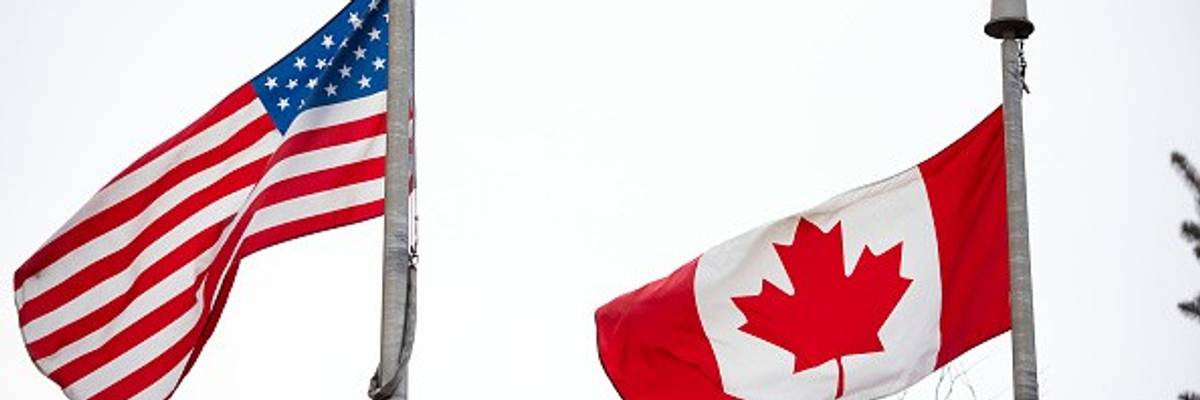
Flags of the United States and Canada fly at a Customs station at the Ambassador Bridge on the first day of President Donald Trump's new 25% tariffs on goods from Canada and Mexico on March 4, 2025 in Windsor, Canada.
In the face of Trump administration threats, Canada has learned from Russia and Iran how to stand up to US economic pressure.
Cuba is starving. Iran is being economically cut off from the world. And Russia is the target of a sanctions regime unlike any that a major nation has ever faced.
The US secretary of state has abandoned his post to play viceroy of Venezuela, and his role has been filled by the amateur team of Steve Witkoff and Jared Kushner. American evolution has favoured the Pentagon and Treasury, while the State Department has gone extinct. Coercion is America’s only foreign policy strategy, and bombs, sanctions, and tariffs are its only tools. The US “will negotiate with bombs” and with “economic statecraft.”
Canada, previously America’s closest ally and its second largest trading partner, is now feeling the weight of that coercion in an economic assault unimaginable for most of the modern history of Canadian-American relations. The relationship changed at the start of President Donald Trump’s second term when he announced that he was prepared to use “economic force” to absorb Canada into the United States. “You’re at war when you get attacked,” Canada’s Prime Minister, Mark Carney, said. “We got attacked.” Canada has been subjected to economy-crushing tariffs and warned to “fall in line or, the consequences for Canada will be far WORSE!”
The punishing 50% tariffs are meant to coerce Canada into surrendering aspects of its sovereignty. Part of what caused the latest round of trade talks to explode was demands that made Canada “a subsidiary of the United States” and “compromise[d] Canada’s sovereignty.”
The US is no longer a hegemon that leads for the mutual benefit of the West. It is a bully that coerces its former friends to “fall in line” for the singular benefit of America.
The US reportedly demanded compromises on the protection of French language and culture that is essential to Canadian federalism and unity. The US wanted Canada to repeal laws that promote French language shows to Canadian subscribers of streaming platforms and wave requirements that package labeling be in French as well as English (a demand the US now seems to have dropped).
They also demanded fealty on crucial trade decisions. The Trump administration demanded that Canada comply with American demands on what tariffs it places on other countries and what countries it trades with. Negotiators went so far as to insist on the right “to review and potentially dictate the terms for Canada’s trade agreements with other countries.” American dominance would be enshrined with the prerogative “to change tariff policy against Canada at any time, irrespective of the agreement.”
The US had already set the precedent for this imperial strategy in other countries. In March, Trump declared that he “will be having the honor of taking Cuba.” Toward that end, he cut Cuba off, mandating that “THERE WILL BE NO MORE OIL OR MONEY GOING TO CUBA—ZERO,” adding that “I strongly suggest they make a deal, BEFORE IT IS TOO LATE.” He then signed an executive order imposing tariffs on any country that sends oil to Cuba.
Despite the devastation that embargo has caused the people of Cuba, the Trump administration has continued to tighten its stranglehold, ever increasing the sanctions. “We have a pretty deep toolbox, especially when it comes to sanctions and enforcing them,” a senior administration official told Axios. “More is on the way.” On August 20, the US announced further sanctions.
The same playbook is being employed in Iran where Treasury Secretary Scott Bessent, who has become Trump’s chief executioner, has boasted of America’s ability to starve people into the streets and countries into submission. “President Trump ordered… maximum pressure on Iran. And it’s worked,” he said, “because in December, their economy collapsed... and this is why the people took to the street. This is economic statecraft.” Bessent told the Senate Banking Committee that “what we have done is created a dollar shortage in the country… The Iranian currency went into free fall, inflation exploded, and hence we have seen the Iranian people out on the street.”
But neither the people in the streets nor the brutal bombing campaign accomplished America’s goals in Iran. So, Washington turned to intensified economic warfare. Bessent has threatened the “toughest sanctions in history.” Trump called it “economic D-day,” "Economic Warfare and Isolation on an unprecedented scale.”
But the coercion extended beyond Iran. Trump warned that “ANY country that… provide[s] any type of lifeline to Iran will itself face TREMENDOUS Economic Consequences.” Bessent provided the details, announcing “an economic onslaught against Iran’s financial connections around the globe.” He said, “Our objective is to sever every economic lifeline that sustains this tyrannical regime until it stands alone.” He then threatened that “any economic engagement of any kind with this murderous regime will expose those responsible to the full reach of American power.”
That global coercion is being challenged. China called the US threat “illegal unilateral sanctions” and promised that it will “take all necessary measures to firmly safeguard its own rights and interests.” Chinese foreign ministry spokesman Lin Jian said, “Cooperation between China and Iran has always been conducted within the framework of international law and should not be interfered with or disrupted."
Shockingly, like Cuba, neither Russia, Iran, nor Canada have backed down. Though Canada can hardly be called a fellow traveler of Russia or Iran, it has learned similar lessons and come to similar conclusions.
Like Russia, Canada has learned that, in the face of tariffs or sanctions, it must rely less on the US and more on itself. Russia has tried to substitute lost American business with domestic replacements. “Building at home,” Carney said, is “our plan A.” He says that Canada is “focused on building strength at home…. Launching big nation-building projects…. And… building Canada strong.”
Like Iran, Canada has learned that America’s “signature [is] written in pencil” and that countries negotiating with the US need to call “into question the reliability of any deal.” Like Iran, Canada has learned that deals with the US can be broken, like the Joint Comprehensive Plan of Action nuclear agreement and the US-Mexico-Canada free trade agreement. Like Iran, Canada has learned not to make any concessions in exchange for future promises but to get everything guaranteed up front because the US can change the terms any time, irrespective of the agreement.
The US is no longer a hegemon that leads for the mutual benefit of the West. It is a bully that coerces its former friends to “fall in line” for the singular benefit of America. Its former friends follow, no longer out of partnership, but out of fear.
Dear Common Dreams reader, It’s been nearly 30 years since I co-founded Common Dreams with my late wife, Lina Newhouser. We had the radical notion that journalism should serve the public good, not corporate profits. It was clear to us from the outset what it would take to build such a project. No paid advertisements. No corporate sponsors. No millionaire publisher telling us what to think or do. Many people said we wouldn't last a year, but we proved those doubters wrong. Together with a tremendous team of journalists and dedicated staff, we built an independent media outlet free from the constraints of profits and corporate control. Our mission has always been simple: To inform. To inspire. To ignite change for the common good. Building Common Dreams was not easy. Our survival was never guaranteed. When you take on the most powerful forces—Wall Street greed, fossil fuel industry destruction, Big Tech lobbyists, and uber-rich oligarchs who have spent billions upon billions rigging the economy and democracy in their favor—the only bulwark you have is supporters who believe in your work. But here’s the urgent message from me today. It's never been this bad out there. And it's never been this hard to keep us going. At the very moment Common Dreams is most needed, the threats we face are intensifying. We need your support now more than ever. We don't accept corporate advertising and never will. We don't have a paywall because we don't think people should be blocked from critical news based on their ability to pay. Everything we do is funded by the donations of readers like you. When everyone does the little they can afford, we are strong. But if that support retreats or dries up, so do we. Will you donate now to make sure Common Dreams not only survives but thrives? —Craig Brown, Co-founder |
Cuba is starving. Iran is being economically cut off from the world. And Russia is the target of a sanctions regime unlike any that a major nation has ever faced.
The US secretary of state has abandoned his post to play viceroy of Venezuela, and his role has been filled by the amateur team of Steve Witkoff and Jared Kushner. American evolution has favoured the Pentagon and Treasury, while the State Department has gone extinct. Coercion is America’s only foreign policy strategy, and bombs, sanctions, and tariffs are its only tools. The US “will negotiate with bombs” and with “economic statecraft.”
Canada, previously America’s closest ally and its second largest trading partner, is now feeling the weight of that coercion in an economic assault unimaginable for most of the modern history of Canadian-American relations. The relationship changed at the start of President Donald Trump’s second term when he announced that he was prepared to use “economic force” to absorb Canada into the United States. “You’re at war when you get attacked,” Canada’s Prime Minister, Mark Carney, said. “We got attacked.” Canada has been subjected to economy-crushing tariffs and warned to “fall in line or, the consequences for Canada will be far WORSE!”
The punishing 50% tariffs are meant to coerce Canada into surrendering aspects of its sovereignty. Part of what caused the latest round of trade talks to explode was demands that made Canada “a subsidiary of the United States” and “compromise[d] Canada’s sovereignty.”
The US is no longer a hegemon that leads for the mutual benefit of the West. It is a bully that coerces its former friends to “fall in line” for the singular benefit of America.
The US reportedly demanded compromises on the protection of French language and culture that is essential to Canadian federalism and unity. The US wanted Canada to repeal laws that promote French language shows to Canadian subscribers of streaming platforms and wave requirements that package labeling be in French as well as English (a demand the US now seems to have dropped).
They also demanded fealty on crucial trade decisions. The Trump administration demanded that Canada comply with American demands on what tariffs it places on other countries and what countries it trades with. Negotiators went so far as to insist on the right “to review and potentially dictate the terms for Canada’s trade agreements with other countries.” American dominance would be enshrined with the prerogative “to change tariff policy against Canada at any time, irrespective of the agreement.”
The US had already set the precedent for this imperial strategy in other countries. In March, Trump declared that he “will be having the honor of taking Cuba.” Toward that end, he cut Cuba off, mandating that “THERE WILL BE NO MORE OIL OR MONEY GOING TO CUBA—ZERO,” adding that “I strongly suggest they make a deal, BEFORE IT IS TOO LATE.” He then signed an executive order imposing tariffs on any country that sends oil to Cuba.
Despite the devastation that embargo has caused the people of Cuba, the Trump administration has continued to tighten its stranglehold, ever increasing the sanctions. “We have a pretty deep toolbox, especially when it comes to sanctions and enforcing them,” a senior administration official told Axios. “More is on the way.” On August 20, the US announced further sanctions.
The same playbook is being employed in Iran where Treasury Secretary Scott Bessent, who has become Trump’s chief executioner, has boasted of America’s ability to starve people into the streets and countries into submission. “President Trump ordered… maximum pressure on Iran. And it’s worked,” he said, “because in December, their economy collapsed... and this is why the people took to the street. This is economic statecraft.” Bessent told the Senate Banking Committee that “what we have done is created a dollar shortage in the country… The Iranian currency went into free fall, inflation exploded, and hence we have seen the Iranian people out on the street.”
But neither the people in the streets nor the brutal bombing campaign accomplished America’s goals in Iran. So, Washington turned to intensified economic warfare. Bessent has threatened the “toughest sanctions in history.” Trump called it “economic D-day,” "Economic Warfare and Isolation on an unprecedented scale.”
But the coercion extended beyond Iran. Trump warned that “ANY country that… provide[s] any type of lifeline to Iran will itself face TREMENDOUS Economic Consequences.” Bessent provided the details, announcing “an economic onslaught against Iran’s financial connections around the globe.” He said, “Our objective is to sever every economic lifeline that sustains this tyrannical regime until it stands alone.” He then threatened that “any economic engagement of any kind with this murderous regime will expose those responsible to the full reach of American power.”
That global coercion is being challenged. China called the US threat “illegal unilateral sanctions” and promised that it will “take all necessary measures to firmly safeguard its own rights and interests.” Chinese foreign ministry spokesman Lin Jian said, “Cooperation between China and Iran has always been conducted within the framework of international law and should not be interfered with or disrupted."
Shockingly, like Cuba, neither Russia, Iran, nor Canada have backed down. Though Canada can hardly be called a fellow traveler of Russia or Iran, it has learned similar lessons and come to similar conclusions.
Like Russia, Canada has learned that, in the face of tariffs or sanctions, it must rely less on the US and more on itself. Russia has tried to substitute lost American business with domestic replacements. “Building at home,” Carney said, is “our plan A.” He says that Canada is “focused on building strength at home…. Launching big nation-building projects…. And… building Canada strong.”
Like Iran, Canada has learned that America’s “signature [is] written in pencil” and that countries negotiating with the US need to call “into question the reliability of any deal.” Like Iran, Canada has learned that deals with the US can be broken, like the Joint Comprehensive Plan of Action nuclear agreement and the US-Mexico-Canada free trade agreement. Like Iran, Canada has learned not to make any concessions in exchange for future promises but to get everything guaranteed up front because the US can change the terms any time, irrespective of the agreement.
The US is no longer a hegemon that leads for the mutual benefit of the West. It is a bully that coerces its former friends to “fall in line” for the singular benefit of America. Its former friends follow, no longer out of partnership, but out of fear.
Cuba is starving. Iran is being economically cut off from the world. And Russia is the target of a sanctions regime unlike any that a major nation has ever faced.
The US secretary of state has abandoned his post to play viceroy of Venezuela, and his role has been filled by the amateur team of Steve Witkoff and Jared Kushner. American evolution has favoured the Pentagon and Treasury, while the State Department has gone extinct. Coercion is America’s only foreign policy strategy, and bombs, sanctions, and tariffs are its only tools. The US “will negotiate with bombs” and with “economic statecraft.”
Canada, previously America’s closest ally and its second largest trading partner, is now feeling the weight of that coercion in an economic assault unimaginable for most of the modern history of Canadian-American relations. The relationship changed at the start of President Donald Trump’s second term when he announced that he was prepared to use “economic force” to absorb Canada into the United States. “You’re at war when you get attacked,” Canada’s Prime Minister, Mark Carney, said. “We got attacked.” Canada has been subjected to economy-crushing tariffs and warned to “fall in line or, the consequences for Canada will be far WORSE!”
The punishing 50% tariffs are meant to coerce Canada into surrendering aspects of its sovereignty. Part of what caused the latest round of trade talks to explode was demands that made Canada “a subsidiary of the United States” and “compromise[d] Canada’s sovereignty.”
The US is no longer a hegemon that leads for the mutual benefit of the West. It is a bully that coerces its former friends to “fall in line” for the singular benefit of America.
The US reportedly demanded compromises on the protection of French language and culture that is essential to Canadian federalism and unity. The US wanted Canada to repeal laws that promote French language shows to Canadian subscribers of streaming platforms and wave requirements that package labeling be in French as well as English (a demand the US now seems to have dropped).
They also demanded fealty on crucial trade decisions. The Trump administration demanded that Canada comply with American demands on what tariffs it places on other countries and what countries it trades with. Negotiators went so far as to insist on the right “to review and potentially dictate the terms for Canada’s trade agreements with other countries.” American dominance would be enshrined with the prerogative “to change tariff policy against Canada at any time, irrespective of the agreement.”
The US had already set the precedent for this imperial strategy in other countries. In March, Trump declared that he “will be having the honor of taking Cuba.” Toward that end, he cut Cuba off, mandating that “THERE WILL BE NO MORE OIL OR MONEY GOING TO CUBA—ZERO,” adding that “I strongly suggest they make a deal, BEFORE IT IS TOO LATE.” He then signed an executive order imposing tariffs on any country that sends oil to Cuba.
Despite the devastation that embargo has caused the people of Cuba, the Trump administration has continued to tighten its stranglehold, ever increasing the sanctions. “We have a pretty deep toolbox, especially when it comes to sanctions and enforcing them,” a senior administration official told Axios. “More is on the way.” On August 20, the US announced further sanctions.
The same playbook is being employed in Iran where Treasury Secretary Scott Bessent, who has become Trump’s chief executioner, has boasted of America’s ability to starve people into the streets and countries into submission. “President Trump ordered… maximum pressure on Iran. And it’s worked,” he said, “because in December, their economy collapsed... and this is why the people took to the street. This is economic statecraft.” Bessent told the Senate Banking Committee that “what we have done is created a dollar shortage in the country… The Iranian currency went into free fall, inflation exploded, and hence we have seen the Iranian people out on the street.”
But neither the people in the streets nor the brutal bombing campaign accomplished America’s goals in Iran. So, Washington turned to intensified economic warfare. Bessent has threatened the “toughest sanctions in history.” Trump called it “economic D-day,” "Economic Warfare and Isolation on an unprecedented scale.”
But the coercion extended beyond Iran. Trump warned that “ANY country that… provide[s] any type of lifeline to Iran will itself face TREMENDOUS Economic Consequences.” Bessent provided the details, announcing “an economic onslaught against Iran’s financial connections around the globe.” He said, “Our objective is to sever every economic lifeline that sustains this tyrannical regime until it stands alone.” He then threatened that “any economic engagement of any kind with this murderous regime will expose those responsible to the full reach of American power.”
That global coercion is being challenged. China called the US threat “illegal unilateral sanctions” and promised that it will “take all necessary measures to firmly safeguard its own rights and interests.” Chinese foreign ministry spokesman Lin Jian said, “Cooperation between China and Iran has always been conducted within the framework of international law and should not be interfered with or disrupted."
Shockingly, like Cuba, neither Russia, Iran, nor Canada have backed down. Though Canada can hardly be called a fellow traveler of Russia or Iran, it has learned similar lessons and come to similar conclusions.
Like Russia, Canada has learned that, in the face of tariffs or sanctions, it must rely less on the US and more on itself. Russia has tried to substitute lost American business with domestic replacements. “Building at home,” Carney said, is “our plan A.” He says that Canada is “focused on building strength at home…. Launching big nation-building projects…. And… building Canada strong.”
Like Iran, Canada has learned that America’s “signature [is] written in pencil” and that countries negotiating with the US need to call “into question the reliability of any deal.” Like Iran, Canada has learned that deals with the US can be broken, like the Joint Comprehensive Plan of Action nuclear agreement and the US-Mexico-Canada free trade agreement. Like Iran, Canada has learned not to make any concessions in exchange for future promises but to get everything guaranteed up front because the US can change the terms any time, irrespective of the agreement.
The US is no longer a hegemon that leads for the mutual benefit of the West. It is a bully that coerces its former friends to “fall in line” for the singular benefit of America. Its former friends follow, no longer out of partnership, but out of fear.