SUBSCRIBE TO OUR FREE NEWSLETTER
Daily news & progressive opinion—funded by the people, not the corporations—delivered straight to your inbox.
5
#000000
#FFFFFF
To donate by check, phone, or other method, see our More Ways to Give page.
Daily news & progressive opinion—funded by the people, not the corporations—delivered straight to your inbox.
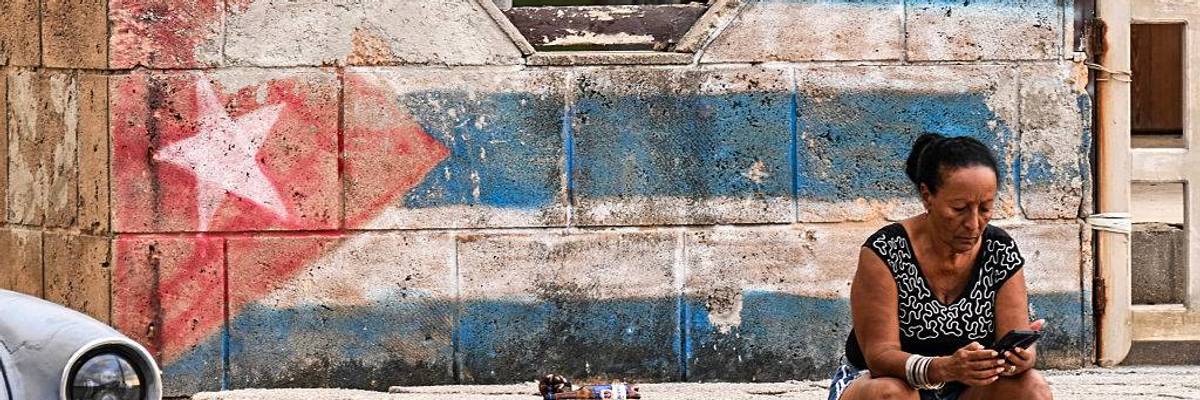
A woman looks at her cellphone on a street in Havana on February 23, 2026.
Mexico earlier this month also stepped up aid shipments to Cuba during the Trump administration's oil embargo.
The Canadian government on Monday announced plans to send aid to Cuba, which is currently being squeezed economically by a US oil embargo.
As reported by the Associated Press, Canadian Foreign Minister Anita Anand revealed that the government is "preparing a plan to assist," adding that "we are not prepared at this point to provide any details" of what it will entail.
A Canadian aid package to Cuba would be the latest rebuff to US foreign policy. The two long-time allies have been at odds since President Donald Trump took office last year and slapped hefty tariffs on Canadian products, while also vowing to make the country into the "51st state" of the US.
Canada wouldn't be the first US ally to step up help for Cuba, as Mexico earlier this month sent two ships loaded with more than 2,000 tons of goods and food to the island nation.
The shipments to Cuba were aimed at easing the humanitarian crisis intensified by the Trump administration's oil embargo, which began shortly after the administration invaded Venezuela and abducted President Nicolás Maduro in January.
Trump has vowed to slap tariffs on any country that sends oil to Cuba, although the US Supreme Court's ruling last week slapping down his powers to unilaterally enact tariffs through the International Emergency Economic Powers Act has potentially neutered that threat.
Earlier this month, a group of United Nations human rights experts called the Trump blockade of Cuba "a serious violation of international law and a grave threat to a democratic and equitable international order," and "an extreme form of unilateral economic coercion with extraterritorial effects."
Medea Benjamin, co-founder of the anti-war group CodePink, traveled to Cuba recently and spoke to local residents who described the devastating impact of the oil blockade.
"With no gasoline, buses don’t run, so we can’t get to work," Marta Jiménez, a hairdresser from Holguín, told Benjamin. "We have electricity only three to six hours a day. There’s no gas for cooking, so we’re burning wood and charcoal in our apartments. It’s like going back 100 years."
Dear Common Dreams reader, It’s been nearly 30 years since I co-founded Common Dreams with my late wife, Lina Newhouser. We had the radical notion that journalism should serve the public good, not corporate profits. It was clear to us from the outset what it would take to build such a project. No paid advertisements. No corporate sponsors. No millionaire publisher telling us what to think or do. Many people said we wouldn't last a year, but we proved those doubters wrong. Together with a tremendous team of journalists and dedicated staff, we built an independent media outlet free from the constraints of profits and corporate control. Our mission has always been simple: To inform. To inspire. To ignite change for the common good. Building Common Dreams was not easy. Our survival was never guaranteed. When you take on the most powerful forces—Wall Street greed, fossil fuel industry destruction, Big Tech lobbyists, and uber-rich oligarchs who have spent billions upon billions rigging the economy and democracy in their favor—the only bulwark you have is supporters who believe in your work. But here’s the urgent message from me today. It's never been this bad out there. And it's never been this hard to keep us going. At the very moment Common Dreams is most needed, the threats we face are intensifying. We need your support now more than ever. We don't accept corporate advertising and never will. We don't have a paywall because we don't think people should be blocked from critical news based on their ability to pay. Everything we do is funded by the donations of readers like you. When everyone does the little they can afford, we are strong. But if that support retreats or dries up, so do we. Will you donate now to make sure Common Dreams not only survives but thrives? —Craig Brown, Co-founder |
The Canadian government on Monday announced plans to send aid to Cuba, which is currently being squeezed economically by a US oil embargo.
As reported by the Associated Press, Canadian Foreign Minister Anita Anand revealed that the government is "preparing a plan to assist," adding that "we are not prepared at this point to provide any details" of what it will entail.
A Canadian aid package to Cuba would be the latest rebuff to US foreign policy. The two long-time allies have been at odds since President Donald Trump took office last year and slapped hefty tariffs on Canadian products, while also vowing to make the country into the "51st state" of the US.
Canada wouldn't be the first US ally to step up help for Cuba, as Mexico earlier this month sent two ships loaded with more than 2,000 tons of goods and food to the island nation.
The shipments to Cuba were aimed at easing the humanitarian crisis intensified by the Trump administration's oil embargo, which began shortly after the administration invaded Venezuela and abducted President Nicolás Maduro in January.
Trump has vowed to slap tariffs on any country that sends oil to Cuba, although the US Supreme Court's ruling last week slapping down his powers to unilaterally enact tariffs through the International Emergency Economic Powers Act has potentially neutered that threat.
Earlier this month, a group of United Nations human rights experts called the Trump blockade of Cuba "a serious violation of international law and a grave threat to a democratic and equitable international order," and "an extreme form of unilateral economic coercion with extraterritorial effects."
Medea Benjamin, co-founder of the anti-war group CodePink, traveled to Cuba recently and spoke to local residents who described the devastating impact of the oil blockade.
"With no gasoline, buses don’t run, so we can’t get to work," Marta Jiménez, a hairdresser from Holguín, told Benjamin. "We have electricity only three to six hours a day. There’s no gas for cooking, so we’re burning wood and charcoal in our apartments. It’s like going back 100 years."
The Canadian government on Monday announced plans to send aid to Cuba, which is currently being squeezed economically by a US oil embargo.
As reported by the Associated Press, Canadian Foreign Minister Anita Anand revealed that the government is "preparing a plan to assist," adding that "we are not prepared at this point to provide any details" of what it will entail.
A Canadian aid package to Cuba would be the latest rebuff to US foreign policy. The two long-time allies have been at odds since President Donald Trump took office last year and slapped hefty tariffs on Canadian products, while also vowing to make the country into the "51st state" of the US.
Canada wouldn't be the first US ally to step up help for Cuba, as Mexico earlier this month sent two ships loaded with more than 2,000 tons of goods and food to the island nation.
The shipments to Cuba were aimed at easing the humanitarian crisis intensified by the Trump administration's oil embargo, which began shortly after the administration invaded Venezuela and abducted President Nicolás Maduro in January.
Trump has vowed to slap tariffs on any country that sends oil to Cuba, although the US Supreme Court's ruling last week slapping down his powers to unilaterally enact tariffs through the International Emergency Economic Powers Act has potentially neutered that threat.
Earlier this month, a group of United Nations human rights experts called the Trump blockade of Cuba "a serious violation of international law and a grave threat to a democratic and equitable international order," and "an extreme form of unilateral economic coercion with extraterritorial effects."
Medea Benjamin, co-founder of the anti-war group CodePink, traveled to Cuba recently and spoke to local residents who described the devastating impact of the oil blockade.
"With no gasoline, buses don’t run, so we can’t get to work," Marta Jiménez, a hairdresser from Holguín, told Benjamin. "We have electricity only three to six hours a day. There’s no gas for cooking, so we’re burning wood and charcoal in our apartments. It’s like going back 100 years."